Wood Grain Patterns: A Guide to Better Furniture


A homeowner in the Capital Region can walk into a showroom, compare two oak dining tables, and wonder why pieces with the same species and finish look nothing alike. One may appear calm and even, while the other carries sweeping arches, dark streaks, or shimmering flecks. That difference usually isn't a defect. It comes from the tree's anatomy, the way the log was sawn, and the finish placed over the surface.
Understanding wood grain patterns makes furniture shopping more practical. Grain affects appearance, finishing, stability, care, and how well separate pieces look together. For homeowners in Freehold, Albany, Schenectady, Troy, Greene County, and the surrounding Greater Albany Capital Region, the right questions go beyond “Which wood is this?” They include “How was it cut?”, “What pattern will the finish emphasize?”, and “Can future pieces be matched?”
What Wood Grain Patterns Actually Mean
At the Freehold showroom, two oak dining tables can share a similar stain and still tell very different visual stories. One may show quiet, mostly parallel lines. Another may display broad arches that sweep across the top like the curved layers of a hillside. Both appearances can be natural results of the same species.
Wood grain describes the direction, arrangement, and appearance of the fibers. Figure describes the decorative pattern those fibers, growth rings, rays, pores, and irregularities create when a board is cut. The distinction matters because a table can have straight grain but a particularly striking figure, or it can have a less predictable grain direction that creates ripples, flecks, or swirling movement. A practical overview of hardwood selection and longevity can also be found in this guide to choosing the right hardwood for furniture.
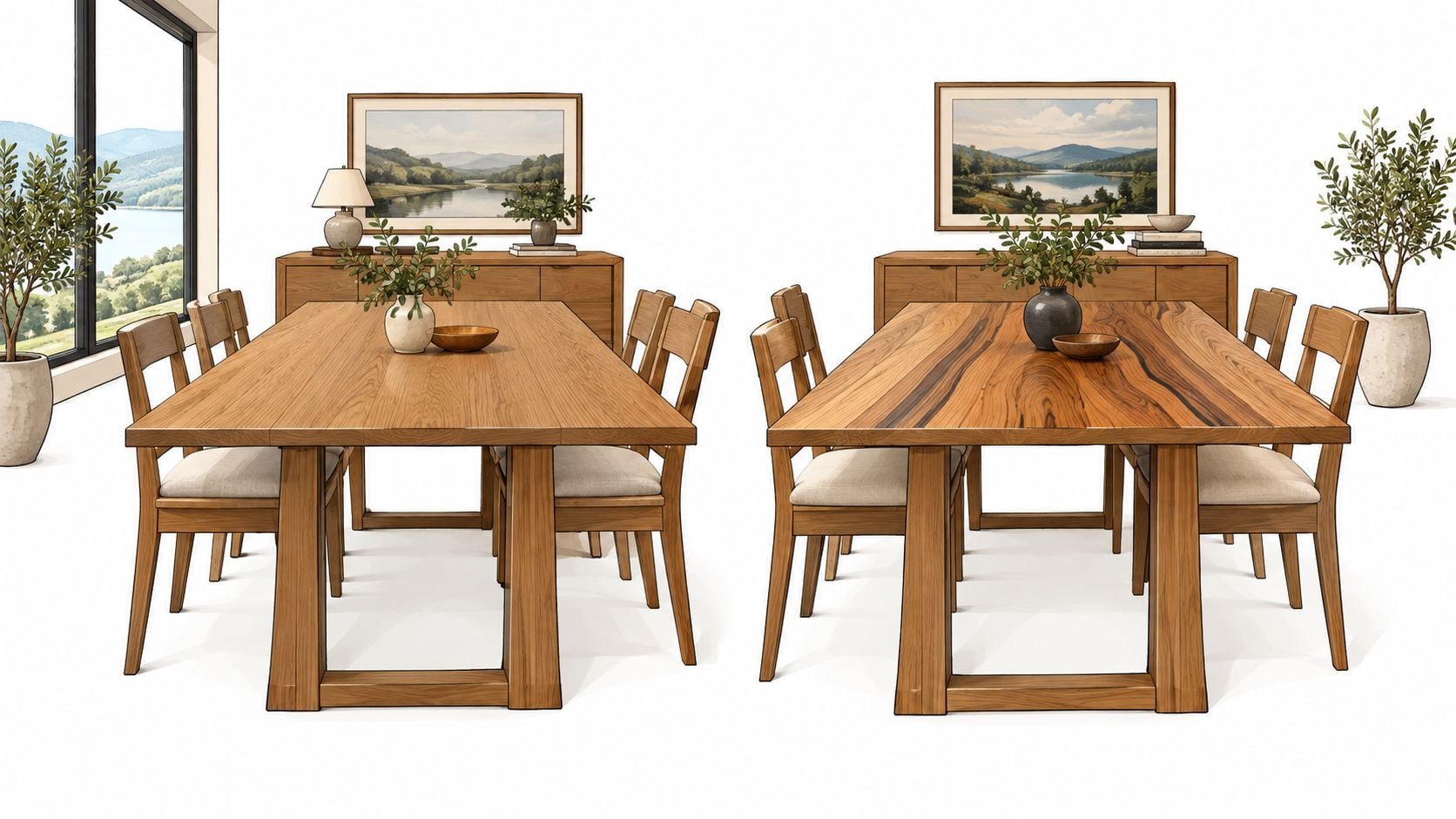
The species name is only the beginning
A label such as oak, cherry, maple, or walnut identifies the tree species, not the final appearance. Boards from different parts of one log can vary in tone, ring spacing, pore visibility, and fiber direction. The sawing angle then determines which features become visible on the face of the furniture.
A plain-sawn oak board may reveal cathedral arches, while a quarter-sawn board from oak can show straighter lines and ray fleck. Maple may look quiet and fine-grained in one piece, then show curly, birdseye, or quilted figure in another. The pattern people see isn't random decoration. It records how the tree grew and how the maker exposed that structure.
The sections ahead connect the science to the buying decisions that matter: the anatomy behind the pattern, the cut that reveals it, the names used in showrooms, the finish that changes its character, and the steps that help a custom dining set stay visually consistent.
How Trees Build the Patterns You See
A tree builds wood from the inside of a thin living layer beneath the bark called the vascular cambium. The cambium produces new xylem, the wood that supports the tree and carries water. In temperate regions, trees commonly form one growth increment per year, so a recognizable annual ring often represents a single growing season. Counting those rings can help estimate a tree's age, which makes ring structure one of the oldest practical tools in wood identification and dendrochronology, as described in the USDA Wood Handbook.
During a season, the tree generally produces earlywood and latewood. Earlywood forms during faster growth and contains larger, lighter cells. Latewood forms during slower growth and is denser and often darker. The contrast works much like a dark line along the edge of a paper cup. Repeated around the trunk, those changes become bands that can look subtle in maple or pronounced in oak.
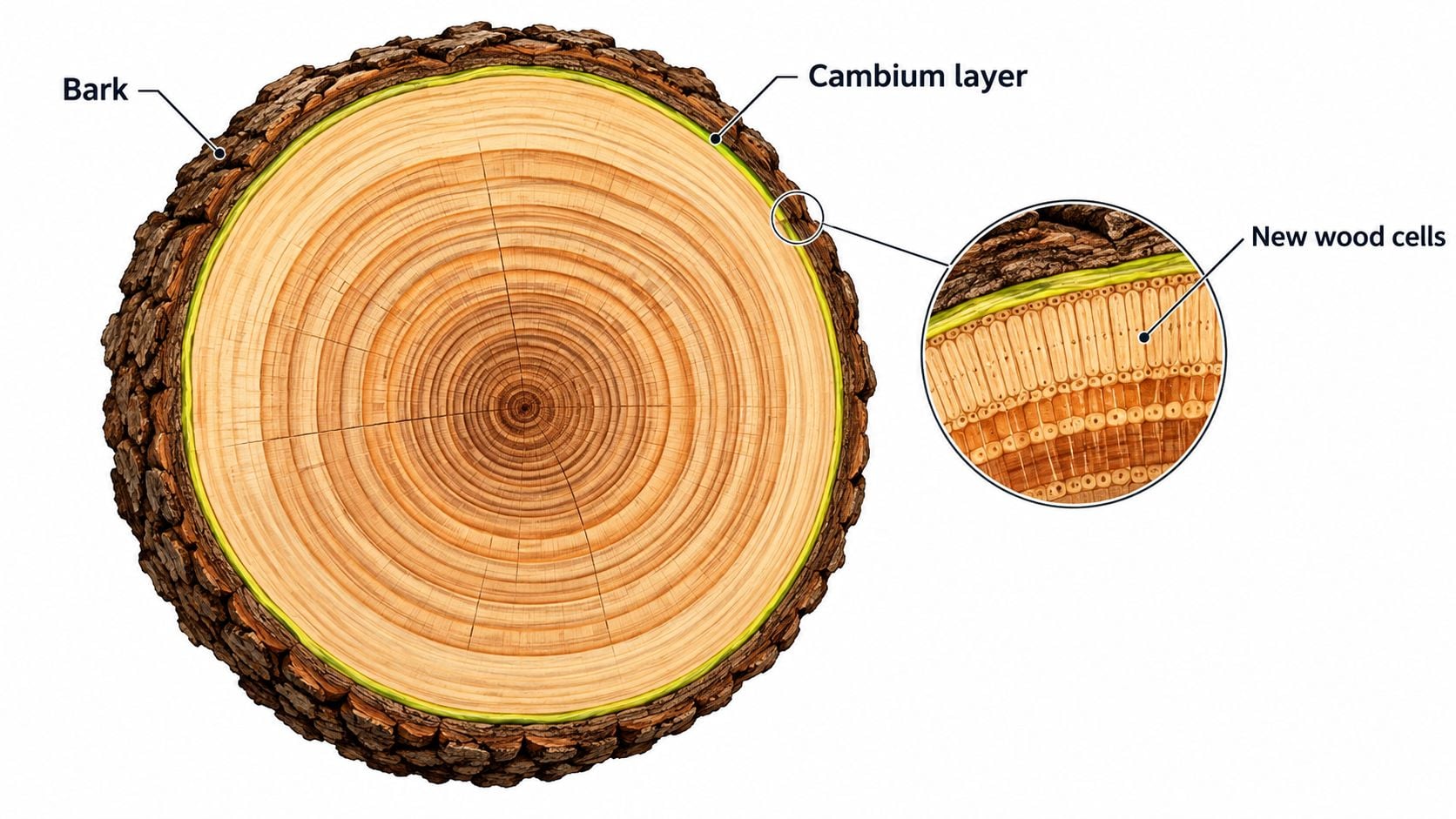
Why one species speaks more loudly
Species anatomy controls how strongly those rings appear. In ring-porous hardwoods, including oak, ash, and elm, spring vessels are much larger than late-season vessels. That sharp change creates pronounced pore bands and stronger visual contrast. The USDA describes distinct ring patterns involving no cell-pattern change, gradual reduction in cell diameter, or sudden reduction, and those anatomical differences help explain why some boards look uniform while others show bold banding.
Medullary rays add another layer. These radial structures extend outward from the tree's center, and a cut that crosses them can expose shimmering flecks. White oak is especially known for visible ray figure when the log is sawn in the right orientation, while cherry and maple generally present a quieter surface.
The same principle helps explain why construction materials and furniture boards can look different even before staining. A homeowner comparing deck lumber can use the same basic observation: the visible lines reflect cell arrangement, growth history, and the plane exposed by the saw.
How Sawing Methods Shape the Look
The saw doesn't divide a log into boards. It chooses which parts of the tree's anatomy become the front face. That decision affects the figure, the amount of usable material, seasonal movement, and the price of a finished piece.
| Sawing Method | Figure Produced | Stability | Typical Use | Relative Cost |
|---|---|---|---|---|
| Plain-sawn | Broad cathedral arches, flame-like shapes, and varied bands | Moderate, with more movement across the face | General furniture, panels, flooring, and wide boards | Lower |
| Quarter-sawn | Tight straight lines and visible ray fleck in suitable species | High, with improved resistance to cupping | Mission furniture, premium tables, cabinets, and distinctive panels | Higher |
| Rift-sawn | Very straight, combed lines with limited ray figure | Very high, with minimal cupping | Clean-lined furniture and architectural work | Higher |
| Live-sawn | A mixture of tangential and radial figure across a wide slab | Varies with the board and moisture movement | Rustic slabs, broad tops, and character-focused work | Varies |
| Rotary-sawn | Broad, repeating veneer patterns | Depends on the substrate and construction | Veneers and engineered panels | Varies |
Plain-sawn boards
Plain-sawing, also called flat-sawing, cuts generally parallel to the log's length and produces the familiar cathedral shape. The growth rings meet the face at a more tangential angle, so the arches become wide and expressive. This method usually yields more usable lumber, helping keep the material cost lower, but the boards can respond more noticeably to changes in moisture.
That makes plain-sawn oak a natural choice for farmhouse dining rooms, traditional kitchens, and spaces where visible movement is part of the design.
Quarter-sawn and rift-sawn boards
Quarter-sawing exposes the growth rings more nearly across the face. The result is a straighter visual rhythm and, in species such as white oak and sycamore, dramatic ray fleck. The cut also improves dimensional stability, which helps explain why quarter-sawn oak furniture often carries a premium.
Rift-sawing takes the straight-line effect further. It produces a combed appearance with less prominent ray figure and is often selected for mission-style or contemporary furniture. The tradeoff is lower yield and more involved milling, so the price reflects both the material and the labor.
Rotary-sawn veneer and live-sawn slabs serve different purposes. Rotary cutting peels veneer into broad repeating patterns, while live-sawn work keeps more of the log's character in one wide board. Neither is automatically better. The useful question is whether the appearance and stability suit the furniture's purpose.
Common Wood Grain Patterns You Will Recognize
A showroom educator often starts with the top of the table because the face reveals the cut most clearly. On a plain-sawn oak top, the eye usually follows cathedral grain, a series of arching loops that widen and narrow across the board. The pattern feels familiar, active, and warm, especially under a medium or dark stain.
Quarter-sawn white oak tells a different story. Instead of broad arches, the surface can show narrow lines crossed by bright, reflective flecks from the medullary rays. Sycamore can also reveal this kind of ray figure. The effect suits furniture with architectural details because the grain has a more orderly rhythm.
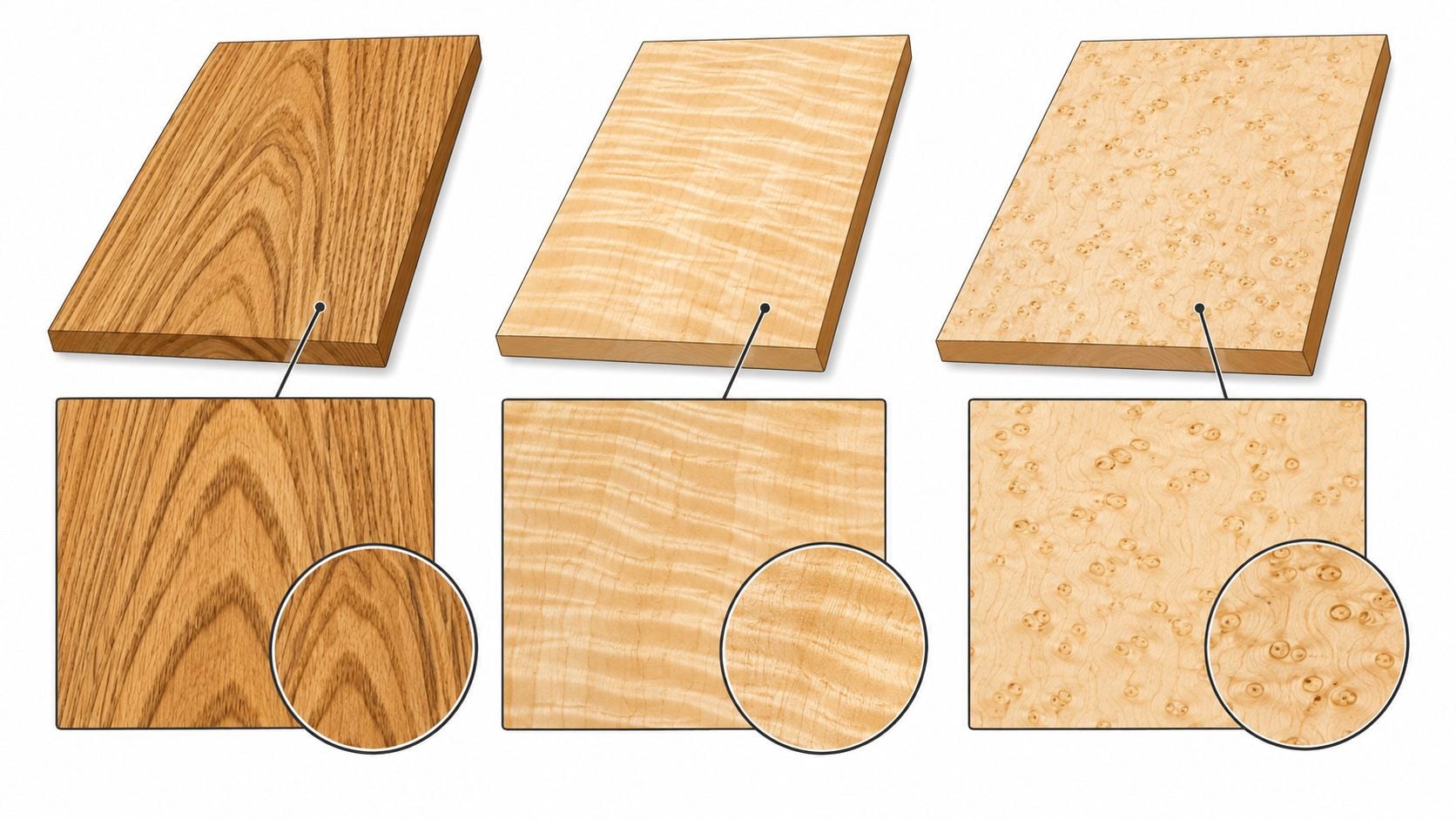
Ripples, eyes, and ribbons
Curly maple and figured walnut show how light can create the impression of depth. Curly or tiger-stripe figure comes from wavy or interlocking fibers that reflect light differently across the surface. As the viewer moves, the bands appear to shift from bright to dark.
Birdseye maple looks more scattered. Small oval lenses appear across a creamy field, giving a cabinet door or accent top a distinctive, almost patterned surface. Fiddleback figure is tighter and more parallel, with ribbon-like waves prized for instrument backs and decorative panels.
Other patterns carry a stronger sense of irregular growth:
- Burl: Swirling clusters with grain running in many directions, often seen in walnut or cherry.
- Spalted maple: Dark zone lines associated with early-stage fungal activity, set against lighter wood.
- Ribbon stripe sapele: Long dark and light bands that run cleanly along the board, especially when the cut exposes interlocked grain.
- Irregular grain: Fibers change direction unpredictably, creating a less orderly surface with strong character.
- Wavy grain: Fibers form smooth waves that can become curly or fiddleback figure.
Wood figure can also combine directional forms. Wavy and curly grain may create fiddleback or beeswing effects, while combinations involving spiral and interlocked grain can produce block mottled, roe, or ribbon-striped figure, as summarized in this reference to Melbourne wooden floor types.
How Stains and Finishes React with Grain
Finish selection starts with pore structure, not color alone. Open-grained woods have larger visible cells and a more textured surface. Closed-grained woods have smaller cells and generally present a smoother face. Oak, ash, and walnut are commonly treated as open-grained examples, while cherry, maple, and birch are commonly described as closed-grained examples, as explained by this wood grain reference.
Match the coloring method to the surface
A pigment stain carries color particles into pores and low areas. On plain-sawn oak, that can deepen the cathedral arches and make the earlywood and latewood contrast more obvious. On open-grained ash, the result may feel bold and rustic because the pores accept color unevenly across the face.
A dye behaves differently. It dissolves into the wood more evenly and can bring out the light-bending ripples in curly maple without filling the figure with heavy pigment. Closed-grained maple and birch often benefit from careful color control because their smoother surfaces can show uneven absorption or blotching more readily.
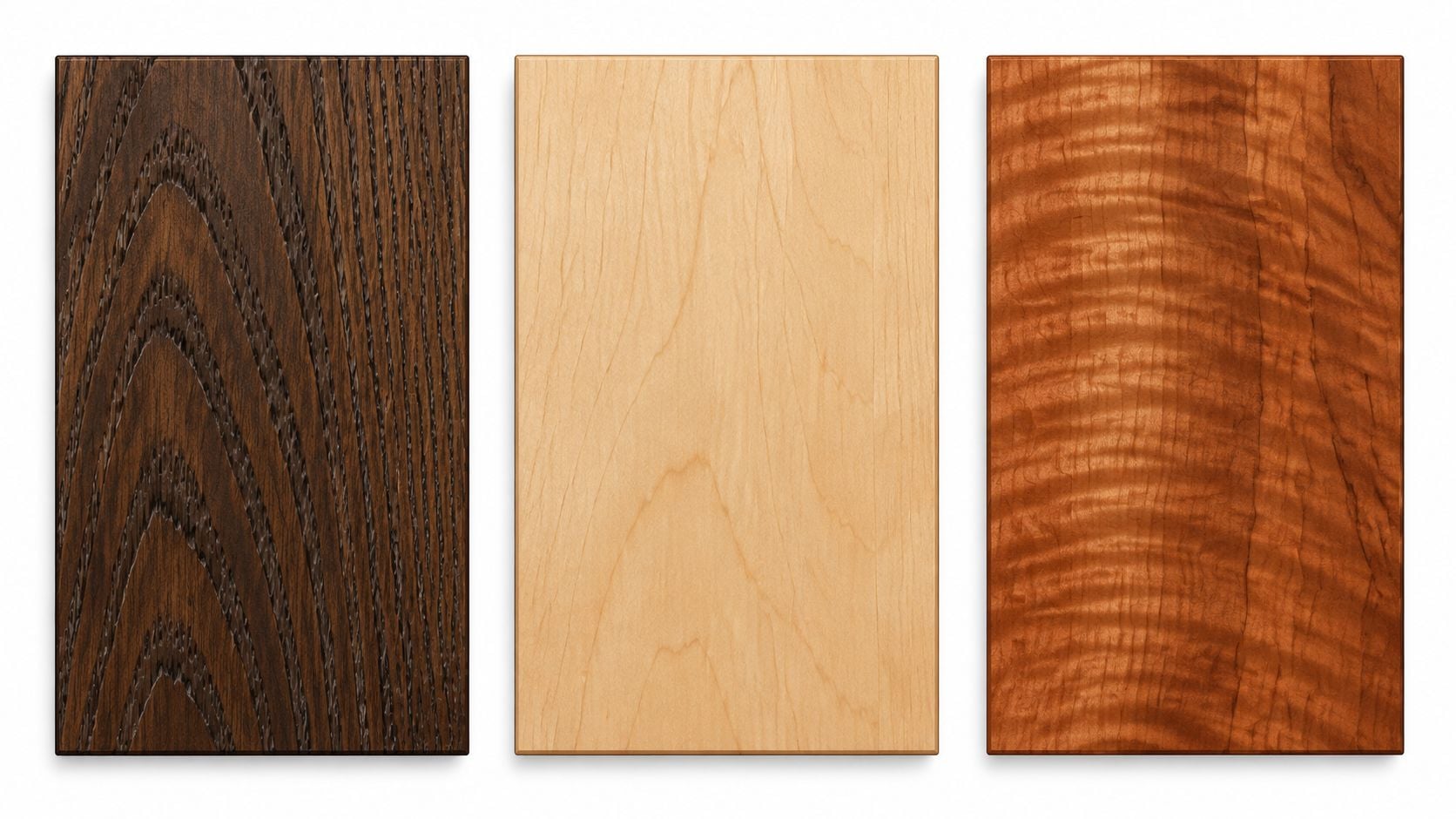
Sheen changes the conversation
The same grain can feel entirely different under different sheen levels:
- High gloss: Reflects more light and amplifies fiddleback, burl, and quilted figure.
- Satin: Keeps the pattern visible while softening glare and visual busyness.
- Matte or flat: Supports quiet straight grain and mission-style furniture.
Birch and pine deserve extra care because both can develop uneven color with some stain products. A compatible pre-conditioner can help moderate absorption. Highly figured surfaces also deserve careful hand sanding, since uneven sanding can create dull patches that interrupt the shimmer.
Homeowners comparing painted and stained surfaces can review this practical guide on how to choose a white finish for timber. For furniture-specific finish planning, the custom wood finishes guide can help frame questions about color, sheen, and long-term use.
Matching Pieces and Ordering Custom Work
A coordinated room looks collected when the furniture shares a visual language. It looks curated when the grain, tone, sheen, and proportions appear intentionally related. Matching grain doesn't mean every board must look identical. It means the differences should feel controlled rather than accidental.
Even boards from the same log can vary in color, cathedral width, ray length, and figure intensity. The strongest opportunity for consistency comes from ordering a dining table and its matching chairs from the same production batch. A maker can then work from the same species selection, finish recipe, and general board character.
What to bring to the showroom
A design appointment becomes more useful when the homeowner arrives with specific reference material:
- Room photographs: Include flooring, nearby cabinetry, rugs, wall color, and natural light.
- Color samples: Bring paint chips, fabric swatches, and existing stain samples.
- Furniture details: Photograph pieces that must remain in the room, including their finish and hardware.
- Measurements: Record doorways, stair turns, hallways, and the intended furniture location.
- Lifestyle notes: Mention children, pets, frequent entertaining, and whether the table will receive daily use.
Questions that protect future consistency
A design consultant should be able to discuss the species, cut, board width, stain recipe, and sheen. It also helps to ask whether the shop can reserve sequential boards or related flitches for a future matching piece. That question matters when a homeowner plans to add a sideboard, kitchen island, or additional chairs later.
Physical samples deserve priority over photographs. A camera can compress figure, shift color, and hide the way a surface changes as the viewer moves. A sample viewed beside the room's flooring and upholstery gives a more reliable sense of the final relationship.
The custom furniture ordering process gives homeowners a useful framework for discussing size, wood type, style, and finish. At Tip Top Furniture & Mattresses, custom ordering can also support a repeatable finish plan across a home, while professional design services have been available since 1984.
Caring for Furniture by Grain Type
Furniture care makes more sense when it follows grain behavior, not just the species label. Open-grained oak has larger pores and a more textured face, so dust and cleaning residue can settle into the low areas. Closed-grained cherry presents a smoother surface, but scratches may stand out more clearly because the face has less texture to disguise them.
Figured burl needs a soft brush or a clean, soft cloth that can reach its valleys without catching on irregular fibers. Curly and fiddleback tops should be treated gently as well. Heavy oil polishes can deepen unevenly across the rippled surface and may make the figure look muddy instead of luminous.
Humidity target: Keep indoor relative humidity between 35 and 55 percent. Stable conditions reduce the expansion, checking, and joint stress that can occur when boards respond differently across their grain orientations.
A furniture-safe cleaner should match the manufacturer's finish instructions. Wax may suit some traditional surfaces, while a polyurethane-coated top typically needs routine cleaning rather than repeated oiling. Recoating or refinishing becomes appropriate when the protective film has worn through, water no longer beads as it once did, or scratches have reached the stained surface.
Sunlight and heat also deserve attention. Direct exposure can change the appearance of wood over time, especially on lighter or naturally warm species. Furniture should sit away from heating vents and radiators, and spills should be wiped promptly rather than allowed to remain in pores or joints. The wood furniture care guide provides a practical reference for regular maintenance.
Choosing the Right Grain for Your Home
The right grain depends on the room, the traffic, and the mood the homeowner wants to create. Quiet straight grain supports formal dining rooms, calm bedrooms, and minimalist interiors because it doesn't compete with architectural details or patterned textiles.
Bold cathedral oak has more presence. It can anchor a farmhouse kitchen, family dining area, or open-plan room where the table needs to hold its own against flooring and cabinetry. Quarter-sawn white oak offers a more ordered character, making it well suited to mission-inspired furniture and rooms that benefit from visible structure without broad arches.
Figured maple can serve as an accent rather than a whole-room statement. A curly or birdseye maple top may work beautifully on a bedroom chest, occasional table, or carefully selected desk where the surface receives less rough daily handling. Walnut brings flowing movement and deep tonal character to living rooms and dining spaces, while cherry's fine, smooth grain suits traditional rooms that can accommodate its changing warmth over time.
A simple decision framework helps:
- Start with use. Daily family meals call for a finish and construction suited to regular contact. A decorative accent allows more freedom with delicate figure.
- Study nearby surfaces. Compare the grain to flooring, cabinetry, trim, and upholstery rather than viewing the piece alone.
- Choose visual energy. Straight grain calms a busy room. Cathedral, burl, or curly figure adds a focal point.
- Plan for additions. If future matching matters, document the species, cut, stain, and sheen before ordering.
- Review the whole project. Furniture, flooring, décor, and even sleep spaces can be coordinated through one local design conversation.
A guide to the best wood for tables can help narrow the species choice, but live samples remain the clearest way to judge grain. Tip Top Furniture & Mattresses is a family-owned showroom based in Freehold, NY, serving Albany, Schenectady, Troy, Greene County, and the wider Capital Region with furniture, Amish-made solid wood pieces, USA-made mattresses, flooring, décor, flexible financing, delivery, and clearance options from more than 50 trusted manufacturers.
Visit Tip Top Furniture & Mattresses in Freehold to compare wood grain patterns, physical finish samples, Amish furniture, custom-order options, flooring, and room furnishings side by side. Homeowners can also book a complimentary design consultation to plan a coordinated room or apply for flexible financing before beginning the project.