Furniture Leg Styles: A Visual Guide for Albany Homes


A shopper in the Freehold showroom can stand between two tables with nearly identical tops and still feel that one belongs in a formal dining room while the other feels relaxed and modern. The difference may be below eye level. A curved cabriole leg, a clean taper, or a slim metal support changes the way furniture looks, feels, and functions in a home.
That choice matters in older Capital Region houses, where wide-plank hardwood, uneven transitions, compact rooms, and multi-generational routines often shape what furniture can comfortably do. Furniture leg styles influence visual character, joint strength, floor contact, cleaning access, and the space available for knees and mobility devices.
Why Furniture Legs Matter More Than You Think
A leg isn't just the part that keeps a table or chair off the floor. It establishes visual weight. A heavy block leg can anchor a large dining table, while a delicate tapered leg can make the same surface appear lighter. A skirted base can make an upholstered piece feel settled and traditional, while exposed hairpin steel gives it a more open, contemporary outline.
On a showroom floor, shoppers can test this difference with a simple touch. Place a hand near the corner joint, press gently against the frame, and look at where the leg meets the floor. A beautiful profile deserves a connection that feels equally deliberate.
Practical rule: Choose the leg for the room's daily work first, then choose the decorative profile that supports that decision.
Ten profiles appear often enough to deserve a working vocabulary:
- Cabriole, an S-shaped curve associated with traditional furniture.
- Turned, a lathe-shaped leg with rounded sections and grooves.
- Bun, a compact rounded foot with a grounded appearance.
- Bracket, a squared, angular support often seen on case furniture.
- Tapered, a straight leg that narrows toward the floor.
- Splayed, a leg that angles outward for a wider stance.
- Block, a substantial square or rectangular support.
- Hairpin, a thin bent-metal leg with a looping profile.
- Metal mid-century, a clean, often angled metal support with restrained geometry.
- Skirted, a fabric-covered base that conceals the legs.
The profile affects more than style. Curves and tapers can make a piece easier to see through, but an open appearance doesn't automatically mean better stability. A leg that flares outward may improve the stance, while a poorly fitted joint can still allow movement. The hidden connection deserves as much attention as the visible silhouette.
Accessibility belongs in the same conversation. A table with open corners can still block a wheelchair approach if its apron or stretcher occupies knee space. A sofa with tall legs may look airy but leave too little usable depth for a comfortable seated position. For Albany, Schenectady, Troy, and nearby homes, the right choice balances history, structure, and clearance rather than treating the leg as a finishing touch.
The Ten Furniture Leg Styles Explained
The quickest way to identify a leg is to look for its dominant line. Does it curve, narrow, turn, angle, disappear under fabric, or rely on metal geometry? The visual guide below provides a useful reference while comparing pieces on the floor.
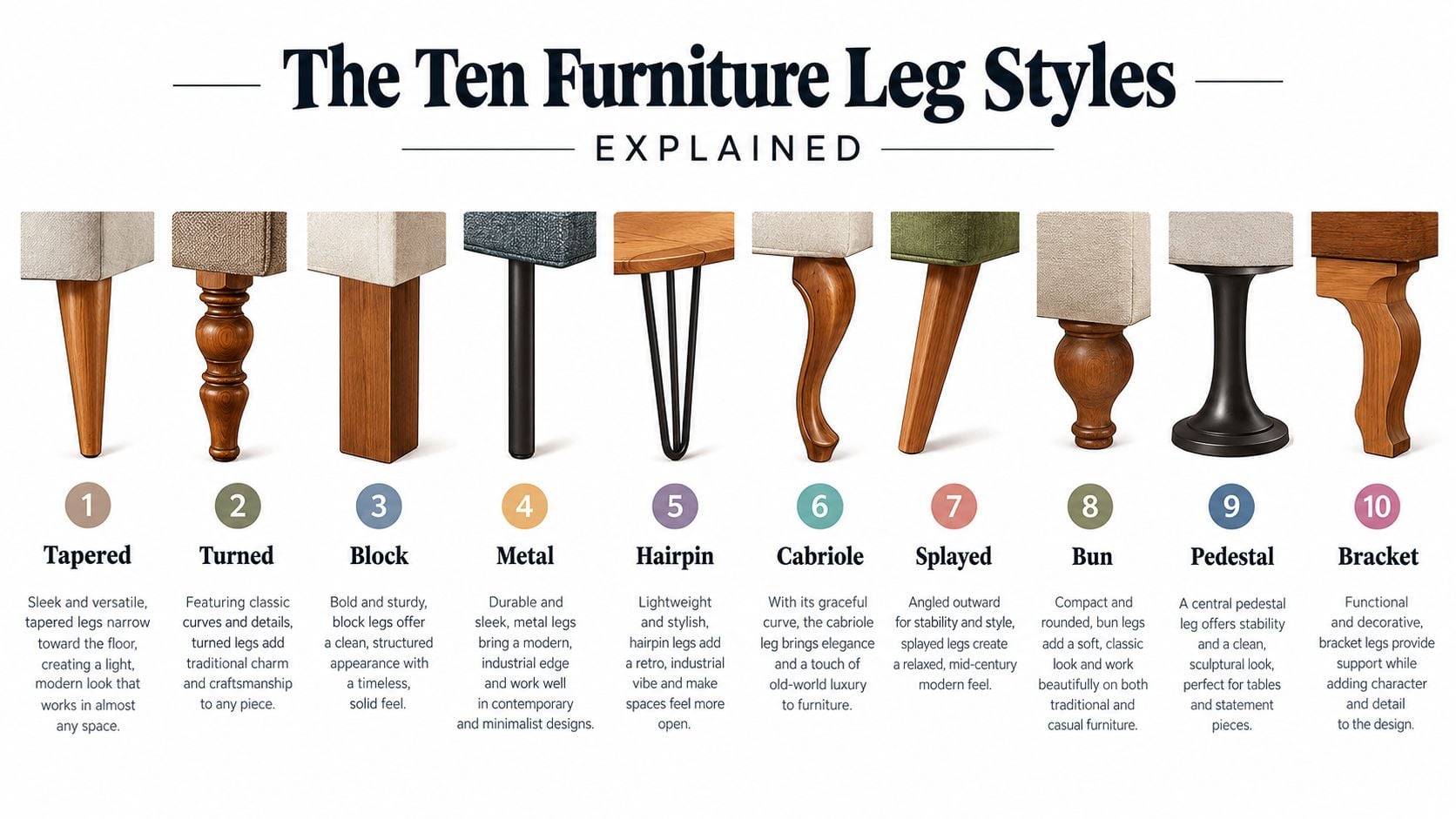
Curved and carved profiles
Cabriole: Look for the unmistakable S curve, convex above and concave below, usually narrowing toward a shaped foot. It suits Queen Anne-inspired dining, occasional, and bedroom furniture, especially where a traditional room needs movement rather than visual heaviness.
Bun: This is a short, rounded support that resembles a wooden bun under the case. Its low profile works well with cottage, farmhouse, and relaxed traditional furniture where a grounded stance feels more comfortable than a tall exposed leg.
Bracket: A bracket leg uses squared corners and angular cutouts rather than flowing curves. It pairs naturally with chests, consoles, and case furniture that needs a substantial, architectural base.
Turned: A turned leg contains rounded sections, beads, rings, or grooves created on a lathe. It brings a sculptural, traditional quality to dining tables, end tables, and desks.
Straight and angled supports
Tapered: A tapered leg is straight but becomes narrower toward the floor. Its restrained geometry works with Federal, transitional, Scandinavian-influenced, and contemporary interiors.
Splayed: A splayed leg leans outward from the frame instead of dropping straight down. It can give a table or chair a broader stance and a more relaxed visual rhythm, provided the attachment is accurately angled.
Block: A block leg is square, rectangular, and visually weighty. It supports modern farmhouse, Craftsman, and contemporary furniture, especially when the room needs a strong relationship between the table, flooring, and architecture.
Modern and concealed profiles
Hairpin: A hairpin leg uses thin bent metal that loops down and back up. Its open shape suits compact desks, occasional tables, and casual modern rooms, though the attachment plate and frame still need careful inspection.
Metal mid-century: This profile typically uses clean metal lines, often angled or gently spreading, with little ornament. It complements modern and mid-century-inspired interiors where the base should look precise rather than carved.
Skirted: A skirted base hides the legs behind upholstery or fabric. It softens sofas, beds, and occasional seating, making the piece feel more traditional while also reducing visible floor-level clutter.
For shoppers comparing related profiles, this quick table helps:
Confusing Leg Styles at a Glance
| Leg A | Leg B | Key Visual Cue | Best Room |
|---|---|---|---|
| Cabriole | Turned | Cabriole curves in an S shape, turned legs show rounded lathe details | Traditional dining room |
| Tapered | Splayed | Tapered stays straight and narrows, splayed angles outward | Transitional dining or office |
| Bun | Bracket | Bun is rounded and low, bracket is squared and angular | Cottage bedroom or farmhouse living room |
| Hairpin | Metal mid-century | Hairpin loops into a narrow bend, mid-century metal uses cleaner angled lines | Modern office or living room |
Before ordering a table, shoppers should also confirm its overall dimensions and walking clearances. This end table dimensions guide can help connect the leg profile to the piece's actual footprint. If a large item requires in-home setup, a guide on how to choose an assembly provider offers useful questions about experience, access, and responsibility for the installation.
A Quick History of Furniture Legs
A leg profile can place a piece in its historical setting before you examine the finish. It also hints at how the frame carries weight, where joints receive stress, and how easily feet can approach the furniture in an Albany Capital Region home.
William and Mary furniture, generally associated with approximately 1690 to 1730, often used trumpet-turned legs. Their rounded, expanded sections created a formal, sculptural effect through lathe work. Because the support remains mostly vertical, its joint behavior differs from a leg that sweeps outward or narrows sharply.
Queen Anne furniture followed with cabriole legs and pad feet. By the 1730s, Boston makers had developed a standardized chair form with S-curved cabriole legs and a vase-shaped splat, while cabriole legs also appeared on high chests of drawers. The broader Queen Anne style is generally associated with American furniture produced from approximately 1730 to 1760 (Metropolitan Museum of Art furniture history).
A cabriole leg has two opposing curves. The upper section is convex, the lower section concave, and the leg usually narrows near the ankle before reaching the foot (BADA's explanation of the cabriole leg). This creates a lighter, more animated outline than a straight support, though the curved geometry can place different demands on its frame joints. Its foot shape also affects how close a shopper can bring a toe or mobility aid to the chair.
During the Chippendale or Rococo era, dated approximately 1755 to 1790, the curve became more elaborate. Carved knees and ball-and-claw feet added ornament, while a restrained pad or slipper foot suggested a simpler Queen Anne interpretation. These details can point toward Chippendale influence (antique furniture leg identification guide).
Between roughly 1780 and 1820, Federal and Neoclassical furniture shifted toward straight, tapered legs with fluted or reeded decoration. The change reflected renewed interest in Greek and Roman principles, symmetry, and controlled ornament (historical furniture leg style reference).
Today, turned legs bring a traditional vocabulary, cabriole legs add movement, and tapered legs feel quieter and more architectural. At Tip Top, custom-order and Amish craftsmanship options can help match that historical character with the joint construction, floor clearance, and daily use expected in a Capital Region home.
How Leg Geometry Affects Stability
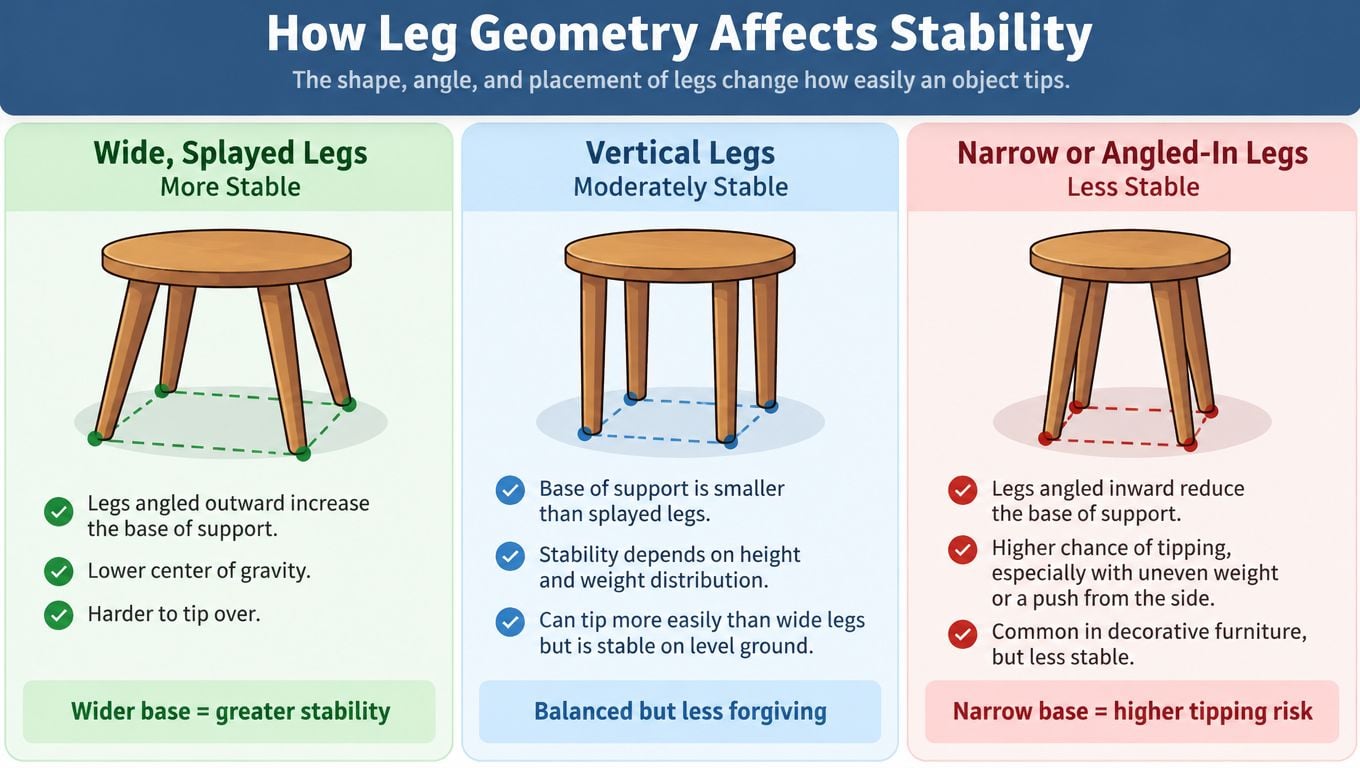
A shopper testing a dining table in a showroom may notice movement before noticing its style. Push gently near a corner, shift your weight against the edge, and watch how the legs and frame respond. Leg geometry affects how widely the piece supports itself, how directly it carries weight, and how much force reaches each joint.
Splayed legs spread the support area and can resist side-to-side movement. Tapered legs send weight through a straighter path and create a lighter visual line. A commonly used outward splay is approximately 5 to 10 degrees from vertical. The angle must remain consistent, because an inaccurate splay can load the joint from the side rather than sending compression down through the leg.
What the joint tells a shopper
The joint usually determines whether an attractive profile remains steady under daily use. Experimental testing of cantilevered wood-furniture leg joints found an average bending-moment capacity of 62.82 N·m for a reinforced configuration with metal corner braces, compared with 39.23 N·m for a typical joint, approximately 60% higher (cantilevered leg joint testing). The testing also found that conventional designs placed much of the stress in wooden components, while reinforcement shifted critical stress toward the metal connectors.
Joint type and wood species change performance too. Related testing reported compression moment resistance from about 60 N·m for Scotch-pine dowel joints bonded with PVAc to 281 N·m for oak half-lap joints with PVAc. The figures illustrate why a leg's silhouette cannot tell you everything about its strength.
Use three quiet showroom checks:
- Press near the corner. Look for movement between the leg and apron.
- Inspect underneath. Check for corner blocks, threaded inserts, plates, or visible joinery.
- Examine the connection. A decorative taper should not become too narrow where racking and compression forces enter the frame.
Custom-order and Amish craftsmanship options at Tip Top can coordinate the profile with its connection, floor contact, and intended use in an Albany Capital Region home. A mortise-and-tenon joint guide explains why traditional joinery may matter more than a decorative leg shape alone.
Clearance, Comfort, and Accessibility
A dining table can look open from the doorway yet feel cramped once a wheelchair, chair, or walker approaches. Leg height, spacing, and the shape of the support determine whether someone can sit comfortably, reach the surface, or move close enough to work. A pedestal removes corner legs, but its base can still block the approach. Four legs may leave generous room on one side and restrict access from another.
Accessibility guidance identifies 27 inches of minimum knee clearance, 30 inches of width, and 19 inches of depth beneath an accessible desk or work surface. Use these dimensions as practical checkpoints for a desk, dining table, or shared work surface, then confirm the actual opening created by the frame.
Measure the usable space, not the advertised height
For a desk, measure from the floor to the lowest obstruction beneath the top. Record the clear width between legs or supports and the usable depth from the front edge toward the back. An apron can reduce the opening even when the tabletop appears spacious.
At a dining table, check the chair approach from each side. Stretchers, pedestals, and cross-supports can interfere with feet or mobility equipment. For a sofa or nightstand, inspect the space beneath the frame if outlet access, cleaning, or a robotic vacuum matters.
Before visiting the Freehold showroom, use this furniture measuring guide to record doorways, wall runs, and required clearances. Those measurements help households across the Greater Albany Capital Region plan rooms that serve children, adults, guests, and older family members.
A skirted sofa can soften a room and hide its frame, while also covering outlets or limiting cleaning access. Exposed tapered, block, and metal legs usually leave more floor visible, but a low frame may still prevent comfortable approach. The style's historical character affects the room's look. Its joint and support arrangement affect movement under load. For an accessible setup, the deciding point is the lowest obstruction, not the leg profile alone.
Tip Top's custom-order and Amish craftsmanship options allow shoppers to discuss leg spacing, support placement, and clearance together, then match those details to an Albany Capital Region home.
Matching Leg Styles to Rooms and Floors
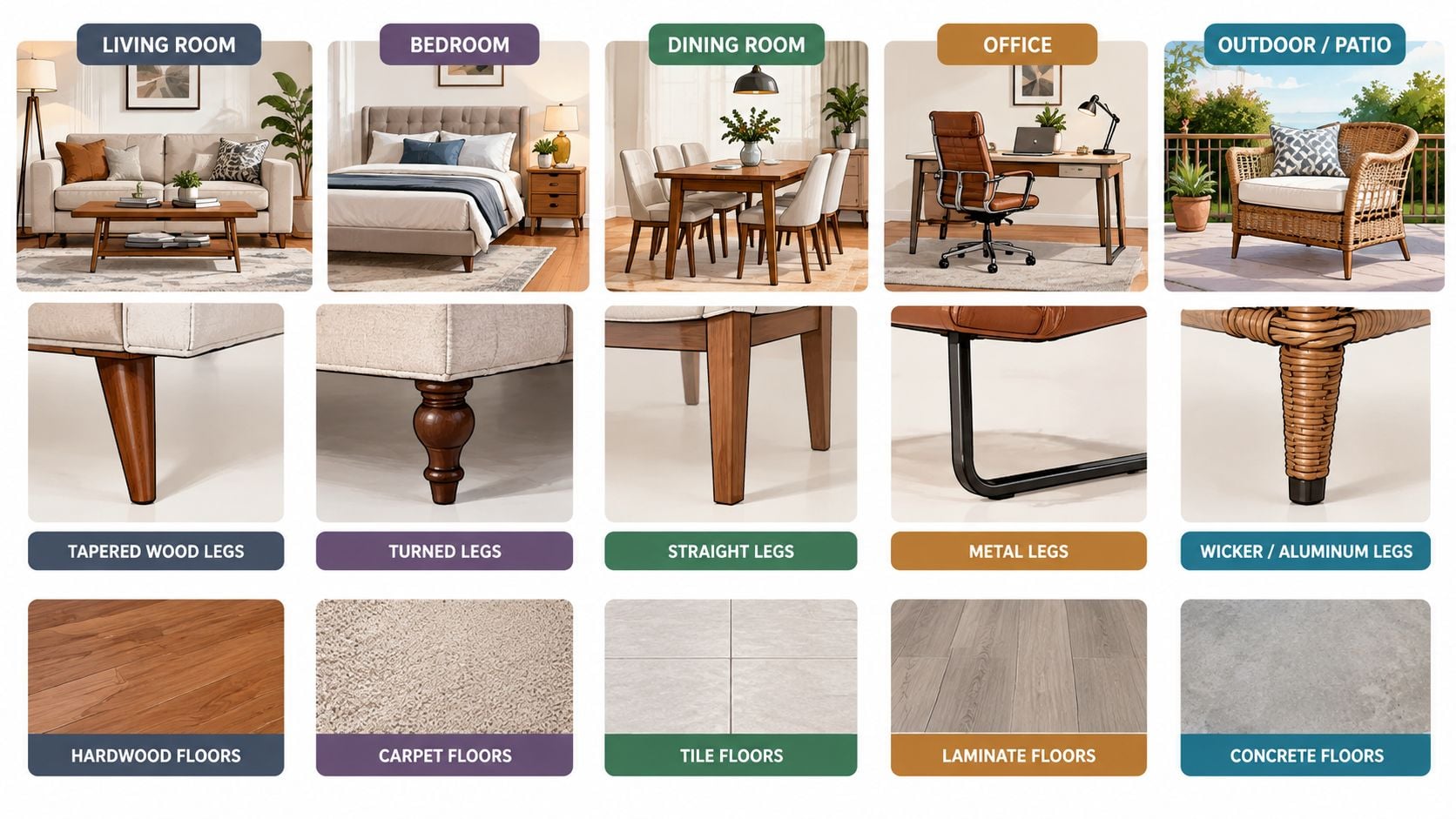
Furniture leg styles work best when they connect three elements: the room's architecture, the floor's surface, and the family's routine. Cabriole and turned legs can complement traditional woodwork and detailed upholstery. Tapered and metal mid-century profiles usually sit comfortably beside cleaner lines, while bun, bracket, and skirted bases bring softness to farmhouse and cottage settings.
Flooring changes the practical answer. A slim leg can disappear visually on wide-plank hardwood, but a narrow foot may concentrate pressure on the surface. Plush carpet can absorb a broader base while making a delicate support appear less stable. Luxury vinyl needs careful attention to sharp edges and dragging because scuffs often begin during repositioning rather than ordinary use.
Room-by-room pairings
Living rooms can use block legs for a substantial sectional, turned legs for traditional seating, or skirted bases when the goal is a softer, settled look. Hairpin and clean metal bases suit smaller occasional tables where visible floor helps the room feel less crowded.
Bedrooms often benefit from bun, bracket, or skirted profiles. These choices support a quieter visual rhythm around beds and case pieces. Cabriole legs can add traditional character to a dresser or nightstand, especially when the finish and hardware share the same period language.
Dining rooms require the closest attention to knees, chair movement, and floor protection. Tapered or turned legs work well with four-corner tables, while an open base may help some seating arrangements. A leg that looks elegant from across the room still needs enough joint strength for daily leaning and repositioning.
Home offices usually favor tapered, block, hairpin, or metal mid-century profiles. The choice should preserve legroom, avoid sharp contact points, and leave enough access for cords and outlets.
| Room | Recommended Styles | Avoid If | Flooring Note |
|---|---|---|---|
| Living room | Block, turned, skirted, hairpin | The base blocks cleaning access | Protect exposed feet on hardwood |
| Bedroom | Bun, bracket, cabriole, skirted | A tall profile catches bedding or walking paths | Check soft contact points on wood floors |
| Dining room | Tapered, turned, splayed | Aprons or stretchers reduce knee clearance | Prevent dragging across hardwood or vinyl |
| Home office | Tapered, block, metal mid-century | Cross-supports interfere with feet | Keep access clear for cords and chair movement |
Rugs can change how a leg feels underfoot. Before placing a table on hardwood, households can review practical advice on keeping rugs from sliding on hardwood. The hardwood floor protection guide also helps shoppers plan pads, lifting methods, and placement before delivery.
Custom Orders and Amish Craftsmanship for Albany Homes
A custom order makes the leg conversation more precise. Instead of accepting a standard height or profile, a shopper can coordinate the wood species, finish, leg shape, attachment method, and overall scale with the room. That matters when a table must clear an existing rug, a desk must accommodate a mobility device, or a bedroom piece must match furniture already in place.
Tip Top Furniture & Mattresses offers custom furniture ordering alongside Amish furniture handcrafted in the USA. The Amish furniture quality guide gives shoppers a closer look at construction details that matter when a visible design feature also carries everyday loads.
Three custom scenarios show how the process can work:
- Dining table: A family may select turned legs in solid wood, specify a finish that relates to the floor, and adjust the leg placement so the table clears an entryway rug without crowding the walkway.
- Home office: A desk can use splayed legs while maintaining the required 27 inches of knee clearance, with the apron, attachment hardware, and surface height planned as one system.
- Bedroom: A bed frame can use a skirted upholstered base, matched to existing bedroom furniture, while the leg height and support layout are checked for outlets, cleaning, and adjustable-base compatibility.
Amish craftsmanship doesn't make every design automatically suitable. The value comes from matching solid-wood construction and careful joinery to the actual specification. A substantial leg still needs a properly reinforced connection, and a beautiful finish still needs to fit the floor and room scale.
Households in Freehold, Albany, and surrounding communities can bring measurements, room photographs, or a sketch to a complimentary Design Consultation. Flexible financing can also help buyers plan a coordinated furniture, flooring, or mattress project without treating every purchase as an isolated decision.
Bringing It All Together and Planning Your Visit
A reliable furniture leg decision follows four questions:
- Which era or visual language fits the room?
- Which room and floor will support the piece?
- What clearance and joint strength does daily use require?
- Which custom finish, height, or profile completes the plan?
Freehold shoppers commonly regret legs that are too short to clear a rug, skirts that cover needed outlets, or tapered legs that wiggle because the corner blocks are weak. Tip Top has served local households since 1978, with Professional Design Services available since 1984, along with furniture, flooring, décor, mattresses, delivery, financing, and custom options from more than 50 trusted manufacturers.
Informational shoppers can try the free online room planner. Budget-conscious buyers can browse the Clearance Corner for immediate availability and reduced prices. Anyone balancing style, access, and construction should book a Design Consultation and review Flexible Financing before ordering.
Tip Top Furniture & Mattresses can help Albany Capital Region households compare furniture leg styles, coordinate flooring and room scale, and specify custom Amish pieces for real daily use. Visit Tip Top Furniture & Mattresses in Freehold, NY, to test construction, discuss clearance, and plan the right next step for the home.