How to Choose a Mattress for Couples: A Smart Guide


A couple can agree on almost everything in a bedroom and still disagree the moment they test mattresses. One partner presses into a soft pillow-top and says it feels welcoming. The other lies on a firmer surface and immediately asks for more support. Then come the familiar questions: Who moves more? Who sleeps hot? Who needs more room? Which comfort sacrifice will become a nightly irritation?
The answer isn't to find the mattress that feels perfect to one person. The right couples mattress is a shared sleep system, tested by both sleepers and judged against both bodies, habits, and sensitivities. The following process helps couples in Freehold, Albany, Schenectady, Troy, and throughout the Greater Albany Capital Region make that decision without letting a showroom label settle the argument.
When One Mattress Has to Please Two People
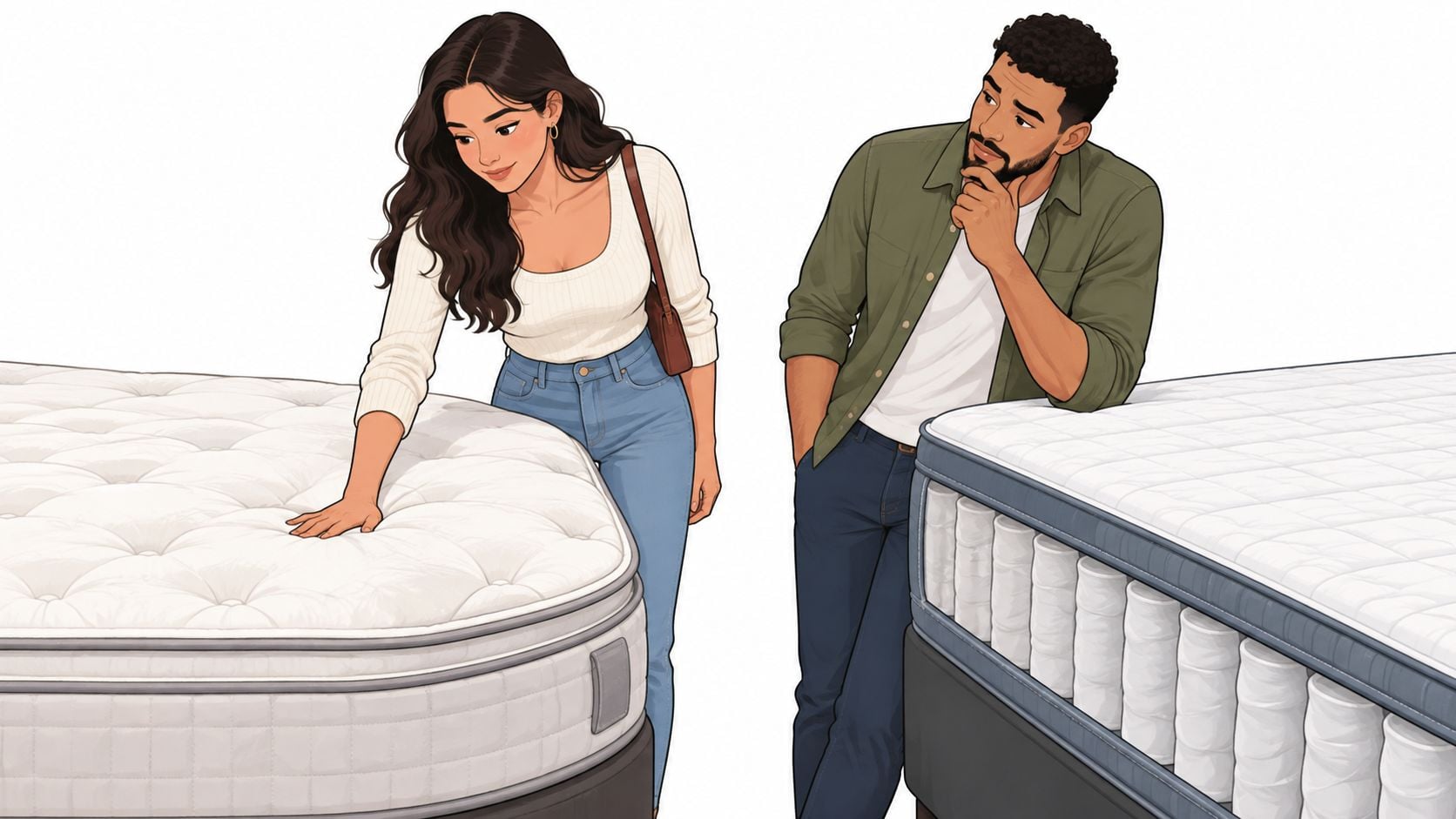
A couple can disagree before either person reaches the mattress aisle. One partner stretches out on a plush pillow-top and feels immediate relief around the shoulders and hips. The other tests a firmer pocket-spring model and prefers its steadier lower-back support and easier movement. Both reactions can be right.
The showroom decision becomes harder because one mattress must serve two bodies, two pressure maps, two sleep routines, and two ideas of comfort. A surface that supports a heavier back sleeper may feel harsh beneath a lighter side sleeper. A soft bed may feel inviting for five minutes, then allow too much sinking, restrict movement, or leave one partner sore by morning.
Bed sharing is common, and comfort is only part of the decision. A 2021 review reported that approximately 82% of married, partnered, or cohabiting couples in the United States routinely share a bed, and cited a laboratory study finding about 10% more REM sleep, with an average REM proportion of 23.0% when sharing a bed compared with 21.0% when sleeping alone (review of bed-sharing research). Partners may report better sleep together even when measurements show more disruption or fragmentation. Emotional closeness matters, so the most aggressively isolating mattress is not automatically the best choice.
Use a four-part shared-sleep test
Do not let one person choose by lying down first. Both partners should test each candidate together and compare the same four factors:
- Firmness: Does the surface support both spines while easing pressure at the shoulders and hips?
- Motion transfer: Can one partner turn, sit up, or leave the bed without waking the other?
- Temperature: Can the mattress and bedding suit a warm sleeper and a cold sleeper?
- Usable space: Is there enough room to change position without pushing either person onto a weak edge?
A laboratory study cited in that review found more synchronized sleep stages and less fragmented REM sleep when couples shared a bed, alongside significantly more limb movements. That balance matters. Choose motion control that limits unnecessary disturbance while preserving the comfort and closeness of sleeping together.
Both partners should compare pressure at the shoulders, hips, and lower back rather than relying on a showroom label. A guide to mattress pressure points can help you identify what to watch for during the trial. Spend enough time on each bed to test turning, lying in your usual positions, sitting near the edge, and getting up. Record each partner's verdict before discussing it, then choose the arrangement that addresses the bigger nightly problem.
The final answer may be one shared firmness, a split configuration, an adjustable base, or separate mattresses within one frame. The right choice is the one both sleepers can test, explain, and live with every night.
What to Know Before You Walk Into the Showroom
Good mattress shopping starts before a couple reaches the showroom. Each sleeper should complete a short checklist independently, then compare answers at home. That keeps the conversation honest and makes it harder for a display label or a sales pitch to dictate the decision.
Each sleeper should record the real problem
Each partner should write down:
- Sleep position: Side, back, stomach, or a combination of positions.
- Current mattress feel: Too soft, too firm, uneven, difficult to move on, or comfortable but disruptive.
- Morning symptoms: Shoulder pressure, hip soreness, lower-back stiffness, numbness, or no significant discomfort.
- Movement sensitivity: Whether turning, sitting, or getting out of bed wakes the other sleeper.
- Temperature tendency: Frequently warm, frequently cold, or comfortable with the current bedding.
- Material concerns: Any known sensitivity or allergy involving latex, wool, adhesives, or other mattress materials.
- Professional guidance: Any doctor-recommended support level or sleeping position.
The point isn't to diagnose a medical condition through mattress shopping. A doctor's recommendation should take priority over showroom advice, especially when a sleeper has persistent pain or a diagnosed condition. For people dealing with hormonal changes that affect rest, a resource on how to improve sleep during menopause can provide useful context before the mattress conversation begins.
Each person should also describe what the current mattress gets wrong. “Too firm” isn't enough. A more useful note says, “The shoulder feels compressed when side sleeping,” or, “The surface feels comfortable, but movement from the other side causes waking.” Specific complaints lead to better testing.
Small preparations make testing more honest
Couples should bring the pillows they use at home, wear loose clothing, and allow enough time for an unhurried visit. A quick sit on the edge doesn't reveal how a mattress supports the body during a normal sleep position. Both partners should expect to lie down, change positions, and discuss the feel without embarrassment.
The ultimate guide for choosing a mattress can help organize questions about construction, support, and comfort before the appointment. A written list also gives both sleepers a neutral reference when two beds begin to feel similar.
Practical rule: A mattress should earn agreement through testing, not through the confidence of the louder shopper.
Finding the Firmness Compromise That Works
Firmness should be selected around support, spinal alignment, and pressure relief, not around the assumption that the hardest mattress is the healthiest. A systematic review of 24 mattress studies found that a subjectively medium-firm mattress, along with a self-adjusted or custom-inflated design, was associated with better comfort, sleep quality, and spinal alignment (systematic review of mattress firmness). A later review reached a similar conclusion about medium-firm surfaces.
That evidence makes medium-firm a sensible starting point, not a universal answer. “Medium-firm” isn't standardized across manufacturers, and the same construction can feel different depending on body size, sleep position, comfort layers, and underlying support. Couples should treat the label as a starting category and test the actual bed.
A practical compromise formula
Each partner can rate the firmness preferred at home, then calculate the midpoint between those preferences. The showroom candidate should begin at that midpoint and then be tested at the next firmer option, rather than automatically choosing the softer feel.
That approach protects against a common mistake. A mattress can feel luxurious during a brief showroom test because the body enjoys the initial cushioning. If the softer partner's preference causes the heavier sleeper's hips or midsection to sink too far, both sleepers may lose support. The lighter sleeper also shouldn't be forced onto an overly firm surface just because the heavier partner prefers a solid feel.
Useful rules include:
- Meet in the middle when both partners have similar body sizes and sleep positions.
- Protect the lighter sleeper's pressure relief when there is a substantial weight difference.
- Give greater weight to a professional support recommendation when chronic pain or a diagnosed condition is involved.
- Use the sleeper's position as a tie-breaker: side sleepers need shoulder and hip cushioning, while stomach and combination sleepers often need stronger control against excessive sinking.
- Reject any mattress that creates persistent pressure, morning stiffness, or visible spinal sag for either partner.
Foam often allows deeper contouring, while pocketed coils and hybrids can provide a more buoyant response. A partner who changes position frequently may dislike excessive sink, even if the other sleeper enjoys the enveloping feel. Couples should compare how each person can turn, not just how comfortable each person feels while still.
Firmness compromise by body weight and sleep position
| Body Weight | Side Sleeper | Back Sleeper | Stomach / Combination Sleeper |
|---|---|---|---|
| Lighter sleeper | Prioritize cushioning at the shoulder and hip without losing underlying support. | Choose balanced support with enough surface conformity to avoid a hard feel. | Avoid excessive firmness if it creates pressure, but control sinking through the midsection. |
| Average-build sleeper | Begin with a medium-firm candidate and check pressure relief in the normal side position. | Medium-firm is a strong starting point for neutral alignment. | Look for stable support and easy repositioning rather than a deeply sinking surface. |
| Heavier sleeper | Seek stronger underlying support with enough comfort material to prevent shoulder and hip pressure. | Test for sagging through the center and confirm that the lumbar area remains supported. | Favor firmer, more stable construction that resists excessive sinking. |
A couple can use this mattress firmness guide to prepare, then test both partners together. Evidence from a peer-reviewed study of 128 adults found that firmness significantly affected 9 of 11 key actigraphic and diary-based sleep measures, while individuals varied widely in the firmness that optimized their sleep (actigraphy and mattress firmness study). The showroom can narrow the choices, but an exchange or home-trial policy should confirm the final decision.
Testing Motion Isolation and Edge Support Together
A couple shouldn't test motion isolation by lying still side by side. That only measures how the mattress feels when nothing happens. The useful test recreates the interruptions that occur at home.
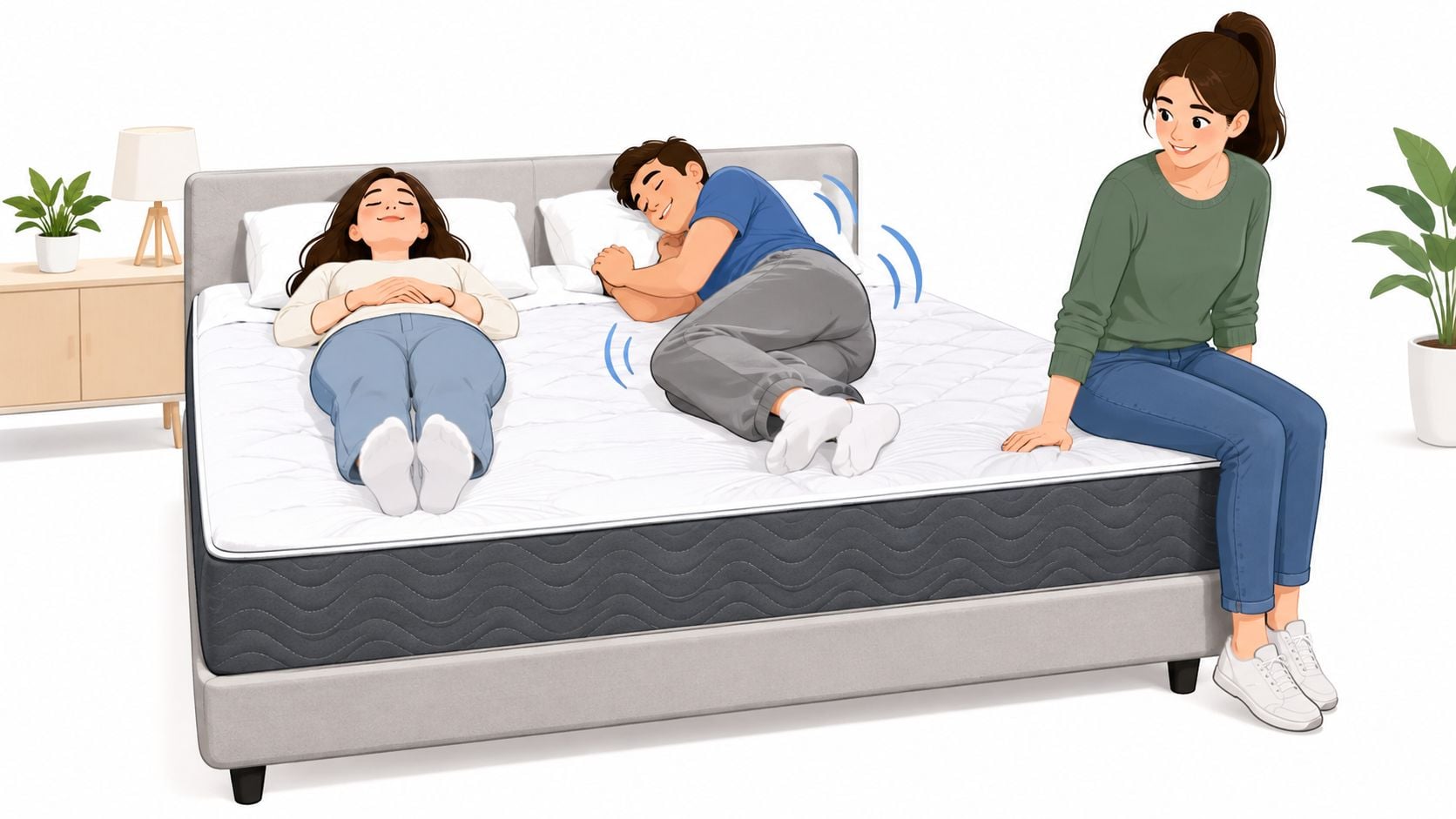
One partner should lie still in a normal sleeping position while the other rolls, sits up, gets into bed, and gets out again. The stationary sleeper should describe both the visible movement and the sensation under the body. A mattress can show surface motion without waking the partner, or appear stable while sending a sharp jolt through the support layers.
Run the movement test in stages
- Stillness first: Both partners lie in their usual positions and identify pressure, support, and heat.
- Rolling next: One sleeper turns from side to back or stomach while the other remains still.
- Entry and exit: One partner sits on the edge, lies down, and leaves the bed while the other listens for disturbance.
- Opposite-side testing: Repeat the process near the perimeter, not only in the center.
- Bottle check: A closed bottle can stand on one side while the other partner sits on the opposite side. If it topples, the surface is transferring significant energy.
The memory foam mattress guide explains why foam comfort layers commonly absorb movement effectively. Consumer Reports also defines mattress stability in terms of how well movement on one side avoids disturbing the other, and reports that foam models generally isolate motion better than innerspring designs. Highly responsive materials can offer easier repositioning and more bounce, but that response may also carry movement farther.
Edge support determines the real sleeping area
Weak perimeter support effectively shrinks a shared mattress. A sleeper who feels the edge collapsing will move inward, reducing space for both partners. Each person should sit on the edge, lie near the perimeter, and push off the side as if getting up in the morning.
Look for reinforced edge foam or wrapped coils that hold their shape. Pocketed coils and traditional memory foam commonly reduce movement transfer, while continuous-coil or bouncier latex designs can feel more responsive. No construction wins every category, so the couple should score each candidate for motion, edge stability, ease of turning, pressure relief, heat, and space.
If one partner can feel the other sit down from the opposite side, the mattress fails the couple's motion test.
A mattress should also be tested for long enough to reveal pressure changes. Couples shouldn't make a final decision after a rushed visit or while testing a bed that remains covered in protective packaging. The pass-or-fail standard is simple: both sleepers need usable edges, comfortable repositioning, and movement that doesn't create meaningful next-day impairment.
Solving the Temperature Tug-of-War
A single mattress marketed as “cooling” won't solve every couple's temperature conflict. Thermal comfort depends on the mattress, bedding, sleepwear, bedroom conditions, body size, and how each sleeper responds to heat. A surface can feel cool at first and still become uncomfortable later, while a material that feels warm to one partner may feel pleasantly insulating to the other.
A 2026 survey reported that nearly two-thirds of couples disagree about bedroom temperature at least sometimes, and 44% of partnered sleepers said they had secretly changed the temperature after their partner fell asleep. The same coverage summarized a review associating each 1°C increase in overnight temperature with roughly 5 to 10 fewer minutes of sleep (temperature conflict coverage). The result is a practical warning: mattress shopping should include a temperature plan, not just a material preference.
Build temperature control in layers
A breathable construction with airflow can help the warmer sleeper, while excessive sink may hold more heat and make repositioning harder. Hybrid designs can combine ventilation from coil systems with cushioning materials, and firmer designs may reduce the body-enveloping effect that some sleepers find warm.
Bedding often provides the easier adjustment. Separate duvets, breathable sheets, individualized covers, and washable toppers let partners customize warmth without replacing the entire mattress. Couples looking for a broader bedding idea can review this resource on a temperature regulating gift from That Blanket Co.
| Sleeper Type | Mattress Feel | Bedding | Add-On |
|---|---|---|---|
| Warm sleeper | Responsive, breathable, and less deeply enveloping. | Moisture-managing sheets and a lighter personal cover. | Airflow-focused topper or individualized mattress cover. |
| Cold sleeper | Supportive with enough cushioning to avoid a chilly, hard feel. | Insulating layers that can be removed independently. | Slightly thicker personal topper or warmer blanket. |
| Temperature-neutral sleeper | Balanced medium-firm comfort with moderate airflow. | Flexible layers that adapt seasonally. | Separate duvets for individual control. |
| Partners with opposing needs | A configuration that limits heat transfer between sides. | Separate bedding is usually more useful than one shared heavy layer. | Individualized covers, toppers, or adjustable ventilation. |
The bedroom also matters. Couples in Upstate New York may experience sharply different conditions between cold winters and humid summers, so seasonal bedding changes deserve attention. The sleep sanctuary guide can help couples coordinate the mattress, lighting, temperature, and bedding instead of asking the mattress to solve every environmental problem.
Shared Bed, Split Feel, or Two Mattresses
The right configuration depends on the size of the comfort gap between partners, not just on the dimensions of the bedroom. Couples should choose the least complicated setup that solves the actual problem. A shared mattress is often enough when both sleepers can agree on support, but a split design makes more sense when one person's comfort consistently harms the other's sleep.
Four configurations deserve a close comparison
| Configuration | Best For | Pros | Watch Outs |
|---|---|---|---|
| Shared mattress | Couples with compatible firmness and temperature needs. | Unified surface, simple appearance, and straightforward bedding. | One comfort level must serve both sleepers. |
| Split firmness | Partners who differ by roughly one comfort level but want one bed. | More individualized feel while preserving a shared frame and overall look. | The center transition can be noticeable, and edge support must be checked. |
| Adjustable base | Couples who want independent elevation for reading, snoring, or reflux concerns. | Each side can change position without forcing the other side to move. | Both partners still need to agree on the underlying mattress feel. |
| Split king with two twin XL mattresses | Partners with substantially different firmness, motion, or temperature needs. | Strongest separation between the two sleep systems. | The center gap, separate toppers, bedding, and frame compatibility require attention. |
A shared mattress remains the cleanest choice for couples who value closeness and can agree on a medium-firm range. It also avoids a visible center seam and makes sheet changes simpler. The trade-off is that both partners accept the same primary comfort surface.
Split firmness works when the disagreement is real but limited. Each side can provide a different feel while the couple keeps a unified bed and headboard. The center area deserves careful testing, especially for couples who sleep close together or frequently move across the full surface.
An adjustable base is useful for independent elevation, but it isn't a substitute for compatible comfort. If one partner needs a softer surface and the other needs a much firmer one, elevation alone won't resolve pressure or support problems. A split king creates the clearest separation and can reduce cross-bed disturbance, though it sacrifices the feel of one mattress.
Let the gap dictate the purchase
Decision rule: Choose a shared mattress when preferences overlap, split firmness when they are close, and separate mattresses when one person's requirements consistently undermine the other's sleep.
Couples should inspect the frame rating, center gap, perimeter support, and actual mattress dimensions. A larger sleep surface may preserve each sleeper's space, but firmness and pressure relief still need to be evaluated separately. Configuration solves disagreement only when the underlying components are matched to each sleeper.
Using the Showroom Bed Match to Make the Final Call
A showroom visit should end with a short, documented comparison rather than a vague feeling that one bed “seemed nice.” Couples should bring their pre-shop notes, identify three models to test, and ask the consultant to compare the strongest candidates using the same positions and movements.
At Tip Top Furniture & Mattresses, the bed matching system is designed to provide personalized recommendations for support and comfort. The family-owned Freehold showroom has served local homeowners since 1978, with professional design services available since 1984. That local expertise can be useful for couples from Freehold and the Greater Albany Capital Region who want mattress guidance alongside bedroom furniture, flooring, décor, delivery, financing, or custom planning.
Use a repeatable final comparison
Each couple should follow the same sequence on the final candidates:
- Lie down together in the positions used at home, including side, back, stomach, or combination sleeping.
- Stay still long enough to assess shoulder, hip, and lower-back pressure rather than judging only the first impression.
- Repeat the movement test with rolling, sitting, entering, and leaving.
- Test the edges separately, since a mattress can perform well in the center but feel unstable around the perimeter.
- Compare heat and space while both sleepers are in their normal positions.
- Ask for construction details, including the comfort layers, support core, coil design, edge reinforcement, foundation requirements, and adjustable-base compatibility.
The consultant's recommendation should explain why the mattress fits both sleepers. It shouldn't rely only on a firmness name. Couples should ask how the layers create pressure relief, how the support core limits sagging, and whether the expected feel changes significantly with body size or sleeping position.
Treat the home trial as the real test
A showroom can identify promising candidates, but real sleep happens through changing schedules, restless nights, seasonal temperatures, and ordinary morning routines. Couples should confirm the exchange or home-trial policy before purchasing and use the trial period deliberately.
They should sleep in their normal positions, test both weekday and weekend routines, and pay attention to morning stiffness, pressure, overheating, and movement-related waking. The decision should be based on repeated comfort for both sleepers, not on which bed felt most impressive during a brief visit.
The retailer's broader selection can also support a complete bedroom project. USA-made mattresses and sleep accessories, bedroom furniture, Amish furniture handcrafted in the USA, custom ordering, flexible financing, delivery, and clearance inventory give homeowners options when the mattress purchase connects to a larger room update. The store works with more than 50 trusted manufacturers, so couples can assess sleep comfort alongside the bed frame, storage, and room layout rather than treating each decision in isolation.
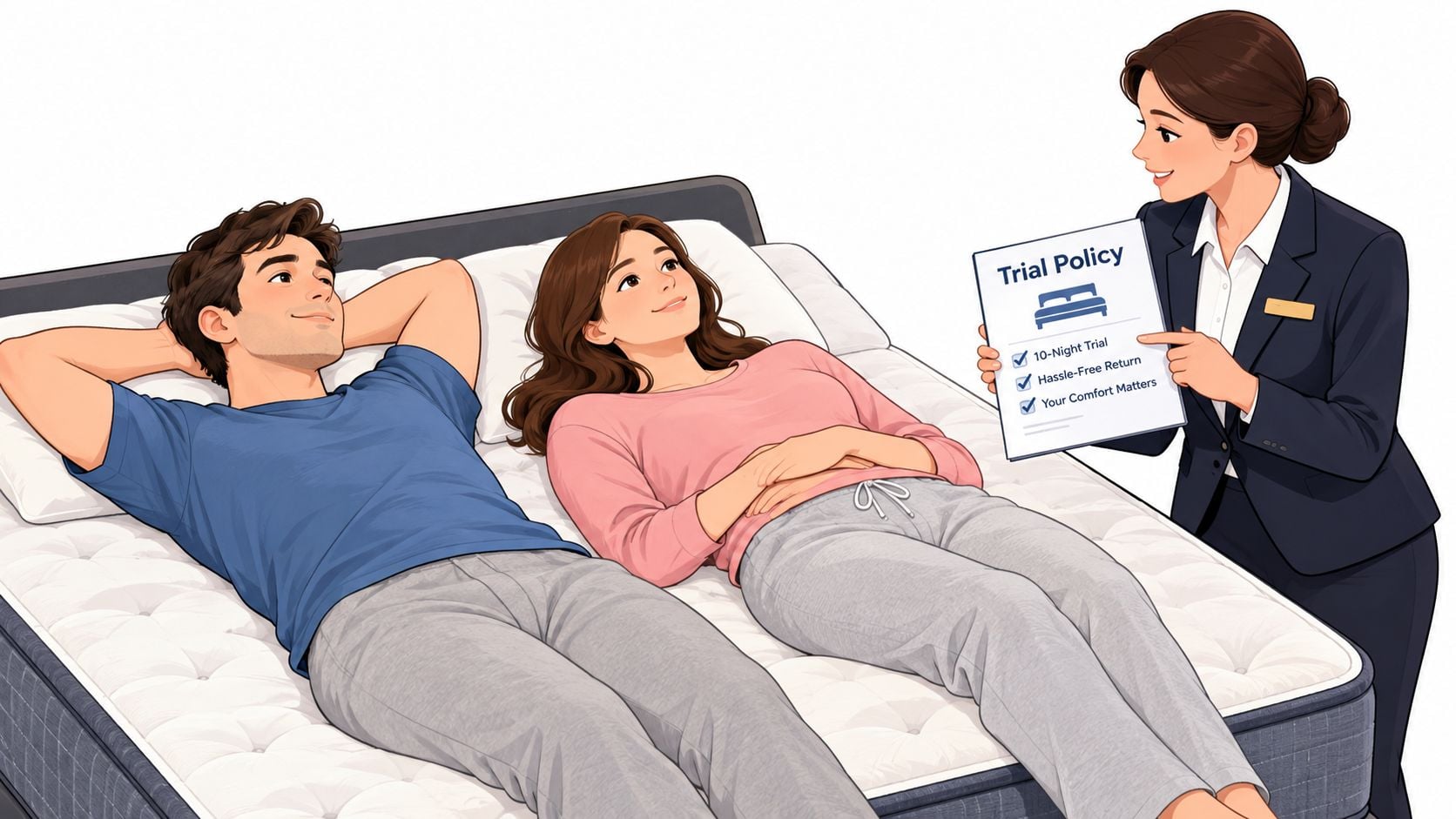
A successful appointment has a clear outcome. The couple should leave with a preferred model, a backup model, a written explanation of the firmness and construction, and a policy for exchanging the mattress if either sleeper develops persistent discomfort. That is how to choose a mattress for couples without turning bedtime into a nightly negotiation.
Couples in Freehold, Albany, Schenectady, Troy, and across the Greater Albany Capital Region can bring their sleep checklists to Tip Top Furniture & Mattresses, where personalized bed matching, USA-made mattresses, delivery, flexible financing, and bedroom design support are available in one family-owned showroom. Schedule a mattress visit, test the leading candidates together, and choose a sleep system that gives both partners a fair share of the bed.