Amish Made Bedroom Furniture: A Smart Buyer’s Guide


A Capital Region homeowner can spend an afternoon comparing bedroom furniture and leave with more questions than answers. One dresser looks attractive online, another feels substantial in a showroom, and the price difference can seem hard to justify until drawer bottoms sag, veneers peel, or hardware loosens after regular use. That's where Amish-made bedroom furniture deserves a closer look, not as a romantic idea, but as a practical construction choice.
The right piece can deliver solid hardwood, traditional joinery, made-to-order dimensions, and a finish selected for the room. The wrong purchase can still leave a buyer paying for a name while overlooking hidden panels, delivery timing, or a style that no longer fits the home. Buyers near Albany, Schenectady, Troy, Greene County, and the wider Capital Region need a clear view of both sides.
Why More Albany Homeowners Are Looking at Amish Made Bedroom Furniture
A homeowner near Albany stands in a bedroom showroom with two dressers in front of her. One is a flat-pack model priced at $899. The other costs nearly four times as much, but its solid hardwood top, carefully fitted drawers, and substantial frame make the comparison less simple than a price tag suggests.
The less expensive dresser may work for a short-term move or a guest room. For a primary bedroom, however, repeated replacement can become its own expense and inconvenience. Many households are tired of peeling veneers, sagging drawer bottoms, loose cam locks, and case goods that can't survive another move.
That frustration has pushed more Capital Region shoppers toward furniture built around repairability, longevity, and personal ownership rather than quick replacement. The wider Amish furniture tradition has roots in Pennsylvania communities dating to the late eighteenth century, and historians note that the style gained broader recognition by the 1920s as early American folk art became valued for its plain, handcrafted character. The history of Amish furniture helps explain why understated construction remains central to the category.
The value sits inside the case
A solid-wood bed or dresser isn't valuable only because it looks traditional. Value also hides in:
- Material depth: Hardwood components can feel more stable and substantial than thin composite panels.
- Joinery: Mechanical wood joints can handle everyday stress more effectively than basic butt joints held mainly by fasteners.
- Future flexibility: Made-to-order pieces can accommodate unusual room dimensions, matching requirements, or a preferred finish.
- Ownership horizon: A well-built bedroom suite can remain useful through moves, room changes, and family handoffs.
The category is also far from isolated. An independent directory lists more than 400 Amish furniture stores across 31 states, including 41 stores in Pennsylvania. Online retail analytics estimated $25 million in aggregate 2025 sales for Amish Furniture and Handmade Craft, with a projected 10% to 20% rebound in 2026 after a projected 10% to 20% decline in the prior year. Those figures point to an active modern market, not merely a historic craft preserved in a few rural shops. Industry and market context for Amish furniture
For shoppers seeking Amish furniture near Albany, NY, the Amish furniture selection serving the Capital Region offers a local starting point for seeing materials and proportions in person.
What Amish Made Bedroom Furniture Really Means
“Amish-made” describes how furniture is produced and where its craft tradition comes from, not one mandatory design style. Amish woodworking shops commonly build pieces through hands-on methods, often using solid hardwoods and traditional joinery. The furniture may look mission, shaker, farmhouse, contemporary, or transitional depending on the builder and the order.
The visual language developed over time. Early Amish furniture traditions emerged in Pennsylvania, including Lebanon County, Lancaster County, and nearby communities, with earlier influences that included painted Germanic forms and more decorated pieces. The work associated with Lancaster County maker Henry Lapp helped move the style toward an undecorated appearance, emphasizing wood grain, proportion, clean lines, and visible construction.
A practical way to read the label
Buyers should separate heritage from assumptions:
- Ask where the piece was built. A dealer should be able to explain the workshop or production source.
- Identify the actual materials. “Wood furniture” can mean solid hardwood, veneer, plywood, MDF, or particleboard.
- Inspect the construction. Open the drawers, look underneath the case, and examine the bed rail connections.
- Confirm the dealer's role. Many shoppers purchase through a showroom or dealer rather than directly from the individual craftsperson.
That last point matters. A dealer does more than display finished furniture. The dealer often translates a customer's preferred dimensions, wood species, stain, hardware, and delivery requirements into a workable order for the builder.
The understated appearance also has a practical advantage. Clean profiles and restrained ornamentation can work with painted walls, upholstered accents, modern lighting, and changing bedding without forcing an entire bedroom into one period look. Buyers can learn more about the distinction between appearance and construction through Amish furniture quality guidance.
What the term doesn't guarantee
The label alone doesn't guarantee that every hidden component is solid hardwood, that every drawer uses dovetails, or that every finish suits a low-emission bedroom. A careful purchase depends on specifications, not assumptions.
Dealer question: “Which parts are solid hardwood, which parts are plywood or composite material, and what joinery is used in each high-stress area?”
How Quality Amish Bedroom Furniture Is Built
Construction separates a durable bedroom piece from a convincing imitation. The buyer's attention should go first to wood species, joint design, drawer construction, and finish chemistry, not decorative details.
Premium North American hardwoods commonly used in the category include oak, cherry, maple, and walnut. Quartersawn white oak is another option buyers may encounter, especially when a more pronounced grain pattern and traditional character are desired. Solid hardwood allows a builder to adjust dimensions and details without depending entirely on veneer over an engineered-board substrate.
Three details deserve a showroom inspection
Solid hardwood species affect appearance, hardness, weight, and cost. Oak provides a pronounced grain and familiar durability. Maple has a cleaner, more even appearance. Cherry develops a warmer character over time, while walnut offers a deeper, richer visual tone.
Dovetail drawer joints interlock the drawer sides and front rather than relying only on fasteners or adhesive. That geometry gives the connection more wood-fiber contact and helps resist the repeated pulling and closing that causes weak drawers to loosen.
Mortise-and-tenon construction connects one wood member through a fitted opening in another. Bed rails and frame components benefit from this approach because the joint can distribute stress through the structure instead of concentrating it at a small fastener point. An explanation of mortise-and-tenon joinery can help buyers recognize the terminology before a showroom visit.
Finish quality matters too
A hand-finished surface may use a durable conversion varnish or a hand-rubbed oil, depending on the builder and the desired look. A quality finish should protect the wood from ordinary moisture and household contact while allowing the grain to remain visible.
Before ordering, buyers should ask:
- Drawer box species: Is the drawer box made from the same hardwood as the face?
- Bottom panel thickness: Is the bottom substantial enough for clothing, linens, or heavier storage?
- Back and interior materials: Are the back panels and case interiors solid wood, quality plywood, MDF, or particleboard?
- Finish type: Is the finish selected for durability, low emissions, or a particular sheen?
- Hardware connection: Are pulls and slides replaceable if a component eventually wears?
A solid top paired with composite drawer bottoms isn't automatically a bad product, but it should be priced and described accurately. The construction details determine whether the buyer is receiving a true heirloom-grade case or only a solid-looking exterior.
Does Traditional Amish Style Still Match Modern Bedrooms
Traditional Amish furniture doesn't have to mean a dark, heavily proportioned bedroom set. In fact, buyers planning a long ownership period should question whether a traditional finish and oversized profile match the room they want today and the room they may want later.
Current bedroom direction favors lighter finishes, softer organic shapes, mixed textures, and coordinated storage. Natural oak, maple, and whitewashed tones can make a room feel more open. Shaker headboards and gently curved bed posts soften the visual weight without abandoning solid wood construction.
Style choices that age well
Classic mission and shaker profiles remain dependable anchors because their lines are restrained. They can support a room with woven textiles, painted nightstands, upholstered benches, or contemporary lamps. A bedroom doesn't need every piece to come from one matching set.
A practical combination might include:
- One statement Amish bed in a lighter finish.
- Painted or upholstered companions to reduce visual heaviness.
- A solid wood dresser selected for storage and construction rather than a perfectly matched stain.
- Textured bedding and window treatments that keep the room from feeling like a showroom display.
This approach protects the investment from a common mistake, buying a full suite in a highly specific style that may feel dated before the furniture shows meaningful wear. The furniture's durability can outlast the room's first design direction by many years.
Longevity includes visual flexibility
A buyer who expects to keep a suite for decades should consider resale appeal, future renovations, and changing household preferences. A lighter finish may coordinate with more paint colors and flooring choices than an extremely dark stain. A simple headboard may also adapt more easily when bedding, lighting, or wall treatments change.
That isn't a criticism of Amish craftsmanship. It's a decision about the buyer's taste horizon. Someone who loves a formal, traditional bedroom should order it with confidence. Someone who wants flexibility should choose a straightforward profile, restrained hardware, and a finish that won't dominate every future decorating decision.
Customization Options Worth Knowing Before You Order
Customization is one of the strongest reasons to consider Amish-made bedroom furniture, but customization isn't free in time or complexity. Each decision affects the build, the finish schedule, the price, or all three.
Wood species comes first. Oak, brown maple, cherry, quarter-sawn white oak, and walnut create different grain patterns and visual weight. Brown maple can offer a softer, more approachable appearance and may be less costly than premium species, but softer wood can show dents more readily in active households.
Choices that shape the finished room
Stain selection ranges from light natural tones to deeper espresso colors. Paint, glaze, distressing, and two-tone combinations can shift a piece from traditional to farmhouse or transitional. Hardware also changes the character, with wood knobs creating a quieter look and metal pulls adding contrast.
Sizing may be the most valuable customization. Buyers can ask about:
- Non-standard mattress dimensions
- Taller or shorter headboards
- Storage beds
- Extra drawer capacity
- Narrower cases for tight rooms
- Matching pieces for furniture already owned
Some sellers invite customers to submit dimensions, descriptions, and stain colors for a quote, while others use a structured process in which the buyer selects wood, stain, and finish before the shop begins. Custom-order planning guidance gives buyers a useful framework for organizing those decisions.
Customization choices and their impact
| Customization Option | Typical Cost Impact | Typical Lead Time Impact |
|---|---|---|
| Standard wood and catalog finish | Lower relative cost | Usually the simplest production path |
| Premium wood species | Higher relative cost | May require additional material scheduling |
| Custom stain or specialty finish | Higher relative cost | Can add finishing time |
| Custom dimensions | Higher relative cost | Requires revised shop planning |
| Matching an existing piece | Higher relative cost | Matching and approval can extend production |
| Storage or modified configuration | Higher relative cost | Additional construction can lengthen the order |
Buyers should approve physical wood and finish samples before signing. Mid-build changes can force the shop to revise materials or restart a finishing sequence, which resets expectations and creates avoidable delays.
Realistic Pricing and Lead Times for Amish Bedroom Sets
Amish bedroom furniture belongs in a serious budget conversation. The exact price depends on wood species, dimensions, configuration, hardware, finish, and the dealer's delivery terms. A buyer should request a written quote that separates furniture, customization, delivery, assembly, and any removal service.
The commonly cited planning ranges below are useful as budgeting guidance, not guaranteed retail quotes. They reflect the broad pricing information available for Amish bedroom furniture and should be confirmed for the selected builder and configuration.
Pricing and lead time ranges for Amish bedroom pieces
| Piece | Typical Price Range (USD) | Typical Lead Time (Weeks) |
|---|---|---|
| Queen bed | $1,000 to $3,000 | 8 to 14 |
| King bed | Above the comparable queen configuration | 8 to 14 |
| Dresser | $1,200 to $3,500 | 8 to 14 |
| Chest | Varies by size and configuration | 8 to 14 |
| Nightstand | $400 to $1,000 | 8 to 14 |
| Mirror | Varies by frame and size | 8 to 14 |
| Bedroom set package | $3,000 to $8,000 | 8 to 14 |
The ranges for beds, dressers, nightstands, and packages come from an independent Amish furniture pricing guide, which outlines common bedroom furniture costs. The lead-time range is a practical planning band for standard pieces, but a fully customized or matched suite can take longer.
The delivery schedule needs honest attention
Furniture-trade reporting placed the median order-to-delivery cycle at 16.3 weeks in Q2 2024, compared with 11.8 weeks in Q4 2022, with material bottlenecks involving FSC-certified hardwood veneers, water-based coatings, and compliant foam suppliers. Furniture trade lead-time reporting shows why a promised delivery window deserves specific discussion.
Custom sizing, specialty finishes, and matched suites can extend production into a longer schedule. Rush service is uncommon and may cost more when available. Buyers in Albany and the surrounding Capital Region should also ask whether delivery includes in-home placement, assembly, stair handling, and old furniture removal. Flexible financing can make a complete bedroom project easier to manage, including Synchrony HOME promotional terms of 6 months on purchases from $299 to $1,998.99 and 12 months on purchases of $1,999 or more, with select participating locations offering terms up to 60 months on qualifying purchases. Synchrony HOME financing information provides the published terms, while shoppers should confirm availability with the participating dealer.
Caring for Solid Wood Bedroom Furniture the Right Way
Solid wood rewards sensible care, not complicated rituals. The biggest household variable is moisture in the air. Keep indoor relative humidity between 35% and 45% throughout the year to reduce the risk of seasonal cracking, warping, and stress at wood joints.
A small hygrometer can show whether the bedroom needs more or less moisture control. A humidifier may help during dry winter conditions, while a dehumidifier can help in summer. Beds and dressers should also stay away from direct sunlight, heating vents, and exterior walls that experience sharp temperature changes.
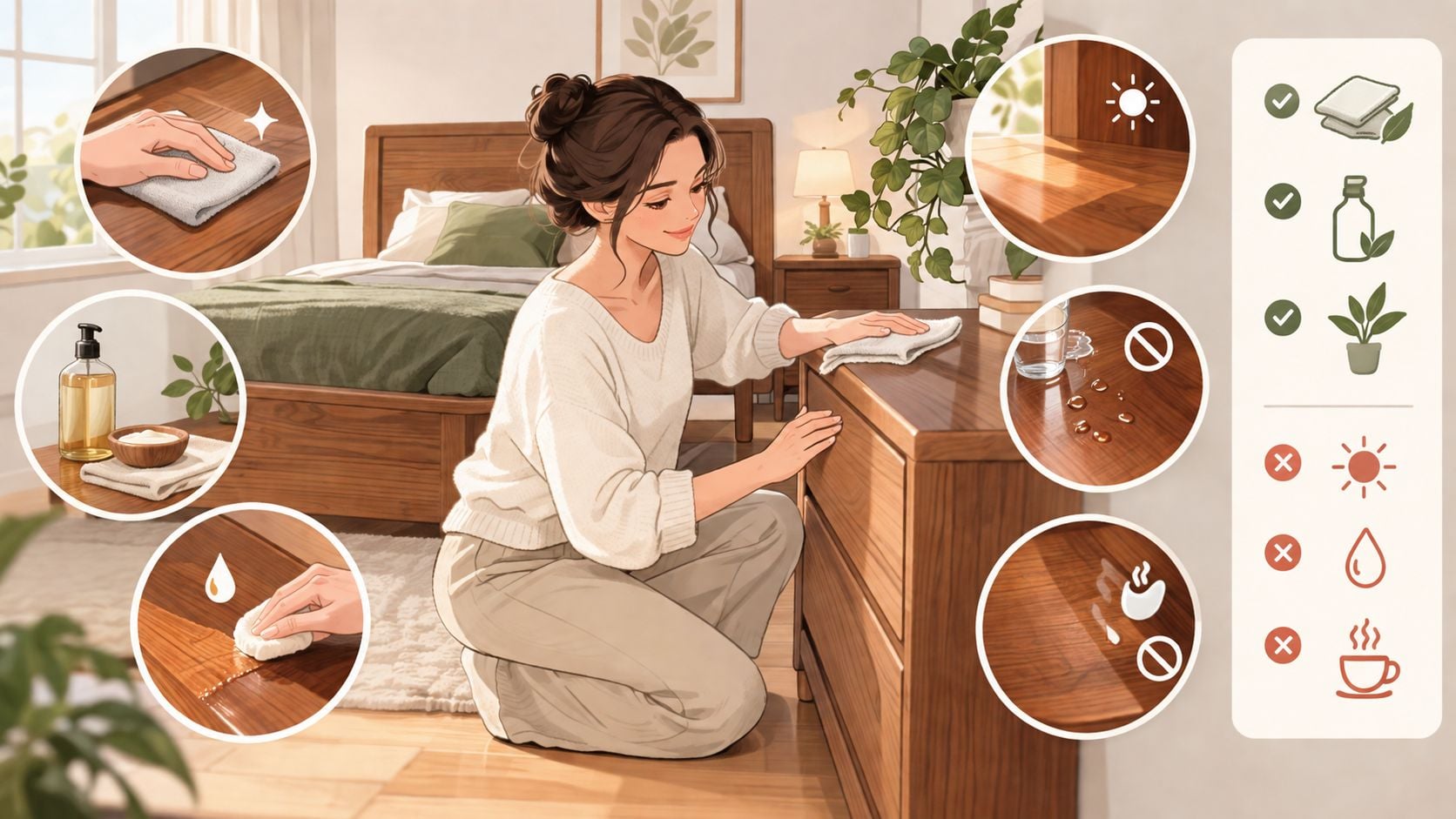
A simple maintenance routine
- Dust weekly: Use a soft, lint-free cloth rather than an abrasive cleaner.
- Clean seasonally: Use mild soap and water sparingly, then dry the surface immediately.
- Protect the finish: Condition solid tops annually with paste wax or the manufacturer-recommended oil.
- Check the structure: Rotate the mattress and inspect bed hardware each year.
- Control exposure: Keep cosmetics, standing water, and harsh household chemicals off finished surfaces.
Buyers who want a plain explanation of the material can review what solid wood furniture means before comparing construction claims. The more important purchasing question is whether hidden surfaces follow the same standard as visible ones.
Don't overlook hidden panels
Formaldehyde concerns usually come from adhesive resins in engineered panels such as particleboard and MDF, not from solid wood itself. U.S. CARB limits apply specifically to composite wood products, including 0.05 ppm for hardwood plywood, 0.09 ppm for particleboard, 0.11 ppm for MDF, and 0.13 ppm for thin MDF. Indoor-air-quality guidance on formaldehyde and furniture explains why concealed components deserve attention.
Ask whether drawer bottoms, backing panels, and case interiors are solid wood, low-emission compliant material, or standard composite board. A mostly solid-wood bedroom set can still contain hidden panels that change the indoor-air-quality picture. More wood-specific care guidance is available through wood furniture maintenance instructions.
Bringing Your Bedroom Project Home with Local Help
A showroom visit turns a catalog decision into a physical inspection. Buyers should open and close every drawer, examine the grain, feel the edge profile, compare finish samples, and sit against the bed's headboard. Photographs can't show the full weight, surface feel, or movement of a drawer box.
Measurements should travel with the shopper. Record the room dimensions, doorway widths, stair turns, elevator limitations, and ceiling heights before ordering. A beautiful bed still creates a problem if the delivery team can't handle the last turn into the bedroom.
Questions to settle before payment
- Delivery: Is placement inside the home included?
- Assembly: Who assembles the bed and checks the hardware?
- Protection: What preparation protects floors, walls, and door frames?
- Removal: Can the old bedroom set be removed?
- Timing: What production and delivery window appears in writing?
- Changes: What happens if the order is delayed or a finish needs correction?
- After-sale support: Who handles warranty questions, touch-up needs, or future matching pieces?
A local dealer can coordinate those details while also helping with the rest of the room. Tip Top Furniture & Mattresses is a family-owned Freehold, NY showroom serving Albany, Schenectady, Troy, Greene County, and the broader Capital Region since 1978, with professional design services available since 1984. Its one-stop selection includes bedroom furniture, USA-made mattresses, décor, flooring, custom ordering, financing, and clearance inventory, with products from more than 50 trusted manufacturers.
A bedroom project shouldn't stop at the bed frame. A design consultant can coordinate wood tones with flooring, select a mattress through a bed-matching system, and use room-planning tools to verify scale before an order is placed. That local accountability is especially useful when a made-to-order piece requires a finish correction, a delivery adjustment, or a future companion piece.
Visit Tip Top Furniture & Mattresses in Freehold, NY to compare Amish bedroom furniture, solid-wood construction, mattress options, flooring, and finish samples with local guidance. Bring room measurements and a preferred delivery window, then ask about custom ordering, flexible financing, and clearance pieces that may fit the project sooner.