Natural Wood Dining Tables: A Buyer and Care Guide for 2026


A shopper in the showroom can stand between two dining tables that look nearly identical, then discover a $1,200 price difference. The cheaper table may have the right color and silhouette, but the questions underneath matter more than the first impression. Is the top solid wood or a thin surface over an engineered core? What happens when a child spills juice, a chair catches the edge, or Upstate New York's dry winter air pulls moisture from the boards?
Natural wood dining tables reward buyers who look past the finish sample. The right table can be repaired, refinished, resized, and passed through a household for decades. The wrong table can swell near a sink, chip along a veneer edge, or demand replacement when the trend that sold it has already faded.
For homeowners in Freehold, Albany, Schenectady, Troy, Greene County, and the wider Capital Region, the buying decision comes down to more than style. Species, construction, finish, dimensions, lighting, humidity, maintenance, delivery, and custom options all determine whether the table becomes a daily pleasure or an expensive regret.
Why a Natural Wood Dining Table Is Worth Thinking About
The price gap between two attractive tables often reflects what sits beneath the finish. A solid hardwood top has material running through its full thickness, so a qualified refinisher can address wear rather than hiding it. Veneer and engineered construction can also be well made, but chipped edges, swollen fiberboard, and peeling surfaces are harder to restore cleanly.
That repair path is the central reason a natural wood dining table earns serious consideration. A properly constructed top can be sanded and refinished instead of discarded when years of meals, homework, holiday gatherings, and everyday clutter leave their marks. The grain remains visible, and many species develop a deeper, warmer character as the surface ages.
Showroom rule: If a table is expected to serve a family for years, the repair plan matters as much as the first-day appearance.
The cheaper alternative can carry hidden costs. A veneer edge that chips may need specialized repair, while an MDF or particleboard core can swell after repeated exposure to spills or damp cleaning. A fashionable raw-looking finish may photograph beautifully but show fingerprints, heat marks, and red sauce more readily than a protective finish.
What the price difference can buy
A more substantial table may provide:
- A serviceable surface: Solid wood can offer a practical path to sanding, color adjustment, and refinishing.
- Better long-term character: Natural grain and tone can mature rather than peel away like a decorative surface.
- Stronger emotional value: A well-built table becomes part of family routines, not just another replaceable item.
- More useful customization: Buyers can often select wood, dimensions, edge treatment, base style, and finish together.
Natural wood has anchored dining furniture for centuries. Earlier Western tables commonly used boards on trestles, while dedicated dining-room furniture became more established by the 16th century. By the 17th century, dining rooms commonly contained a table and a small number of chairs, with oak, pine, and cherry among the straightforward woods used for tables. Extendable tables with leaves and more refined leg styles emerged by the late 18th century. This history of dining tables across six centuries helps explain why wood still feels appropriate in both traditional and contemporary homes.
A buyer should leave the showroom able to answer seven questions: which species fits the household, how the top is built, which finish suits daily use, what size fits the room, how the table relates to existing pieces, what climate controls it needs, and who will help if the table requires service later. Those answers matter more than a passing trend.
Choosing the Right Wood Species for Your Home
Species selection starts with household behavior, not color alone. A quiet dining room with careful adult use can accommodate a more delicate surface, while a home with children, pets, craft projects, and cast-iron cookware needs a wood that disguises everyday contact and accepts occasional repair.
Match the species to the room
Oak remains the practical default for good reason. Its visible grain gives minor marks somewhere to hide, and its familiar tone works with farmhouse, traditional, and transitional rooms. Hickory brings more contrast and visual movement, making it a strong choice for buyers who want a durable, expressive surface rather than a uniform one.
Maple has a tighter, calmer grain and a lighter appearance. It suits homes that want a clean surface, and it can accept an even stain when the finish is applied carefully. Maple also works well in rooms where a darker table would feel visually heavy.
Walnut is for the buyer who wants depth and is comfortable paying for it. Its darker tone creates a strong centerpiece, though sunlight and age can change the appearance over time. Samples should be viewed in the actual room light before a final selection.
Cherry rewards patience. Its color changes as it ages, so a new table may look different after years of exposure and use. That developing patina appeals to buyers who want furniture with a sense of continuity rather than a permanently fixed showroom color.
Ash offers a lighter domestic hardwood look with noticeable grain. It can bridge modern and relaxed interiors, especially where the floor and wall colors already provide visual warmth.
| Species | Janka Hardness | Typical Tone | Best For |
|---|---|---|---|
| Oak | Ask the showroom for the tested value of the selected variety | Light to medium, visible grain | Busy households and classic interiors |
| Maple | Ask for the tested value of the selected variety | Light, tight grain | Clean rooms and even stain colors |
| Walnut | Ask for the tested value of the selected variety | Deep brown, rich variation | Statement tables and darker palettes |
| Cherry | Ask for the tested value of the selected variety | Warm reddish-brown that develops with age | Traditional rooms and patina-minded buyers |
| Hickory | Ask for the tested value of the selected variety | Light with strong contrast | Rustic rooms and active family use |
| Ash | Ask for the tested value of the selected variety | Pale to medium, open grain | Airy modern and transitional spaces |
The Janka hardness rating is useful only when tied to real life. A harder species generally makes sense for kids, pets, frequent entertaining, and craft work, but hardness doesn't make a tabletop immune to dents or finish damage. A softer wood can still be an excellent choice when the buyer accepts a lived-in surface and chooses a repairable finish.
Softwoods and reclaimed boards deserve direct questions. Softwood can bring a relaxed, marked-up character, while reclaimed material may contain variation, old fastener locations, or a more uneven surface. Tight-grain domestic hardwoods are often the safer starting point for homes that move from dry winters to humid summers. For a deeper species discussion, the guide to the best wood for tables gives buyers another way to organize the decision before visiting the Freehold showroom.
Construction and Finishes That Hold Up Over Time
A table's construction determines whether the surface stays stable and the base stays tight. The finish determines how the table feels, how quickly daily damage appears, and how easily a professional can restore it.
Compare the top and the joinery
Solid wood offers the strongest refinishing path, but it moves with indoor conditions and requires a builder who allows that movement. High-quality veneer over a stable substrate can resist some environmental changes more predictably and may deliver a uniform appearance. Engineered-core furniture isn't automatically poor quality, but buyers should know whether the core can tolerate moisture and whether damaged edges can be repaired.
The base deserves equal scrutiny. Mortise-and-tenon joints and carefully fitted aprons provide substantial mechanical support. Dovetailed aprons can add strong interlocking connections. Metal corner brackets can reinforce a properly designed structure, but cheap knock-down hardware often loosens under repeated assembly, movement, and leaning.
| Option | Durability | Repair Path | Climate Behavior |
|---|---|---|---|
| Solid wood top | Strong long-term potential when properly built | Can be sanded, repaired, and refinished | Moves with humidity and needs allowance for expansion |
| High-quality veneer | Stable appearance with a good substrate | Surface repairs are more limited | Often less movement than a solid top, but edges remain vulnerable |
| Engineered core | Depends heavily on materials and edge protection | Swelling and core damage can be difficult to reverse | Moisture exposure can cause serious deterioration |
| Hand-fitted wood joinery | Supports long-term structural service | Individual joints may be repaired | Must accommodate natural wood movement |
| Basic knock-down hardware | Convenient for assembly, less convincing over time | Loose hardware may need replacement or tightening | Seasonal movement can expose weak connections |
Choose the finish for actual meals
Conversion varnish creates a durable, professional surface with good resistance to routine spills and wear. Repairs may require a skilled refinisher because the coating is harder to blend casually.
Catalyzed lacquer can feel smooth and refined while offering practical protection. It generally behaves better as a finished film than an oil-only surface, though damage still requires the correct repair approach.
Hand-rubbed oil leaves the wood feeling natural and makes spot maintenance more approachable. It also asks more from the household, especially around standing water, hot dishes, food dyes, and seasonal dryness.
Hardwax oil sits between a penetrating oil and a more protective surface treatment. It preserves tactile grain while allowing localized maintenance, but it still needs regular attention in a heavily used dining room.
Polyurethane provides a protective film that suits families seeking lower daily maintenance. A damaged area can be harder to blend invisibly, but the finish handles ordinary use more comfortably than an unprotected top.
The guide to custom wood finishes helps shoppers compare finish choices before selecting a custom piece. The question to ask a salesperson is simple: “If this top gets a deep scratch or water mark, what is the approved repair method?” A confident answer should identify the finish, the maintenance products, and the point at which a professional should handle the work.
Sizing Your Table So Chairs, Walkways, and Plates Fit
A table should be sized from the room outward, not from a favorite tabletop inward. Start by measuring the usable footprint and subtracting 36 inches of walkway clearance on every side that opens to traffic. That space protects circulation around chairs, doors, cabinets, and serving routes.
A pulled-out chair needs about 24 inches behind it, while a seated diner needs roughly 24 inches of elbow and plate room. That makes a practical planning depth of about 48 inches per place setting, though the actual room arrangement still depends on chair width, wall openings, and how often the table expands.
Use the shape to solve the room
Rectangular tables usually provide the most efficient seating along long walls. A 60-inch rectangle seats six, while a 72-inch rectangle seats six to eight comfortably when the room provides adequate clearance. A 48-inch round table squeezes four, making it useful for a compact breakfast area but less suitable for larger gatherings.
| Table Shape | Seats Comfortably | Typical Size | Min. Room with 36-inch Walkways |
|---|---|---|---|
| Rectangle | Six | 60 inches long | Add 72 inches to length and width |
| Rectangle | Six to eight | 72 inches long | Add 72 inches to length and width |
| Round | Four | 48 inches diameter | Add 72 inches to diameter in both directions |
| Oval | Varies by length | Confirm with the showroom | Add 72 inches to the overall footprint |
| Extendable | Varies by closed and open size | Measure both configurations | Add 72 inches around the open footprint |
Round and oval tops improve conversation and soften tight corners, but their curved perimeter can make serving space less predictable. Extendable tables solve holiday seating only when the leaves can open fully. A nearby hutch, wall, radiator, or pendant location can make an otherwise suitable table unusable at full length.
A rug should extend far enough to keep chair legs supported when diners pull back. Tables jammed against walls create the same problem, because the person on the wall side loses comfortable access and the chair scrapes the finish.
For additional guidance on choosing chairs and preserving an heirloom dining setting, these heirloom dining furniture tips from Lewis and Sheron Textiles provide useful context. Before visiting Tip Top's Freehold showroom, homeowners should tape the proposed tabletop on the floor at home, then place temporary chair outlines around it. The dining table size guide can help organize those measurements before a purchase.
Matching Style to Flooring, Lighting, and Existing Pieces
A table doesn't live in isolation. Flooring, cabinet wood, wall color, chair fabric, and pendant lighting all change how the tabletop reads. A finish that looks warm in a showroom can appear orange against a red-toned floor, while a pale wood can disappear beside light flooring without enough contrast.
Farmhouse trestle and pedestal bases pair naturally with wide-plank oak or distressed hickory floors. Warm pendant lighting supports that relaxed combination, especially when the room already contains woven textures and traditional hardware. The table should look grounded, not like a separate trend display.
Modern slab tables work better against smooth concrete, large-format tile, or matte hardwood. Light maple and whitewashed bases can keep the room open, while cooler lighting supports a cleaner, more architectural effect. The goal isn't to match every surface. It's to control the contrast.
Use established shapes when the room already has a language
Traditional turned-leg and Parsons silhouettes are reliable partners for cherry or mahogany cabinetry. They reinforce the existing vocabulary without demanding a complete redesign. Mid-century tapered legs can bridge modern and traditional pieces, especially when the room includes both sleek seating and older case goods.
Lighting can expose a poor finish choice. A matte or unfinished top beneath a bare bulb will reveal fingerprints, dust, and uneven sheen. A linen drum shade softens the light and makes the same surface more forgiving.
Trend-led decisions often fail because they ignore those relationships. Natural grain may be fashionable, but the right question is whether the wood supports the floor, lighting, and furniture already in place. A showroom visit should include a finish sample held beside a flooring sample and viewed under more than one light source.
Care, Climate, and Repair for Real Family Use
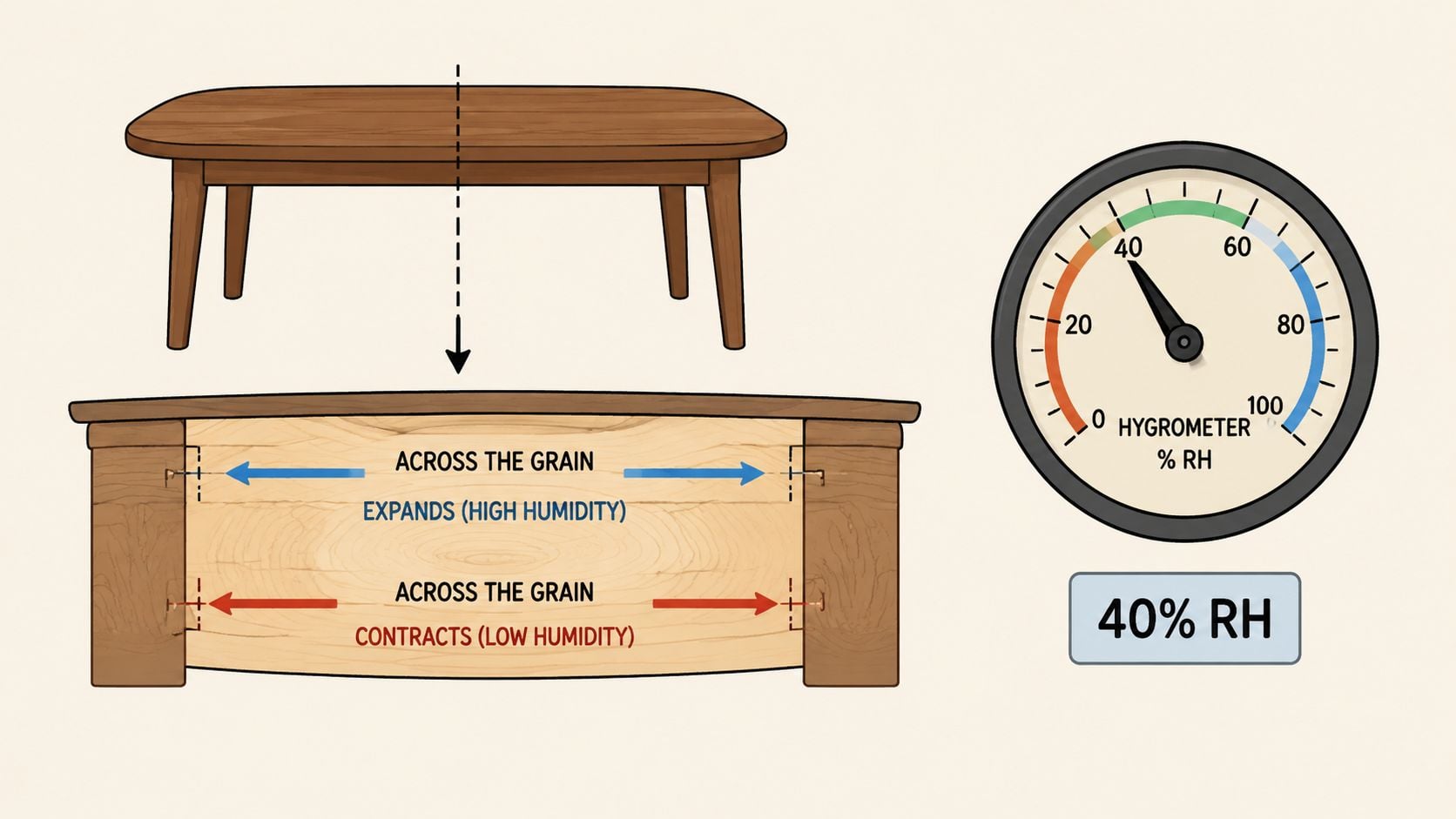
Climate is the first maintenance decision. Wood expands in humid air and contracts in dry conditions, so indoor relative humidity drives many problems that owners later blame on poor construction. A practical target for natural wood dining tables is 35% to 45% relative humidity, supported by a hygrometer placed near the dining area. A wood-table care guide explains the risks of humidity outside that range.
Furniture lumber is commonly dried to about 6% to 8% moisture content, while indoor furniture in the United States often stabilizes around 6% to 11% equilibrium moisture content, depending on humidity. A flat-grain board can change about 1% in width for every 4% change in moisture content, so a 12-inch board may move roughly 1/8 inch across a 6% to 10% equilibrium-moisture swing. The relationship between moisture and wood movement explains why acclimation and stable storage matter before installation.
Control the room before repairing the table
Keep a solid-wood table away from direct heating vents, return-air grilles, and intense sun through a south-facing glass door. Those locations can create uneven drying or heating across the top, which encourages movement and finish stress.
Seasonal control should be practical:
- Winter: Use a humidifier when heated air makes the room uncomfortably dry.
- Summer: Use air conditioning or a dehumidifier when damp air persists.
- Year-round: Check the hygrometer rather than guessing from how the room feels.
Some care guidance recommends 40% to 55% relative humidity, while another recommends 50% to 60% for trouble-free indoor use. This seasonal maintenance guide reflects that advice. The useful conclusion is consistent: avoid severe swings and follow the finish manufacturer's instructions.
A daily routine prevents most avoidable damage. Use placemats, coasters, and trivets. Keep hot dishes, wet glasses, spills, and moisture off the surface, then wipe with a barely damp microfiber cloth. Practical wood-table care recommendations support those simple habits.
Repair the finish according to its condition
Oiled tops may need a fresh coat of compatible hardwax or maintenance oil as the surface loses protection. Film finishes such as conversion varnish and polyurethane usually need routine cleaning rather than frequent re-oiling, though the exact product instructions control.
Minor marks don't always require refinishing. A damp cloth and low iron heat through a towel may lift some water rings, and steam can help raise a small dent when handled carefully. Deep gouges, separated joints, peeling veneer, and broad finish failure deserve a qualified refinisher, not an aggressive home sanding project.
The raw-oil trend deserves skepticism. It looks excellent in photographs, but households with children, red wine, craft supplies, and dry winter heat will notice its weaknesses quickly. Buyers who enjoy that appearance should accept the maintenance schedule before signing the order. Even care routines for other natural materials reward this same discipline, as shown by these practical ideas for extending your bouquet's life.
For a room-by-room maintenance reference, the guide to caring for wood furniture gives homeowners a useful starting point.
Buying Smart Through a Local Showroom and Custom Orders
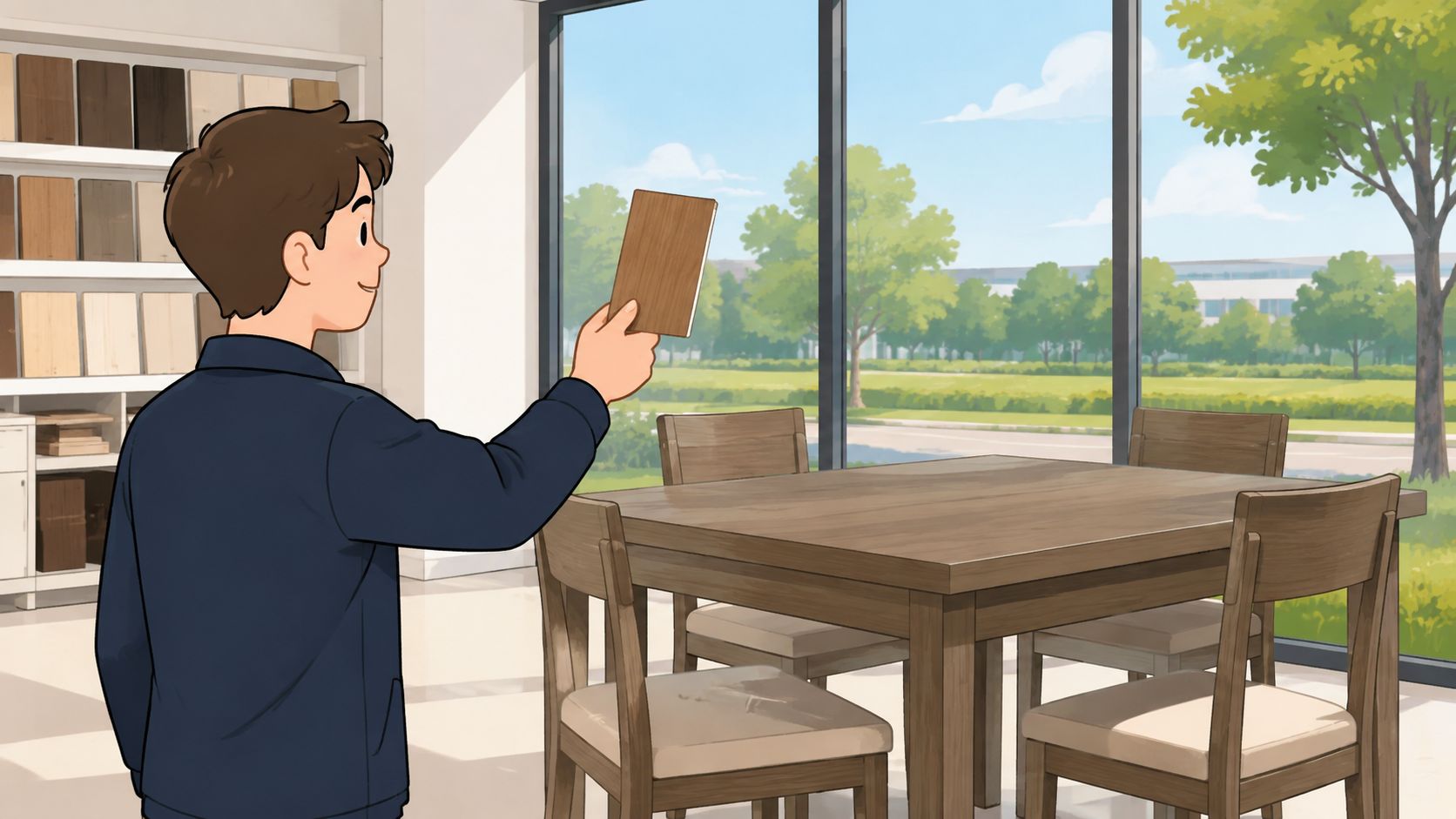
A local showroom earns its place before delivery day. Finish samples look different under a homeowner's actual lighting, and a buyer needs to sit in the chairs, test knee clearance, feel the edge profile, and judge whether the table height works with the intended seating.
A showroom visit also exposes problems that online dimensions hide. A pedestal may interfere with knees, a trestle may limit chair placement, or an extension mechanism may require more clearance than the room can provide. Those are tactile and spatial decisions, not screen decisions.
Assign each service to the decision
Use the showroom for tactile questions. Compare wood samples, edge comfort, chair support, finish sheen, and the soundness of the base.
Use custom ordering for dimensional problems. An unusual room width, additional leaves for holiday seating, a specific leg shape, or a finish that coordinates with existing flooring can justify a custom table. Custom ordering can also support Amish Furniture choices, handcrafted in the USA with solid-wood construction and heirloom intent.
Use a room planner for layout. Scaled planning can reveal blocked walkways, hutch conflicts, and insufficient chair clearance before furniture arrives. Tip Top provides free online room planning software for this purpose.
Use financing for budget control. Flexible payment options can help a household select the construction and species it needs rather than downgrading solely to meet an immediate cash limit. Financing terms and availability should be reviewed with the showroom before purchase.
Tip Top Furniture & Mattresses is a family-owned Freehold, NY showroom serving the Greater Albany Capital Region since 1978. Its selection covers dining and other rooms, décor, flooring, USA-made mattresses, clearance furniture, and pieces from more than 50 trusted manufacturers, with professional design services available since 1984. The custom-order guide outlines the information shoppers should prepare before requesting a personalized piece.
The one-stop approach can be practical for a whole-room project. Flooring samples can be coordinated with the dining finish, design services can connect the table to nearby living and bedroom furnishings, and delivery planning can account for doors, stairs, and room access. Buyers should also ask about availability, delivery timing, finish care, warranty terms, and what happens if the table needs adjustment after installation.
The right table isn't the one that looks best under showroom lights. It's the one whose construction, finish, dimensions, and climate requirements match the way a household lives.
Visit Tip Top Furniture & Mattresses in Freehold, NY to compare natural wood dining tables, Amish Furniture, custom finishes, room-planning support, flexible financing, delivery options, and clearance pieces for the Greater Albany Capital Region. Bring room measurements and flooring samples so the design team can help select a table that fits the space and remains practical through Upstate New York's changing seasons.