Your Home Office Desk with Storage Guide for Albany, NY


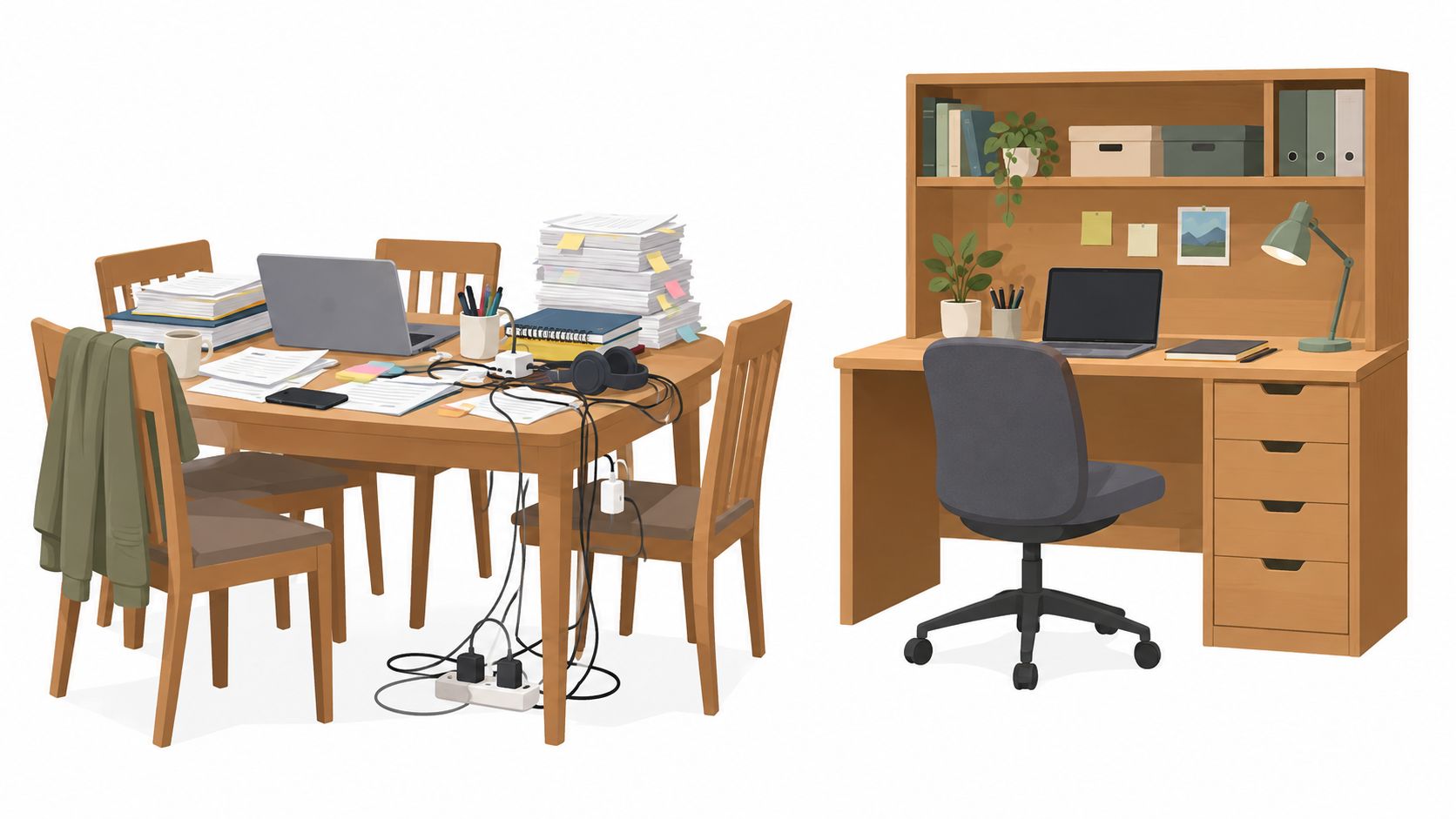
A dining table can become a home office by accident. First comes a laptop, then a monitor, paperwork, chargers, and a printer. Before long, the table no longer works well for meals or focused work, and every evening ends with the same chore of moving office supplies out of the way.
A dedicated home office desk with storage can solve that problem, but drawer count alone shouldn't determine the purchase. Storage needs to protect the clear area required for typing, viewing, and changing seated positions. For homeowners in Albany, Schenectady, Troy, Greene County, and throughout the Greater Albany Capital Region, the right desk should fit the room, the work habits, and the person using it.
For more ideas on turning an everyday room into a useful workspace, see these home office setup ideas. Tip Top Furniture & Mattresses has served local families from its Freehold, NY showroom since 1978, combining furniture selection with local design guidance, custom options, delivery, and flexible financing.
Your Guide to a More Productive Home Office
A homeowner in the Capital Region might start working at the dining table because a guest room is full, a child needs the office, or remote work has gradually become part of household life. The arrangement seems temporary, but the clutter often becomes permanent. A stack of files occupies one end of the table, the monitor sits too close to the edge, and cables trail toward the nearest outlet.
That setup creates friction before work even begins. The user must clear a space, search for supplies, and shift the monitor or keyboard repeatedly. A properly planned desk gives each item a home while preserving the open surface needed for the current task.
Start with the work zone
The most useful desk isn't the one that fills every corner with compartments. It keeps the primary work zone clear, places supplies where they can be reached without twisting, and leaves enough room for the chair to move close to the work surface.
Before shopping, consider:
- Daily work: Will the desk support writing, video calls, paperwork, creative work, or several monitors?
- Room function: Is the office permanent, or must the room return to guest, family, or household use?
- Storage behavior: Should papers stay concealed, or do frequently consulted materials need open access?
- Future needs: Could the household add equipment, change chairs, or share the workstation?
A storage desk should make the room easier to use at the end of the workday. That might mean a concealed compartment for a laptop, a side cabinet for files, or an adjacent bookcase that keeps vertical storage separate from the typing area.
Local guidance matters
A family-owned showroom can help homeowners compare proportions and construction in person instead of relying only on photographs. Tip Top's professional design services have been available since 1984, supporting room planning for homes in Freehold and across the Albany Capital Region.
The same visit can support a broader project. Furniture, décor, flooring, and even a USA-made mattress can be considered together when a guest room or flex room needs to serve several purposes. That one-stop shopping with local expertise is especially useful when a desk must coordinate with existing bedroom, living room, or dining furniture.
Understanding Different Types of Storage Desks
A desk with storage works like a kitchen. The best layout isn't determined by how many cabinets exist, but by whether the right tools are close to the person using them. A cook needs daily utensils near the preparation area, while rarely used equipment can occupy a farther cabinet. Office storage follows the same logic.
Match the desk style to the workflow
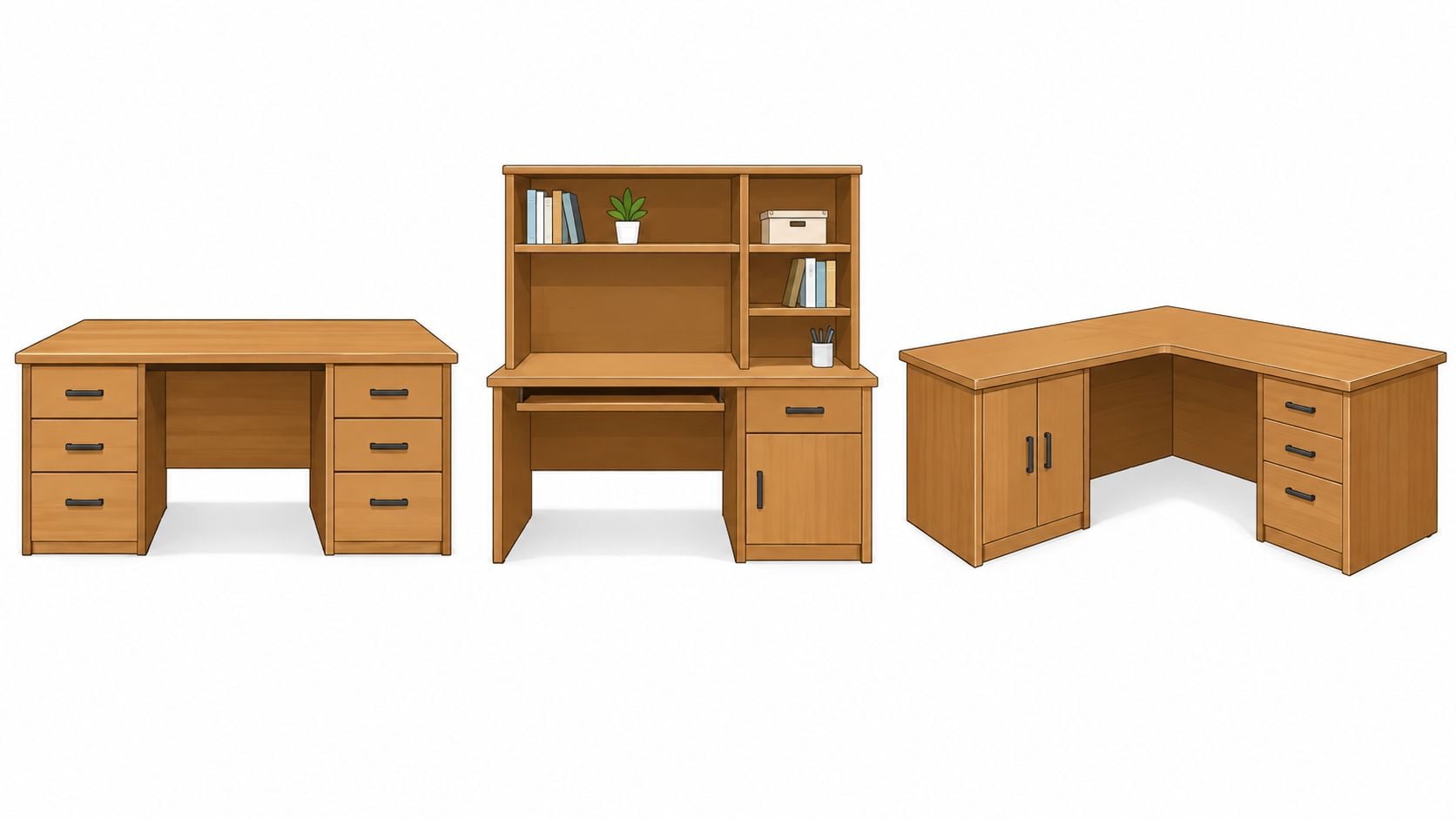
Executive desks usually provide deep pedestals or side storage. They suit a homeowner who handles paper files, office supplies, and administrative work at the desk every day. The trade-off is physical bulk. Pedestals can reduce legroom, so the knee-and-foot area must be checked before purchase.
Credenza desks add storage along a wall, often behind or beside the main work surface. They work well for a household administrator, consultant, or professional who needs a broad command center for files, equipment, and reference materials. Because the storage can sit beside the user rather than underneath the primary seating area, the arrangement may preserve better chair clearance.
L-shaped configurations divide tasks into separate surfaces. One side can hold the monitor and keyboard, while the return supports paperwork, a printer, or a second activity. This setup can be effective in a corner, but the room must provide enough passage space around the shape.
Desks with hutches use vertical space for books, files, and display items. They're useful in a smaller room where floor area is limited, but an upper unit shouldn't force the monitor into an uncomfortable position. A hutch that crowds the screen can create a visually tidy but physically awkward workstation.
Modular desks allow a homeowner to combine a writing surface with a lateral file, bookcase, or mobile pedestal. This flexibility is valuable when the room may change function or when two people use the space at different times.
Choose concealed or open storage
Concealed drawers and cabinets create a calmer visual field. They're appropriate for paperwork, chargers, and supplies that should disappear after work. Open shelving makes books, reference folders, and decorative pieces easier to reach, but it requires more discipline because every item remains visible.
Drawer operation also affects daily satisfaction. A drawer that binds, wobbles, or doesn't extend far enough can turn a useful compartment into dead space. Homeowners interested in the mechanics behind smooth drawer movement can review this drawer slide installation guide for useful terminology and construction considerations.
The most suitable category depends on the work pattern:
- Paper-heavy work: Consider pedestals, lateral files, or a credenza.
- Mixed household use: Consider modular pieces or concealed storage.
- Small rooms: Consider vertical storage, provided it doesn't interfere with monitor placement.
- Creative work: Consider an L-shaped surface with supplies stored beside the active area.
- Occasional work: Consider a smaller desk paired with a nearby cabinet rather than permanent built-in bulk.
For homeowners who want paperwork and equipment hidden from view, desks with hidden compartments can offer a cleaner close-of-day routine without sacrificing access.
Designing for Comfort and Health with Ergonomics
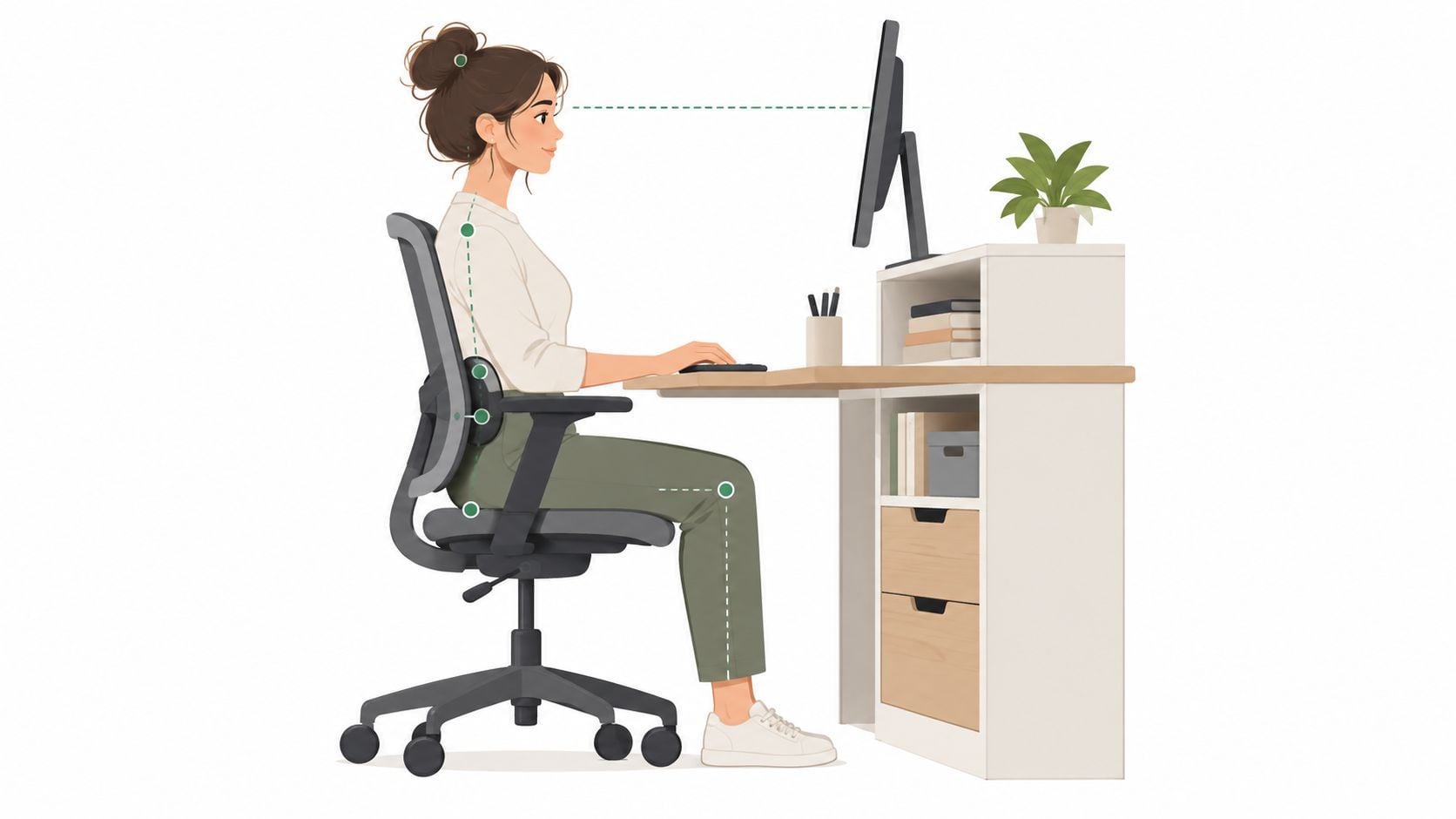
A desk can look organized and still make the user uncomfortable. Storage placement affects whether the chair can move close enough, whether the monitor sits at a usable distance, and whether the user must twist to reach a file. Those details matter more than an extra drawer.
The U.S. Department of Defense ergonomics guidance highlights an important trade-off: more built-in storage can reduce ergonomic flexibility when shelves force the screen too low or drawers prevent close seating. A desk should support neutral posture, not merely conceal clutter.
Protect legroom and seated clearance
Under-desk space is functional space. OSHA recommends positioning the monitor directly in front of the user and at least 20 inches, or 50 centimeters, away. The keyboard, mouse, and frequently used devices should remain within easy reach, while files, books, computer towers, and cabinets shouldn't block leg movement or prevent posture changes. These requirements appear in OSHA's desk guidance for computer workstations.
A practical planning range is approximately 20 to 28 inches, or 50 to 72 centimeters, of unobstructed vertical leg clearance. That range is a specification for planning, not a guarantee that every user or chair will fit. The chair, armrests, foot position, and desk height still need to be checked together.
Place drawers, pedestals, or shelving beside the user or above the desk when possible. A side cabinet may provide the same capacity as an under-desk pedestal while allowing the user to sit close enough to type comfortably.
Measure the monitor relationship
OSHA identifies a preferred monitor viewing distance of 20 to 40 inches from the user's eyes to the screen. The monitor should be directly in front of the user, with its top at or slightly below eye level. The center of the display is normally positioned 15 to 20 degrees below horizontal eye level. These measurements are detailed in OSHA's monitor positioning guidance.
A raised hutch shelf can interfere with this arrangement. So can a shallow desktop that leaves no room to position the screen far enough away. Measure from the seated user's eyes to the screen, not just from the back edge of the desk to its front.
Keep typing centered
Cornell ergonomics guidance recommends a comfortable arms-length monitor distance, straight and flat wrists, and a monitor and keyboard positioned directly in front of the user. It also calls for a stable work surface and a keyboard tray that doesn't bounce during typing. The Cornell workstation guidance helps explain why a pullout shelf should be evaluated as a structural component, not just a convenience feature.
Before choosing a desk, check:
- Seated elbow height: The keyboard should sit approximately at elbow height, as OSHA explains in its desk purchasing guide.
- Chair clearance: Armrests shouldn't collide with drawers or side panels.
- Mouse space: The mouse should remain beside the keyboard without forcing the wrist sideways.
- Printer location: A printer should be reachable without repeated twisting.
- Cable paths: Power and data cables shouldn't cross the user's legs or pull equipment out of position.
For compact rooms, a narrow writing surface can be attractive, but the useful question is whether it preserves a centered keyboard and monitor arrangement. A general overview of small-room ergonomic gaming desk layouts can offer additional ideas for handling equipment in tight spaces, even when the workstation serves office rather than gaming needs.
A complimentary design conversation and a home office desk setup review can help Albany-area homeowners test these relationships before ordering.
Choosing Durable Materials and Finishes
A home office desk receives daily contact from hands, equipment, paperwork, and coffee cups. Material selection affects how the desk feels today and how well it can remain part of the home as needs change.
Solid wood
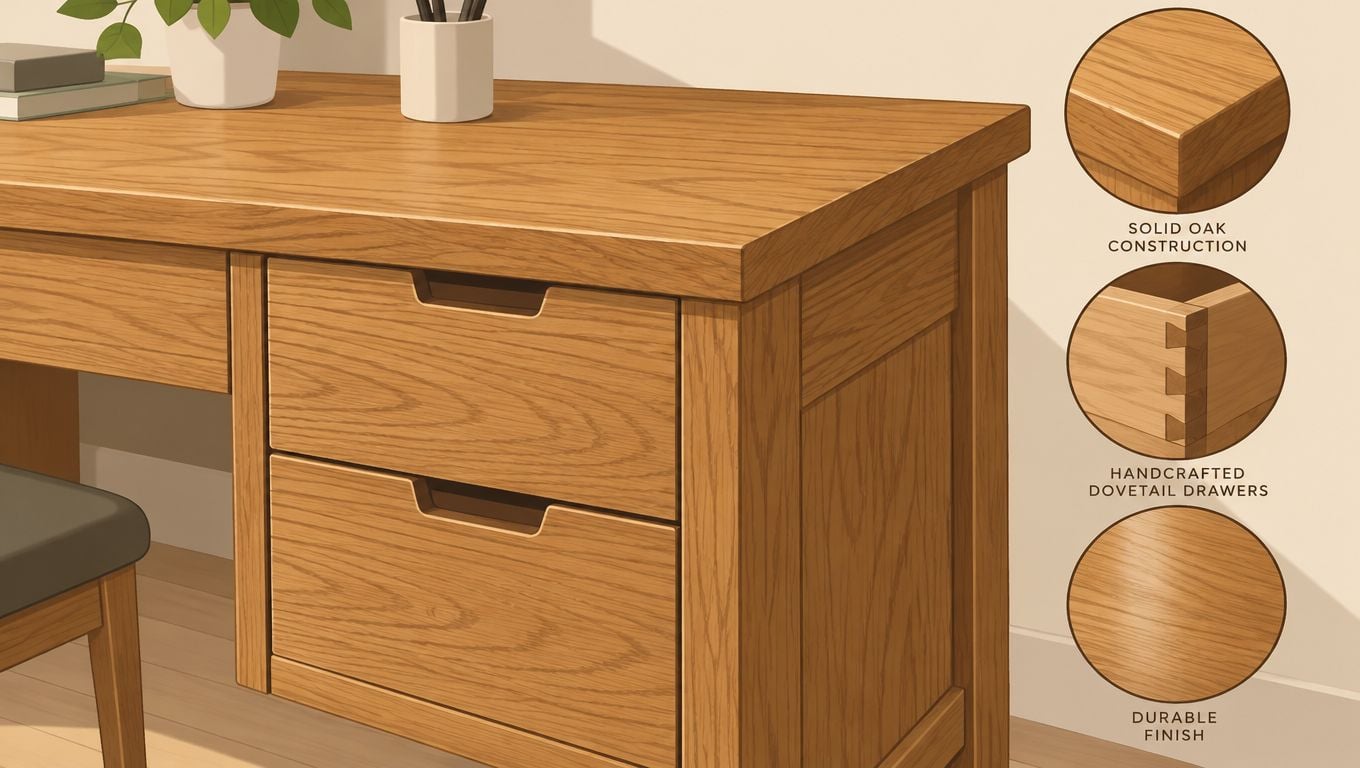
Solid hardwood offers a substantial feel, visible grain, and the possibility of future refinishing. Amish furniture handcrafted in the USA is often selected for heirloom quality, especially when the homeowner wants the desk to remain useful through a move, a room change, or a change in work style.
Oak, cherry, and maple create different visual effects. Oak tends to show pronounced grain, cherry brings warmth as its finish develops, and maple offers a cleaner, lighter appearance. The practical advantage isn't only appearance. A solid-wood desk can often be ordered in a preferred size, wood type, and finish, making it suitable for a room with unusual dimensions.
Veneer
Quality veneer uses a thin layer of real wood over a stable substrate. It can provide an authentic wood appearance while allowing manufacturers to control movement and offer a different price point from thick solid lumber.
Veneer makes sense when a homeowner wants a particular grain pattern or coordinated office collection without requiring every component to be solid hardwood. The finish still matters. A well-made veneered surface needs sensible care, especially around moisture, heat, and heavy equipment.
Laminate
Durable laminate can be a practical choice for intense everyday use. It generally offers a tough, easy-care surface and can suit a household where the desk also handles schoolwork, crafts, mail, or family administration.
The compromise is tactile and visual. Laminate may not provide the same depth or repair potential as solid wood, although its consistent surface can be easier to maintain. The right decision depends on how the desk will be used rather than on a simple hierarchy of materials.
Compare the finish with the room
A stain can emphasize grain and coordinate with traditional furniture. A painted finish can make a compact office feel lighter or connect the desk with trim and cabinetry. Hardware also changes the impression, from understated pulls to more decorative fittings.
Tip Top Furniture & Mattresses offers access to over 50 trusted manufacturers, including USA-made furniture and Amish selections. That range gives homeowners in Freehold, Albany, Schenectady, and Troy room to compare construction, finish, storage, and scale instead of treating material as an isolated decision.
The most durable purchase is the one that fits the household's actual use. A solid-wood desk may suit a long-term study, while a durable laminate may be more sensible for a shared family workspace that must tolerate varied activities.
Tips for Smart Organization and Cable Management
Storage only helps when it supports a repeatable routine. A desk can have generous drawers and still feel chaotic if daily tools are buried, papers have no category, or chargers occupy the main work surface.
Build three retrieval zones
Oregon OSHA recommends reserving the immediate work surface for items used often, placing infrequently used materials in drawers, filing cabinets, or overhead shelves. Ergonomics guidance identifies a primary zone of roughly 12 by 12 inches directly in front of the torso for items used throughout the shift. Frequently used objects should generally stay within 10 to 16 inches, occasional-use items within 16 to 24 inches, and seated reaches beyond 24 inches should be avoided, as explained in the Oregon OSHA office ergonomics guide.
Apply that guidance by assigning each group a home:
- Active tools: Keep the keyboard, mouse, phone, and current documents on the central surface.
- Regular supplies: Place pens, notebooks, files, and chargers in side drawers or adjacent shelving.
- Archive materials: Store older paperwork, spare supplies, and seasonal equipment in farther or higher compartments.
Practical rule: Storage capacity should be judged by access geometry, not by drawer count.
A drawer that requires shoulder rotation every time it opens isn't convenient. The same applies to a shelf that forces repeated overhead reaching for a commonly used binder.
Make cable routes part of the furniture decision
Cable management works best when planned before the desk arrives. Look for rear grommets, wire trays, openings between compartments, and enough space for a power strip without blocking legroom.
A simple arrangement can include:
- Label each cable near its plug so the correct cord can be identified quickly.
- Route cords toward one side of the desk instead of allowing them to cross the user's knees.
- Keep the power strip accessible for maintenance, but conceal it from the primary visual field.
- Separate signal and power cords where possible to make troubleshooting easier.
- Leave slack at moving equipment so a monitor or laptop can be repositioned without pulling the connection.
The same organizing principle used for compact kitchen storage applies to an office. Homeowners considering small counter and cabinet K-Cup organizers may recognize the value of assigning each small item a defined location. Office drawers benefit from that same discipline, whether they hold cables, pens, adapters, or paper clips.
For additional layout ideas, these home office storage ideas can help translate available compartments into a workable daily system.
Plan the end of the workday
Shared rooms need a closing routine. A concealed laptop compartment, a drawer for active paperwork, and a charging path can help the dining room, guest room, or family room return to its non-office role.
A permanent office can use open shelves for reference books, while a shared workspace may benefit more from removable organizers or a mobile pedestal. The best storage arrangement makes the next work session easier without forcing work materials to remain visible all evening.
Customizing Your Desk and Making It Affordable
A standard desk works well when its dimensions match the room and the user. It becomes less suitable when a home has an angled wall, a narrow guest room, multiple users, unusual equipment, or a particular furniture style that must be coordinated.
Custom order around the room
Custom ordering can address the details that mass-produced furniture can't always solve. A homeowner may need a specific width for an Albany-area apartment, a shallow return for a guest room, a particular wood and finish, or a combination of drawers and open shelving that isn't available as a stock configuration.
Custom Amish furniture may be created from a picture or sketch, allowing the design conversation to begin with a real room problem rather than a fixed product category. The important measurements include:
- Wall width and door swing
- Chair and walking clearance
- Monitor and keyboard placement
- Printer and charging locations
- Storage frequency
- Existing wood tones and flooring
That last point matters in a one-stop project. A desk should relate to the room's other furnishings, but the surrounding flooring, window treatments, décor, and lighting also influence how the finished workspace feels.
Balance the project with available options
Flexible financing can make a larger furniture project easier to plan, subject to store terms and approval. Delivery also matters for a substantial desk, particularly when the home is outside Freehold and the purchase is being coordinated with other room furnishings.
Budget-conscious shoppers shouldn't overlook clearance inventory. The Clearance section can provide immediate availability and high-quality pieces at a deep discount, although dimensions, finish, and storage configuration should still be checked against the ergonomic requirements.
A new desk should support the user's body, workflow, and room for the long term. If the exact combination isn't on the floor, a custom order may be more sensible than compromising on chair clearance or monitor position.
Tip Top Furniture & Mattresses helps homeowners across Freehold, Albany, Schenectady, Troy, and the Greater Albany Capital Region compare storage desks, Amish furniture, custom dimensions, flooring, décor, mattresses, financing, and delivery in one place. Visit Tip Top Furniture & Mattresses to plan a home office desk with storage that fits the room and supports comfortable daily work.