Memory Foam vs Innerspring: A 2026 Buyer’s Guide

Waking up stiff, rolling a shoulder to loosen it, and wondering whether the mattress is the problem is a familiar moment for a lot of households around Albany, Schenectady, Troy, and the surrounding Capital Region. Most shoppers land on the same fork in the road. Memory foam or innerspring?
That question sounds simple, but it usually isn't. One bed can feel soft for five minutes and uncomfortable by morning. Another can feel supportive in the store but too firm on sore hips and shoulders after a full night. The difference often comes down to how the mattress is built, how the body sleeps, and how accurately the trade-offs are weighed.
Families shopping in Freehold, NY often want the same thing. They want straight answers, not mattress jargon. With a local showroom legacy that goes back to 1978, plus professional design services offered since 1984, the advice shoppers tend to value most is still practical: what feels good, what holds up, what sleeps cooler, and what works for real people instead of marketing labels.
Good sleep also depends on habits outside the bedroom. Anyone trying to improve both mattress comfort and sleep routines may find these natural ways to better sleep useful alongside the mattress decision.
Table of Contents
- Finding Your Perfect Night's Sleep
- Understanding the Core Construction
- A Detailed Comparison of Feel and Function
- Which Mattress Is Best for Your Sleep Style
- Comparing Lifespan Durability and Long-Term Value
- Considering a Hybrid The Best of Both Worlds
- How to Choose Your Mattress in the Albany Capital Region
Finding Your Perfect Night's Sleep
The memory foam vs innerspring decision starts with one question. What's going wrong at night? If a sleeper wakes up with sore shoulders, numb hips, partner disturbance, or a hot back, the mattress feel is only part of the story. Construction matters because construction controls pressure relief, pushback, airflow, and motion.
Many shoppers in the Greater Albany Capital Region arrive at a showroom thinking they need “something firmer.” Sometimes they do. Just as often, they need better pressure relief, less motion transfer, or a mattress that keeps them from overheating. A bed can feel firm and still be wrong. A bed can also feel plush and still support the body well enough in the right spots.
Three practical questions help narrow the field quickly:
Where is the discomfort showing up
Shoulder and hip pressure often point shoppers toward contouring comfort. Lower body sagging often points toward stronger structural support.How does the sleeper move at night
Someone who changes positions often may dislike a slow, sinking surface. Someone who stays mostly in one position may prefer deeper contouring.Who shares the bed
Couples usually care more about motion control, edge use, and temperature differences than solo sleepers do.
Practical rule: Mattress shopping gets easier when the shopper stops asking “Which type is best?” and starts asking “Which type solves the problem that's happening every night?”
That's why local, in-person feedback matters so much. Over decades of helping households from Freehold to Albany, the pattern stays consistent. The wrong mattress usually fails in one of two ways. It either creates pressure where the body needs cushioning, or it lets the body sink where it needs lift.
Understanding the Core Construction
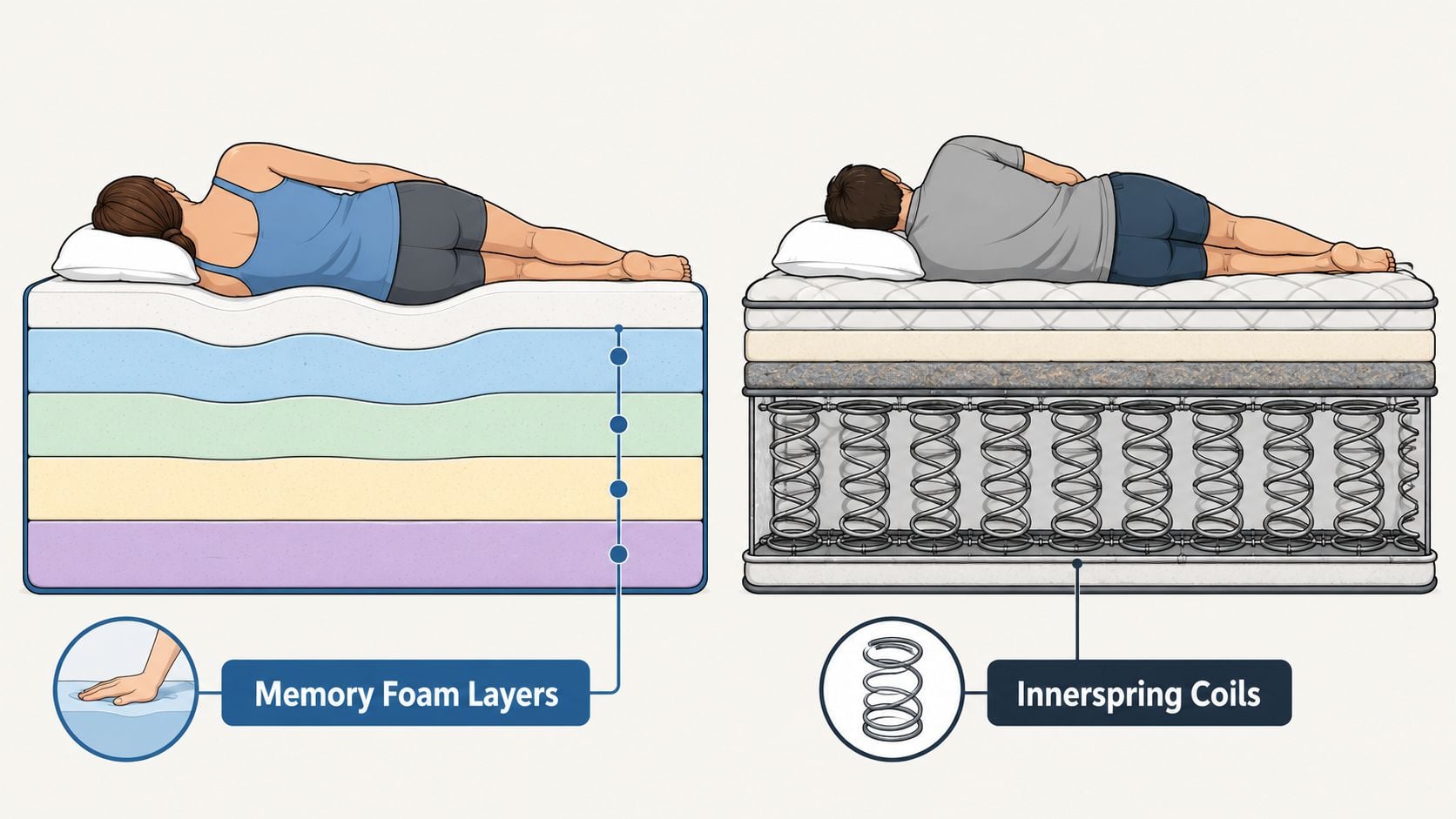
Before comparing feel, it helps to know what's under the fabric. Memory foam and innerspring mattresses don't just feel different. They respond differently because their cores are built to do different jobs.
Shoppers who want a broader breakdown of materials, firmness, and mattress categories can also review this guide to mattress types explained.
How an innerspring mattress is built
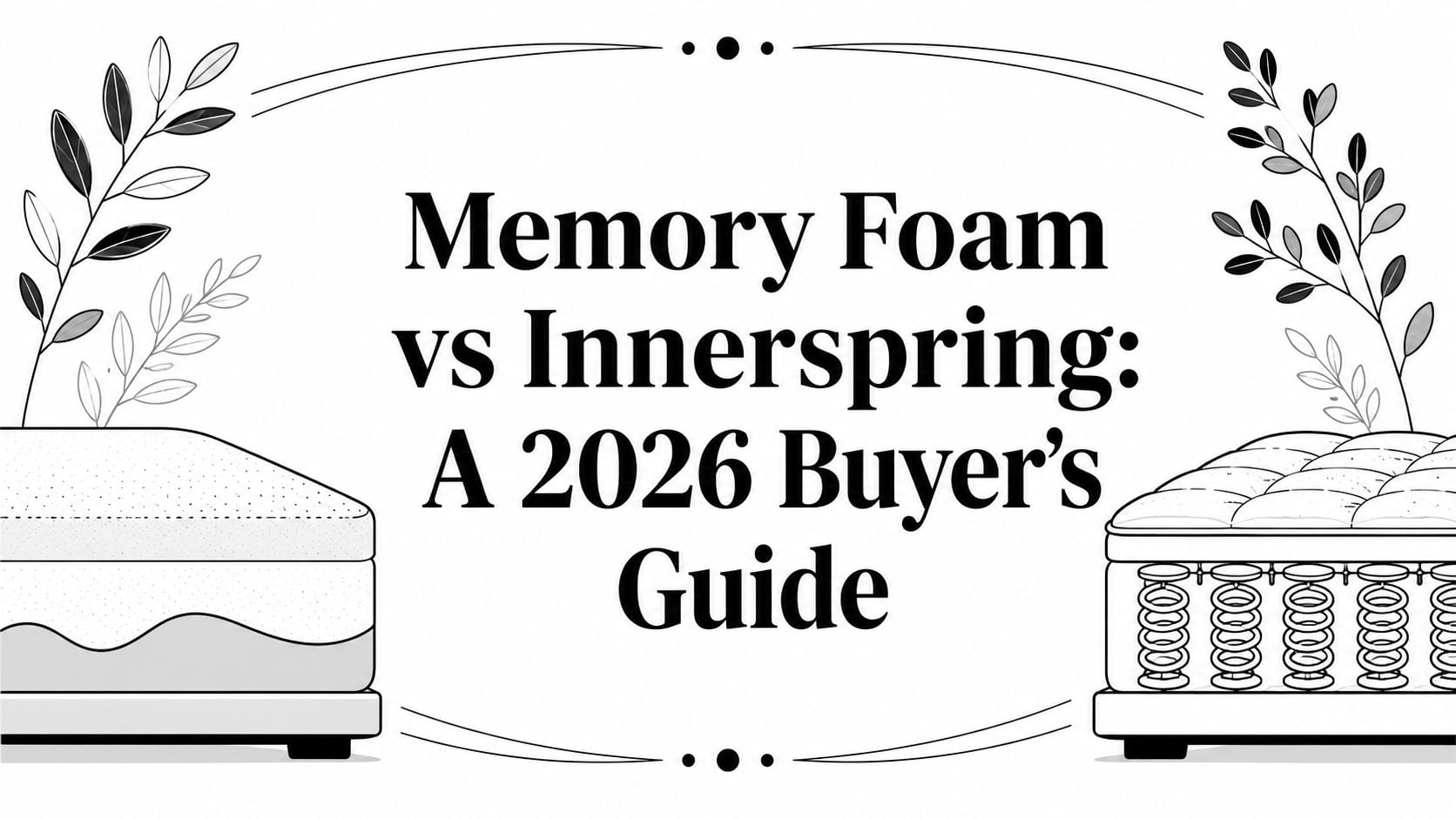
An innerspring mattress uses a steel coil system as its main support structure. Think of it as a supportive grid. The coils do the heavy lifting, while the layers above them shape the initial comfort.
Different spring systems can create a different feel, but the general character stays familiar:
Coil support core
This creates the lifted, buoyant feel many shoppers describe as “sleeping on top of the bed.”Padding above the coils
Fiber, foam, or quilted layers soften the surface so the mattress doesn't feel hard or harsh.A responsive surface
Because the support comes from metal coils pushing back, the mattress tends to feel quicker and bouncier.
This is the mattress style many people grew up with. It usually feels easier to move around on, which matters for combination sleepers or anyone who dislikes sinking into the surface.
How a memory foam mattress is built
A memory foam mattress relies on layered foam instead of a coil core. The key material is viscoelastic foam, originally developed by NASA, which responds to heat and pressure by shaping itself around the body.
The easiest way to picture it is soft dough over a sturdier base. The top layers contour. The deeper layers stabilize.
Most memory foam mattresses include:
- Comfort layers that cushion the shoulders, hips, and other pressure points
- Transition layers that keep the body from dropping too quickly
- Support foam below that gives the mattress structure
That layered build creates the classic “hugging” sensation shoppers talk about. Some people love it right away. Others feel too enclosed by it.
The biggest construction difference is simple. Springs push back from below, while memory foam yields around the body before supporting it.
That one distinction shapes nearly every comfort difference discussed later, from temperature to motion isolation to pressure relief.
A Detailed Comparison of Feel and Function
The memory foam vs innerspring debate becomes practical. The materials matter, but the nightly experience matters more. A mattress has to feel right when a sleeper lies still, shifts position, shares the bed, and sits near the edge.
Shoppers comparing softness and firmness often benefit from a separate look at this mattress firmness guide, because firmness and mattress type aren't the same thing.
Memory Foam vs. Innerspring at a Glance
| Feature | Memory Foam | Innerspring |
|---|---|---|
| Feel | Contouring, body-hugging, quieter | Lifted, bouncy, more traditional |
| Pressure Relief | Strong pressure relief around hips and shoulders | More surface-level cushioning |
| Support Feel | Can feel more enveloping | Feels more “on top” of the bed |
| Temperature | Tends to retain more heat | Better airflow and cooler sleep |
| Motion Transfer | Lower motion transfer | More movement felt across the bed |
| Edge Support | Usually softer at the perimeter | Usually stronger at the perimeter |
| Ease of Movement | Slower response | Faster response |
| Best Match | Side sleepers, couples, light sleepers | Hot sleepers, combination sleepers, shoppers wanting more bounce |
Pressure Relief
Memory foam often demonstrates its superiority most clearly in pressure relief. Memory foam mattresses are superior for relieving pressure on sensitive parts of the body compared to standard innerspring mattresses, because joints ease into the foam layers rather than pressing against a coil-driven surface, as noted by Mattress Firm's comparison of innerspring and memory foam.
That's why side sleepers often react strongly to foam. Shoulders and hips don't get jammed upward as much. The body gets more contour where it needs it most.
Innerspring mattresses can still feel comfortable, especially with well-padded tops. They just usually don't mold around pressure points in the same way.
Support
Support gets oversimplified all the time. Many shoppers use “support” to mean “hard,” but that's not accurate. Real support means the mattress helps keep the spine from sagging out of position.
An innerspring mattress usually feels more supportive to people who want lift. The body stays more level on the surface. A memory foam mattress may feel supportive in a different way, but some sleepers read that contouring as softness.
If a sleeper likes to feel cradled, memory foam often feels better. If a sleeper wants to feel held up, innerspring usually feels better.
Temperature Regulation
Temperature is one of the clearest trade-offs. Innerspring mattresses offer better airflow and temperature regulation than memory foam because space between the coils promotes ventilation, while dense foam tends to trap more body heat, according to Sleepopolis on innerspring vs memory foam mattresses.
For hot sleepers in the Capital Region, that can be the deciding factor. Plenty of shoppers like the contouring of foam in winter, then change their mind after a warm stretch.
The same source also notes a sharp difference in off-gassing after unboxing. Spring mattresses averaged 0.5 days of odor, while memory foam mattresses averaged 3.08 days.
Motion Isolation
Couples notice this fast. Expert benchmark testing found that memory foam mattresses show approximately 40% less motion transfer than innerspring mattresses, while innerspring models have faster response times and more bounce, according to NapLab's memory foam vs spring testing.
That means one partner getting up, shifting, or rolling over is less likely to disturb the other on memory foam.
For light sleepers, that's often a stronger advantage than expected.
Edge Support
Edge support is often underestimated in its importance. It affects how secure the bed feels when sitting down, tying shoes, or sleeping near the perimeter.
Innerspring mattresses generally do better here because the coil base creates a stronger perimeter feel. Memory foam edges often compress more, which can make the bed feel smaller even when the dimensions are the same.
Which Mattress Is Best for Your Sleep Style
The right mattress type depends less on trends and more on how the body rests. Sleep position, body weight, and sensitivity to pressure change the answer quickly.
A shopper trying to match mattress style to body mechanics can also compare options in this guide on how to choose the right mattress for your sleeping style.
Side sleepers
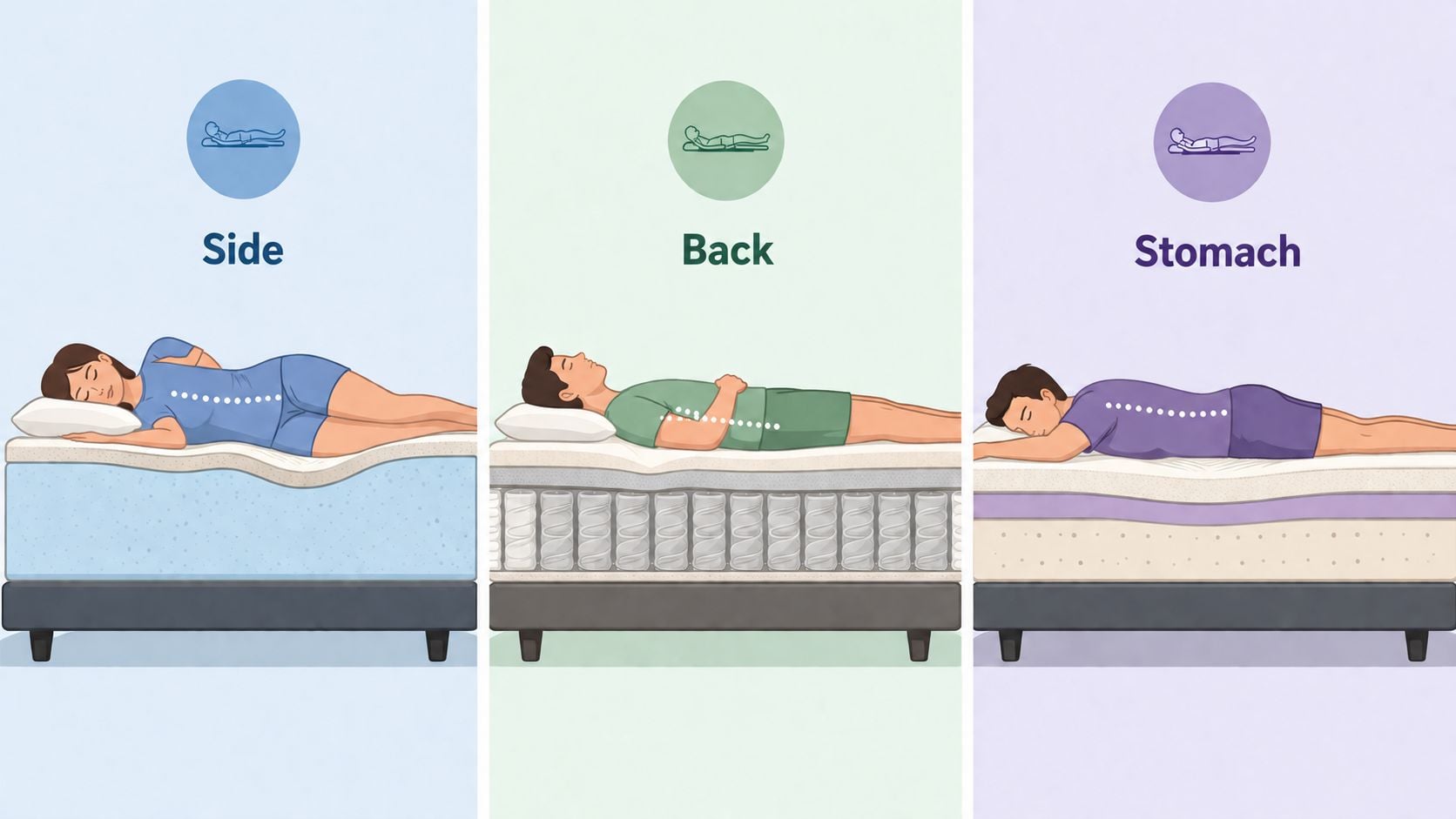
Side sleepers usually place the most pressure on the shoulders and hips. That's why memory foam often works well for them. The material contours around those joints instead of pushing sharply back against them.
This matters even more for people who wake up with numb arms or tender hips. Anyone dealing with recurring lower back pain should also look at whether the mattress is relieving pressure without letting the midsection sink too far.
A side sleeper should pay attention to two things during a showroom test:
Shoulder ease
The shoulder should settle in enough that it doesn't feel jammed upward.Waist support
The torso shouldn't collapse into a hammock shape.
Back sleepers
Back sleepers usually need a balance. Too much cushioning can let the hips drop. Too much firmness can leave the lower back unsupported and the upper body tense.
Many back sleepers prefer an innerspring because it creates a flatter, more lifted surface. Others like a memory foam feel if the mattress has enough underlying support to keep the hips from sinking.
The test is simple. A back sleeper should lie still for several minutes and ask whether the lower back feels supported naturally or forced flat against the bed.
Stomach sleepers
Stomach sleeping is the toughest position to fit well because the midsection carries a lot of weight. If the mattress lets the pelvis sink too low, the lower back usually takes the hit.
That's why many stomach sleepers lean toward the firmer, more lifted feel of an innerspring. They generally need less deep contour and more surface stability.
A mattress can feel comfortable for a stomach sleeper at first touch and still be wrong if it bows the midsection downward.
Heavier sleepers and body weight considerations
The usual online advice often misses a critical distinction. Pressure relief and support are not the same thing.
While foam excels at pressure relief by contouring to joints, springs provide stronger structural support for heavier individuals who need to stay more on top of the bed. For sleepers over 250 lbs, some foams may bottom out and affect spinal alignment, while a quality innerspring tends to maintain lift, as discussed in this Reddit mattress support thread.
For heavier sleepers, the practical takeaway is straightforward:
If pressure points are the main complaint
Foam may feel better initially.If sagging and alignment are the main complaint
Springs often solve the bigger problem.If both issues matter
A hybrid deserves serious attention, which comes next.
Comparing Lifespan Durability and Long-Term Value
Sticker price gets attention first. Long-term value is what matters after a few years of use.
What lasts longer
Memory foam mattresses have an average lifespan of 10 years, while traditional innerspring mattresses typically last 6 to 8 years, according to Saatva's comparison of memory foam and innerspring mattresses.
That durability gap helps explain why many shoppers who originally focused on upfront price start looking differently at the category. A mattress that holds comfort and shape longer may cost more at purchase but still work out better over time.
A mattress protector also matters more than many people realize. Moisture, spills, and general wear can shorten the useful life of any bed, so it helps to understand the purpose of protective mattress covers before bringing a new mattress home.
How to think about value instead of sticker price
The same Saatva comparison reports that queen memory foam mattresses generally range from $700 to $3,000, while queen innerspring mattresses generally range from $500 to $2,200.
Those ranges tell only part of the story. The better question is whether the mattress keeps doing its job. A lower-priced bed that loses comfort too early isn't a bargain. A higher-priced bed that still feels right years later may be the better buy.
For budget-conscious households in Freehold and across the Albany area, a practical value checklist looks like this:
Look past the first price tag
Ask how long the mattress is likely to stay comfortable, not just how much it costs today.Protect the mattress from day one
A clean, well-protected sleep surface usually ages better.Plan the purchase realistically
Flexible payment options can make a better long-term fit easier to manage than settling for the cheapest short-term option.Watch for immediate-value inventory
Clearance can be useful for shoppers who want quality for less and don't need to special order.
For ongoing care after purchase, this guide on mattress maintenance and cleaning tips to extend its lifespan is worth reviewing.
Considering a Hybrid The Best of Both Worlds
Some sleepers read through the memory foam vs innerspring trade-offs and realize neither extreme sounds ideal. They want contouring, but not heat. They want support, but not too much motion transfer. That's where a hybrid comes into the conversation.
Why hybrids solve a common mattress problem
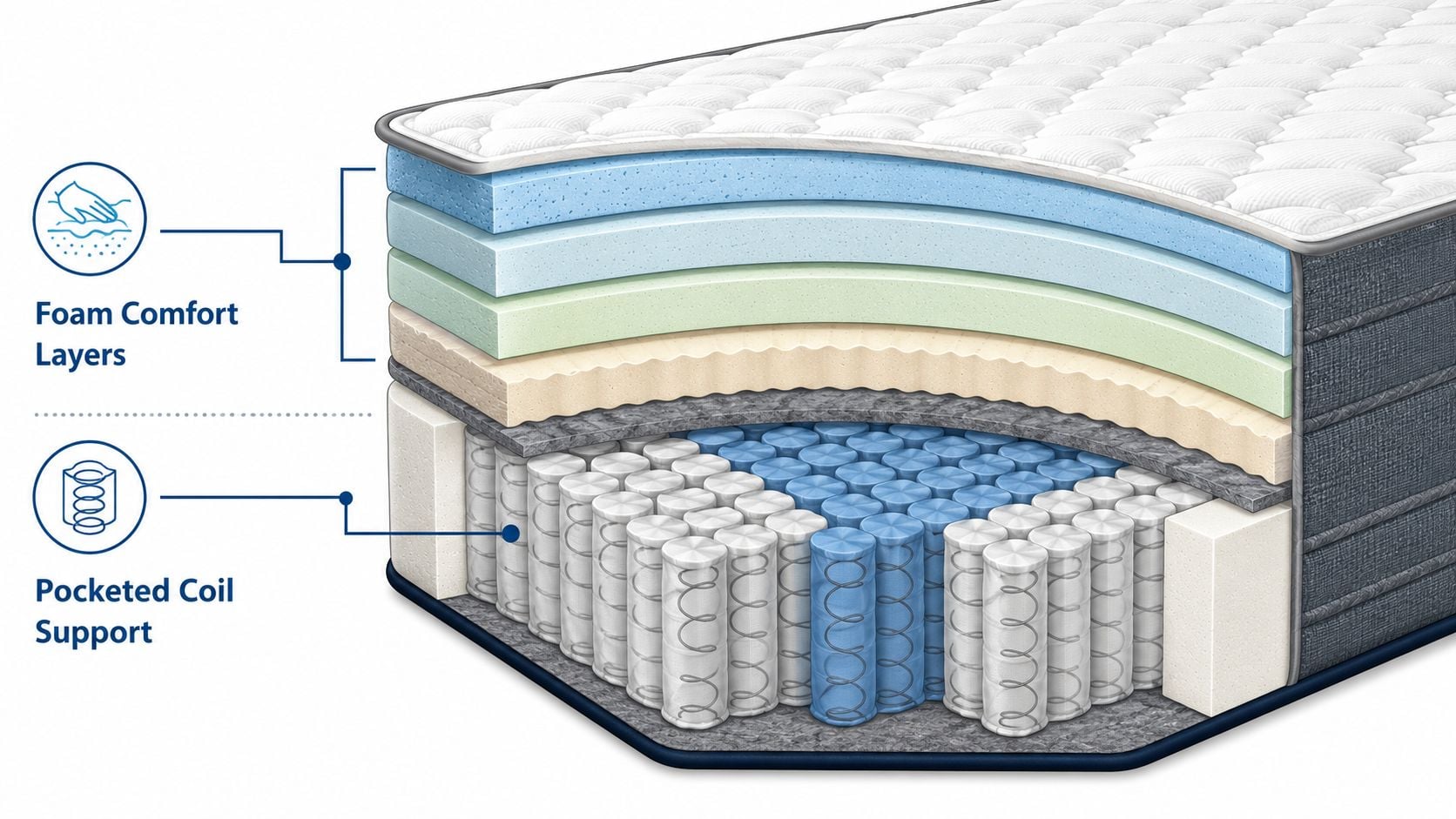
Hybrid mattresses combine foam comfort layers with an innerspring-style support core. According to PerformaSleep's hybrid vs memory foam vs innerspring guide, hybrids balance comfort and support by combining the pressure relief of memory foam with the airflow and firmness of innerspring, helping address the heat-trap issue of pure foam while also improving motion control compared with pure innerspring.
That's the practical reason hybrids have become such a sensible middle ground. They don't erase every trade-off, but they reduce some of the biggest complaints attached to each category.
Who should look at a hybrid first
A hybrid often makes sense for these shoppers:
Couples with different comfort preferences
One partner may want contouring while the other wants more lift.Sleepers who like foam but get too warm
The coil base can help create a more breathable overall feel.People who want pressure relief without a deep sink
Hybrids often feel more balanced and easier to move on.Shoppers who don't love all-foam or all-spring beds
A hybrid can land in the middle in a useful way.
Anyone curious about construction details can explore what a hybrid mattress is.
For many shoppers, a hybrid isn't a compromise in the negative sense. It's a solution to two competing needs.
How to Choose Your Mattress in the Albany Capital Region
Online research helps narrow the field. It doesn't replace lying down on a mattress long enough to notice what the body is saying.

How to test a mattress properly in a showroom
A proper test is slower than one might expect. Sitting on the edge for a few seconds won't tell much. Neither will a quick bounce test.
A better showroom routine looks like this:
Lie in your typical sleep position
Side sleepers should stay on the side. Back sleepers should stay flat. Stomach sleepers should test exactly that way.Stay there for several minutes
Pressure points often show up after the body settles.Roll and reposition
This exposes whether the surface feels trapped, springy, or easy to move on.Use the edge
Sit, shift, and lie near the perimeter to judge stability.
Why local mattress matching helps
The value of in-person guidance is evident. A family-owned showroom serving the Capital Region since 1978 has heard decades of customer feedback about what works in real homes, not just on a spec sheet.
Tip Top Furniture & Mattresses in Freehold uses a high-tech bed matching system to help identify support and comfort preferences, and that can save shoppers from guessing based only on firmness labels. It's especially useful when two mattresses feel similar at first but perform differently once pressure, position, and motion are factored in.
There's another advantage to shopping locally for a mattress instead of treating it like a one-click item:
- USA-made mattress options help shoppers focus on value and durability
- Flexible financing can make a better fit more manageable
- Custom home planning matters when the mattress purchase is part of a bigger bedroom update
- One-stop shopping helps coordinate bedroom furniture, décor, flooring, and layout in one place
- Clearance opportunities can help shoppers who need quality with faster availability
For households coming from Albany, Schenectady, Troy, Greene County, and nearby communities, the final mattress choice usually gets clearer once the body has tested the difference between contouring foam, lifted coils, and balanced hybrids in person.
A better mattress decision starts with testing the right options side by side. Shoppers across the Capital Region can visit Tip Top Furniture & Mattresses in Freehold, NY to compare USA-made memory foam, innerspring, and hybrid models in person, use the bed-matching technology for more personalized guidance, explore coordinating bedroom furniture and décor, and review flexible financing or clearance options that fit the project budget.