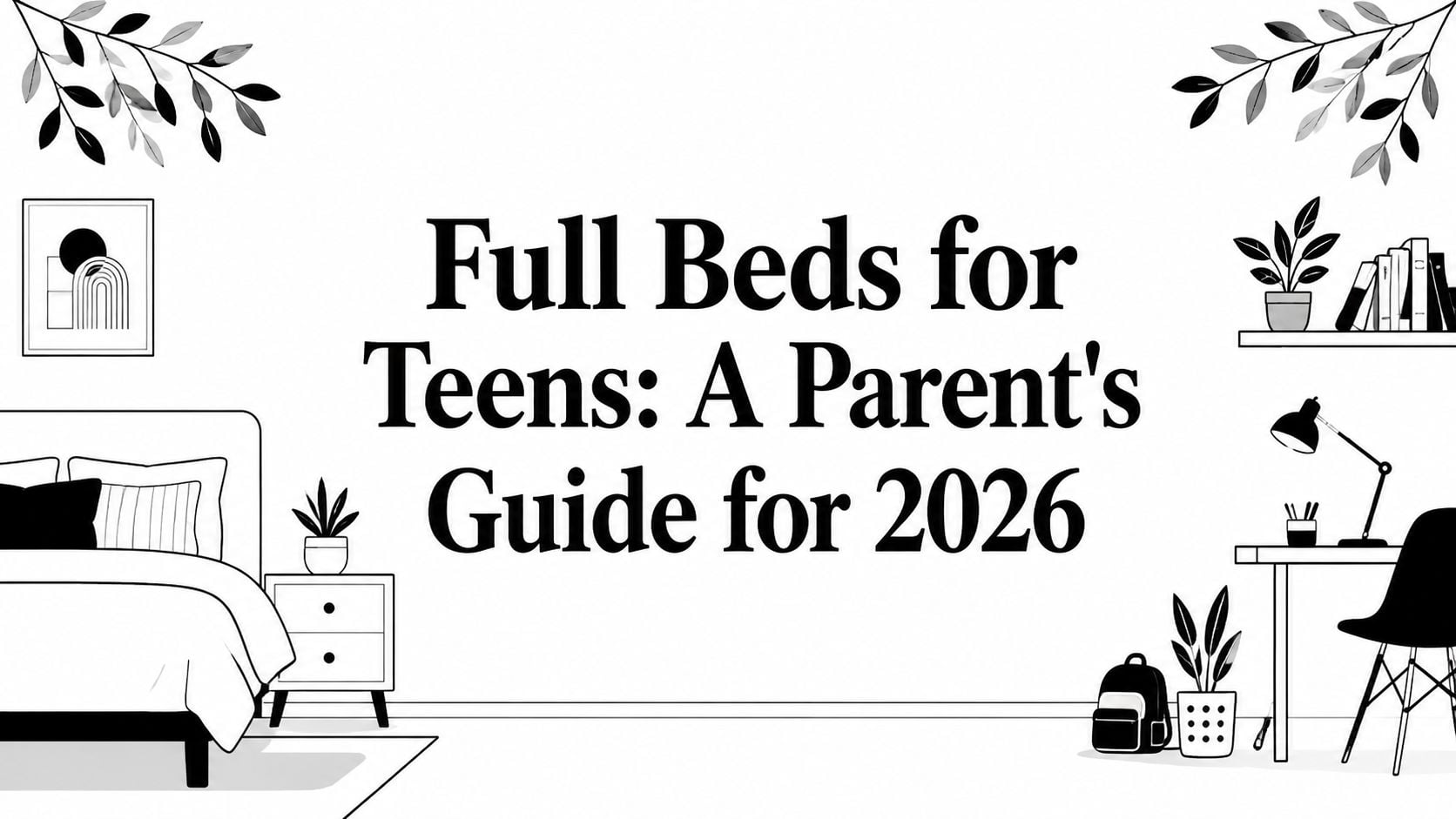
Full Beds for Teens: A Parent’s Guide for 2026

A lot of parents reach the same moment at about the same time. The twin bed that worked for years suddenly looks too short, too narrow, and too much like a leftover from childhood. Homework ends up spread across the comforter, pillows are shoved to one side, and the room stops working for the way a teenager lives.
That's usually when the main question shows up. Is a full bed just a stopgap, or is it the smart long-term move?
For families around Albany, Schenectady, Troy, and the wider Capital Region, that decision isn't only about fitting a bigger mattress into a bedroom. It's about sleep, daily function, durability, budget, and whether the furniture bought now will still make sense a few years from now. In a region where many homes mix modest bedroom sizes with long winters and busy school schedules, the bed often becomes more than a place to sleep. It becomes a study spot, a lounge area, and the most-used piece in the room.
Why This Guide Matters for Your Growing Teen
A teen bedroom changes fast. One year it's still decorated around childhood habits. The next, the space has to support later nights, more schoolwork, sports gear, hanging out with friends, and a body that's still growing.
That's where many families get caught in what some guides miss. Most guides overlook the sizing trap, where teens outgrow twin beds by age 14, but parents often wait until age 16 to upgrade, creating a two-year gap in adequate sleep space that affects health and development according to this discussion of teen bedroom furniture.
That gap matters because the bedroom usually doesn't fail all at once. It fails gradually.
What the sizing trap looks like in real life
Parents often notice small signs first:
- Crowded sleep posture means a teen curls up or sleeps diagonally just to get comfortable.
- Mixed-use overload shows up when the bed becomes the homework station, reading chair, and weekend hangout.
- A room that feels younger than the person using it starts creating friction, even if the furniture is still technically usable.
None of those problems looks urgent in isolation. Together, they point to a room that no longer matches the person living in it.
A bed that's too small doesn't just look out of date. It changes how the whole room functions.
In Upstate New York homes, that matters even more because bedrooms often have to work hard. The same room may need to support sleep, school, storage, and downtime without adding clutter or forcing awkward layouts.
Why waiting often costs more in the long run
Buying a second “just for now” bed rarely solves the underlying issue. A rushed purchase can leave parents replacing the frame again when style, durability, or storage needs change. A better approach is to choose a size that supports the teen years well, fits the room with intention, and still makes sense later.
For many households, full beds for teens hit that middle ground. They feel like a real upgrade, but they don't demand the same footprint or budget jump as larger options.
The Impact of a Full Bed on Teen Sleep and Health
Sleep isn't a side issue for teenagers. It shapes mood, focus, recovery, and how they handle the pace of school and daily life.
The challenge is that many teens already aren't sleeping enough. According to the National Sleep Foundation, 75% of teenagers aged 13–18 do not get the recommended 8–10 hours of sleep per night, and having a full bed instead of a twin increases sleep quality by reducing the likelihood of falling off the bed or feeling cramped, which directly addresses the 60% of teens who report sleep issues due to uncomfortable or inadequate sleeping surfaces as noted in this summary on sleep and furniture comfort.

Why extra sleep space changes the experience
Parents sometimes think of bed size as a comfort preference. In practice, it affects whether a teen can settle into sleep without constantly adjusting position or waking up cramped.
A 2023 study by the American Academy of Sleep Medicine found that teens who transition from twin to full beds report a 40% reduction in morning fatigue and a 25% improvement in academic focus, thanks to better quality sleep according to this cited overview.
Those numbers line up with what many families notice after an upgrade. Mornings get a little easier. Teens seem less restless at night. The bedroom starts supporting recovery instead of working against it.
Better rest supports more than bedtime
A bed doesn't create healthy habits by itself, but it removes one common barrier. If a teen is sleeping in a space that feels cramped, every other good sleep habit has less room to work.
For parents who want a deeper understanding of sleep quality, this guide to understanding restorative sleep gives helpful background on why feeling rested isn't only about total hours. Sleep cycles, comfort, and uninterrupted rest all matter.
There's also value in learning how sleep stages work together. A closer look at REM sleep and why it matters can help families connect mattress and bed choices to how the body and brain recover overnight.
Practical rule: If a teen uses the bed for sleeping, reading, scrolling, studying, and decompressing, the bed needs to support movement without feeling tight from edge to edge.
A quality full bed doesn't solve every sleep problem. But it does solve one problem that's easy to overlook and hard to ignore once the room is no longer keeping up.
Choosing the Right Full Bed Frame for Your Teenager
Once the size decision is made, the frame becomes the next fork in the road. The right frame doesn't just hold a mattress. It shapes storage, floor space, cleaning access, durability, and how grown-up the room feels.
A quick look at what's available helps narrow the field.
Platform beds for a clean look
Platform beds work well when the room needs simplicity. Their low profile can make a smaller bedroom feel less busy, and they usually pair well with a modern or transitional style that won't feel dated next year.
They're often a smart fit when a teen wants:
- A cleaner silhouette that doesn't dominate the room
- Easy access for getting in and out without climbing onto a tall mattress stack
- A style that ages well from middle school into later teen years
The downside is practical. A plain platform bed won't solve storage problems on its own. If the room already struggles with clothing, books, or sports gear, the visual calm may come at the cost of lost function.
Storage beds for tighter rooms
Storage beds earn their keep in smaller bedrooms across the Capital Region. Built-in drawers can replace part of a dresser's job or reduce how much loose furniture has to fit into the room.
That's especially useful when the bedroom needs to hold more than sleep.
A good storage bed often works best for teens who have:
- Limited closet space
- Bulky seasonal items
- A room where every piece has to do double duty
Parents should pay attention to drawer clearance. A storage bed can look perfect on paper and still feel awkward if the drawers can't open fully because of a desk, radiator, or tight walkway. For families considering headboard storage as part of the layout, this guide to beds with a storage headboard is worth reviewing before committing to a final setup.
In a compact bedroom, storage built into the bed often works better than adding more case pieces around it.
Loft and elevated options for multi-use rooms
Some teens need floor area more than they need a traditional footprint. In that case, a loft-style or raised bed can free up space below for a desk, lounge chair, or extra storage.
This option can be excellent when the room has one major constraint and one clear goal. For example, a student may need a defined homework zone but doesn't have enough floor space for both a larger bed and a separate study setup.
Still, this style isn't for everyone. It's less relaxed, less accessible, and often less timeless than a strong standard frame.
Material matters more than many parents expect
Frame style gets most of the attention, but material determines whether the bed still feels solid after years of use.
A few broad rules help:
- Solid wood usually offers the best long-term stability and repairability.
- Heavier construction tends to handle daily wear, lounging, and teenage use better.
- Heirloom-quality craftsmanship, including Amish-made options, makes sense for families who want a bed that can last far beyond high school.
Metal or lighter frames can work, but the wrong one may start to squeak, wobble, or feel temporary. For parents who want this purchase to last, sturdiness matters more than trend.
The Perfect Mattress Match for a Growing Teen
The frame gets attention first. The mattress does the daily work.
For teens, the right mattress has to handle changing sleep habits, changing bodies, and changing schedules. Some teens sleep hot. Some flop from side to side all night. Some want a surface that feels cushioned, while others sleep better with steadier support.
How to think about the main mattress types
A simple comparison usually helps more than technical jargon.
- Innerspring mattresses tend to feel more traditional and responsive. They can be a good match for teens who don't like the slower contour of foam.
- Memory foam often appeals to sleepers who want more body-hugging comfort and pressure relief.
- Hybrid models combine coil support with comfort layers, which can make them a balanced choice for households trying to avoid extremes.
No single category is right for every teen. Sleeping position, temperature preference, and how the mattress feels after several minutes matter more than quick first impressions.
What parents should prioritize
A teen mattress should do three things well.
First, it should support alignment without feeling hard and punishing. Second, it should hold up over time, especially if the bed doubles as a reading or study spot. Third, it should offer consistent comfort, not just a soft showroom feel.
A mattress that feels impressive for thirty seconds can still be the wrong mattress for nightly use.
USA-made mattresses are often worth serious consideration because they tend to offer a strong mix of value, durability, and construction quality. For families trying to make one smart purchase instead of a series of short-term ones, that matters.
Remove guesswork before you buy
Teens often struggle to describe what feels wrong about their current mattress. They may only say it's uncomfortable, too soft, too firm, or “just bad.” That's why a guided fitting process can be useful.
A high-tech bed matching system helps narrow the choices based on body support and comfort needs instead of pure guesswork. That kind of approach is especially helpful when parents are buying for a teen whose preferences are still developing.
For a broader overview of comfort levels, materials, and practical buying steps, this guide for choosing a mattress is a helpful next read.
Planning Your Teen's Room Around a Full Bed
The biggest hesitation many parents have isn't whether a full bed would help. It's whether the room can handle it without feeling stuffed.
That concern is fair. Good layout matters as much as the bed itself.
Start with the actual dimensions
Full beds measure 54 inches wide by 75 inches long, providing 12 inches of additional width compared to a standard twin bed, which is essential for teens who use their bed for sleeping, studying, and lounging according to this bed size reference.
That extra width is usually what changes the room plan. It affects where the bed can sit, how much walkway remains, and whether a desk or dresser needs to shift.
Here's a simple comparison for planning.
| Bed Size | Dimensions (Width x Length) | Best For |
|---|---|---|
| Twin | Narrower than a full, same length category in everyday use | Younger kids or very tight rooms |
| Full | 54 inches x 75 inches | Teens who need more room to sleep, study, and lounge |
Measure the room before falling in love with a style
A full bed can work in many teen rooms, but only if the layout is honest.
Use a tape measure and check:
- Wall length behind the bed so the frame doesn't crowd windows or trim
- Door swing and closet access because those are easy to overlook
- Walking space between the bed and the next largest piece
- Desk placement if the room also needs a serious study zone
Parents often get the best result by choosing the bed first, then deciding what other pieces are still necessary. A room feels tighter when it keeps every old piece plus a larger bed.
Build zones, not just a furniture lineup
The most functional teen rooms usually separate the space into a few clear uses. Sleep in one area. Study in another. Everyday storage where it's easy to reach. That approach keeps a full bed from taking over the whole room.
A practical layout often looks like this:
- Anchor the bed on the strongest wall rather than forcing it under a window just because that's where the twin sat.
- Keep the desk near natural light when possible, even if it means moving the dresser.
- Use vertical storage so the floor stays open and the room still feels breathable.
For families that want to test different layouts before buying, the online planner can save a lot of frustration. This guide on how to plan room layout is a useful place to start.
The best teen bedroom layouts don't try to preserve the old room exactly. They rethink the room around how the teen lives now.
A new bed is often the right time for a style refresh too. If parents want ideas for colors, accents, and age-appropriate personality without making the room feel childish, these teen room decoration ideas can help spark practical choices.
Custom ordering can also make a big difference here. The right wood tone, fabric, or finish helps a full bed look intentional in the room instead of oversized by accident. When the bed, dresser, rug, and flooring work together, the room feels calmer and more useful.
Budgeting for a Full Bed as a Smart Investment
Parents usually compare three things at once. What the bed costs now, how long it will last, and whether spending more today prevents another purchase later.
That's where the full bed often stands out. Full beds are the most cost-effective upgrade for teens, with average prices being significantly lower than queen beds, making them the optimal choice for Upstate New York families balancing quality and budget, avoiding the typical 35% price increase of a queen according to this discussion of furniture value and delivery options.
Why the middle option often wins
A twin can feel like postponing the inevitable. A queen can solve the space issue, but it may push the room and the budget further than needed.
A full often works because it balances all three priorities:
- Enough room for the teen years without taking over the bedroom
- A more manageable overall spend than stepping up to a queen
- Better long-term usefulness than replacing another too-small bed later
That combination is what makes it an investment rather than a quick fix.
Where families can stay flexible
There are practical ways to make the purchase easier without cutting corners on the core pieces.
- Finance the right setup when spreading payments makes more sense than settling for a temporary option. Families can review furniture financing options to see what fits their budget.
- Shop clearance for value if the goal is immediate savings on solid pieces that are ready now.
- Put the budget into the frame and mattress first and keep accessories simple until later.
A bed that lasts from the early teen years into college, a guest room, or a first apartment often delivers better value than a cheaper purchase that needs replacing sooner.
Why Albany Families Trust Tip Top for Teen Furniture
Choosing among full beds for teens comes down to more than dimensions. Parents need a bed that supports better sleep, fits the room, suits the budget, and still feels like a smart choice years from now.
That's why local guidance matters. Families in Albany, Schenectady, Troy, Greene County, and the surrounding Capital Region often aren't shopping for one item in isolation. They're trying to solve a full-room problem. The bed needs to work with storage, style, mattress comfort, delivery timing, and sometimes flooring or design decisions too.
What makes a local showroom valuable
A family-owned showroom in Freehold, NY can offer something national chains and guesswork can't. It gives parents a place to compare construction quality in person, talk through room constraints, and sort out whether a platform, storage, or custom option fits the home.
That's especially helpful when the purchase is meant to last. Since 1978, and with professional design services available since 1984, Tip Top Furniture & Mattresses has served Upstate New York families who want one-stop shopping with local expertise, from furniture and mattresses to décor, flooring, financing, delivery, and custom ordering.

Why the full-room approach works
The strongest teen bedroom results usually come from combining several decisions instead of treating them separately:
- Custom ordering helps match the right size, wood, finish, or fabric to the room.
- USA-made mattresses bring comfort and durability into the same purchase.
- Amish furniture offers handcrafted, solid wood quality for families buying with the long view in mind.
- Design help makes it easier to coordinate the bed with storage, décor, and even flooring.
- Delivery and financing remove some of the friction that slows families down.
Good teen furniture should feel settled, not temporary. It should support the years ahead, not just solve this month's problem.
For many parents, that's the true value. Not just a bed that fits, but a room that finally works.
If your family is weighing the move to a full bed, Tip Top Furniture & Mattresses is a smart place to start. Visit the Freehold, NY showroom to compare quality in person, explore bedroom options for homes across Albany and the Capital Region, ask about custom orders and USA-made mattresses, or look into flexible financing and clearance pieces that help the project stay on budget.