Dining Room Table Extension Guide: Types, Sizing, and Care

A holiday dinner can expose a familiar problem: the everyday table looks right in the room, but once the extra chairs come out, guests are squeezed together and the walking path disappears. A dining table with an extension can solve that mismatch, provided it fits the room both closed and fully open.
For homeowners around Freehold, Albany, Schenectady, and Troy, choosing well means looking beyond the advertised seat count. The mechanism, leaf storage, chair clearance, and care requirements all affect whether the table works comfortably on an ordinary evening and when company arrives.
Why Your Dining Room Needs an Extension Table
At a holiday meal, a table that's comfortable for the household can feel too small as soon as extra guests arrive. Someone borrows a chair from another room, another guest ends up near a doorway, and serving dishes compete with place settings. An extension table offers a practical alternative: keep a more compact footprint for everyday meals, then add surface area when the occasion calls for it.

That idea is far older than modern homes. Historical furniture references trace expandable tables to 16th-century Europe, where gate-leg and draw-leaf designs helped households add seating without keeping a large table in the room all the time (a history of dining table extensions). During the late 17th-century William and Mary period, the butterfly drop-leaf design used hinged supports shaped like wings to hold the leaves while preserving more legroom. Later, cabinetmakers developed interlocking wooden slides that let tabletops separate and accept additional leaves.
Expandable furniture also became part of American homes. The Metropolitan Museum is reported to date a Baltimore-made drop-leaf dining table to approximately 1795–1810, while French inventor Antoine-Joseph Loriot developed an expandable round tabletop in 1764. These designs addressed a lasting household challenge: one table needed to serve everyday meals, family gatherings, and formal entertaining without taking up the largest possible space all year.
The practical point: An extension table isn't just for holidays. It gives a household a way to adapt its dining space to different routines.
The right choice still has to suit the room. Before settling on a shape or finish, homeowners can start with where to begin when designing a dining room, including how the table relates to chairs, circulation, and other furnishings. That planning matters as much as the table's open length.
Understanding the Main Extension Mechanisms
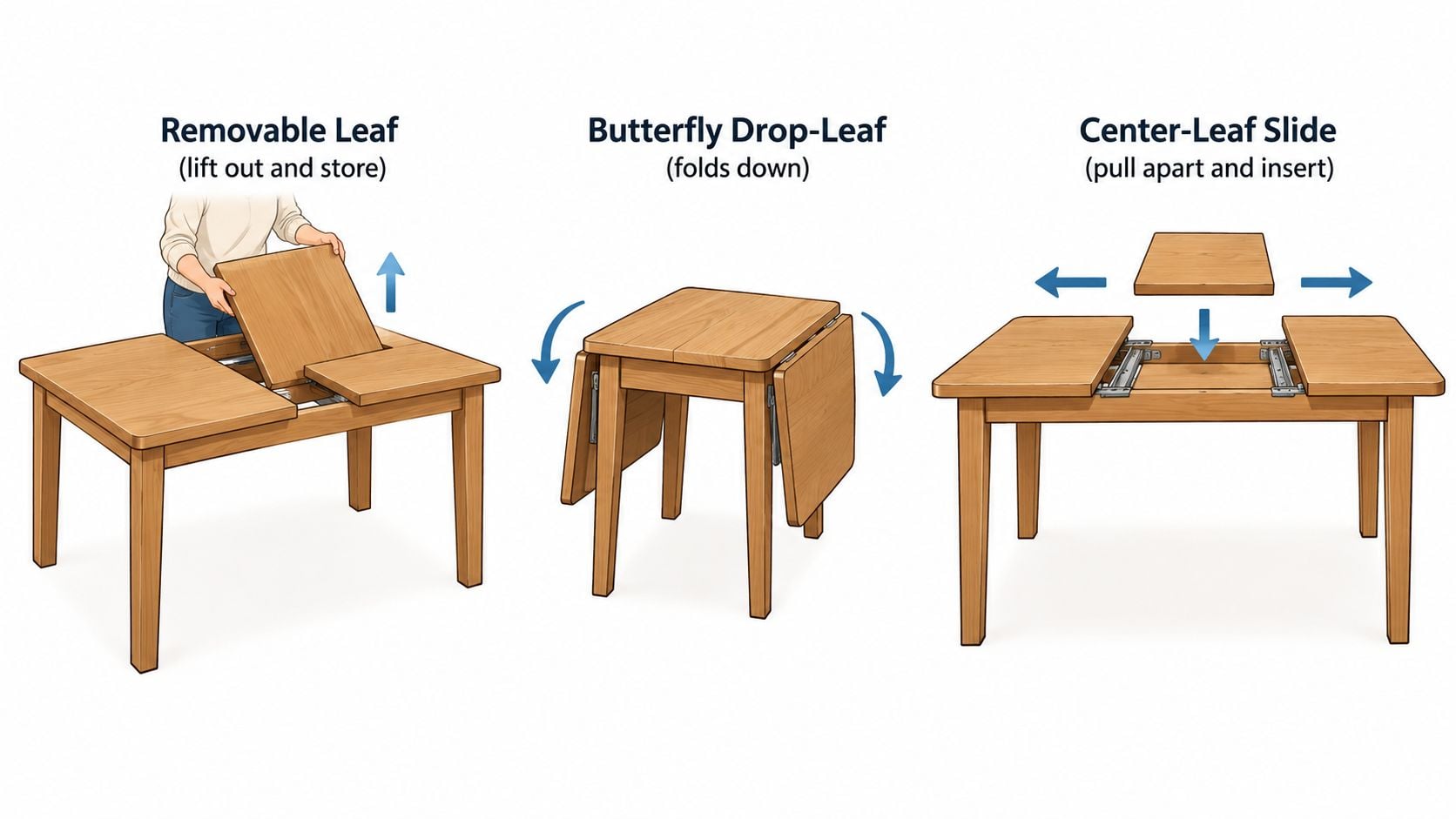
An extension table's mechanism determines how it opens, where its leaf goes when it isn't needed, and how much setup the household must handle. The main designs are easier to understand when pictured as three simple actions: add a separate piece, unfold a hinged piece, or pull the tabletop apart to make room for an insert.
Removable leaves
With a removable-leaf design, the tabletop separates and one or more inserts fit into the opening. The insert may be called a leaf. Depending on the design, it needs to be stored somewhere outside the table when the table is closed. That arrangement can be straightforward, but it's only convenient if the leaf has a safe, accessible storage place.
Butterfly drop-leaf designs
A butterfly leaf folds beneath the tabletop when it's not in use, then unfolds into place as the table opens. Its hinged movement is a little like opening a pair of wings. Because the leaf stays attached, there's no separate insert to find, though the folding mechanism adds moving parts that should open and close smoothly.
Center-leaf slide mechanisms
A center-leaf table works by separating its tabletop halves along a track and placing a separate leaf in the opening. Unlike a butterfly leaf, that insert doesn't remain hinged beneath the top. Buyers should check whether the leaf stores inside the table or needs an external storage spot; if it's kept elsewhere, it should have a dry, accessible home (how center-leaf extension tables work).
The terminology can be confusing: self-storing means the leaf stays with the table, while an externally stored leaf must be brought out and fitted when needed. A salesperson can show the opening process, but the buyer should also ask where each piece goes when the table is closed. That simple question can reveal whether the design fits the household's storage habits.
Comparing Extension Types and Their Trade-Offs
The most convenient mechanism isn't automatically the best one. A design with more moving parts may make expansion easier, but it also brings more pieces that need to stay aligned and work properly. A simpler removable leaf can suit a household that expands the table occasionally and has a good place to store the insert.
| Mechanism | How It Works | Storage | Best For |
|---|---|---|---|
| Removable leaf | The top separates and a separate insert fits between the halves. | Usually stored outside the table unless designed otherwise. | Buyers who want a straightforward system and have room for the leaf. |
| Butterfly leaf | A hinged leaf folds out from beneath the tabletop. | Stays attached beneath the table. | Households that value integrated storage and quick access. |
| Center-leaf slide | The top moves apart on a track and a separate leaf fills the opening. | May be self-storing or require external storage. | Buyers who prefer a separate insert and can confirm its storage arrangement. |
A consumer-trend analysis reports that assembly challenges were the leading complaint associated with extendable sets, representing 17.9% of complaints (consumer-trend analysis of dining tables). That figure is a useful reminder to evaluate the entire table, not just the extension idea. A complicated mechanism isn't automatically a more reliable one, and a design that feels awkward in a showroom may become frustrating at home.
Match the mechanism to the routine
Consider how often the table will open. A household that hosts frequently may prefer a leaf that stays with the table, while someone who expands it only occasionally may be comfortable storing a separate insert. Either way, the table should open without force and close without a struggle.
The same reasoning applies to stability and repair. Ask how the leaf locks, whether replacement parts are available, and what support the extended top receives. Durable furniture that can be maintained and repaired may remain useful longer than a table that's replaced because its mechanism no longer works.
Room shape and seating layout also influence the decision. A guide to dining-table shapes and seating arrangements can help clarify whether a particular table form makes sense for the space before the mechanism becomes the deciding factor.
How to Measure Your Room for an Extended Table
A table that fits when closed may crowd the room when open. Measure the available space in both configurations before choosing a model, and include the area chairs need when people sit down and stand up. The table's extended footprint matters as much as its everyday size.
Start with the room's usable dimensions
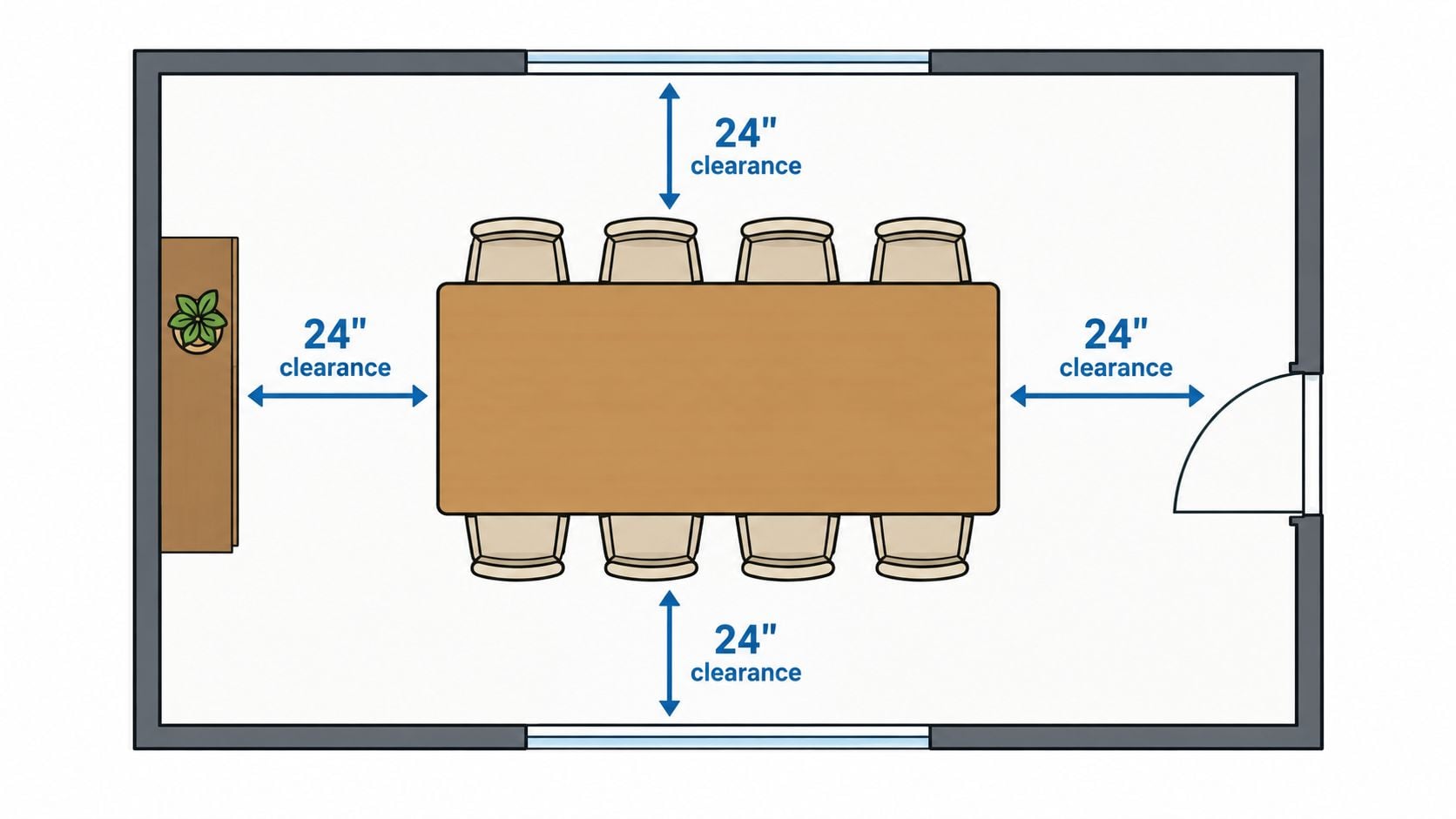
First, measure the clear length and width of the dining area, noting door swings, cabinets, and the routes people use to pass through the room. Then mark the table's closed footprint and its fully extended footprint on a floor plan or with tape. Don't measure only the tabletop: a table that opens but leaves nowhere to pull out chairs won't function well.
Plan on at least 24 inches (61 cm) of table-edge length per diner; 28–30 inches (71–76 cm) allows more elbow room for place settings and glassware (dining-table sizing and clearance guidance). A rectangular table about 72 inches long can accommodate roughly six diners, while a 96-inch configuration generally supports eight to ten, depending on leg placement and chair width.
Check clearance on every side
Keep at least 36 inches (91 cm) between the table edge and nearby walls, cabinets, or furniture so chairs can be pulled out. Where people need to walk behind seated guests or serving traffic is frequent, 42–48 inches (107–122 cm) is more practical. These clearances need to work with the table open, not just in its smaller everyday arrangement.
For example, a 90-inch table with 36 inches of clearance at each end needs about 162 inches, or 13 feet 6 inches, of clear length (extending-table clearance example). That calculation covers the table and end clearances, so the rest of the room still needs to accommodate chairs and traffic.
For a useful planning sequence, measure the room, subtract twice the clearance needed, then compare the remaining dimension with the table's fully extended length. A guide to measuring a room for furniture can help organize those measurements. Once the table size is settled, a sizing guide for entertaining hosts can help with choosing a cloth that suits an oblong table.
What to Check Before You Buy
A showroom test should include more than looking at the finish. The extension mechanism affects how the two tabletop halves meet, how much effort opening requires, and how steady the table feels once it's extended. A careful inspection can surface issues before the table reaches the home.
Run the mechanism through its full motion
Open and close the table repeatedly. Notice whether the slides move smoothly, whether the halves travel evenly, and whether the center joint remains flush when the table is closed. Measure the closed and extended lengths, then compare them with the stated specifications.
Check these details while the table is open:
- Seam and alignment: Press lightly near the center joint and check that the surfaces meet evenly.
- Side-to-side movement: Test for lateral wobble rather than assuming a heavy table will be stable.
- Support and locking: Ask about the support rails, center supports, positive leaf locks, and whether the slides move together or independently.
- Leveling: Check whether an adjustable leveler is included and ask how the table should be set up on the home's floor.
- Leaf storage: Confirm where the insert goes and how it should be protected when stored separately.
The slide system matters because a split tabletop travels apart on runners to create an opening for the leaf. Well-designed supports and locks can help reduce racking, uneven joints, and deflection under place settings (extension-table construction and care guidance).
Ask about wood movement and assembly
Solid wood expands and contracts across the grain as humidity changes. That seasonal movement isn't automatically a defect, but a binding mechanism, uneven gap, or joint that won't sit flush deserves attention. The tabletop and leaves shouldn't be rigidly fastened in a way that prevents normal wood movement.
For a custom hardwood table, get the details in writing: leaf storage, finish matching, support design, and the intended maximum seating load. Buyers comparing table height and legroom can also use this guide to choosing dining room chairs to make sure the chairs pair comfortably with the table.
Styling and Maintaining Your Extension Table
A table should look intentional in its everyday arrangement and remain useful when extended. Keep the closed setup uncluttered enough that the room feels comfortable, then plan where serving pieces, extra chairs, and table linens will go when the gathering grows. That practical preparation can make the transition feel simple instead of rushed.
For a separate leaf, choose a dry place where it won't be knocked against other furniture or exposed to damaging conditions. Keep any locking pieces with the insert, and make sure the leaf can be carried to the table without moving heavy items out of the way. Before an event, test the extension and check that the surface and joints are ready for use.
Give wood room to respond to the season
In Upstate New York, indoor conditions change with the seasons. Solid wood can expand and contract as humidity changes, so avoid treating every small seasonal variation as a mechanical failure. Follow the furniture maker's care instructions, clean the surface with suitable products, and use protective pads or other surface protection when the table is in use.
The mechanism also benefits from occasional attention. Open and close the table to confirm that it still moves smoothly, and check whether the leaf, locks, and supports remain aligned. If movement becomes stiff or the seam no longer sits level, ask a furniture professional to assess the cause rather than forcing the parts together.
A guide to caring for wood furniture can help owners build simple care habits. For homeowners in Freehold and across the Greater Albany Capital Region, a durable table can be part of a broader home plan: Tip Top Furniture & Mattresses offers dining furniture, custom ordering, professional design services available since 1984, and flooring options for coordinating the room.
Frequently Asked Questions About Extension Tables
Can leaves stay inside the table?
Some tables are designed to store their leaves within the structure, while others require external storage. Confirm the design before buying, and ask how the insert should be positioned and protected. If it needs a separate spot, choose one that's dry and accessible so the leaf doesn't become difficult to retrieve.
How much clearance should be left around the table?
At least 36 inches between the table edge and nearby obstacles gives chairs room to move. More space is useful where people need to pass behind seated guests or carry serving dishes. Check the clearance in both the closed and fully extended positions, including around doorways and common walkways.
Does an extension table take up more usable room?
Yes, when it's open, the larger footprint uses more of the room. The extra seating can be worthwhile, but only if chairs can pull out and people can still move through the space. Marking both table sizes on the floor before purchase can show whether the open arrangement is practical.
How many people can an extension leaf add?
A 20- to 24-inch leaf may often create room for about two people, based on a planning estimate of roughly 24 inches of table edge per diner. The actual number depends on chair width, leg placement, seating arrangement, and whether anyone sits at the ends. Check the table's capacity in both its closed and extended configurations rather than relying on a single advertised seat count.
Is a more elaborate mechanism always better?
No. Convenience matters, but extra moving parts can also mean more alignment requirements and potential repair points. A good fit is the design that opens smoothly, stays stable, stores its leaf appropriately, and suits how the household uses the room.
Tip Top Furniture & Mattresses is a family-owned Freehold showroom serving homeowners across the Greater Albany Capital Region, with dining furniture, custom options, design services, delivery, and flexible financing. Visit Tip Top Furniture & Mattresses to explore extension-table choices and get help planning a table that fits both the room and the way it's used.