How to Measure a Room for Furniture Perfectly


Measuring a room for furniture sounds simple enough, right? Use a tape measure to get the room's length and width, then measure key features like doorways, windows, and ceiling height. But this simple act is what prevents costly mistakes and ensures your new furniture feels perfectly at home in your Capital Region home.
Why Accurate Measurements Are the Foundation of Great Design
Before you fall in love with a new sofa in our Freehold, NY showroom, the most important first step happens right at home. As a family-owned business serving the Greater Albany Capital Region since 1978, we know that learning how to measure a room for furniture is about more than just making sure a piece physically fits; it's the secret to creating a space that feels balanced, functional, and truly inviting.
With over 45 years of experience helping families from Schenectady to Troy, we've seen firsthand how a few precise numbers prevent the disappointment of a poorly scaled room. Getting the dimensions right is the key to mastering proportion and creating clear, comfortable traffic flow. It’s what turns a simple room into a thoughtfully designed home.
More Than Just Fit—It's About Feel
Accurate measurements are the language of good design. They help you understand the scale of your space, preventing you from choosing a tiny loveseat that gets lost in a large living room or an oversized sectional that completely overwhelms a smaller one. This foundational step informs every single decision that follows.
A well-measured room is the difference between furniture that's just in a room and furniture that makes the room. As your local experts, we know it ensures harmony between your pieces and the space they occupy.
When you have the correct dimensions, you can confidently plan your layout. This includes:
- Creating Functional Walkways: Making sure there's enough space to move around comfortably without bumping into corners.
- Balancing Scale and Proportion: Choosing pieces that complement each other and the room's architecture.
- Planning for Clearance: Leaving room for doors to swing open, drawers to pull out, and recliners to fully extend.
These details might seem small, but they have a massive impact on your daily life. A well-planned room just feels effortless and intuitive. For homeowners just starting out, understanding these principles is a great first step; you can explore more about where to begin with your home design in our detailed guide.
Taking the time to measure properly now saves you from headaches later. Our Professional Design Services, a cornerstone of Tip Top since 1984, can help turn those measurements into a stunning, practical reality.
Get Your Measurement Toolkit Ready
Before you even think about measuring, you need to gather the right gear. A little prep work here saves a ton of headaches and ensures the beautiful pieces you find in our Freehold showroom will actually fit where you imagine them. Think of it as your interior design mission prep.
Here’s a quick rundown of what you’ll need to get started.
Your Room Measurement Toolkit
| Tool | Why It's Important | Pro Tip from Tip Top |
|---|---|---|
| Locking Metal Tape Measure | You need a sturdy, locking metal tape measure that’s at least 25 feet long. Fabric ones sag, giving you bad numbers. The locking feature is a lifesaver when you're working alone. | Pull the tape taut across long distances to avoid any slack, which can throw your measurements off by a surprising amount. |
| Notepad & Pencil | The classic for a reason. There’s nothing better for quickly sketching a rough floor plan and jotting down dimensions on the fly. | Draw a simple "bird's-eye view" of your room, noting where doors and windows are before you even start measuring. |
| Smartphone Camera | Your phone is a secret weapon here. Snap photos of everything—outlets, light switches, weird corners, air vents. These visual cues are invaluable later. | Take a slow panoramic video of the room. It helps you recall the space's flow when you're back at the store. |
| Painter's Tape | This is optional but highly recommended. It’s perfect for marking out the footprint of a sofa or table directly on your floor. | Use different colors of tape to map out multiple furniture pieces to see how they interact in the space. |
Advanced Tools for a Perfect Fit
If you're tackling a big project or planning a room with custom Amish furniture, a laser measure can be a fantastic upgrade. It gives you pinpoint accuracy with the click of a button, which is especially handy for tall ceilings or long walls where you don’t have an extra set of hands.
Pro Tip from Tip Top: Use a roll of painter's tape to outline the footprint of potential furniture directly on your floor. This simple trick helps you visualize not just the fit, but also the traffic flow around the piece before you commit.
Having all your tools ready means you can capture every detail in one go. You won't have to stop, lose your place, or worse, forget a crucial measurement.
Once you have your room’s dimensions, the next step is figuring out the size of the furniture itself. For that, check out our guide on how to measure different types of furniture. Combining both sets of measurements is the secret to a perfectly balanced space in your Capital Region home.
How to Capture Your Room's Core Dimensions
Alright, you've got your tools ready. Now it's time to get the numbers that will define your new space. This can feel like the most tedious part of the process, but as your local experts, we know getting it right now saves a world of headache later. We'll walk through it just like our designers do when they visit a home in the Albany area.
Start with the big picture: the room's overall footprint. Grab your tape measure (and a helper if you can—it makes wrangling a long tape measure so much easier) and measure the main length and width of the room, from one wall directly to the other.
A pro tip we always share: take each of these wall-to-wall measurements at three different heights—once near the floor, once around the middle, and once up near the ceiling. If you get slightly different numbers, always use the smallest one. Older homes, especially around the Albany area, are famous for walls that aren't perfectly plumb.
This simple infographic breaks down the essential flow: measure, note, and then visualize.
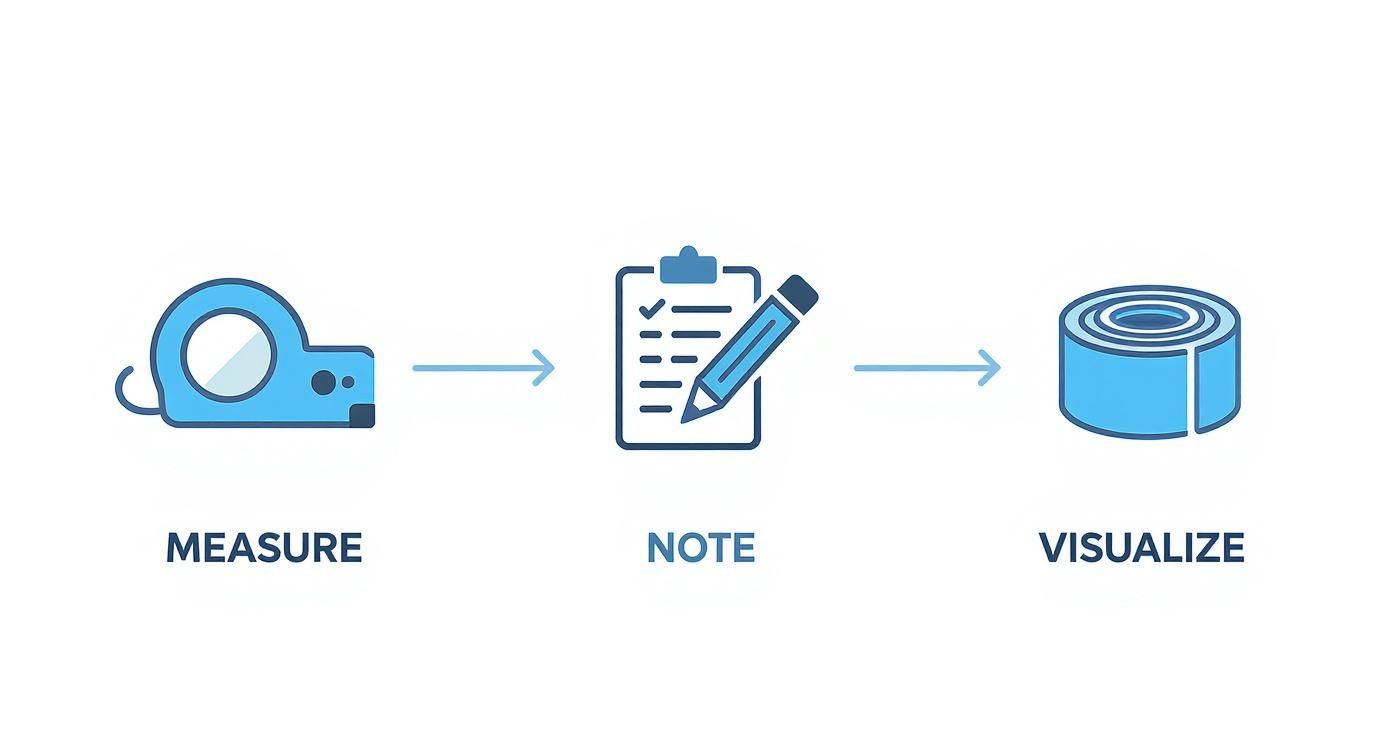
Following these core ideas ensures you won't miss a thing, from the main layout to the smallest fixture that could get in the way.
Documenting Doors, Windows, and Fixtures
With the basic outline done, it's time to zoom in on all the things that break up your walls. These are the critical details that truly dictate where furniture can—and can't—go. This is especially true for taller pieces like bookcases or entertainment centers.
For every architectural feature in the room, you’ll need to jot down a few specific numbers:
- Doors and Entryways: Get the width and height of the doorway itself. Crucially, don't forget to measure how much space the door needs to swing open!
- Windows: Note the width and height of each window. Just as important is the distance from the floor up to the bottom of the windowsill. This tells you if a console table or the back of a sofa will fit neatly underneath.
- Permanent Fixtures: This includes anything that's not moving, like radiators, fireplaces, built-in shelves, or little architectural nooks. Get their height, width, and depth, and mark down exactly where they sit on the wall.
Expert Tip: As you sketch your room, mark the exact locations of light switches, electrical outlets, and heating vents. There's nothing worse than getting a beautiful new media console home, only to find it completely blocks the only usable outlet on that wall.
Understanding Furniture Dimensions
When you start shopping, you’ll see dimensions listed in a specific way. The industry standard is always width, then height, then depth (W x H x D). This consistency helps everyone from the Amish craftsmen who build our furniture to our designers in Freehold communicate clearly. It’s what ensures the piece you're eyeing will actually fit. You can discover more insights about these furniture measurement standards to feel even more confident while you browse.
Finally, don't forget to look up! Measure your ceiling height. It's a step so many people skip, but it's absolutely essential for getting the scale of the room right. Your ceiling height determines what size lighting, wall art, and tall furniture will look best. A low ceiling can make a tall bookcase feel overwhelming, while a high ceiling can handle grander, more substantial pieces. This vertical measurement is every bit as important as the floor plan for creating a space that feels balanced and complete.
Planning for People and Traffic Flow
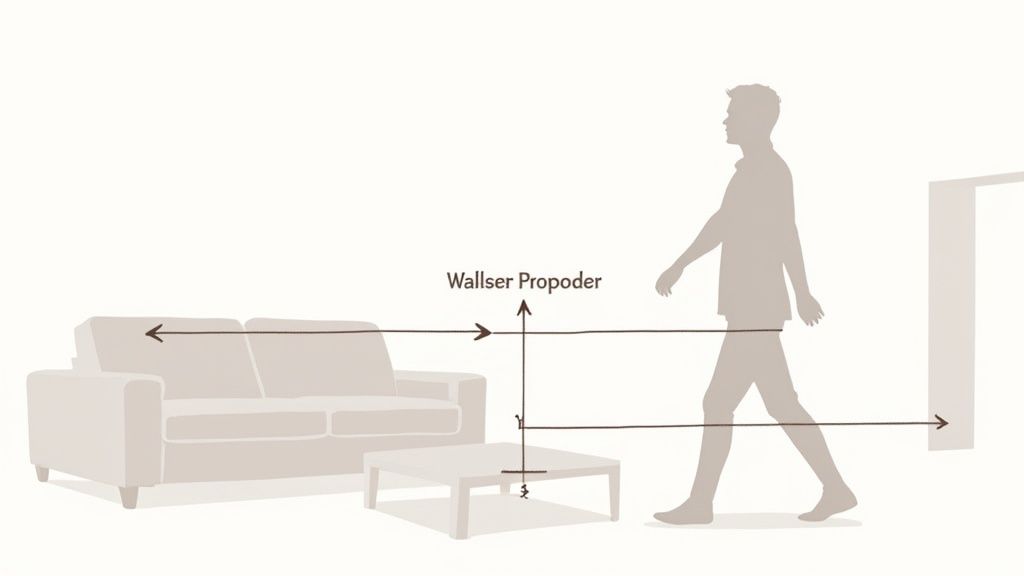
Here's a secret that can make or break a room's design: just because a piece of furniture technically fits between two walls doesn't mean it actually works in the space. The real magic happens when you plan for the people who will actually be living there. This step is all about making sure you can move around freely without bumping into corners or squeezing past the sofa.
This isn't a new concept, either. Designers and architects figured out a long time ago that for a home to feel right, the room's layout and its furniture have to work together. It’s a principle we still rely on heavily today.
Creating Clear Pathways in Your Albany Home
The first thing to consider is traffic flow—the natural paths people take when they walk through a room or head for a doorway. You need to keep these main arteries clear to avoid creating frustrating bottlenecks.
- Main Walkways: For any primary path, like the route from a hallway to the sofa, aim for at least 30 to 36 inches of clear space.
- Minor Walkways: For smaller, less-used paths, you can usually get by with a minimum of 18 to 24 inches.
Think of these as invisible hallways inside your room. Blocking them with a poorly placed chair is a surefire way to make the entire space feel awkward and cluttered.
Spacing Your Furniture for Comfort
Once you’ve mapped out your walkways, it’s time to think about the "zones" where you'll sit and relax. The spacing between furniture pieces is just as important as the pathways around them. The goal is to make conversation easy and keep everything within arm's reach.
Our Pro Tip: We always advise clients to keep seating close enough for a good conversation but far enough apart so everyone has a bit of personal space. A good rule of thumb is to leave between 3.5 and 10 feet between a sofa and an accent chair.
Here are a few other key measurements our design team uses every single day:
- Sofa to Coffee Table: The sweet spot is between 16 and 18 inches. This is close enough to set down a drink or prop up your feet, but still gives you enough legroom.
- Dining Chair Clearance: Make sure there are at least 24 inches of open space behind each dining chair. This lets guests pull their chair out and stand up without bumping into a wall or another piece of furniture.
- Drawer and Cabinet Access: If you're adding a dresser or chest, pull a drawer all the way out, measure that distance, and then add a few more inches. You need room to stand in front of it and actually get things out!
Nailing these little details will transform your room from just functional to truly comfortable and livable. For more layout inspiration, check out our guide on how to arrange living room furniture for some great visual examples.
Common Measuring Mistakes to Avoid in the Capital Region
With over 45 years of helping families in the Greater Albany Capital Region furnish their homes, we've seen a few common measuring missteps that can cause major headaches. It’s one thing to know how to measure your room, but it's another thing entirely to know the little traps that can trip you up.
Here are the most frequent errors we see and, more importantly, how you can sidestep them.
Forgetting About Baseboards and Trim
This one seems so simple, but it’s probably the most critical mistake we see. People measure from wall to wall, but they forget about the architectural details that jut out and steal precious inches—things like baseboards, chunky window sills, and door trim.
A beautiful media console that fits the wall-to-wall measurement on paper might not sit flush once you realize your baseboard is taking up 1/2-inch to 1-inch of that space. Always get down low and measure at floor level, between the baseboards, to find out the true usable space you're working with.
Neglecting the Delivery Path
This is the big one. You've measured your room perfectly, and the heirloom-quality Amish armoire you’ve fallen in love with is the ideal fit. But how are you going to get it into the room? So many people forget to measure the "delivery path"—the entire journey the furniture has to take from our truck to its final spot.
You absolutely have to measure:
- Doorway Width and Height: Don't just measure the room's door; measure the front door, too.
- Hallway Width: Pay close attention to any tight corners or awkward turns.
- Stairwell Clearance: Measure the width, of course, but also the height at the lowest point, especially if you have a slanted ceiling.
A gorgeous new sofa isn't much use if it's stuck in your stairwell. Taking these extra measurements is the key to a smooth, stress-free delivery day from our trusted team.
Only Measuring Floor Space
It's natural to focus on length and width, but don't forget to look up! Vertical space is just as crucial for creating a room that feels balanced and harmonious. Forgetting to measure your ceiling height can lead to pieces that feel either comically small or overwhelmingly large for the space.
At Tip Top, we remind our customers that scale is everything. A tall bookcase might technically fit under an 8-foot ceiling, but it could easily dwarf every other piece in the room and throw off the entire vibe.
Thinking about scale isn't new; historical furniture dimensions were often tied to the architecture of the time. A trestle table in the 15th century could be 22 feet long, demanding a truly grand hall. While our tables are a bit more practical for modern homes, the principle holds true: the furniture has to match the scale of the room.
Making these little checks prevents some pretty big problems down the road, especially when you're investing in a piece you plan to love for years. For more tips on arranging your main pieces, check out our guide on calculating the best placement for your sofa and television.
Bring Your Plan to Our Capital Region Experts
Okay, you did it. With your detailed measurements and sketches in hand, the most exciting part of the journey is about to begin. This is where all that careful planning starts to feel real, turning into a beautiful, functional space you'll love coming home to. For over 45 years, our family has been right here in the Greater Albany Capital Region, helping homeowners do exactly that.
Armed with your new measuring skills, you can start playing around with ideas right away. A fantastic starting point is our Free Online Room Planner. It’s a great tool for arranging virtual furniture to see how different layouts might feel in your space. You can perfect your design and build a ton of confidence before you even set foot in our showroom.
Let Our Family Help Yours
When you're ready for a more personal touch, we’d love for you to visit us at our Freehold, NY showroom. Our team is here to help you navigate our incredible selection of furniture, from heirloom-quality Amish pieces to durable, USA-made mattresses. We know the unique character of homes in this area—from Albany to Schenectady—and can offer practical, trustworthy advice that comes from decades of local experience.
Since 1978, our goal has been simple: to provide attentive, expert guidance without the pressure. We believe in building relationships and helping our neighbors create homes that will be enjoyed for generations to come.
Professional Guidance Makes It Easy
Feeling a bit overwhelmed or just want an expert eye on your project? Our Professional Design Services are the perfect next step. Since 1984, our designers have worked with customers to coordinate everything from furniture and decor to flooring, creating a cohesive and polished look. They can take your measurements and help you discover pieces that not only fit perfectly but also truly reflect your personal style.
We also make it simple to bring your dream home to life without breaking the budget. Our flexible financing options are designed to make any project affordable, ensuring you don’t have to compromise on quality or style. So bring us your plans, your ideas, and your measurements. Together, we’ll create a space that is perfectly suited to you and your family.
At Tip Top Furniture & Mattresses, we're more than just a furniture store; we're your local partner in creating a home you love. Visit us online to start exploring our collections today.