Best Mattress for Light Sleepers: An Upstate NY Guide


A lot of people in the Albany area walk into a mattress showroom with the same complaint. They aren't sleeping badly because they picked a “cheap” bed. They're sleeping badly because every small thing wakes them up. A partner shifts. The frame clicks. A shoulder gets sore. The room gets warm. Sleep breaks apart, even when the mattress looked fine in a quick online review.
That's why the best mattress for light sleepers usually isn't the one with the loudest marketing or the most aggressive “universal comfort” claim. Light sleepers need a bed that handles subtle problems well. Some are light sleepers because they wake easily. Others are physically lightweight, which changes how a mattress feels under the body. Many people are both.
In Freehold and across the Greater Albany Capital Region, mattress shopping gets easier when those two issues are separated first. A lighter body often needs more pressure relief than standard advice suggests. A sensitive sleeper also needs a quiet, stable sleep setup from the mattress down to the base. Since 1978, family-owned local guidance has mattered because real mattress fitting isn't just about lying down for 30 seconds. It's about finding the setup that stays comfortable and quiet after the showroom visit is over.
Table of Contents
- Why Light Sleepers Need a Different Kind of Mattress
- The 5 Key Mattress Features for Undisturbed Sleep
- Mattress Types Decoded for Capital Region Homes
- The Tip Top Advantage Finding Your Perfect Match in Freehold
- Beyond the Mattress Bedding and Toppers for a Quieter Bed
- Your Light Sleeper Questions Answered
Why Light Sleepers Need a Different Kind of Mattress
A light sleeper doesn't need a mattress that's merely “comfortable.” That sleeper needs a mattress that prevents disruptions before they start. That's a different assignment.
Two different problems get lumped together
The phrase light sleeper gets used for two separate issues:
- Sleep-sensitive light sleepers wake up from motion, noise, temperature shifts, or a partner getting in and out of bed.
- Lightweight sleepers don't put enough body weight into the mattress to activate firmer comfort layers the way an average-weight sleeper does.
Those shoppers often get the same generic advice. That's a mistake. One person may need stronger motion control. Another may need more surface give at the shoulders and hips. A third may need both.
Practical rule: The first question isn't “What mattress is popular?” It's “What actually wakes the sleeper up?”
That changes the whole buying process.
Why generic mattress advice fails
A lot of mattress advice is written for an average sleeper. That's the problem. If a mattress feels balanced to someone with more body weight, it can feel too firm and unresponsive to someone much lighter.
The result is familiar. The sleeper doesn't sink in enough, pressure builds at the shoulder or hip, and small discomforts become repeated wake-ups through the night. Then the mattress gets blamed for “not being soft enough” or “not being supportive enough,” when the problem is a mismatch between body weight, sleep position, and construction.
For shoppers in Albany, Schenectady, Troy, and the surrounding Capital Region, this matters even more during in-person testing. A quick sit on the edge of the bed tells almost nothing. Light sleepers need enough time on the mattress to notice pressure points, subtle bounce, and any sound coming from the frame underneath.
A better mattress search starts with a blunt conclusion. The best mattress for light sleepers is rarely the most standard mattress in the room. It's the one that responds to lower body weight, stays quiet under movement, and works with the full bed setup, not just the comfort layer on top.
The 5 Key Mattress Features for Undisturbed Sleep
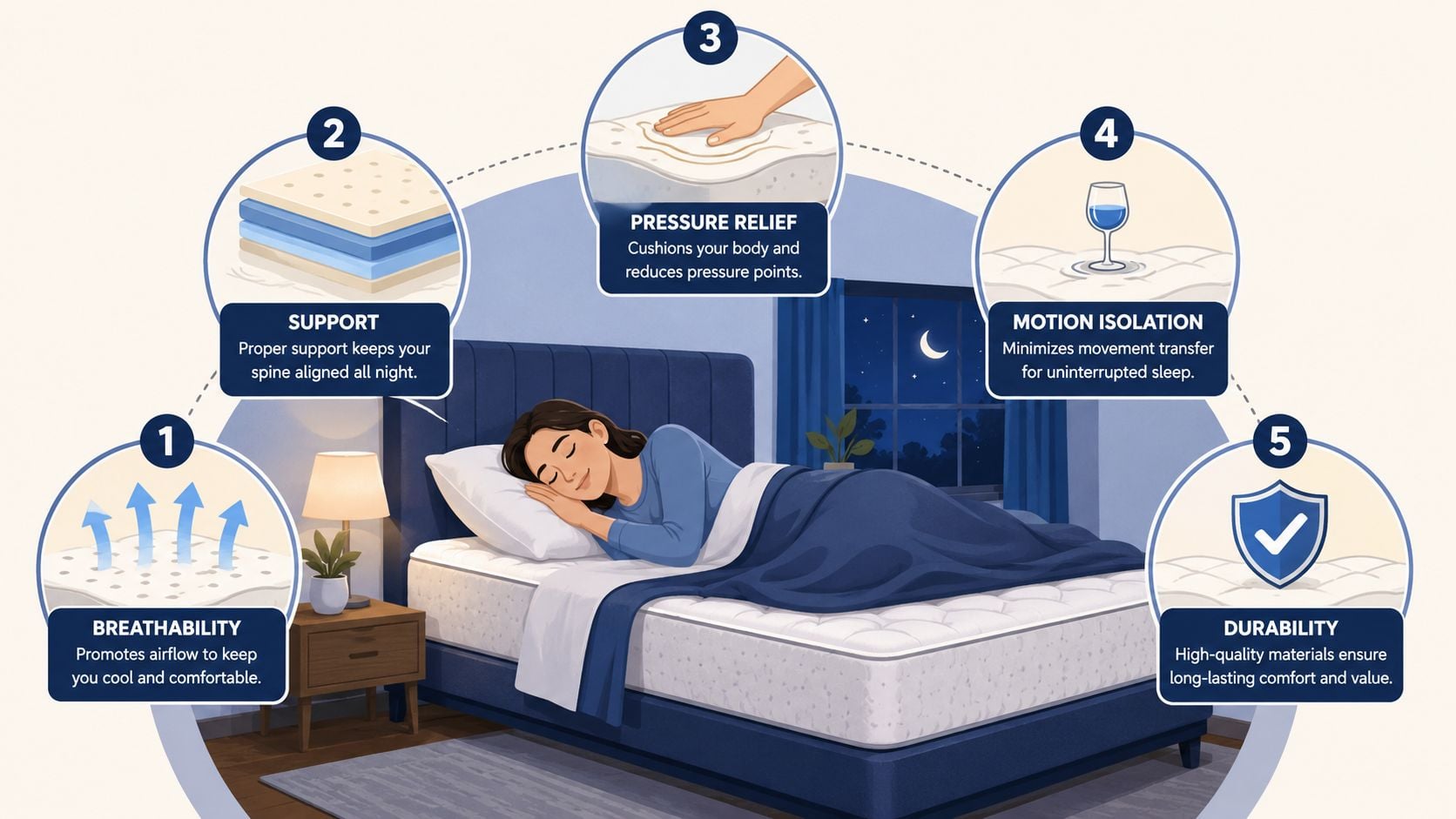
Light sleepers do not need a mattress with the longest feature list. They need a bed that stays quiet, cushions the right spots, and keeps small disturbances from turning into full wake-ups.
What matters most when sleep breaks easily
Start with the features that affect what a light sleeper feels at 2 a.m., not what sounds impressive on a tag in the showroom.
Motion isolation is the first filter for couples. If movement travels across the mattress, the lighter sleeper pays for it. Foam comfort layers usually absorb motion well. Pocketed coils can work too, but only if the comfort layers above them are doing their job.
Noise reduction needs a full-bed check, not a mattress-only check. Sleep guidance from the Sleep Foundation notes that noise in the bedroom can trigger sleep disruptions and more nighttime awakenings, which is why light sleepers should test the mattress, foundation, and frame together for squeaks, shifting, and vibration (how noise affects sleep quality). National bed-in-a-box reviews usually skip this part. In a local showroom, you can actually lie down, roll, sit, and listen.
Pressure relief is a deal breaker for lighter bodies. If the surface does not give enough at the shoulders and hips, the sleeper keeps adjusting all night. That kind of low-grade discomfort is one of the most common reasons a mattress feels fine for five minutes and wrong by morning.
Temperature regulation matters because overheating causes shallow, broken sleep. Breathable covers, open-cell foams, latex, and coil systems with room for airflow usually sleep calmer than dense, heat-trapping builds.
Edge support affects more than sitting on the side. For couples, weak edges can make the bed feel smaller and less stable. A light sleeper near the perimeter will notice that drifting, tilted feeling right away.
If you want to sort out feel before you test beds in person, this mattress firmness guide gives a useful baseline.
The firmness mistake lighter sleepers make
The most common mistake is choosing a mattress that is too firm because someone repeated the old “medium-firm works for everyone” line. It does not. Lighter sleepers often do better on surfaces with more immediate pressure relief because they do not weigh enough to engage a firmer comfort system the way an average-weight sleeper does.
Guidance for lightweight sleepers points to softer comfort ranges and more flexible materials, including lighter-gauge pocketed coils and pressure-relieving foam or latex, because those constructions respond more easily under a lighter body.
A mattress has to respond when the sleeper lies down.
If the bed stays flat and pushy under a lighter body, support turns into pressure.
Here is the showroom checklist I give shoppers who wake up easily:
- Lie in your real sleep position, not flat on your back if that is not how you sleep at home.
- Stay there long enough to notice your shoulders and hips. Those spots usually reveal a bad fit first.
- Have your partner get in, turn, and get out of bed if you share the mattress.
- Listen to the base and frame for creaks, clicks, or rubbing sounds.
- Sit on the edge, stand up, and lie back down again to test stability and noise from the full setup.
That is the standard. Judge the mattress by its comfort and quiet performance in the complete bed setup.
Mattress Types Decoded for Capital Region Homes
A couple comes into the showroom after trying an online mattress that looked perfect on paper. By the third night, one partner is waking up every time the other rolls over, and the frame has started making a light clicking sound they never noticed before. That is common with light sleepers. The mattress type matters, but the way the whole bed works together matters just as much.

Foam, latex, innerspring, and hybrid
Here is the straight answer. Light sleepers usually do best with mattress types that absorb movement, cushion pressure points quickly, and stay quiet under changing weight.
| Mattress type | Where it tends to help | Where it can fall short for light sleepers |
|---|---|---|
| Foam | Excellent motion control, quiet surface, strong pressure relief | Can feel slower to move on, and some sleepers sleep warmer |
| Latex | Responsive comfort, better airflow, easier to change positions | Has more bounce, which some motion-sensitive sleepers notice |
| Innerspring | Familiar feel, easier movement, often better airflow | More motion transfer, more potential noise, often too firm on top for lighter bodies |
| Hybrid | Blends contouring with support, often a good pick for couples | Performance depends heavily on coil design, comfort layers, and the base underneath |
If you want the simplest recommendation, start with foam or a well-built hybrid. Those two categories solve the biggest problems light sleepers bring into the store.
Traditional innersprings are usually a harder fit. Many feel fine for two minutes and too pushy after ten, especially for lighter side sleepers who need the surface to give at the shoulder and hip. Latex can be a very good choice too, especially for shoppers who dislike the slow feel of memory foam and want a cooler, springier surface.
If you want a broader breakdown of constructions before you shop, this mattress types explained guide gives a clear overview.
Why the base matters as much as the mattress
This is the part national bed-in-a-box reviews usually miss. A light sleeper does not experience a mattress by itself. They experience the mattress, the foundation, the frame, the slats, and sometimes the floor under all of it.
That is why a good showroom conversation should cover the full setup at home, including:
- What kind of base is under the current mattress
- Whether the slats are solid and spaced correctly
- Whether the frame already squeaks or shifts
- Whether an adjustable base is part of the plan
- Whether the bedroom is in an older home where floor movement can add vibration
A quiet mattress placed on a noisy setup will still wake a light sleeper.
In the Capital Region, that comes up all the time. Older homes can have a little floor flex. Older frames can click at the joints. A mattress that feels calm in a quick online review can behave very differently once it is sitting on the wrong support system. That is why in-store testing with local guidance matters. You can check the mattress feel, the motion response, and the bed's noise as one system instead of guessing from a product page.
The Tip Top Advantage Finding Your Perfect Match in Freehold
Buying a mattress online is easy. Buying the right mattress is harder. Light sleepers usually figure that out after a few restless weeks.
Why in-person testing still matters
A lightweight side sleeper, a back sleeper under average body weight, and a motion-sensitive couple don't need the same thing. Online quizzes flatten those differences. In-store testing exposes them quickly.
That's especially true when a shopper lies down long enough to feel what the mattress is doing. Surface softness can feel pleasant for one minute and wrong by minute ten. A hybrid can seem supportive until partner movement is tested. A frame can stay silent until someone shifts weight near the edge.
Shoppers who want to prepare before coming in can make the process easier with this mattress shopping guide.
What a better showroom process looks like
The strongest local advantage is guided testing. Instead of guessing based on internet buzzwords, shoppers can narrow the field by body type, sleep position, and what interrupts sleep at home.
A better process usually includes:
- Body-type matching so a lighter sleeper doesn't get steered automatically toward a firmer feel that never compresses properly
- Position-based testing because side, back, and combination sleepers need different pressure relief patterns
- Partner testing so motion and edge feel can be checked in real time
- Base evaluation to catch frame noise, slat issues, or support problems before the mattress is blamed
One practical option in the area is Tip Top Furniture & Mattresses, where shoppers can use a high-tech bed-matching system and test USA-made mattress options in person rather than guessing from a boxed delivery photo. That kind of process is useful for light sleepers because subtle differences in pressure relief and movement transfer are easier to feel than to predict.
The mattress that looks “close enough” on paper often feels obviously wrong once the right tests are done in person.
That local process also helps with bigger bedroom decisions. Many shoppers replacing a mattress are also updating the room, and that's where coordinated shopping can save time. A new bed often leads to a better frame, better support, or a full bedroom refresh, especially for households that want matching pieces and dependable delivery across Albany, Troy, Schenectady, and Greene County.
Beyond the Mattress Bedding and Toppers for a Quieter Bed
A new mattress isn't always the first move. Sometimes the current bed can sleep better with a few smart changes.
When a topper makes sense
A topper helps most when the mattress is still structurally sound but feels too firm, too lively, or slightly uneven in comfort. For a lighter sleeper, adding a softer top layer can reduce pressure at the shoulder and hip without replacing the entire mattress.
A topper can also help absorb some surface-level movement. It won't fix a bad support core or a squeaky frame, but it can soften the feel of a mattress that's waking the sleeper with minor pressure points.
Good topper use usually looks like this:
- Choose it to solve one clear problem such as firmness, pressure relief, or mild motion sensitivity
- Don't use it to rescue a worn-out mattress with sagging support
- Check sheet fit and protector fit so the bed doesn't bunch or shift at night
Bedding and room conditions that help light sleepers
Fabric matters more than people think. If a sleeper runs warm, heavy or less breathable bedding can trigger repeated wake-ups. Lighter, breathable materials are usually the safer choice for sensitive sleepers.
Sheets and comfort layers that breathe well can help the bed feel more stable through the night. Many shoppers also sleep better when protectors, comforters, and layering pieces are chosen to match the season instead of using the same setup year-round. This guide to bedding, mattress protectors, and comforters is a helpful place to sort out those choices.
Room air can matter too, especially during dry Upstate New York winters. For shoppers trying to improve the whole sleep environment, this article on sleeping with a humidifier for better sleep from Covenant Aire Solutions offers useful context on comfort and nighttime dryness.
A quieter bed isn't always about buying more. Sometimes it's about removing the small irritations that keep breaking sleep.
Your Light Sleeper Questions Answered
What if partners need different feels
One of the most common problems I see is a couple lying on the same mattress and feeling two different things. The lighter sleeper feels pressure at the shoulder or hip. The other sleeper says the bed feels too soft. You do not fix that by splitting the difference and hoping both people adjust.
The better answer is usually a split comfort setup, a custom order, or a mattress line that gives each side a different feel in the same shared size. For lighter side sleepers, softer comfort layers usually do a better job cushioning pressure points. For lighter back and stomach sleepers, a medium to medium-firm feel usually keeps the body from floating on top without support. The right choice depends on how each person rests, not what an online quiz spits out.
This is one place where testing in person matters. A good bed-matching system and a knowledgeable sales associate can spot pressure issues, support gaps, and motion problems much faster than a boxed mattress review can.
Can an adjustable base help
Yes, if it matches the mattress and the sleeper's habits.
For some light sleepers, a slight head or leg raise reduces pressure enough to cut down on tossing and turning. For couples, split adjustable bases can also reduce disturbance when one person wants to read, snore less, or change position without shaking the whole bed.
The base matters more than shoppers think. If the mattress, foundation, and frame do not work well together, you can end up with extra creaks, shifting, or flex that wakes a sensitive sleeper. That is why I always tell people to test the full setup, not just the mattress by itself on a showroom platform.
If pressure wakes you up, the right position can matter as much as the mattress feel.
How should shoppers think about budget
Start with the parts that affect sleep every night, then spend around those.
- Match the mattress to body weight and sleep position
- Cut motion transfer and noise
- Use a base that supports the mattress properly
- Choose comfort layers that ease pressure without swallowing the sleeper
After that, decide whether in-stock options, custom ordering, or clearance gives you the best value. Around Albany and Greene County, I've seen plenty of families save money by buying the right mattress once instead of replacing the wrong one a year later. If the goal is better rest overall, these 12 practical tips for better sleep are worth reading too.
If allergies, congestion, or dust are part of the problem, the mattress may only be half the story. This article on indoor air quality for allergy sufferers is a smart companion read.
Shoppers looking for the best mattress for light sleepers can explore options at Tip Top Furniture & Mattresses, visit the Freehold, NY showroom, ask about USA-made mattress choices, review custom-order possibilities for split comfort needs, or look into flexible financing and clearance pieces for a more affordable upgrade across the Greater Albany Capital Region.