Sleigh Bed Furniture Sets: A Complete Buying Guide


The bedroom photo looks right: a curved wood bed, matching nightstands, and a dresser that finally makes the room feel finished. Then the practical questions start. Will the frame make the turn upstairs, will the existing mattress work, and will the finished bed be comfortable to climb into? Sleigh bed furniture sets deserve a complete room plan, not just a finish selection.
Why a Sleigh Bed Set Looks Easier to Buy Than It Actually Is
An Albany-area homeowner browsing bedroom furniture can easily fall for the whole arrangement rather than evaluate each piece. The bedding hides the mattress support, the camera angle makes the footboard look compact, and nothing in the photograph shows the narrow landing outside the bedroom.
That's a useful shopping scenario, not an unusual design problem. A beautiful set still has to pass through the house, leave room for everyday movement, and work with the person sleeping in it.

Start With the Bedroom, Not the Catalog Arrangement
The sensible starting point is a short project file: room measurements, photographs of the delivery route, existing mattress information, and a list of storage needs. The guide to choosing bedroom furniture provides a useful starting framework for separating room requirements from decorative preferences.
A shopper shouldn't assume that everything pictured belongs in the purchase. A large dresser may be unnecessary when closets already handle folded clothing, while a smaller bedside cabinet may be more useful than the collection's oversized nightstand.
- Record daily habits: Note where clothing gets stored, where a phone charges, and which side of the bed provides the easiest access.
- Identify nonnegotiables: Keep essential storage, comfortable bed access, and an unobstructed route to the doorway ahead of ornamental extras.
- Separate the purchases: Ask for the bed frame, mattress support, mattress, storage pieces, and delivery to be identified individually.
Practical rule: The right set is the one that works with the room and the sleeper, not the one that most closely reproduces the showroom display.
Make the First Showroom Visit a Working Appointment
For homeowners traveling from Schenectady, Troy, or elsewhere in the Greater Albany Capital Region, bringing that project file to Freehold makes the visit more productive. Staff can evaluate actual constraints rather than guess from a description.
The first decision shouldn't be whether the finish is dark enough. It should be whether the proposed arrangement solves the bedroom's real problems without introducing new ones.
What Defines a Sleigh Bed and What Belongs in the Matching Set
A sleigh bed is defined by its curved or scrolled headboard and footboard, which resemble the profile of a horse-drawn sleigh. The silhouette belongs to French and American Empire furniture traditions of the early nineteenth century, rather than being a recent showroom invention, as outlined in this history of the sleigh-bed form.
That heritage helps explain the style's sculptural character. A sleigh bed isn't a flat panel bed with decorative trim. Its appeal comes from the relationship between the sweeping ends, the rails, and the surrounding furniture.
Recognize the Silhouette Before Choosing the Ornament
Some shoppers prefer a pronounced outward scroll and substantial wood panels. Others want a gentler curve with less visual weight. Neither approach requires an entire room of elaborate furniture.
The useful showroom question is whether the bed's shape remains appealing without the styled bedding. Looking at the frame from the side makes the curve easier to judge; viewing it from the doorway shows how strongly it will dominate the room.
A coordinated set commonly carries the bed's wood finish, curves, and ornamental details into its case pieces. That shared design language matters more than repeating a scroll on every available surface.
| Component | Its Job in the Room | The Buying Decision |
|---|---|---|
| Bed | Establishes the main silhouette | Choose the curve and visual weight |
| Nightstands | Support bedside routines | Match storage to actual habits |
| Dresser | Holds folded clothing | Confirm usable drawer space |
| Mirror | Completes a dressing area | Keep it only if the placement works |
| Chest | Adds another storage option | Compare its usefulness with existing closets |
Buy the Pieces That Earn Their Place
A bench or media chest can be considered separately if available, but neither should become an automatic addition. A coordinated room doesn't need every component offered in a collection.
The stronger recommendation is to select the bed first, then build the storage arrangement around the household's needs. Matching nightstands can create a balanced appearance, but symmetry shouldn't take priority over an accessible bedside route.
For a smaller bedroom, restraint often produces the more comfortable result. A distinctive bed and carefully chosen case goods can preserve the character of sleigh bed furniture sets without making the room feel furnished beyond its capacity.
Materials, Construction, and Finish Choices That Actually Matter
A solid-wood label isn't enough to establish quality. Buyers should ask how the lumber was conditioned, how the components connect, and how the manufacturer allows for normal wood movement.
Wood exchanges moisture with indoor air. Furniture hardwood is commonly dried to approximately 6–8% moisture content, according to the USDA Forest Products Laboratory's guidance on wood drying and dimensional change. That makes moisture management a meaningful construction question for furniture heading into a seasonally heated Upstate New York home.
Judge the Assembly, Not Just the Surface
The most useful comparison starts with a material breakdown. Ask which parts are solid hardwood, which use veneer over a substrate, and which contain engineered panels. A vague answer such as “wood construction” doesn't provide enough information.
Solid hardwood, veneered panels, and engineered components should be evaluated by their intended role rather than ranked from a photograph. The buyer needs to know what supports the mattress, what holds the rails, what forms the drawer boxes, and what is primarily decorative.
- Solid hardwood: Ask how broad panels and curved components accommodate movement.
- Veneered surfaces: Request details about the underlying panel and the manufacturer's repair guidance.
- Engineered panels: Identify where they're used and how fasteners attach.
- Metal accents: Inspect attachment points and ask whether replacement decorative hardware is available.
- Drawer construction: Open the drawers fully, examine the joints, and check how the hardware is mounted.
The explanation of mortise-and-tenon joinery gives shoppers useful vocabulary for discussing connections. Still, naming a joint isn't a substitute for inspecting the complete assembly and asking why that connection suits the component.
A finish sample shows the color. An explanation of the construction shows what the buyer is actually purchasing.
Inspect Finish Quality With Future Care in Mind
A showroom inspection should include the inside edges of the scroll, the rail connections, drawer fronts, and surfaces around hardware. Buyers should ask how to clean the finish and whether the manufacturer provides an approved touch-up method.
The higher price worth paying is the one attached to documented construction, appropriate materials, and useful support after purchase. Decorative carving alone doesn't answer those questions.
At home, avoid placing the furniture beside direct heat or against a damp wall. A reasonably stable indoor environment belongs in the ownership plan, especially when a coordinated set includes substantial wood panels throughout the room.
Sizing, Finish, and Mattress Compatibility Decisions
Plan from the frame's external dimensions, not the mattress label. "Queen" names the mattress category. That label tells you nothing about how far a scrolled headboard projects behind the sleeping area or how much floor the footboard claims.
A nominal queen mattress measures about 60 × 80 inches, per the dimensions in the complete guide to mattress sizes. One widely sold queen sleigh frame with storage measures 92.25 inches long × 62.5 inches wide × 47.25 inches high, roughly 12 inches longer than the mattress it holds. Many queen sleigh frames land in that same neighborhood, about 90 to 93 inches long and 62 to 63 inches wide.
On clearance, I tell buyers the same thing I've told them for years: keep 30 to 36 inches of open walking space on the sides you use daily. Anything tighter turns a bedroom into an obstacle course.
Sleigh Bed Sizing and Footprint Planning
| Mattress Size | Nominal Mattress (in) | Typical External Frame (in) | Planning Note |
|---|---|---|---|
| Queen | Approximately 60 × 80 | Example frame: 62.5 W × 92.25 L | Measure the model you intend to buy, not a category average |
| King | Approximately 76 × 80 | Expect roughly 16 inches more width than a comparable queen frame | Request the drawing for the exact model before committing |
| California king | Approximately 72 × 84 | About 4 inches narrower and 4 inches longer than a king setup | Confirm the frame's length still clears your walking paths |
These numbers are planning starting points, not guarantees. Sleigh profiles vary enough that substituting an assumed exterior size creates the very mistake careful planning should prevent. Get the drawing for the specific frame, then lay it out in the room.
Choose Size by the Space Left Over
Queen, king, and California king options should be compared as complete room arrangements. The right choice provides the sleeping space you need while preserving workable storage access and circulation.
- Map moving parts: Show dresser drawers, closet doors, the bedroom door, and any storage-bed drawers in their open positions.
- Measure the delivery route: Include stair turns, landings, hallway corners, and doorway openings. Ask for the largest packaged or assembled component.
- Check bedside placement: Confirm that outlets remain usable and that nightstands don't interfere with the headboard's curve.
- Get support requirements in writing: Slat spacing, center support, weight rating, foundation thickness, and whether the frame accepts an adjustable base all belong on that list.
A verbal assurance that an adjustable base "should fit" isn't sufficient. The mattress, foundation, and frame work as one system, and their requirements should agree before any of them is ordered.
Choose the Finish Against the Existing Room
Bring a flooring sample, wall-color reference, or clear daylight photograph to the showroom. A wood finish should be judged beside the room's existing materials, not only under display lighting.
Exact matching isn't always the strongest choice. A deliberate contrast is easier to live with than a near-match that looks accidental, and it ages more gracefully when you replace a piece years later.
Tip Top's professional design services can coordinate furniture, décor, window treatments, and flooring within the same project. That one-stop approach works best when you bring actual samples and ask for a complete palette rather than choosing each finish in isolation.
Total Bed Height and How the Mattress Changes Everything
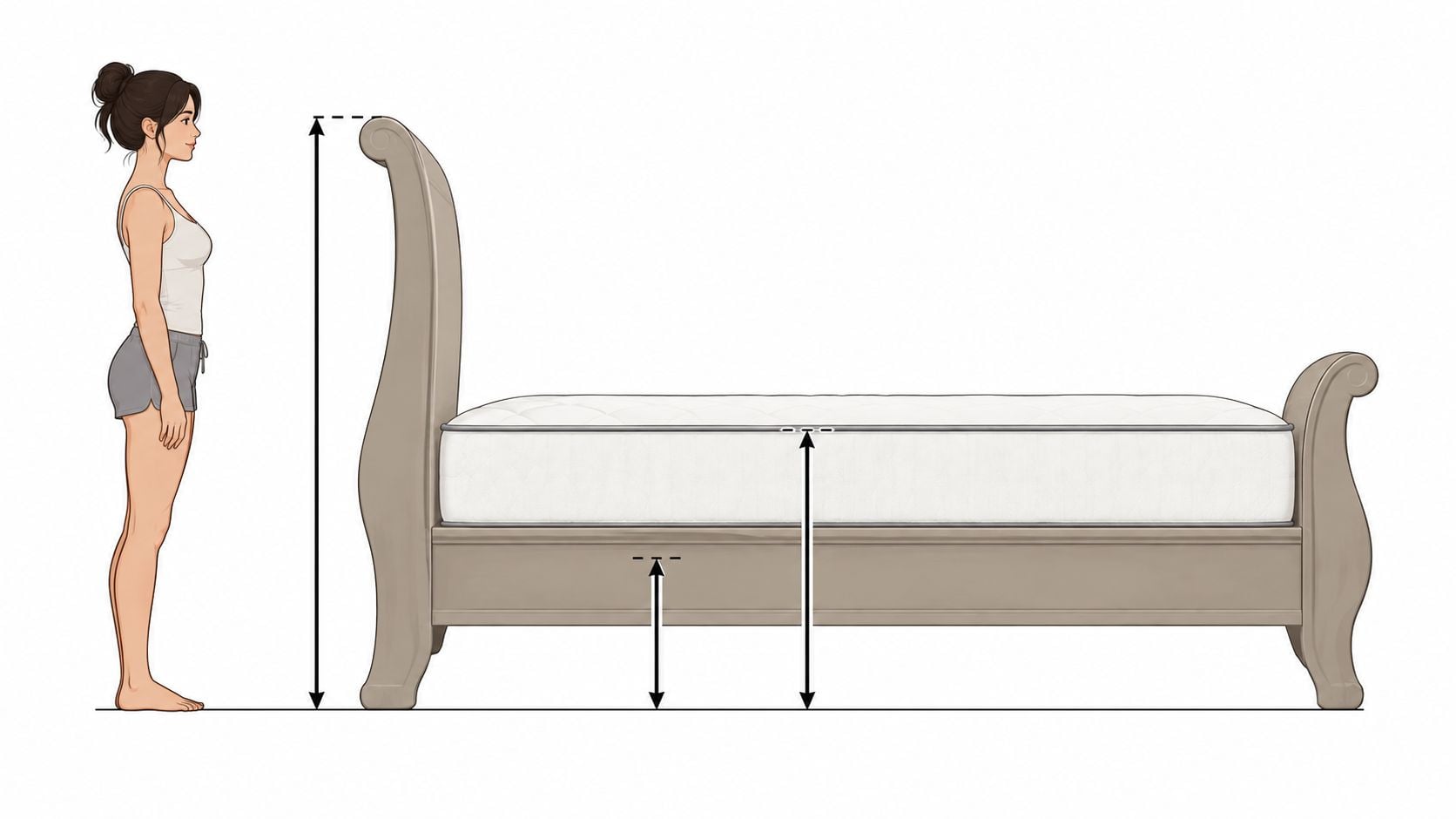
A bed can fit the floor plan and still be wrong for the sleeper. The final sleeping surface, not the top of the headboard, determines the everyday transfer into and out of bed.
In a study of homes used by people with Parkinson's disease, 80% had bed surfaces above the recommended range, and 50% of participants reported minor injuries associated with bed-height problems; the authors recommended approximately 45–50 cm, as described in the study of home environmental barriers and bed height. Those findings concern a specific population, not all furniture buyers, and the recommendation shouldn't become a universal target.
Calculate the Complete Sleep Surface
The useful calculation is straightforward:
Support-deck height + approved foundation thickness, if required + mattress thickness = estimated sleeping-surface height.
The headboard's height doesn't enter that sum. Neither does the clearance beneath the side rail, although both remain relevant specifications for appearance, access, and equipment placement.
For a setup using an adjustable base, use that base's actual support height rather than automatically adding a conventional foundation. The guide to box springs and mattress support provides background, but the selected mattress and frame requirements should determine the final assembly.
A thicker mattress shouldn't be treated as a harmless upgrade after the furniture order is complete. It changes the height being evaluated and may change how the sleeper reaches the floor.
Test Sitting, Standing, and the Approach
A useful fit check has the sleeper sit at the edge with feet flat and knees near a right angle. The person should then assess standing up without an awkward slide, drop, or climb.
Fit comes first: Neither a high bed nor a low bed is automatically easier. The complete setup must suit the individual using it.
For someone with arthritis, reduced leg strength, or a movement disorder, the showroom comparison should include the intended mattress firmness and height as closely as practical. A clinician or occupational therapist can help when transfers already present a safety concern.
Before purchase, resolve the questions that a photograph can't answer:
- Foundation options: Can the approved support arrangement use a low-profile foundation?
- Footboard access: Does the outward curve obstruct the sleeper's usual approach?
- Assist equipment: Can a needed handle be installed safely under both equipment and frame instructions?
- Bedside reach: Will essential items remain accessible from the finished mattress surface?
The correct answer may be a different support combination. It may also be a simpler bed frame, and that's a better outcome than forcing an unsuitable sleigh bed into daily use.
Custom and Amish Options Versus Production Sleigh Sets
Choose custom work to solve a defined problem, not merely to purchase a more elaborate version of the same room. A production set can be the sensible choice when its dimensions, construction, finish, and support requirements already meet the household's needs.
Custom and Amish-built options deserve attention when the standard selection misses something important. That might mean a preferred wood, a different bedside cabinet width, a coordinated finish, or a requested change to the footboard design.
Compare What Can Actually Be Supplied
Tip Top offers Amish-made bedroom furniture handcrafted in the USA, including solid-wood, heirloom-focused options and custom ordering. Its custom process can begin with a photograph or sketch, but the proposed design still needs confirmation of dimensions, feasibility, finish, and construction.
Neither “custom” nor “Amish” should end the evaluation. Buyers should ask the same practical questions of every set and request written answers for any feature essential to the project.
| Decision | Production Set | Custom or Amish-Built Option |
|---|---|---|
| Design flexibility | Choose from the offered configurations | Confirm which changes the maker accepts |
| Finish selection | Evaluate available collection finishes | Review approved wood and finish samples |
| Timing | Verify stock and delivery scheduling | Obtain a current production estimate |
| Budget | Price the exact selected pieces | Request an itemized specification and quote |
| Future service | Ask about parts and finish support | Document repair and reorder arrangements |
No blanket delivery promise belongs in this comparison. An available production piece and a made-to-order piece have different purchasing paths, but current availability must be confirmed for the actual order.
Put Repairability Ahead of Perfect Matching
The strongest long-term purchase isn't necessarily the largest matching package. It's furniture that remains useful when a household moves, changes storage needs, or replaces the mattress and bed.
Ask whether rails, slats, center supports, drawer hardware, and finish materials can be serviced or replaced. Keep the invoice, finish identification, assembly instructions, and approved specifications together so future service doesn't depend on remembering a showroom conversation.
A nightstand should also make sense apart from the original bed. That gives the household more choices later and avoids treating the entire suite as disposable when one component no longer suits the room.
Match the Buying Route to the Budget
For Capital Region homeowners, Tip Top combines a family-owned Freehold showroom with bedroom furniture, USA-made mattresses, sleep-matching technology, décor, and flooring coordination. Its local history and established professional design service provide a place to discuss the whole project rather than just an isolated frame.
Budget-conscious shoppers should compare Clearance Corner availability with the cost of the exact new-order arrangement. Clearance can offer discounted pieces ready for a more immediate purchase, while flexible financing can spread payments subject to the applicable terms; neither replaces checking condition, fit, and total cost.
Delivery arrangements also belong in the written plan. The strongest final choice is the one that balances usable design, documented construction, serviceability, and a payment arrangement the household understands.
Bring room measurements, delivery-route photographs, and mattress specifications to Tip Top Furniture & Mattresses in Freehold, NY, for a practical comparison of sleigh beds, mattress pairings, and custom or Amish-built options. Homeowners from Albany, Schenectady, Troy, and surrounding communities can use the free online Room Planner before visiting, then discuss design services, delivery, and flexible financing around a clearly defined bedroom project.