How to Customize Furniture the Right Way for Your Home


A homeowner finds the perfect dining table online, saves the image, and visits a showroom ready to order. Then the tape measure comes out. The table is six inches too wide for the alcove, the chairs block the walkway, and the finish clashes with the existing floor. The design is beautiful, but the room has already rejected it.
That problem is rarely caused by poor taste. It comes from making style decisions before making sequencing decisions. Homeowners in Freehold, Albany, Schenectady, Troy, and the wider Capital Region get better results when they settle the room's function, expected lifespan, and hard dimensions before choosing wood, finish, fabric, or hardware.
Why Customizing Furniture Is Worth the Wait for Your Home
A custom order earns its place when a ready-made piece forces the room, the household, or the delivery route to compromise. A made-to-order dining table can serve an awkward alcove, a media console can account for outlets, and a sofa can be built around a narrow stairway or doorway. The value is practical before it is decorative. You get a piece sized for the room and built for the way your household uses it.
Customization has also moved beyond a small luxury category. One industry estimate valued the worldwide custom furniture market at $23.51 billion in 2021 and projected it to reach $74.60 billion by 2033, a 10.1% CAGR over that period. The estimate placed North America at $6.75 billion in 2021 and $19.99 billion by 2033, while the U.S. market was projected to grow from $5.13 billion to $15.03 billion during the same span. Cognitive Market Research identifies fit, finish, and made-to-order dimensions as central drivers of the category.
The wait makes sense when the order is sequenced correctly. Start with the decisions that are expensive to change later.
Three decisions to make before the showroom visit
Define the room's function. A dining table used for daily family meals needs different proportions and surface protection than one reserved for occasional formal use. Judge a sofa by lounging habits, seating needs, and traffic flow before choosing its silhouette.
Set the expected service life. If the piece may move through several homes, prioritize solid construction, repairable materials, and timeless proportions. Decorative details can be added later, but weak construction is costly to correct.
List the decisions that affect the order. Record the required dimensions, seating capacity, outlet locations, radiator positions, and walking paths before approving a style. This prevents a finish or fabric choice from forcing a redesign.
Practical rule: A beautiful custom piece still fails if it does not fit the room, the household, or the delivery route.
Domestic Amish craftsmanship deserves consideration for long-term ownership. Authentic Amish furniture is generally built in the United States, with major production clusters in Michigan, Ohio, Pennsylvania, and Indiana. Ask the seller to identify the specific workshop or builder. A vague handmade label does not tell you who made the piece or how it was constructed. Gardner-White's Amish furniture guide explains that distinction.
Custom work is a sequencing exercise, not a shopping trip. Set function first, then measurements, construction, materials, finish, upholstery, price, and production approval. That order protects the budget and reduces preventable delays.
Measure and Plan Your Room Before You Customize
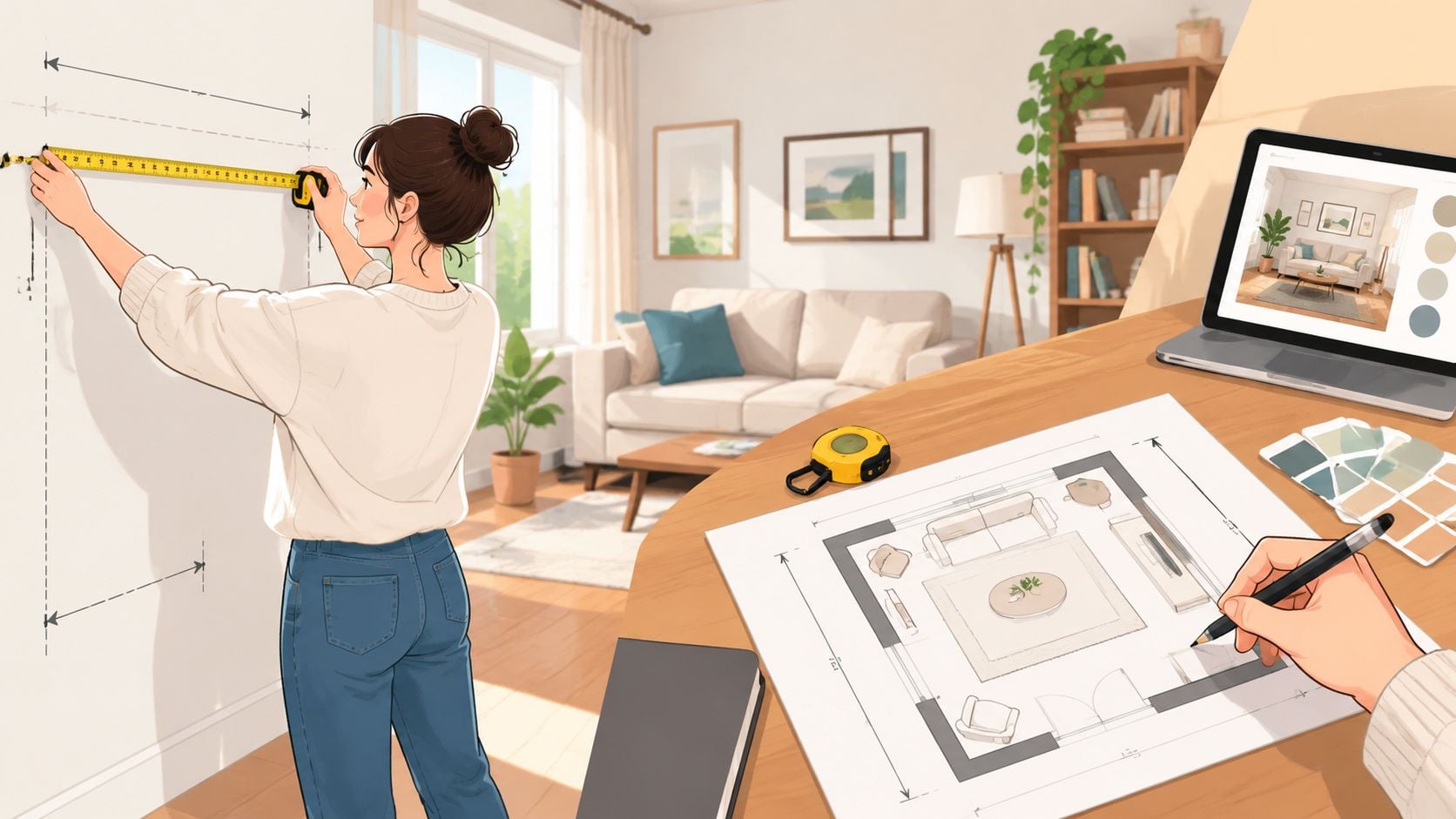
A consultant can't correct measurements that were never taken. Before visiting a showroom, homeowners should create a practical room record that includes the full space, not just the largest empty wall.
What to measure
Start with wall-to-wall dimensions, then record ceiling height. Measure every doorway, hallway turn, stair landing, and elevator or porch access point that the delivery team may need to use. A piece can fit its final wall and still fail at the front door.
Next, mark:
- Window clearances: Include trim, sill depth, and where curtains or shades sit.
- Door swings: Record the space each door needs when fully open.
- Traffic paths: Leave a usable route between entrances, seating, dining areas, and adjacent rooms.
- Radiators and registers: These can limit cabinet depth and sofa placement.
- Outlets and cable points: Their locations often decide where a credenza or media console can sit.
- Existing furniture: Measure pieces that will remain so the new order is scaled against reality.
Photographs make those numbers more useful. Take wide shots of each wall, then close-ups of corners, outlets, trim, and obstructions. Keep the tape measure visible in several images. A consultant can read scale and identify potential conflicts far more accurately from photographs than from memory.
Turn measurements into a usable layout
The room measuring guide can help organize the information before the consultation. Tip Top's free online Room Planner also gives homeowners a way to test furniture placement to scale, rather than relying on a rough sketch or an optimistic guess.
The common mistake is measuring only the largest open wall. The better approach is to create a one-page room brief with two parts:
- Measured facts: Wall lengths, ceiling height, openings, obstacles, outlets, and access limitations.
- Prioritized functions: Required seating, storage, dining capacity, display space, work surface, or media equipment.
That brief gives the designer something concrete to solve. It also keeps a tempting photograph from driving an order that the room can't support.
Choosing Wood Types and Finishes That Hold Up
Wood selection should come before stain selection. A finish can change the tone and protection of a piece, but it can't transform one species into another or correct a construction choice that doesn't suit daily use.
Oak offers visible grain and a familiar, durable character. Maple has a cleaner, more uniform appearance and works well when a lighter, orderly look matters. Cherry brings warmth that deepens over time, while walnut supplies a darker, richer presence. Quarter-sawn white oak adds a distinctive grain pattern and a strong, structured look for buyers who want more visual character.
Wood and Finish Comparison for Custom Furniture
| Wood Species | Best Finish | Durability | Ideal Room Use | Climate Note |
|---|---|---|---|---|
| Oak | Stain or protective clear finish | Strong choice for frequent use | Dining, living, and entry furniture | Visible grain helps hide everyday marks |
| Maple | Natural or lightly stained finish | Hard, smooth-wearing surface | Contemporary dining and bedroom pieces | Stable appearance suits rooms with changing humidity |
| Cherry | Natural or warm stain | Durable with aging character | Formal dining and heirloom pieces | Color changes over time, so matching requires planning |
| Walnut | Natural oil or clear protective finish | Durable with a refined surface | Statement tables, offices, and living rooms | Needs thoughtful placement away from harsh direct sun |
| Quarter-sawn white oak | Natural, stained, or oil finish | Strong and visually resilient | Dining, cabinetry, and architectural interiors | Grain movement gives the piece a substantial appearance |
Homeowners in Upstate New York should account for dry winters and humid summers. Wood expands and contracts as household humidity changes, so construction quality, acclimation, and an appropriate finish matter more than chasing a particular color.
Stain emphasizes grain and gives the most flexibility for coordinating with existing floors. Painted finishes create a crisp statement but show dings and edge wear sooner. Natural oils are appealing on farmhouse tables because they age into a patina that many owners prefer, though they call for an owner who accepts visible change over time. More finish guidance is available in Tip Top's custom wood finishes resource.
Fabric belongs later in the sequence. Performance upholstery is the sensible choice for children, pets, and heavy daily dining, while decorative upholstery may suit a lower-use accent chair or formal room.
Choose the wood first, then the finish, then the fabric.
Working With a Design Consultant in Freehold
A productive consultation turns inspiration into specifications. A Pinterest board or magazine image can show the direction, but it rarely supplies the dimensions, joinery, fabric requirements, or delivery constraints needed for a real order.
At the Freehold showroom, a homeowner should arrive with:
- Room measurements and photos, including doorways and tight corners.
- Existing samples, such as a wood piece, flooring sample, paint card, or fabric swatch.
- A short inspiration board, limited to the shapes, tones, and details that matter.
- A written constraint list, including doorway width, radiator clearance, storage needs, and seating capacity.
The consultant's job is to separate practical requests from expensive changes. A request for a different table length may be straightforward. A request to recreate a reference photo with nonstandard dimensions, unusual joinery, custom matching, and a special finish may require a different production path.
What the consultation should clarify
The conversation should cover scale, construction, wood species, finish direction, edge profiles, leg styles, hardware, joinery, upholstery, fabric performance, and delivery access. The consultant should also explain which options affect price, which affect timing, and which are cosmetic.
Tip Top's professional design services have been available since 1984, and its interior design consultation services address furniture, décor, and coordinated flooring needs. That one-stop approach is practical for a Capital Region homeowner furnishing several rooms, because a dining finish, flooring choice, window treatment, and living room upholstery can be evaluated together instead of in isolation.
Before leaving, the buyer should have clarified dimensions, selected materials, a written specification, pricing, the deposit or approval path, and delivery expectations. If the reference image is only a starting point, that should be stated early. A clear conversation prevents the expensive disappointment of a piece that arrives in the wrong size, with an unsuitable color, or on an unexpected schedule.
Understanding Custom Order Timelines
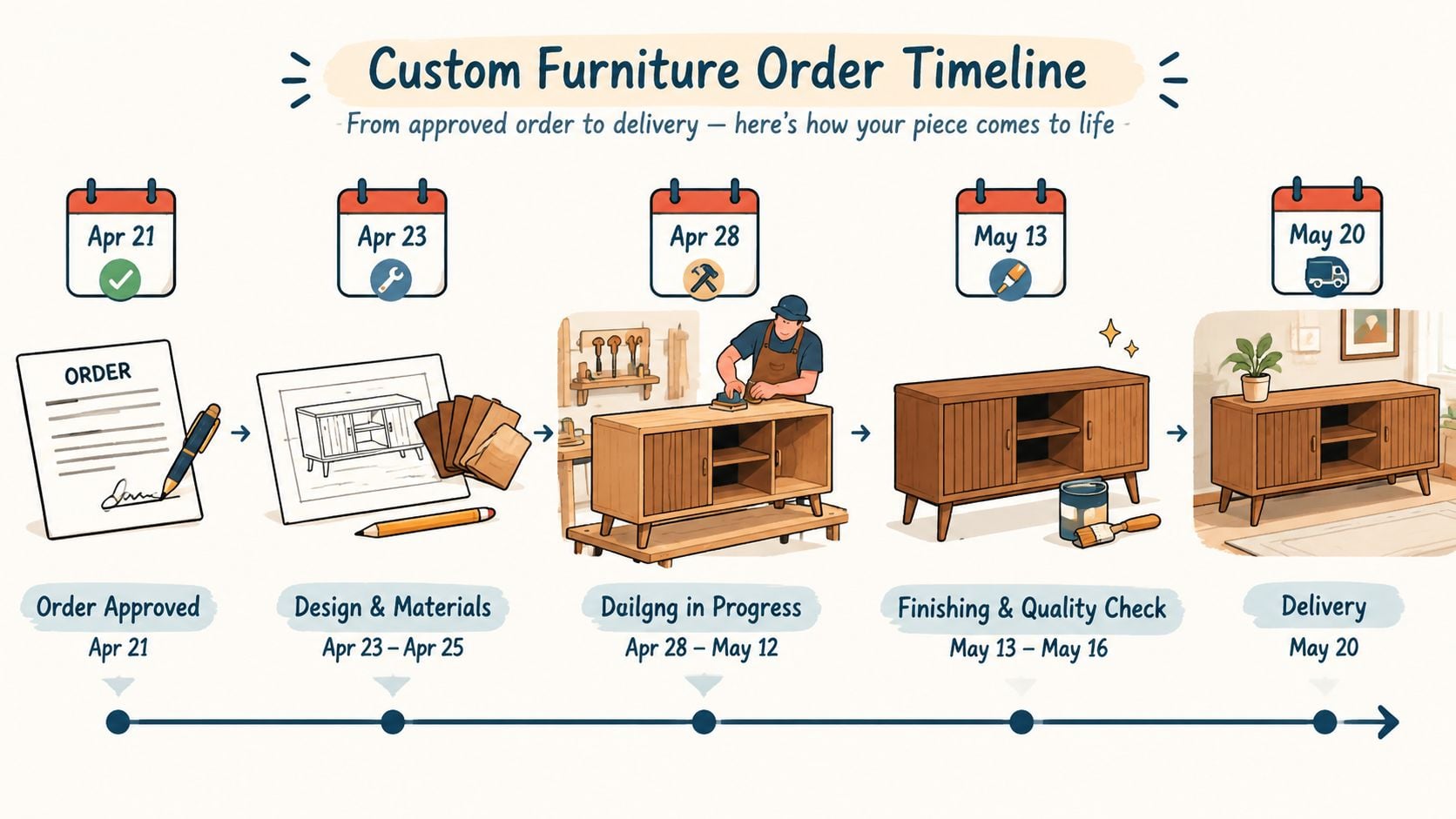
A made-to-order dining table scheduled for a holiday gathering can become a costly problem if the finish, dimensions, or delivery route remains undecided. Custom furniture needs a planning range, not a casual promise. Domestic made-to-order work commonly runs about 8 to 16 weeks. European imports commonly require 12 to 24 or more weeks. Some custom upholstery and case goods can reach 18 to 30 or more weeks, while importing may add another 4 to 8 weeks for shipping, according to current furniture lead-time guidance.
The production clock starts only after the information needed to build the piece is complete. Treat customization as a sequence. Lock in measurements and access first, then technical specifications, price, and final authorization. That order prevents the most expensive rework.
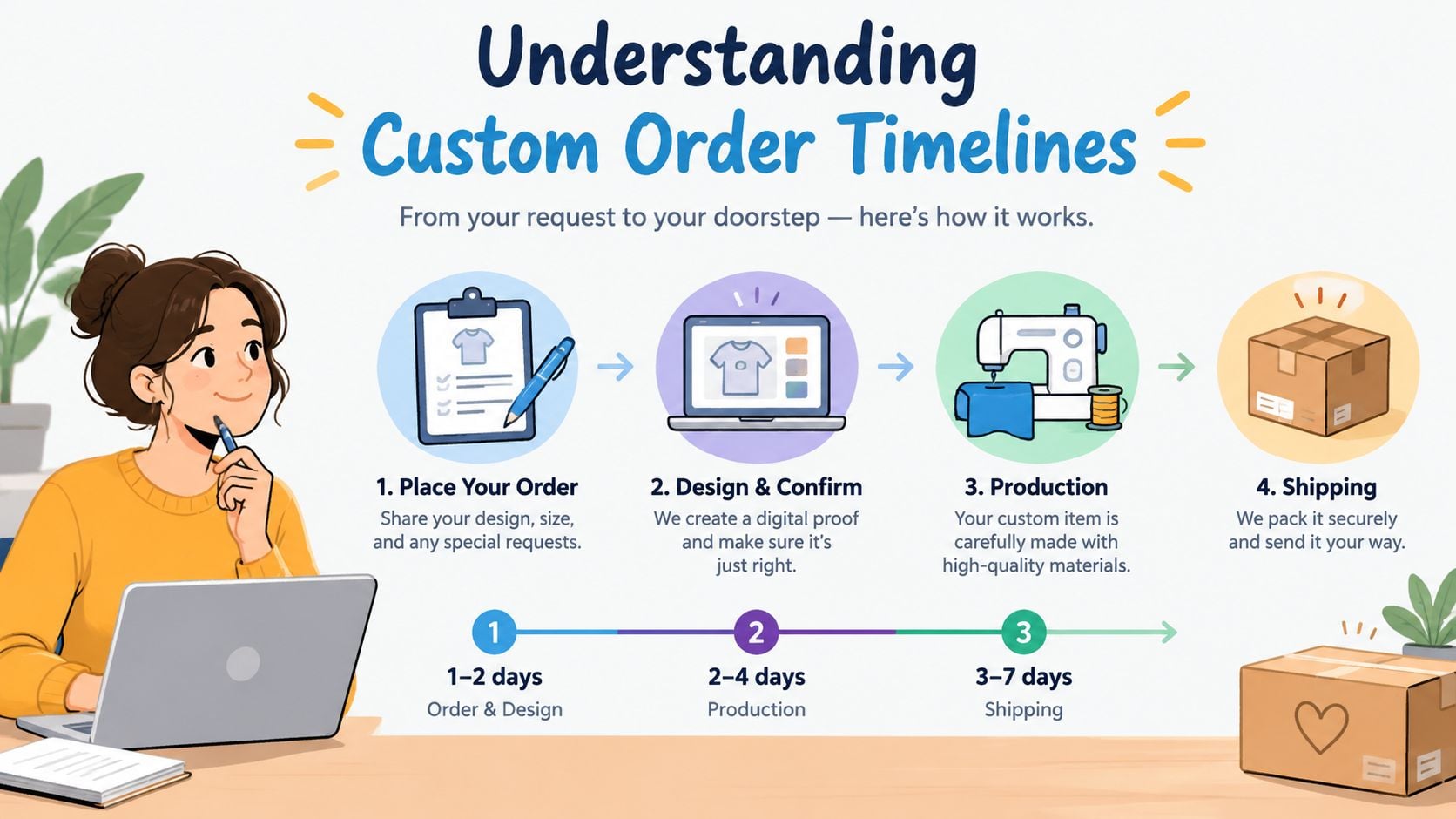
The four approval gates
First, close the measurement gate. Confirm the floor plan, critical dimensions, access route, and placement. A missing doorway measurement can create trouble after the workshop has started building.
Second, approve the technical scope. The written order should identify wood species, finish, upholstery, hardware, construction details, dimensions, and exclusions. “Similar to the picture” does not give a craftsperson enough information to build accurately.
Third, settle the financial gate. Confirm the final price, deposit, payment conditions, and included services. Establish whether delivery and setup are included before production begins.
Fourth, authorize production. Identify the decision maker, sign the final order, and approve any production drawing. Buyers can use this custom order starting guide to prepare for the approval process.
A weighted estimate, calculated as (O + 4M + P) / 6, gives a more defensible delivery date than an informal guess. It combines optimistic, most-likely, and pessimistic estimates, giving the most-likely scenario the greatest weight.
Schedule warning: Production should not begin while approvals remain open. Late changes create rework, and rework creates delays.
Before ordering, identify the desired delivery window, moving dates, events, stair access, narrow halls, and long-distance transportation needs. Workshop completion and home delivery are separate milestones.
Custom Furniture Costs and Financing Options
A custom order can exceed its budget before the first cut of wood if the choices are made in the wrong sequence. Lock in the room's required dimensions and the piece's function first. Then decide where craftsmanship matters most, and reserve decorative upgrades for the end. That order prevents paying for details on a design that later needs expensive revisions.
Custom pricing starts with the base construction, then rises as specifications are added. Standard dimensions, established designs, commonly stocked wood species, and regular finishes usually provide the clearest value. Nonstandard sizing, added leaves, specialty hardware, complex joinery, premium hardwoods, performance fabrics, and labor-intensive finishes can all raise the total.
Upholstery deserves close attention. Fabric grade, cushion construction, welt details, pattern matching, and the number of pieces in a set can change the quote substantially. Delivery distance, stair carries, and difficult access may affect the final cost too.
Custom Furniture Cost Drivers and Smart Savings
| Choice | Budget Impact | Practical Trade-off |
|---|---|---|
| Standard dimensions | Usually the most economical route | Less exact fit for unusual rooms |
| Nonstandard dimensions | Adds design and production work | Solves genuine space constraints |
| Common wood species | Keeps material selection manageable | May limit a highly specific color or grain |
| Premium hardwoods | Raises material cost | Can support a stronger heirloom character |
| Specialty hardware | Adds component and labor cost | Useful when function or style depends on it |
| Complex joinery | Raises labor and construction demands | Makes sense when durability and repairability matter |
| Performance fabric | Can increase upholstery cost | Better suited to children, pets, and frequent use |
| Decorative details | May add cost without improving function | The safest place to reduce spending |
Spend first on the parts you use and repair least easily. A stronger frame, comfortable cushion construction, durable fabric, and a finish suited to daily use usually deliver more value than carved details or specialty pulls that disappear once the room is furnished. Ask the consultant to price a standard design with targeted modifications beside a fully bespoke version. The comparison shows whether the added fit and craftsmanship justify the cost.
Tip Top Furniture & Mattresses can explain deposit expectations and payment schedules during a consultation. Buyers should review promotional terms, interest, and repayment obligations before applying, as detailed by your Tip Top consultant. Review the furniture financing options page before the appointment so questions are ready when the quote is discussed.
For broader home projects, homeowners may also compare window replacement financing options when furniture, flooring, and window work are planned together. Keep that comparison separate from the furniture decision. A financing plan does not make an overpriced specification economical.
A custom quote should state what is included, from delivery and setup to hardware and cushions. Confirm those items before approving the order, because an attractive base price can lose its value when necessary services appear later as added charges.
Bringing Your Custom Vision to Life
Customization is justified when it solves a problem a stock piece can't solve. Three triggers usually make the decision sensible:
- Nonstandard room dimensions: The alcove, wall, doorway, or seating arrangement demands a specific size.
- Heirloom-grade expectations: The buyer wants solid materials, durable construction, and a piece intended for long ownership.
- A specific architectural style: The room calls for proportions, woodwork, or details that standard lines don't match.
Aesthetic preference alone can justify a custom order, but it shouldn't hide a weak plan. If the room has ordinary dimensions and the buyer needs furniture immediately, a semi-custom or modular option may be the smarter choice. Clearance inventory can also solve a budget or timing problem when the available dimensions work.
The final pre-order checklist
Before a deposit is paid, the homeowner should confirm:
- Measurements are complete, including delivery access.
- The room layout is approved, with a saved screenshot or printed plan.
- Wood and finish are selected, with the intended tone reviewed beside existing materials.
- Fabric is chosen, with the swatch in hand for comparison.
- The quote is signed, including specifications, exclusions, delivery, and setup.
- The deposit is paid, according to the agreed payment condition.
- A delivery window is scheduled, with access limitations documented.
The most common post-order mistake is changing the fabric or finish after production begins. Even a small substitution can require a new approval, a different material allocation, or a revised production sequence. That change may reset the lead-time clock, especially when the original fabric or finish has already been ordered or applied.

Tip Top Furniture & Mattresses is a family-owned Freehold showroom serving homeowners throughout the Greater Albany Capital Region, including Albany, Schenectady, Troy, Greene County, and nearby communities. Since 1978, the store has combined furniture, mattresses, décor, flooring, custom ordering, delivery, financing, and products from 50-plus trusted manufacturers in one local setting.
That broader service matters when a custom piece must coordinate with the rest of the home. USA-made mattresses, Amish furniture, flooring, window treatments, bedroom furniture, living room seating, and clearance selections can all be considered within the same project, while the free Room Planner helps test the layout before an order is written.
Custom furniture rewards patience, preparation, and clear sequencing more than any single design choice. The homeowner who measures first, selects construction before decoration, closes every approval gate, and protects the production schedule is far more likely to receive a piece that fits both the room and the life it needs to support.
Tip Top Furniture & Mattresses helps Freehold and Capital Region homeowners customize furniture with room planning, professional design consultation, Amish and USA-made options, coordinated flooring, mattresses, flexible financing, and delivery support. Visit Tip Top Furniture & Mattresses to bring room measurements, inspiration, and a clear budget to a complimentary design consultation before placing a custom order.