
25 Foot Tape Measure Guide for Smarter Home Projects

The sofa looked right on the screen. The delivery crew got it to a living room doorway outside Albany, then stopped. The opening was tighter than the order sheet, and the piece went back on the truck. That miss usually starts with a blade that sagged, a hook that didn't sit flush, or a single reading nobody checked twice.
A 25 foot tape measure is the tool most homeowners already reach for. It covers a wall, a flooring run, or a mattress path through a hall, and it still fits in one hand. Used carelessly, it prints numbers that look official and turn out wrong. The gap between a fit and a return is rarely the furniture. It is the measurement that decided the order.
What a 25 Foot Tape Measure Is and Why It Fits Most Homes
A Saturday morning in a Greene County living room shows the job clearly. Someone wants a sofa against the long wall, a clear path to the stairs, and enough room to open a door. A short pocket tape dies halfway across the room. A surveyor's reel is clumsy indoors. The 25 foot tape measure sits in the middle, long enough for one pull and compact enough to carry from the hall to the bedroom.
The tool is a retractable steel tape in a case. Pull the blade, read the mark, lock it, then let the spring wind it back. That format is older than it looks. William H. Paine's 1860 patents covered a cased steel measuring tape, patent no. 29,096 for the case and patent no. 29,514 for the tape, and the steel was coated with tin to slow rust. William H. Bangs added a spring-return improvement in 1864 under patent no. 45,372. Alvin J. Fellows patented a pocket tape with a spring return in 1868, patent no. 79,965. By 1922, Hiram A. Farrand's concave-convex blade could stand out from the case instead of drooping, then retract for storage.
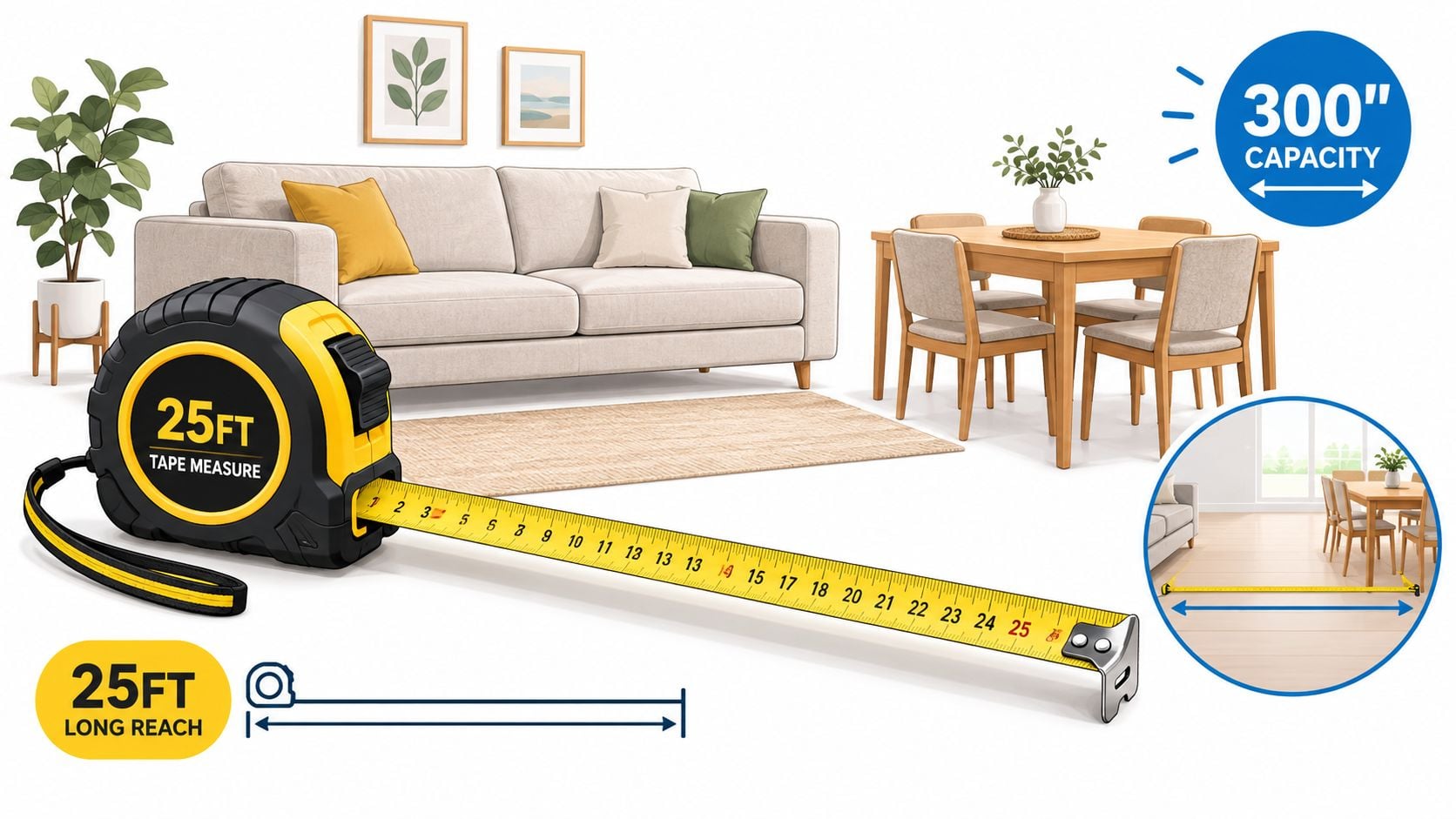
300 inches in one case: a 25-foot blade spans 300 inches, which is enough for many residential walls, furniture footprints, and installation clearances without giving up portability.
Historical accounts also treat 25-, 50-, 75-, and 100-foot versions as engineer's tapes for buildings, bridges, and dams. The 25-foot length became the practical home-improvement size because it covers common rooms and still rides in a pocket or a tool bag. Modern tapes keep that idea, with a curved steel blade, a spring motor, a lock, and a projecting hook.
Which household jobs stay inside that span
- Room widths and wall runs: most living rooms, bedrooms, and dining rooms in Capital Region houses fall inside one pull.
- Furniture footprints: a sofa, a bed, or a dining table rarely needs more than the blade already in hand.
- Paths and clearances: doorways, stair landings, and the route from the curb to the room are the checks that prevent a return.
A longer engineer's tape still earns its place on a dam or a bridge layout. For a Freehold-area house measured before a trip in from Schenectady or Troy, 25 feet is usually the right ceiling. Shoppers comparing blade width, lock style, and standout can compare 25 foot tape measures before they trust a single reading on a sofa order. The same numbers later feed a room-measuring routine for furniture.
The Parts of a Tape Measure and What Each One Does
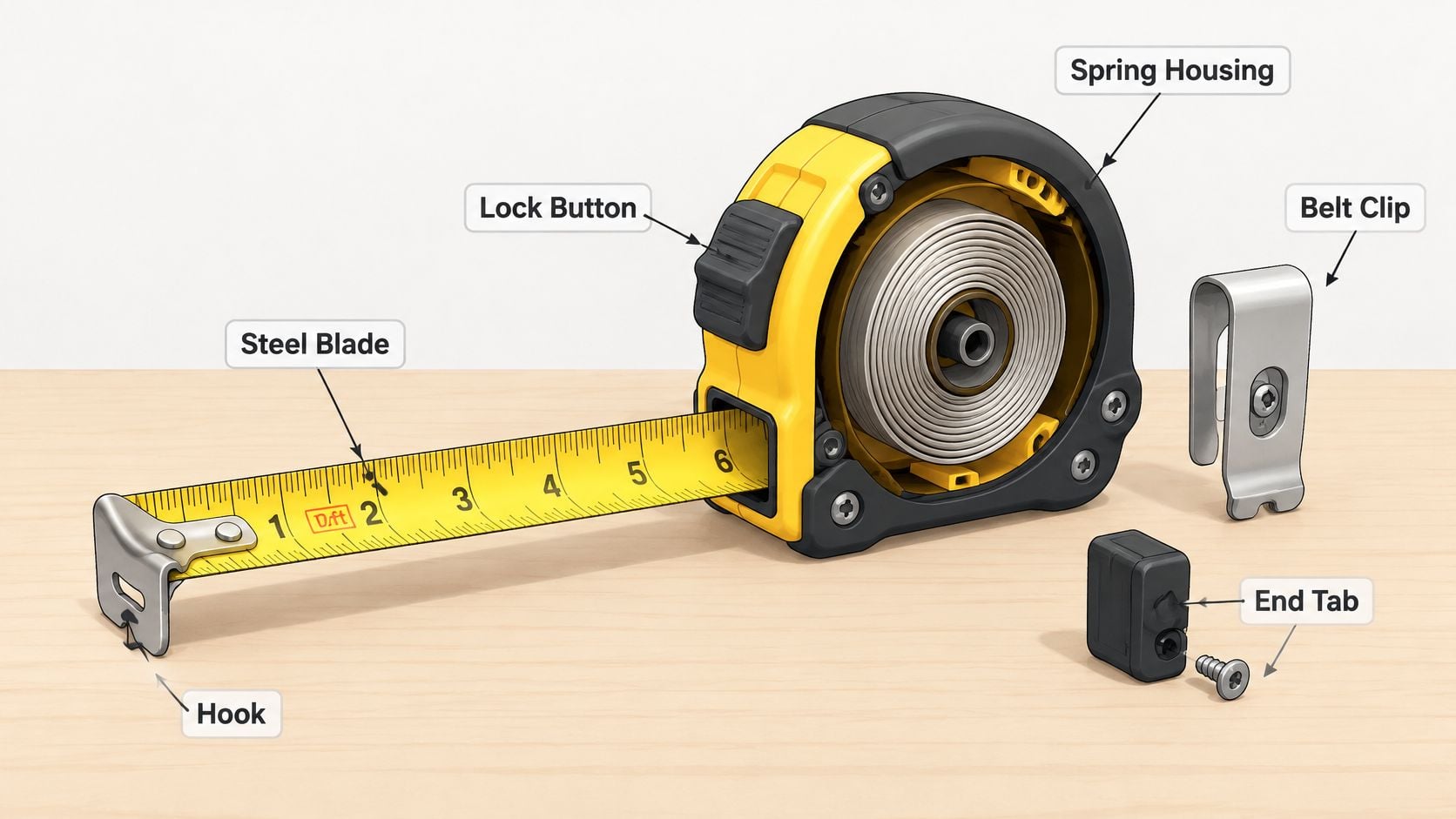
Hold the case in one hand and the hook finds the baseboard. That single motion uses every part of the tool. Knowing the names makes later mistakes easier to catch.
Blade and hook
The blade is a thin strip of yellow steel. In the 1870s, metal tapes went flat, about one-half inch wide, and graduated in feet, inches, and fractional inches, a shift described in a history of the household tape. Current 25-foot blades are commonly about 1 inch wide, so the marks stay readable and the strip resists buckling across a room. Farrand's 1922 concave-convex profile, already noted above, is why the blade can extend for a one-person reading instead of collapsing at the first few feet.
The projecting hook grabs a wall edge, a door stop, or the end of a mattress. It is meant to move slightly. That slide lets the same zero work for an outside hook-over and an inside push against a wall. If the hook is bent, stuck, or flopping sideways, every later number inherits the error.
Lock, spring, and case
The lock freezes the blade so a mark can be read without the spring stealing the length. Press it before looking away to write the number down. The spring motor retracts the blade. Let it slam home from a long pull and the end can whip. Walk the blade back with a thumb on the lock instead. The case is the handle, the housing, and the thing that gets dropped on a hardwood floor. A case that needs a hard squeeze is a poor match for a long afternoon of room checks.
Why this format replaced the folding ruler
Long tapes of 25, 50, 75, and 100 feet stayed with engineering work, while pocket models stayed short. Through the 20th century the 25-foot strip of thin yellow steel spread through construction and pushed folding wooden rulers aside. The same span that crosses a wall also covers a furniture footprint and an installation clearance, which is why it became the default for home planning. Wider blades made those household distances easier to read without a second person holding the middle.
Key Features That Actually Affect Your Measurements
Durability and a long standout sell tapes. They don't decide whether a mattress clears a turn or a flooring transition lands on the right board. Accuracy does, and accuracy has a limit that marketing copy rarely prints.
The National Institute of Standards and Technology steel-tape specification says a steel tape's total-length error, supported horizontally at 68°F (20°C) and held at standard tension, should not exceed 0.1 inch per 100 feet, equal to 2 millimeters per 25 meters. Applied proportionally, that is about 0.025 inch over 25 feet. Lengths are ordinarily certified to the nearest 0.001 foot, or 0.0002 meter. A consumer package may name a different class or intended use. The printed length is a benchmark, not a promise that every pull in a cold hallway matches the lab.
A summary based on NIST Handbook 44 lists a tolerance of 1/16 inch for tapes from 7 through 30 feet, which includes a 25-foot tape. Commercial tapes are built to a stated tolerance. The reading a homeowner writes down also depends on alignment, sag, and how the marks are read.
Tape Measure Accuracy Benchmarks for a 25-Foot Tape
| Benchmark | Value | Condition |
|---|---|---|
| Total-length error limit | 0.1 inch per 100 feet | Horizontal support, 68°F, standard tension |
| Proportional figure for 25 feet | about 0.025 inch | Same reference conditions, scaled |
| Handbook 44 band, 7 to 30 feet | 1/16 inch | Commercial tape tolerance summary |
| Ordinary certification step | 0.001 foot | Nearest reported length |
What moves the number more than the spec
- Sag and angle: an unsupported blade bows, so the path along the steel is longer than the straight distance between the walls.
- Temperature and pull: a cold blade and a hard yank don't match the reference conditions the tolerance assumes.
- Hook movement and worn ink: a stuck hook or a faded fraction shifts the zero even when the case looks new.
- Push versus pull: pushing the blade across a floor buckles it. Pulling it tight changes length the other way.
A premium tape is not automatically required for placing a chair. It becomes worth caring about when the number orders a sofa, a mattress, a built-in, or a flooring transition. A 1/16 inch tool tolerance is smaller than a crooked reading at the doorway. For a tight gallery wall, the same habit shows up in a picture-hanging measurement sequence. Keep the blade straight, skip the extra yank, and treat heat, cold, and support as part of the measurement.
How to Measure Rooms, Furniture, and Flooring Accurately
A fair test of a steel tape is not a loose blade on the carpet. NIST's mechanical conditions compare a tape supported horizontally along its length, at 68°F (20°C), and at a standard tension of 10 pounds (4.5 kilograms) for tapes from 25 to 100 feet. Nobody stands in a bedroom pulling with a 10-pound weight. The point is mechanical. An unsupported blade sags. Pulling harder than that reference can stretch the effective length. Two people, one yanking and one letting the middle droop, will disagree on the same wall. Homeowners in Freehold, Greene County, and the Albany Capital Region run into that split on long walls, flooring runs, and diagonals.
A four-step habit before any order
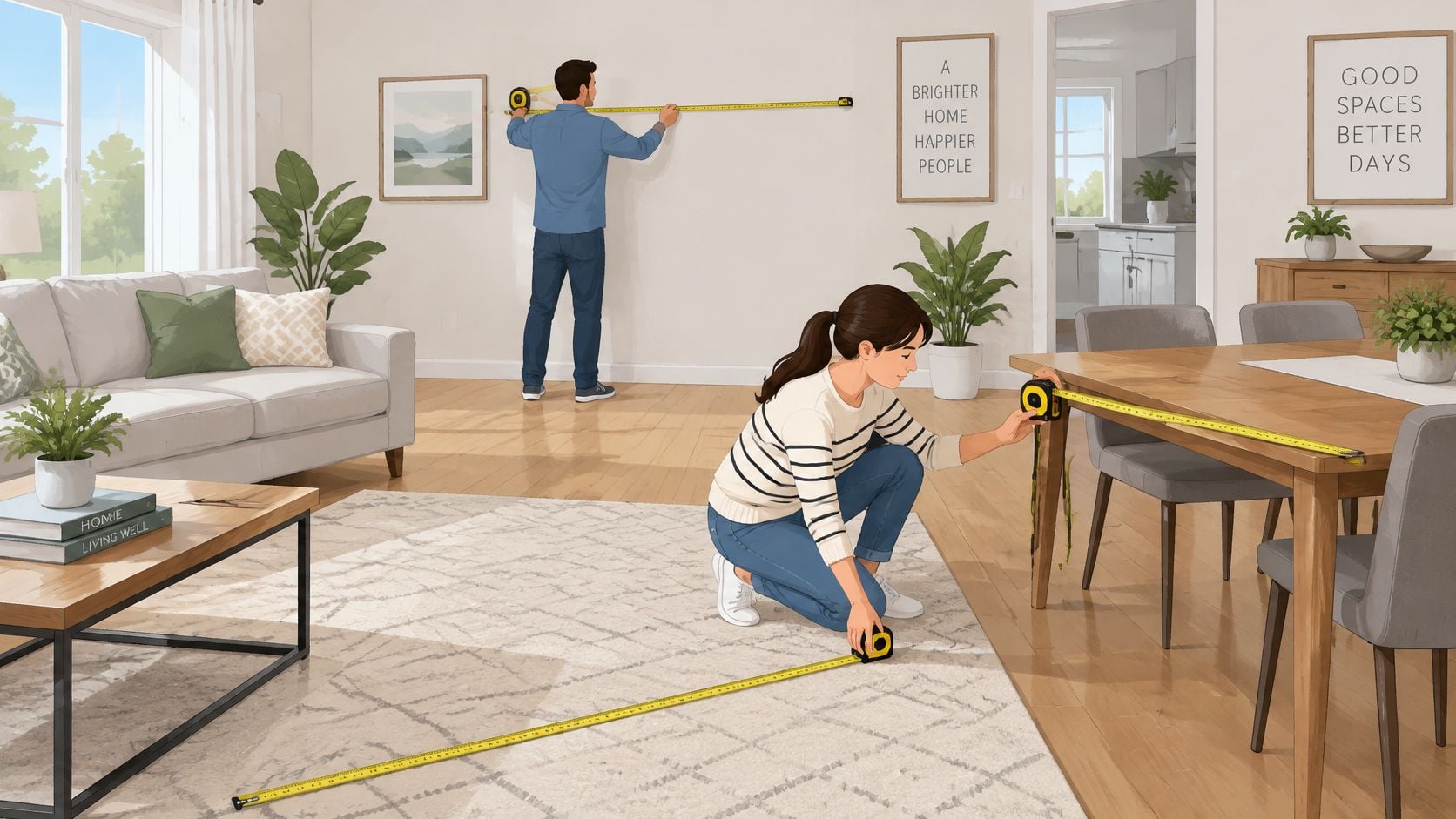
- Measure twice. Write both numbers. If they don't match, the third reading is the one that counts.
- Keep the blade straight. Support the middle on a floor for a long run, or have a helper pinch it at waist height on a wall.
- Record inside versus outside. Hook over an outside edge for an outside size. Push the hook's back against a jamb for an inside size. Don't mix the two in one note.
- Confirm the expensive dimension. A second person, or a rigid rule on a short span, catches the error a springy blade hides.
Three jobs that actually get ordered
Room for furniture. Measure length and width at the floor, then again at sofa-back height if the walls aren't plumb. Note radiators, doors that swing in, and the path from the entry. A furniture measuring checklist keeps those notes in one place before a footprint gets compared with the room.
Footprint against a doorway or stair. Measure the piece, then the narrowest opening on the route, including the landing where a turn happens. The smaller number wins. A sofa that fits the wall and misses the stair is still a return.
Flooring run. Pull along the floor, not in the air. Break a long room into sections if the blade wants to arc, and mark each end with painter's tape when working alone. Transitions at doorways need their own short check, because a proud saddle changes the usable width.
The dimensions worth a second pass are sofa width, mattress size, doorway clearance, and any flooring transition. Those four are where a casual reading turns into a restocking fee.
Comparing 25 Foot Tapes with Other Tape Lengths
A doorway is only a few feet wide, but a small measuring error can turn a delivery into a costly return. Choose a tape length that suits the job and is easy to control.
A 12-foot tape works well for a nightstand, window casing, or chair. It may not reach across a full living room wall. A 16-foot tape covers many single walls and carpentry cuts, though a longer room measurement may require two pulls. A 25 foot tape measure reaches across most residential rooms and furniture footprints without the bulk of a longer blade. Tapes longer than 30 feet are generally more useful for open areas, fences, or foundations than for routine indoor measuring.
When a shorter tape is the smarter one
- Small, close-up jobs: A shorter tape is easier to control around a bed, stair, or uneven floor.
- Limited grip: Choose a case and lock you can operate comfortably. A tape that is difficult to hold or lock is harder to use accurately.
- One long wall: Measure in sections and add the lengths rather than carrying a larger, heavier tape for a single reading.
Standout, the distance a blade can extend before folding, can help when measuring alone. A wider blade often stays extended farther, but a long unsupported span may still bend and produce a misleading reading.
What to do with the numbers
Enter wall, doorway, and furniture dimensions into a room planner that lets you check a layout to scale. Include door swings and the full furniture footprint. For example, a sofa that overlaps a door swing in the layout will block that space in the room, too.
Tip Top Furniture & Mattresses is a family-owned Freehold showroom serving the Capital Region, with design assistance and flooring available alongside furniture and mattresses. Its selection includes mattresses, custom-order Amish furniture, and flooring such as hardwood, carpet, and laminate. Clearance items and flexible financing options can help with a full-room project. Accurate measurements help you compare choices with the space you have.
Safe Solo Measuring and Tape Measure Care
Stretching 25 feet of steel across a room is a physical task, not only a math task. Older adults, people with arthritis, and anyone measuring alone around a bed or a stair feel that quickly. Awkward bending and reaching show up in ergonomic research on tape-based work. In one 2024 study, an assistive tool reduced assessed ergonomic risk and saved 34.5% of working time. CDC workplace materials also treat tape measures as part of ergonomic assessment. The tool is part of the strain, not separate from it.
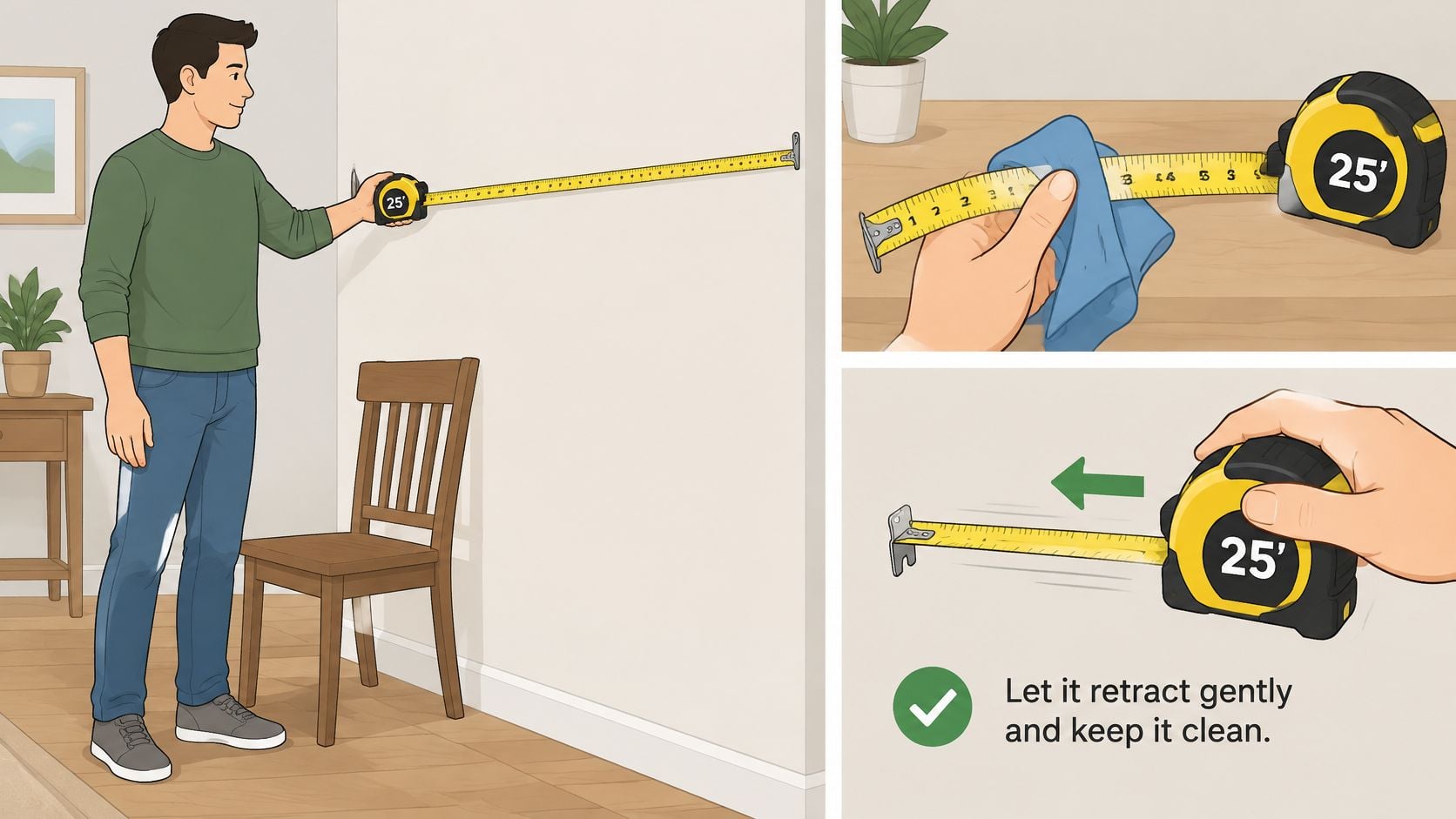
Safer pulls when reach or grip is limited
- Anchor first. Set the hook on the far edge before walking the case backward. Don't extend into open air and hope the end stays put.
- Don't release a tight blade. A highly tensioned strip snaps back hard enough to cut a hand or kink the steel. Ease it in.
- Mark the ends. Painter's tape or a helper holds the point so the case hand can run the lock without a death grip.
- Work in sections. Shorter pulls stay straighter and ask less of the shoulder.
- Pick the hardware for the hand. A lock and case that operate without a hard squeeze get used correctly. One that fights the user gets forced, and forced readings wander.
Care that protects the zero
NIST's steel-tape specifications require a standard tape to be a single metal ribbon. Graduations don't belong on detachable solder, sleeves, wire loops, spring balances, or tension handles that can shift or come loose. A calibrated length is ordinarily certified to the nearest 0.001 foot or 0.0002 meter, about 0.2 millimeter. A consumer tape is not a lab instrument. The lesson still applies. If a hook rivet wallows out or a sleeve slides, the numbers can look crisp and still be false. Check the hook, the blade, and the printed marks before a doorway or a furniture order that will be checked against the Freehold showroom.
Wipe grit off the blade, store the tape dry, and retract it under control. Retire it when the hook is twisted, the lock slips, the spring sticks, or the fractions are worn through at the lengths used most. A fresh tape is cheaper than a sofa that doesn't fit. The same careful measuring habit carries over to finish work such as baseboard molding installation, where a short error shows up at every joint.
Choosing the Right Tape and Taking the Next Step
Match the blade to the longest span that has to be straight, not to the biggest number on the package. A readable width, a lock that works without a hard squeeze, and a hook that still slides smoothly matter more than a thicker case.
Before anything expensive gets ordered, run this short list.
- Length: the longest wall, diagonal, or delivery path fits on the blade with a little left over.
- Readability and grip: the fractions are clear, and the lock and case work one-handed.
- Hook and marks: nothing is bent, stuck, or faded at the lengths that will be used.
- Two readings: sofa width, mattress size, and the narrowest doorway agree on a second pass.
A tape is the wrong tool when the span is longer than the blade can support, when the reading really needs two people, or when a single number decides whether a sofa or mattress clears a door. In those cases, measure in sections, ask for a helper, and confirm with a rigid rule on the short, critical openings.
This week, put the notes into a scaled layout with a room layout plan, then bring them to the Freehold showroom or book a complimentary design consultation so furniture, décor, and flooring get checked against the same dimensions. Albany, Greene County, and the rest of the Capital Region are full of older doorways that don't match a catalog photo. The tape, used twice and kept straight, is what keeps the order honest.
Tip Top Furniture & Mattresses helps Capital Region homeowners turn careful room, doorway, and flooring measurements into furniture and mattresses that fit. The Freehold, NY showroom pairs local design help with custom orders, USA-made mattresses, flooring, clearance finds, and flexible financing. Visit Tip Top Furniture & Mattresses with those double-checked numbers and plan the room before the delivery truck arrives.


