Window Treatments with Shutters: A Practical Layering Guide


A January living room in Albany can look finished and still feel wrong. Plantation shutters may frame the windows beautifully, yet the glass feels cold, afternoon glare makes the room uncomfortable, and the space lacks the softness that full-length fabric panels provide. In July, the same windows may need stronger solar control than interior shutters can deliver.
That's why window treatments with shutters work best as a layered system. Shutters provide the architectural foundation, while drapes, shades, and curtains handle changing needs for privacy, daylight, warmth, and texture. The right combination gives each room more than one useful setting instead of forcing one treatment to solve every problem.
Why Layering Shutters with Other Treatments Makes Sense
A homeowner in Greene County might choose full-height shutters for a living room because they offer a clean profile, adjustable privacy, and a finished connection to the window trim. After the first cold evening, however, the room may still need another layer. The shutters control the view, but floor-length drapes can add softness, frame the furniture, and create another boundary between the room and the glass.
The same principle applies in summer. Closed louvers can reduce glare, but a carefully selected shade or exterior treatment may be more effective on a west-facing window exposed to late-day sun. Layering lets occupants make smaller adjustments instead of choosing between complete darkness and uncontrolled brightness.
Shutters form the working layer
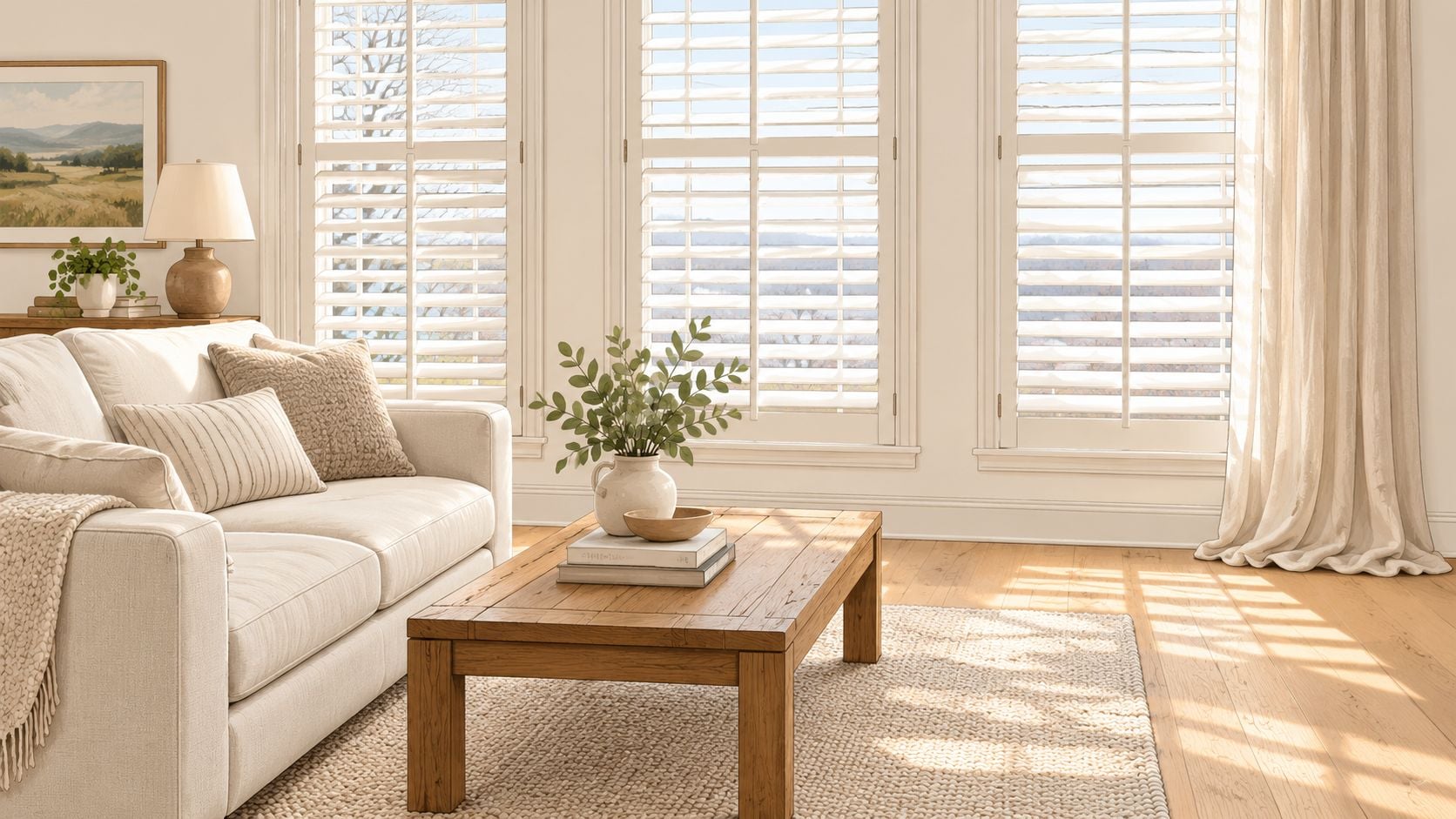
Shutters are especially useful as the structural backbone of a window system. Their panels remain in place, their louvers can be tilted throughout the day, and their material can reinforce the room's architectural style. A second treatment then performs a more specific task.
- Shutters: Handle everyday privacy, ventilation, glare, and architectural definition.
- Drapes: Add softness, color, sound absorption, and a fuller visual frame.
- Cellular shades: Provide a discreet insulating layer and stronger bedroom light control.
- Roller or solar shades: Reduce glare and manage bright exposure without adding much visual weight.
A layered design also avoids a common mistake, installing a heavy treatment everywhere. A room doesn't need maximum coverage at every hour. It needs practical choices that respond to the window's direction, the room's use, and the season.
Practical rule: The shutter should solve the daily operating problem. The second layer should solve the room's specific comfort or style problem.
Homeowners comparing proportions, fabrics, and mounting positions can use this guide to choosing window treatments before measuring. The key is to plan the shutter and its partner together, because hardware, frame depth, panel clearance, and stack-back space all affect the finished result.
Understanding the Different Types of Window Shutters
A showroom conversation becomes easier once the basic shutter styles are clear. Each style changes the balance between view, privacy, daylight, ventilation, and insulation.
Match the panel design to the room
Interior plantation shutters use adjustable louvers and are the familiar choice for living rooms, dining rooms, bedrooms, and street-facing windows. The louvers can be angled to admit daylight while limiting direct views. Larger louvers create a more open appearance, while smaller louvers provide a busier but more traditional rhythm.
Full-height shutters cover the entire opening from sill to head. They suit tall windows and work particularly well when consistent privacy is important. A divider rail can allow the upper and lower sections to operate differently, so the lower louvers stay closed while daylight enters above.
Café shutters cover only the lower portion of the window. They're useful where privacy is needed at eye level but the upper glass should remain open for daylight. This style can work in a dining room or a lower-level room that faces a sidewalk.
Tier-on-tier shutters divide the window into independently operating upper and lower panels. They provide more control than a single full-height panel and can be useful in rooms that need privacy during the day but open views at other times.
Solid-panel shutters offer a more traditional, enclosed appearance. They block light effectively when closed and can suit period-inspired interiors, bedrooms, or windows where insulation and darkness matter more than an open view.
Exterior shutters serve a different purpose
Exterior-mounted shutters sit outside the glazing and can provide storm readiness, shading, and an additional thermal boundary. Their performance depends on close fit, weather sealing, durable hardware, drainage, and safe operation. They also require careful review of emergency egress before installation.
The history of shutters explains this range of forms. Early examples are commonly traced to ancient Greece, where marble panels controlled sunlight, improved ventilation, and protected interiors from severe coastal weather. As shutters spread through the Mediterranean, wood replaced stone and movable louvers offered finer control. By the medieval period, shutters helped protect homes with unglazed windows from wind, rain, insects, and birds. In England, glazed windows with opening casements existed at the Queen's Chamber at Guildford Castle by 1245, and two-panel hinged shutters appeared by the 1680s, according to the Georgian Group's history of window shutters.
Homeowners can compare these operating styles and materials through window treatments in Albany, NY, especially when an unusual window shape or older frame makes a standard choice unsuitable.
Pairing Shutters with Drapes, Shades, and Curtains
The best partner treatment depends on what the shutter doesn't handle well enough. Drapery adds softness and scale. Cellular or Roman shades add a controlled fabric layer. Solar and roller shades manage brightness with a clean, restrained profile.
| Pairing | Privacy | Light Control | Insulation | Best Room |
|---|---|---|---|---|
| Shutters with drapery panels | Strong, especially when both layers close | Flexible, from filtered daylight to darkened conditions | Moderate to strong when panels are full and lined | Formal living room or dining room |
| Shutters with cellular or Roman shades | Strong, with adjustable privacy | Strong, particularly for bedrooms | Strong when the shade fits closely | Bedroom or family room |
| Shutters with solar or roller shades | Moderate to strong, depending on fabric openness | Strong for glare and bright sun | Moderate, with a slim profile | Sun-exposed office, kitchen, or west-facing room |
Drapery creates softness around a firm architectural layer
Full-length drapes mounted outside the shutter frame can make a living room feel less rigid. The panels should clear the louvers and hardware when open, then stack far enough to avoid covering too much glass. Lined fabric can add another still air space near the window, but the design shouldn't sacrifice access to the shutter controls.
Panel proportion matters. Homeowners planning fabric should review curtain panel sizes before ordering, because narrow or short panels can make an otherwise well-designed window feel unfinished.
Shades target a specific comfort problem
Cellular shades pair naturally with shutters in bedrooms because they add a discreet insulating layer and can darken the room without requiring heavy drapery. Roman shades provide similar coverage with more pattern and texture, though their folds need sufficient clearance from the shutter frame.
Solar and roller shades are better suited to rooms where glare is the chief complaint. They can sit outside the shutter opening, inside the trim, or above the entire assembly depending on the desired appearance and available space. For additional background on selecting energy-efficient window treatments, homeowners can review the practical considerations around fit, material, and operation before choosing a second layer.
The wrong pairing is usually the one that duplicates the shutter without adding a useful function. A second rigid treatment may create visual bulk, while a delicate fabric panel may do little for a drafty window. Layering succeeds when each component has a defined job.
Insulation and Energy Performance in Cold Climates
Closed shutters create a relatively still air cavity between the panel and the glass. That cavity slows heat movement, but the result depends on the shutter's fit, the window's existing performance, the material, and how consistently occupants close the panels.
Research on exterior foam shutters found that closing two-inch-thick exterior shutters overnight from October through April reduced overall building heating demand by 7% for windows with a U-value of 0.28. For more efficient U-0.20 windows, the reduction was 5%, compared with 4% for exterior storm windows. Older windows rated U-0.48 or higher saw reductions of as much as 12% with thermal shutters, while exterior storm windows reached reductions of up to 15% under the tested conditions. These findings come from a cold-climate window insulation analysis, and they aren't universal utility-bill promises.

Fit and timing control the outcome
A recent experimental and computational study of shuttered double-glazed units measured a 1.5- to 2-fold increase in thermal resistance, while simulations reported approximately 2- to 2.5-fold improvement in the tested configurations. The same research emphasizes that tracks, hinges, frames, and fasteners can create thermal bridges, and that gaps allow air exchange. The study of shuttered double-glazed units therefore supports evaluating the complete window and shutter assembly, not the panel alone.
For an Albany or Greene County home, a sensible winter sequence is straightforward:
- Close insulated panels overnight: This is when cold outdoor conditions and interior temperature differences can increase heat loss.
- Open shutters on sunny winter days: Let useful passive solar warmth enter where glare and privacy allow.
- Close poorly performing windows first: Single-pane and clear-glazed windows generally offer more opportunity than already-efficient low-emissivity insulated glazing.
- Check egress and ventilation: A treatment that saves heat but blocks a required exit or traps moisture isn't a sound installation.
Exterior shutters usually intercept summer solar radiation earlier than interior treatments because the sun reaches the shutter before the glass. A building-energy case study found conventional insulating shutters reduced window heat gain by up to 50%, while modeled automatic rolling shutters reached up to 59% lower heat gain and as much as 32% lower energy use for single-glazed windows under its conditions, as reported in this building-energy study of shutter control.
For broader glazing decisions, a homeowner can also consult this guide to energy-saving window options. Shutters can support comfort, but they won't correct major air leaks or replace efficient glazing.
Room-by-Room Style Recommendations for Upstate Homes
Window orientation and room use should guide the layering plan more than a trend. A colonial near Albany may need a formal treatment in the front room, while a Greene County kitchen may need moisture resistance and easy cleaning.
Living rooms and dining rooms
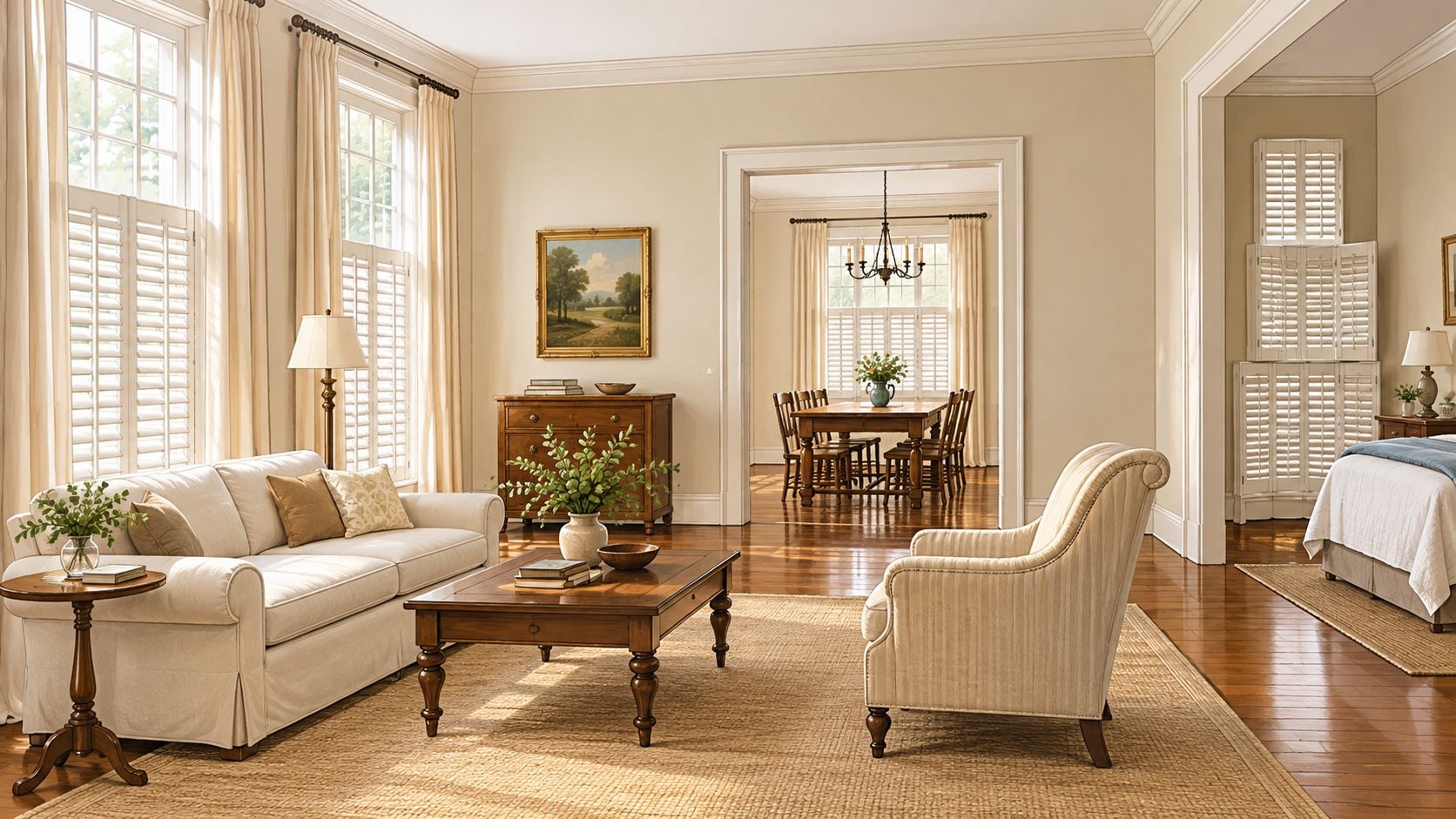
Full-height shutters paired with floor-length drapery suit formal living rooms because the shutters provide everyday control and the fabric panels add height, softness, and visual warmth. Neutral woven textures can complement solid wood furnishings, including heirloom-quality Amish furniture, without competing with the window's proportions.
Street-facing dining rooms often benefit from tier-on-tier shutters. The lower panels can stay closed during meals while the upper panels remain open for daylight. If the room faces east or west, an additional solar shade can reduce glare during the periods when the sun enters at a low angle.
Bedrooms and private spaces
Bedrooms need privacy and reliable darkness. Louvered shutters paired with blackout cellular shades provide two operating modes, adjustable louvers for daytime privacy and a close-fitting fabric layer for sleep.
A bedroom facing west deserves particular attention because late-day solar exposure can create glare and unwanted heat. Exterior shading offers stronger protection than relying only on interior panels, while the shutter louvers remain useful when the room needs daylight without a direct view.
Kitchens and bathrooms
Moisture changes the material decision. Composite or well-specified vinyl shutters can be easier to maintain in bathrooms and kitchens than natural wood, especially near sinks, tubs, and cooking areas. Solid panels can provide stronger light blocking, while louvered designs offer ventilation and adjustable privacy.
Homeowners in Freehold, Albany, Schenectady, Troy, and surrounding communities can compare finishes, frame styles, and pairing options at the Freehold showroom operated by Tip Top Furniture & Mattresses. Custom ordering helps when a home has arched openings, narrow casements, or window shapes that need more than an off-the-shelf treatment.
A 2025 building-performance study found that combining shading with window-opening strategies reduced overheating hours by as much as 85% in modeled scenarios, as discussed in its research on shading and window-opening strategies. That supports a seasonal approach. Shutters shouldn't remain permanently closed if open windows, daylight, or winter sun provide a useful benefit.
Choosing Shutter Materials for Durability and Maintenance
Material selection affects more than color. It changes the panel's weight, moisture behavior, maintenance routine, surface character, and suitability for a high-sun or high-humidity room.
Wood brings warmth but needs protection
Properly finished wood offers natural variation and a substantial feel. It works well in living rooms, dining rooms, libraries, and bedrooms where the finish can become part of the interior design. Wood needs protection from moisture and finish deterioration, so bathrooms, damp kitchens, and windows exposed to harsh conditions require careful specification.
Routine care is usually gentle dusting and occasional cleaning with a suitable product. Repainting or refinishing may become necessary when the finish shows wear, especially on bright exposures.
Composite handles demanding rooms
Composite shutters resist moisture absorption differently from wood, helping reduce the risk of mold and rot. They also aren't susceptible to termite damage. That makes composite a practical choice for bathrooms, kitchens, laundry areas, and homes where lower maintenance matters more than the exact character of natural grain.
Composite can still deliver a painted or wood-inspired appearance, but homeowners should review panel weight, hardware requirements, and the manufacturer's care instructions before ordering.
Vinyl keeps the decision simple
Vinyl is generally lightweight and economical. It can suit rental properties, secondary rooms, and low-visibility windows where budget and easy cleaning carry more weight than substantial construction or natural-wood character.
The right comparison isn't just wood versus composite versus vinyl. It's a question of where the shutter will be installed and how much care the household will provide.
- Choose wood when warmth and natural character lead the design.
- Choose composite when moisture resistance and long-term practicality lead.
- Choose vinyl when light weight, straightforward maintenance, and cost control matter most.
Specific warranties and installation instructions remain the final authority. A showroom consultant should also verify whether the material is appropriate for the window's exposure, operating size, and hardware.
Installation, Cost Considerations, and Long-Term Care
A well-designed shutter can underperform if the measurement is wrong. Inside mounts need accurate depth and squareness, while outside mounts need enough overlap to cover the opening without interfering with trim, handles, locks, or emergency egress. Gaps around the panel can reduce privacy and weaken the insulating effect.
Cost usually follows the project's complexity rather than one simple material label. The main variables include:
- Window count: More openings increase measuring, manufacturing, and installation requirements.
- Shutter style: Tier-on-tier, solid-panel, and specialty configurations involve different construction and hardware.
- Custom shapes: Arches, angled tops, narrow windows, and unusual casements require additional planning.
- Layering products: Drapery, cellular shades, roller shades, rods, and mounting hardware add to the complete project.
- Installation conditions: Deep trim, uneven walls, difficult access, and required repairs can change the scope.
Homeowners who want to handle part of the process can review DIY window treatments for basic planning. Measuring for a final custom order, however, deserves professional verification when fit, insulation, and safe operation matter.
Tip Top's Freehold showroom serves homeowners throughout the Greater Albany Capital Region with professional design services available since 1984, delivery support, custom options, flexible financing, and access to more than 50 trusted manufacturers. Its one-stop approach also connects window planning with living room furniture, bedroom furnishings, USA-made mattresses, flooring, décor, Amish furniture handcrafted in the USA, and clearance inventory. A project can be scaled from a focused window update to a coordinated room without treating each decision as a separate purchase.
Long-term care is uncomplicated when the system is checked regularly:
- Inspect finishes: Look for moisture damage, fading, peeling, or loose components.
- Clean gently: Dust louvers and wipe suitable surfaces without soaking joints or hardware.
- Check hinges and tracks: Confirm smooth movement and tighten or service components when needed.
- Review seasonal operation: Close panels on cold nights and intense summer exposures, then reopen them when daylight, passive solar gain, ventilation, or egress calls for it.
- Keep clearances safe: Furniture, cords, and drapery should not obstruct operation or emergency exits.
Tip Top Furniture & Mattresses helps homeowners in Freehold, Greene County, and the Greater Albany Capital Region plan window treatments with shutters alongside furniture, flooring, décor, and mattresses. Visit Tip Top Furniture & Mattresses to compare materials and layered options in person, discuss custom ordering and design support, and ask about flexible financing or clearance choices for the project.