Folding Wooden Table and Chairs: The Complete Buyer’s Guide


The call light never stops. A daughter needs extra chairs for Sunday dinner, somebody's hosting a holiday spillover, and a compact dining room still has to work on Monday morning. That's where folding wooden table and chairs earn their keep, especially for Capital Region homes that need real function without giving up precious floor space.
The catch is simple, most buyers judge these sets by appearance alone. That's how they end up with furniture that looks fine folded in the store, then wobbles, crowds the room, or refuses to fit the closet back home. The smart move is to measure the folded envelope, check the load rating, and choose hardware that stays solid after repeated use.
Why Folding Wooden Table and Chairs Deserve a Spot in Your Home
A good folding set solves the exact problem many families face on a Tuesday night, too many people, not enough space, and no desire to drag out mismatched extras. In a Freehold, NY home, that can mean a breakfast nook that needs to serve as a homework station, a guest overflow setup for the holidays, or a patio that has to switch between storage and dining fast. Folding wooden table and chairs do all of that without forcing a room to stay committed to one purpose.
The category has serious staying power for a reason. Folding seating has an old archaeological lineage, with examples of folding stools and chairs appearing in the Mediterranean and Near East from roughly the 15th to 13th century BC, plus evidence in Egypt, Minoan Greece, and Bronze Age Europe, and even a folding chair in Tutankhamun's tomb with ebony, ivory, and gold fittings (Folding chair history). That matters because it shows folding furniture was never just a flimsy convenience, it was a practical design with status, portability, and real utility.
Practical rule: if a piece only works when nobody touches it, it's not furniture for daily life.
Modern wooden folding sets are more refined than the old “card table and borrowed chair” image. They're chosen because they can be stored flat, brought out quickly, and still feel like part of the room instead of temporary clutter. For households in Albany, Schenectady, and Troy, that combination of usefulness and warmth is hard to beat.
Materials and Folding Mechanisms That Actually Last
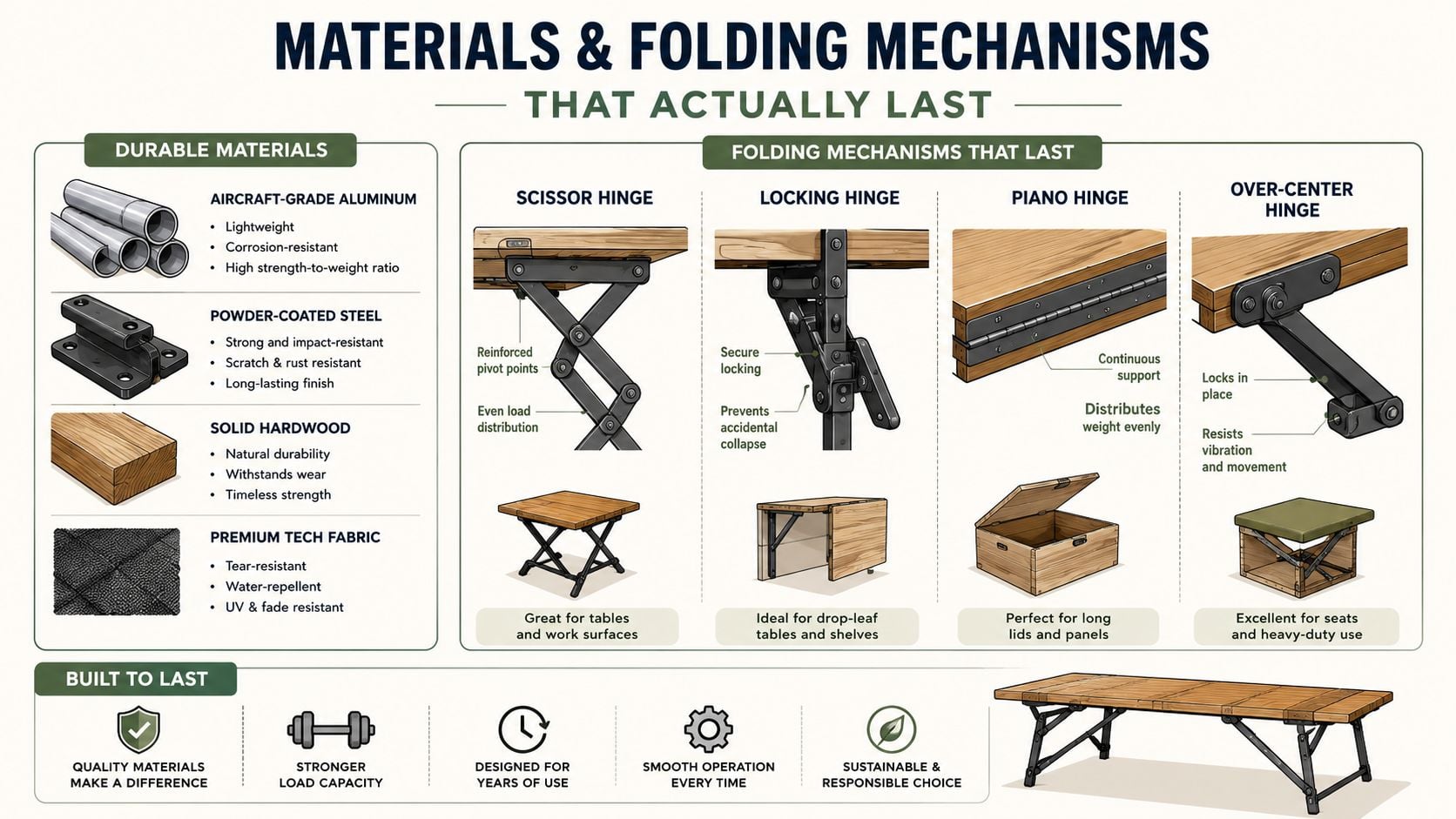
A folding set can look solid on the showroom floor and still fail where it matters, at the joints, hinges, and contact points that take repeated stress. Teak, acacia, and solid hardwoods deserve attention because they hold shape better, resist everyday wear, and stand up better to moisture and movement than flimsy alternatives. For shoppers comparing species, a guide to the best wood for tables helps separate attractive grain from wood that can handle use.
What the mechanism should actually do
A well-made wooden folding chair works as a geometric system of three lever groups joined by swiveling joints, with the seat acting as the key moving element and the two leg assemblies crossing as it folds (wooden folding chair construction). That geometry is the reason a chair opens cleanly, stays aligned, and still supports a person without feeling loose.
The build details that deserve attention are straightforward:
- Locking hardware, because a chair that does not lock confidently will eventually feel sketchy.
- Diagonal cross braces, because they resist racking and reduce side-to-side movement.
- Supported hinge lines, because folding joints take repeated stress every time the set opens and closes.
- Level assembly, because tightening screws on an uneven surface invites wobble later.
A maker's guide for wooden folding chairs points to a seat about 14 to 15 inches square, same-sized hinge holes and bolts for pins, and cross braces placed near the bottom of the legs (wooden folding chair construction). Those details explain why the better pieces feel calm under load while cheap ones twist when somebody shifts position. The same logic matters for folding tables, especially in larger setups, which is why some buyers also look at folding tables for large events before they choose a set.
A folding chair should move easily when opened, then feel boring once someone sits down.
For shoppers comparing heirloom-style solid wood with lighter utility pieces, the question is which one uses stronger joints, better pivots, and enough wood where the stress lands. That is the difference between a temporary purchase and furniture that can stay in rotation for years.
Understanding Load Ratings and Folded Dimensions
A folding wooden set can look perfect on a showroom floor and still fail in a real home if the structure is too light or the folded profile is too bulky. The numbers that matter are load rating and folded thickness, because they tell you whether the set can handle daily use and still disappear cleanly into storage. A folding table and chair set should be judged as a complete system, considering both load rating and folded thickness.
Product specs make the difference plain. One acacia-wood bistro set is rated for 240 lb per chair and 90 lb for the table, while another solid-wood outdoor set rates each seat at 110 kg and the table at 75 kg, with a 3 cm thick wooden top and a UV-resistant wood finish (folding furniture load ratings). A separate solid-wood folding table spec lists a 2-inch board and a 45 lb table mass, which shows the usual tradeoff, thicker parts add stiffness and stability, while they also make the piece harder to move.
Folding wooden set specifications at a glance
| Furniture Type | Typical Load Rating | Folded Thickness | Best For |
|---|---|---|---|
| Folding wooden chair | Around 240 lb per chair in one spec, higher on heavy-duty builds | Thin enough to store against a wall, some chairs fold to a very slim profile | Extra seating, compact dining, guest overflow |
| Solid-wood folding table | Table ratings can vary from modest service loads to sturdier outdoor specs | One sample table folds from 70 x 14 x 75 cm when collapsed | Dining rooms, patios, multipurpose rooms |
| Heavy-duty wood set | Higher chair and table ratings, suited to frequent use | Storage-friendly when the hinge layout compresses depth | Daily meals, entertaining, semi-permanent setups |
Storage is where bad buying decisions show up fast. One solid-wood set lists a table at 120 x 70 x 75 cm unfolded but only 70 x 14 x 75 cm folded, while the matching chairs collapse from 46 x 62 x 89 cm to 46 x 9 x 109 cm (folded envelope and dimensions). Those measurements matter because folded furniture is only practical if the collapsed shape fits the storage spot, not just the room where it will be used.
Before you buy, measure the space where the set will live, then measure where it will be stored. A practical room check is laid out clearly in this furniture measuring guide, and it will save you from guessing wrong on clearance. The same logic applies to larger setups, which is why readers comparing capacity and storage often look at folding tables for large events before they commit.
How to Measure Your Space for a Folding Wooden Set
A folding set that looks compact on the sales floor can turn a dining room into a choke point once it gets home. The usual mistake is measuring the tabletop and stopping there. Chair pullout, elbow room, and the path behind seated guests decide whether the room works day to day.
Start with clearance. 36 inches on primary circulation sides and 30 inches on secondary sides are the numbers that keep people moving without scraping walls or pinning chair backs. If the room is tighter than that, a folding wooden set will feel cramped even when it technically fits.
A room measurement guide helps, but the test is how the space behaves once the chairs are open and people are seated. The better question is whether the room still feels comfortable after guests sit down and people start moving through the space. That is the standard that keeps buyers out of trouble in homes across Albany, Freehold, and the surrounding Capital Region.
Measure the room the way it will be used
- Place the table where it will live. Mark the open footprint with painter's tape so you see the full impact on the floor.
- Pull the chairs out fully. Measure from the table edge to the back of the chairs, because that is where clearance gets lost.
- Check the main walking path. Keep the 36-inch primary clearance where people will pass most often.
- Check the secondary side. Leave at least 30 inches where traffic is lighter.
- Measure the folded storage position. Confirm the set clears closets, hallways, trunks, and utility rooms in its collapsed state.
- Test wall and doorway movement. Make sure a folded table or chair can be carried through corners without scraping paint or catching on trim.
The folded dimensions matter just as much as the open footprint. A set can look tidy in use and still be a bad fit if it will not slide into a utility room, stand flat in a closet, or fit the storage shelf you already have. That is where real-room planning saves money and frustration. For households using design software before buying, an ai patio design generator can help map furniture placement before anyone commits.
Measure the chair pullout first. That is where small-room mistakes usually start. A table that looks reasonable on paper can still crowd a doorway, block a buffet, or force people to twist sideways just to sit down.
Comfort after setup matters more than the showroom footprint. If guests can sit without bumping the wall and people can move behind them without squeezing through, the set is sized correctly.
Best Use Cases for Folding Wooden Table and Chairs
The right folding wooden set depends on how hard the furniture will work. A family that uses it every day in a tight kitchen needs a different build than a homeowner who only opens it for holidays. The question is simple. Will the set act like a daily table, a patio piece, or backup seating that stays stored most of the time?
Daily indoor use calls for heavier solid wood. It sits more firmly, stays quieter, and is less likely to shift when someone leans on the table during a meal. Outdoor use puts more pressure on the finish and the hinges, and UV-resistant protection helps a wood set handle sunlight and weather exposure better. If the set will live on a patio for part of the year, the frame also needs to fold and store without becoming a hassle. For families sketching out a room before buying, a small-space furniture guide can help show how much room the open set really needs.
Match the set to the job
- Everyday compact dining: Pick a sturdier wood build. Daily use exposes loose joints fast, and flimsy hardware shows up quickly.
- Patio and deck seating: Focus on finish protection and easy storage. If the set moves in and out often, the hinge action has to stay smooth.
- Holiday overflow: Choose compact folded dimensions and chairs that stand neatly when put away.
- Guest seating in a small home: Go with a set that folds thin enough to disappear when the room returns to normal use.
- Heirloom-minded buyers: Amish-crafted solid wood fits when the goal is a set that stays attractive and useful for years.
A patio setup benefits from planning before the furniture even arrives. A ai patio design generator can help map where the table, chairs, and walking space will sit without crowding the area.
For Capital Region homeowners trying to make one room do more, the best folding wooden set usually looks permanent while storing like temporary gear. Tip Top Furniture & Mattresses in Freehold, NY helps families coordinate room plans through its broader furniture selection, including dining pieces and custom ordering options, which matters when a folding set has to fit existing floors and décor. That kind of fit matters more than showroom looks.
Use this rule. If the set will be used more than stored, buy for stability first. If it will be stored more than used, buy for folded size and easy handling.
Maintenance and Finishing Care for Long-Lasting Beauty
Folded joints need the same attention you'd give any moving part in a busy home. Wooden folding furniture lasts when owners treat the hinges, locks, and support points as working hardware that needs regular attention. A set can look great on day one and still start to fail early if screws loosen, moisture lingers around the fold lines, or the finish wears away. In Upstate New York, seasonal storage matters just as much as day-to-day cleaning.
Good care stays simple, but it has to be consistent. Wipe the wood with a soft cloth, keep grit out of the folding points, and check the locks before each season of heavier use. If you want a fuller care routine for solid wood pieces, use these wood furniture care tips as a starting point. The point is to catch small issues before they turn into wobble, binding, or finish failure.
A few habits do most of the work.
- Wipe moving parts after use: Moisture trapped near hinges shortens hardware life.
- Store dry and covered: Damp storage invites warping and surface trouble.
- Check screws and locks each season: Loose hardware usually shows up before bigger instability.
- Treat scratches early: Small marks are easier to repair before the finish starts breaking down.
- Keep outdoor sets out of winter exposure: Cold, moisture, and repeated freeze-thaw cycles are hard on wood.
Dry storage is required for wooden folding furniture that lives outside part of the year.
Listen to the furniture. A squeaky chair usually points to the hinge. A table that rocks usually needs the joint line checked. Tighten fasteners on a flat surface, because an uneven floor can leave the frame twisted and make the wobble seem worse than it is.
Finish care should match the wood and the coating already on the piece. Use the wrong cleaner or the wrong polish, and you can dull the surface or weaken the protection. Keep the care routine tied to the material, and you preserve both the look and the folding action. That is what keeps a folding set useful year after year.
Questions to Ask Before Buying and Where to Shop Locally
Buyers who avoid regret ask the hard questions before they buy. Start with the wood species, the joinery, the weight rating, the locking hardware, and whether the set is meant for indoor use, outdoor use, or both. If the answers stay vague, the piece is a poor bet.
Ask how the chair locks, how the table legs brace under load, and whether the finish matches the room where the set will live. A folding set should feel steady at the joints, not just light in the showroom. If it flexes or rattles in your hands, keep shopping.
A quick floor check tells you more than a product tag. Open and close the set, press on the table corners, and make sure the folded footprint will clear the hallway, pantry, or storage spot you plan to use. A set that looks fine in a display area can still be awkward at home if the folded thickness is too bulky or the legs catch on nearby furniture.
- What wood is this made from? Solid hardwood behaves differently than softer, lighter material.
- How does the folding mechanism lock? Loose hardware usually shows up fast in daily use.
- What's the realistic load rating? The number should match the heaviest user and the intended use.
- Can the set be custom ordered? Finish and size control can solve fit problems before they start.
- What happens after delivery? Assembly and setup support matter when the room is tight.
Local buying also gives you something a product page cannot. At Tip Top Furniture & Mattresses in Freehold, shoppers can ask the staff to walk through fit, folding clearance, and delivery details before they commit. The store has been serving the Greater Albany Capital Region since 1978, with professional design services available since 1984, and that experience matters when the goal is a set that works in a real home, not just on a screen.
Shoppers can also review the store's delivery and assembly information before they buy, especially if stairs, tight doors, or a narrow dining area are part of the plan. That kind of local support saves time and prevents the usual mistake, buying a folding set that fits the catalog and fails in the room.
Your Next Steps to Finding the Perfect Folding Set
The right folding set is the one that fits the room, holds steady, and stores without becoming a headache. Start with measurements, then check the load rating and the folded thickness, then decide whether the piece needs to live indoors, outdoors, or both. Families who do those three things usually avoid the most common regret, buying for looks instead of daily use.
If the space is still uncertain, a room planner helps turn guesswork into a layout that makes sense. If the purchase needs to happen now, the Freehold showroom is the place to see how the pieces feel in person, and the Clearance Corner can be a practical stop for immediate value. That combination of one-stop shopping, custom orders, flooring, mattresses, and financing keeps the whole home project under one roof.
Visit Tip Top Furniture & Mattresses in Freehold, NY to see folding wooden table and chairs that fit real rooms, real budgets, and real daily use. The team can help with room planning, custom options, delivery, and financing, so the set you bring home works the way your family needs it to.