Plantation Shutter Cost in Upstate New York

A full-home plantation shutter installation commonly lands near $1,341 to $4,792, with a typical average around $3,028, and installed pricing often sits in a $20 to $45 per square foot band. Greene County and Albany Capital Region quotes can sit above or below that national picture once local labor and stock enter the bid.
A single average misleads in the same way a sofa price does when nobody names the size or the fabric. Window count, opening size, and the lines on the paperwork move the check more than a room label ever will. Homeowners in Freehold, Albany, Schenectady, and Troy get a usable budget when they compare written scopes, not the lowest advertised rate, and when they treat shutters as comfort and glare control in an Upstate climate rather than a promised cut on the heat bill.
Plantation Shutter Cost Ranges for 2026
Installed plantation shutters commonly run $20 to $45 per square foot, according to HomeAdvisor's plantation shutter cost guide. That rate offers a starting point; the total scales with window count and opening size.
| Scope | Typical range | How to read it |
|---|---|---|
| Installed price per square foot | $20-$45 | Material, size, and labor set the rate |
| Full-home project | $1,341-$4,792 | Average near $3,028 |
| What sets the total | Window count and opening size | Larger areas and more windows raise the total |
For a 15-square-foot living-room window, a rate of $25 per square foot gives an area-based estimate of $375. At $45 per square foot, it is $675. Frames, unusual shapes, tax, and labor can affect the final quote.
Why one average misleads
A narrow double-hung window in a Greene County home has a different scope from a wide opening with deep Albany-area casing. Size, shape, trim, and material all affect what the written quote covers.
National cost figures offer a broad starting point for Freehold, Albany, Schenectady, and Troy. Local labor and available stock can shift a project's price. Two homes with the same number of windows may still have different totals if their openings and trim differ.
If the project includes aging sashes, the Superior Home Improvement replacement cost guide explains how window and door replacement work is priced. Tip Top's historic Freehold showroom has served Albany, Schenectady, Troy, and greater Greene County since 1978. Compare written scopes line by line, including the opening, materials, and labor each quote covers.
How Shutter Material Changes the Price
Once you know the square footage, material is the main price lever. This Old House's plantation shutter cost breakdown puts estimated material-only rates at about $20 to $30 per square foot for vinyl or PVC, $25 to $35 for composite, $30 to $40 for faux wood, and $35 to $45 for real wood. Real wood sits in the premium tier. Vinyl and composite cut the upfront number and often handle humidity better.
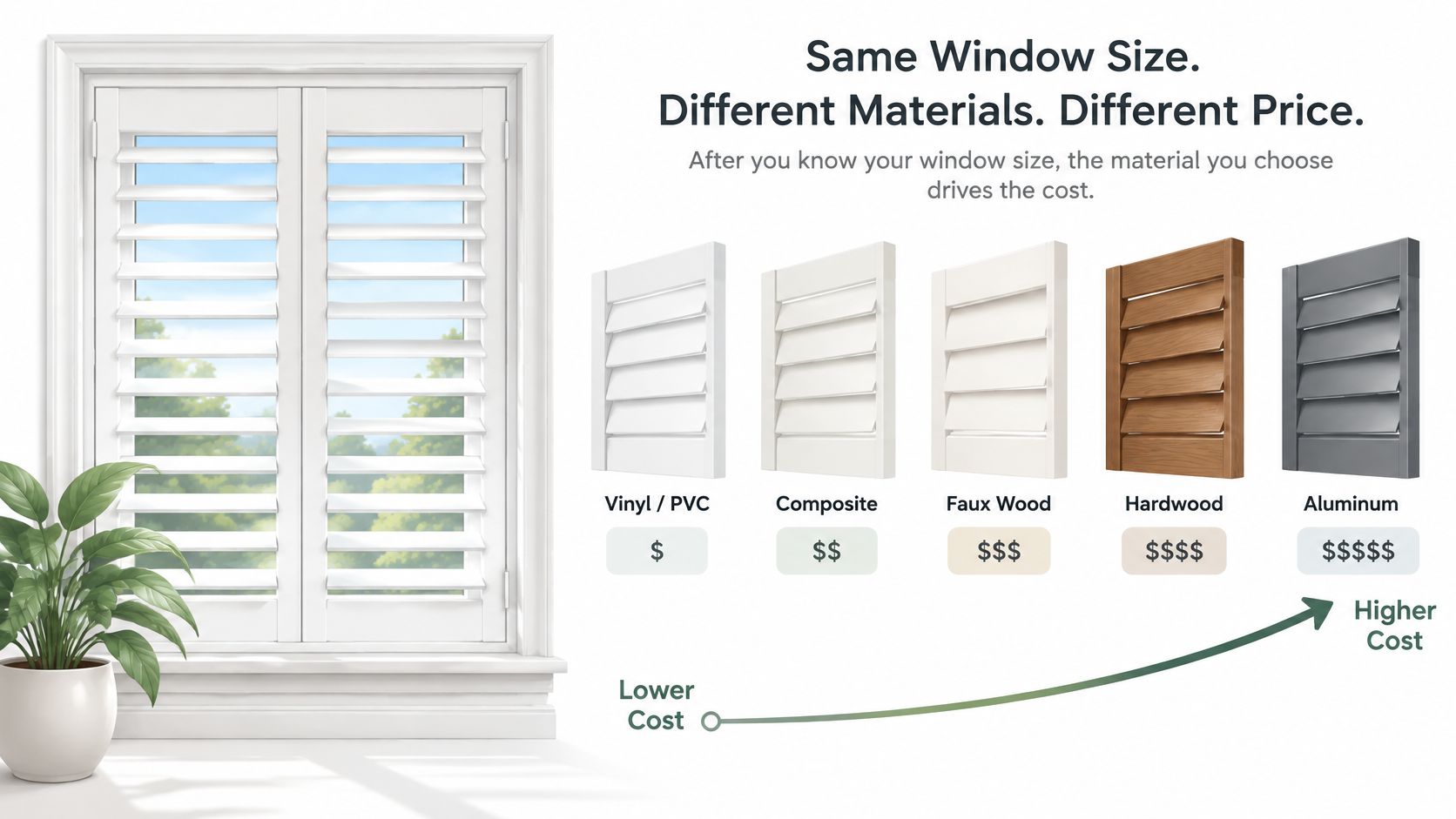
| Material | Material-only rate | Moisture behavior | Typical fit |
|---|---|---|---|
| Vinyl or PVC | $20-$30 per sq ft | Strong humidity resistance | Baths, kitchens, damp sills |
| Composite | $25-$35 per sq ft | Good moisture resistance | Everyday bedrooms and family rooms |
| Faux wood | $30-$40 per sq ft | Better than bare wood, varies by core | Wood look without hardwood price |
| Real wood | $35-$45 per sq ft | Needs finish and drier rooms | Formal rooms where grain matters |
On a 10-square-foot opening, those bands imply roughly $200 to $300 for vinyl or PVC and $350 to $450 for real wood, before labor, specialty hardware, or trim. The plantation name comes from wide Southern shutters on large estates. Today's spread is mostly this material trade-off, not a new invention.
Humidity versus a formal room
Real wood costs more because the maker pays for lumber, machining, stain or paint, and moisture protection. Vinyl and composite use engineered or polymer construction that is cheaper to produce and less likely to swell on a damp sill. Faux wood sits in the middle when you want a wood look without the full hardwood premium.
Bathrooms, kitchens, and older Upstate houses with winter condensation usually do better with moisture-resistant vinyl or composite, even when wood looks richer beside a formal living-room mantel. Ask for the material core, not just the color name. A low per-window price can hide hollow construction that feels light and limits finish choices.
Stain care stays simpler when you follow practical plantation shutter stain removal tips instead of guessing at solvents on a painted louver. If you already own Amish-made solid-wood furniture, custom ordering lets you match species and finish so the shutters don't fight the case pieces. If louvers feel like too much hardware for a low-use room, compare blinds and shades before you commit every opening.
What Turns a Shutter Price into a Project Price
The lowest advertised price per square foot is often not the lowest finished cost. A cheaper panel can still need a different frame, fewer finish choices, or extra labor when the opening won't take a standard mount. Neutral notes in a federal laboratory window document show that window work can average hundreds of dollars per opening, and that the total changes when the estimate leaves work out.
A written estimate should split the job into separate lines:
- Shutter panels: the louvers and stiles, named by material core.
- Frame or trim: L-frame, deco frame, or extra casing to cover an out-of-square opening.
- Professional measure: who records width, height, and depth, and who owns a bad number.
- Installation labor: mounting, shimming, and adjustment, not a vague "install extra."
- Delivery: freight to Greene County or a Capital Region job site.
- Disposal: haul-away of old blinds, shades, or broken brackets.
- Specialty shapes: bays, French doors, arches, and circles, each called out.
- Tax and financing: sales tax, plus any interest or fee if you spread the balance.
A large opening is often priced by covered area, not by how many window units the house has. One wide picture window can outrun three small double-hungs. In older Freehold, Greene County, and Capital Region homes, out-of-square openings, deep sills, thick casing, and replacement windows are common, and they can force custom fabrication.
Questions every bidder should answer
Ask every bidder the same list. You want measured width and height, inside mount versus outside mount, frame depth, and whether the sill or a crank blocks the louvers. Ask who removes existing coverings, who fills holes, and who handles paint touch-up. Confirm included hardware and the tilt rod, the warranty, and what happens if the opening will not accept the planned mount.
Practical rule: Two quotes at $30 per square foot are not equal until the written scope matches line for line.
Take an apples-to-apples checklist to any showroom. Same openings, same material core, same louver size, same frame, install included or excluded, and a line for tax. A Realtor.com cost guide reported that professional installation may add approximately $100 per hour, while prefabricated sets can begin near $150. Ask whether a low quote is a prefab set or a custom fabrication with full installation. Staff who handle custom window treatment design can put those assumptions on one page before you compare the next bid.
How to Measure Before You Order Shutters
A width measured at only one point can miss a pinched opening. If a panel is ordered to the wider measurement, it may bind and need to be remade. For older or uneven windows, a professional measurement can help catch problems before fabrication.
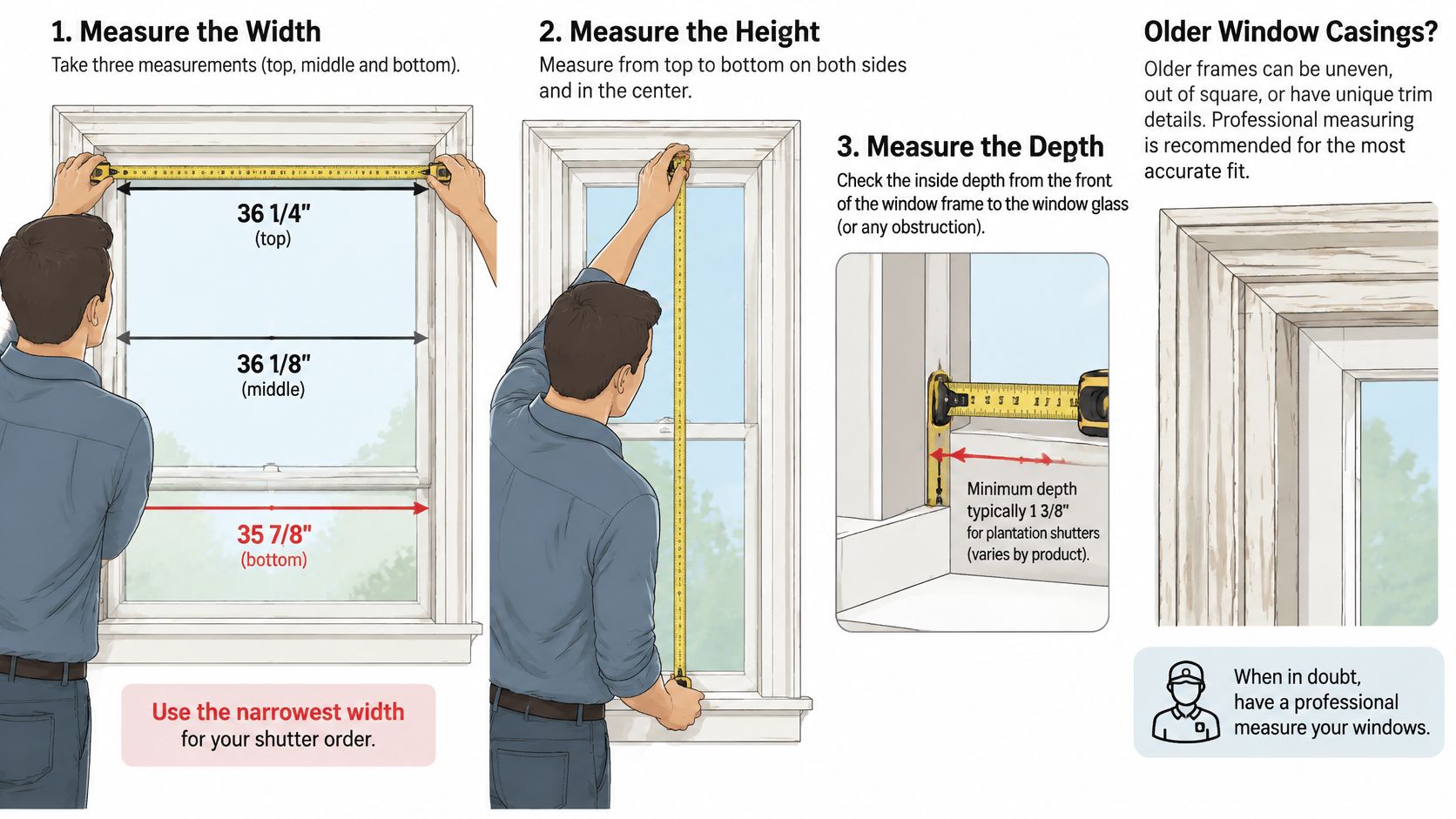
- Measure width at three heights. Take measurements at the top, middle, and bottom of the opening. Record the narrowest one.
- Measure height at three points. Check the left, center, and right sides. Record the shortest measurement.
- Photograph each window. Include the sill, handles, locks, and any existing blind brackets so the fabricator can see possible obstructions.
- List rooms with moisture. Note bathrooms, kitchens, and windows that collect condensation in winter. That information helps determine which shutter core suits the room.
- Confirm what cleanup includes. Ask who removes old coverings, fills holes, and handles paint touch-up. These tasks may not be included in an installation quote.
For guidance on the installation sequence, see these window-treatment DIY basics. The process can be straightforward on square, unobstructed windows. Shims or a custom frame may be needed when an opening is uneven.
Louver size and extra hardware
Wider louvers provide a more open view. Smaller louvers can suit openings with limited clearance, and the machining can affect the price. Hidden tilt, a divider rail on a tall window, and special hinges may also appear as separate line items. Ask to have each included in the written quote before fabrication.
Sample Quotes for Capital Region Windows
A 12-square-foot bedroom window and a 30-square-foot living-room pair show how quickly size and material affect a shutter estimate. These are hypothetical examples, not quotes.
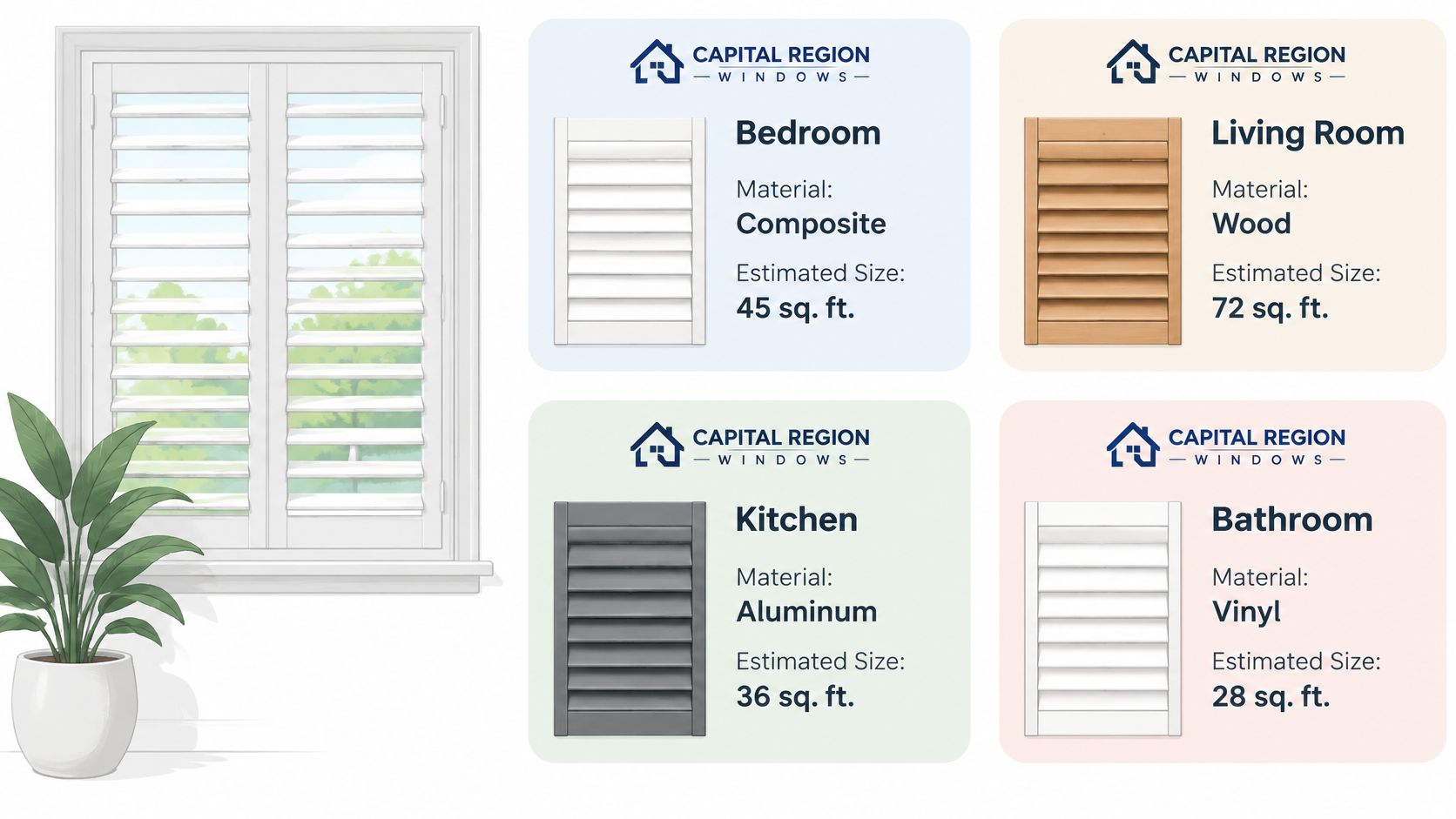
| Example | Openings | Material assumption | Illustrated range | Usually still extra |
|---|---|---|---|---|
| One bedroom window | About 12 sq ft | Composite at $25-$35 per sq ft | $300-$420 | Measure, install, tax |
| Living-room pair | Two openings, about 15 sq ft each | Real wood at $35-$45 per sq ft | $1,050-$1,350 | Frames, hardware, labor |
| One bathroom window | About 8 sq ft | Vinyl or PVC at $20-$30 per sq ft | About $160-$240 | Moisture-rated core, install, tax |
| Ten similar windows | 10 openings | Vinyl through hardwood per-window bands | About $750-$6,000 materials | Install and odd openings |
For the bedroom, 12 square feet × $25–$35 gives $300–$420 for the assumed composite material. The living-room pair totals 30 square feet × $35–$45, or $1,050–$1,350 for real-wood panels. The bathroom estimate assumes a moisture-rated core. The ten-window example covers materials only.
How to scale a sketch
Angi's plantation shutter cost article gives typical material ranges of $75–$150 per window for vinyl, $150–$400 for faux wood, and $250–$600 for hardwood. For 10 similar windows, those per-window bands add up to about $750–$6,000 in materials before installation. Section 1 covers the broader national project benchmarks.
Use measured square footage and the chosen material rate to build a starting estimate. Then compare written scopes: check whether each includes frames, hardware, measuring, installation, removal, tax, and finish work. A low per-square-foot rate can cover less work than a higher rate, so the listed total alone does not show which quote includes more.
Window shape also affects the comparison. An Albany colonial with many small double-hungs may price differently from a home with one wide picture window, even when both use the same material. Sketching the rooms in a free online planner can help show how shutter width lines up with furniture and a TV. Closed louvers can reduce glare and make a room feel more comfortable, though the examples here do not establish a utility-bill saving.
Ways to Save and Where to Price Them Locally
Save by choosing which windows to cover and keeping the order straightforward. Start with rooms where shutters will be used most, then add other windows when they become a priority.
- Phase the house. Begin with sun-struck living-room and bedroom windows. A smaller first order also lets you check the color and louver size before extending them to other rooms.
- Match material to the room. Vinyl or composite suits wet rooms. Real wood can make sense where its grain complements solid-wood furniture.
- Keep the design consistent. One louver size, color, and frame style is easier to price than several custom combinations.
- Price standard shapes first. Compare rectangular windows before adding arches, bays, or French doors, which require more custom fabrication.
- Ask about items already on the floor. In-stock or clearance window treatments may suit rooms you are furnishing now. Check whether a shorter custom lead time is available for made-to-order options.
If the same room needs furniture, the Clearance Corner at Tip Top Furniture & Mattresses may have items to consider. Financing can spread the cost of a multi-window order. Ask whether interest or fees are included in the project total, and read the financing terms before signing. Custom orders can specify fabric, finish, and wood type when you need a close match to furniture you have already chosen.
Price the sunny rooms first, then add other windows as your needs and budget allow.
For a local starting point, explore window treatments available to Albany-area homeowners. Bring window photos and a room list to the Freehold, NY showroom or request a design consultation. Ask for a written scope so you can compare what each quote includes, such as measurements, installation, and any finish work. Tip Top Furniture & Mattresses has been family-owned since 1978 and carries products from more than 50 manufacturers.
Plantation Shutter Questions Buyers Still Ask
Do shutters cut heat bills in Upstate New York?
Shutters can reduce glare and help a room feel more comfortable during Upstate New York winters. The U.S. Department of Energy's overview of window coverings explains how coverings affect heat transfer and solar gain as part of the window system. For energy improvements, compare shutters with air sealing, insulation, storm windows, and replacement windows, then weigh comfort alongside the project cost. A written scope makes that comparison clearer than advertised per-square-foot rates. See how plantation shutters pair with other window treatments.
Is a do-it-yourself install cheaper?
A do-it-yourself installation can cost less on a square opening with clear access and accurate measurements. Custom panels depend on the opening's dimensions and frame depth, and a measuring mistake can leave panels that cannot be trimmed to fit. Older or uneven casing can make a professional measure the safer choice.
Can you shutter only some windows?
Yes. Start with the rooms where privacy, glare, or comfort matters most, then add other windows later. Keep the louver size and frame style consistent across the room so the finished windows look coordinated.
How long does a custom order take?
Lead time varies by material, color, and specialty shape. Get the expected delivery date in writing before scheduling painters or furniture delivery, so the work and furnishings can be planned around the shutters.
Tip Top Furniture & Mattresses, family-owned in Freehold since 1978, helps Greater Albany Capital Region homeowners coordinate shutters with furniture and flooring. Bring window photos and a room list to the Freehold showroom or book a complimentary design consultation. Ask for a written scope you can compare, and review financing options before ordering. Visit Tip Top Furniture & Mattresses to speak with local staff.