Eclectic Style Interior Design: A Practical Room Guide

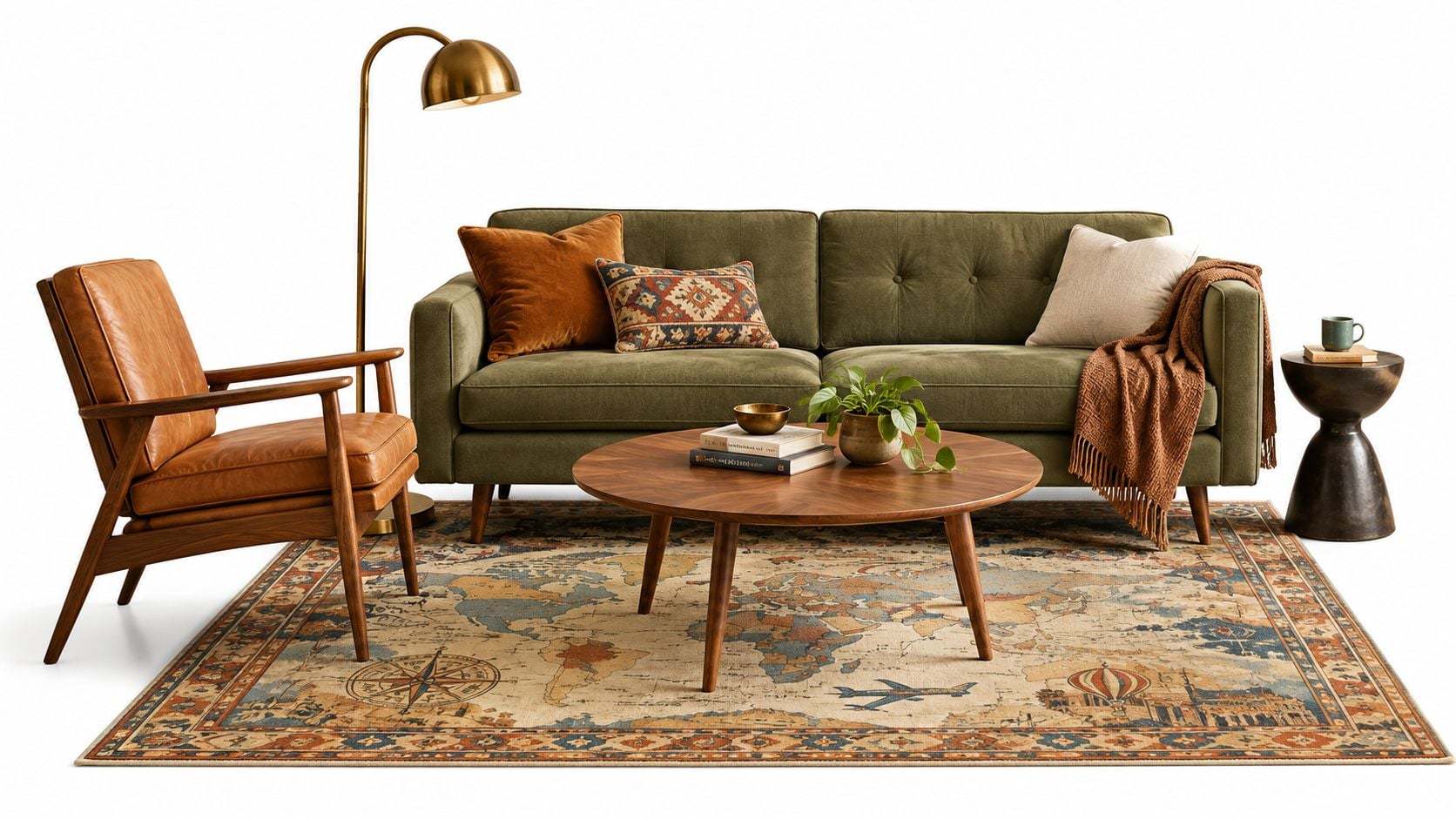
A sofa from another decade, an inherited brass lamp, and a patterned rug brought home from a trip can make a room feel personal. Yet the same pieces can look accidental when their colors, proportions, and placement have no relationship.
That's the challenge behind eclectic style interior design: keeping the character without keeping the confusion. For homeowners in Freehold and the Greater Albany Capital Region, the most useful approach starts with a few visual rules, then checks whether the room still works for reading, gathering, storage, and everyday movement.
What Eclectic Style Interior Design Really Means
An eclectic room isn't defined by how many styles it contains. It's defined by the connections between them.
Consider a contemporary sofa beside a carved wood cabinet. A curved lamp can echo the cabinet's rounded details, while a cushion repeats a color from the artwork above it. The pieces don't match, but they belong together.
Eclectic interior design is a deliberate blend of eras, makers, materials, and cultural influences, unified by a shared thread. It works like a well-edited playlist: songs from different years can share a rhythm without sounding alike.
A collected style with historical roots
Eclecticism has roots in the Victorian era, 1837 to 1901, when interiors combined Gothic Revival, Rococo, Renaissance, Arts and Crafts, and non-Western decorative traditions, as described in the Leighton House history. That history helps distinguish thoughtful synthesis from random accumulation.
The style also remains relevant to professional designers. A 1stDibs designer survey, reported by Accio's interior design trends overview, found that 38% of respondents identified eclecticism as an aesthetic expected to remain popular in 2026. That's a forecast of designers' expectations, not a measure of how many homes already use the style.
Eclectic style compared with related styles
| Style | Core idea | Typical palette | Biggest risk |
|---|---|---|---|
| Eclectic | Curated mix of eras and cultures held together by a shared thread | Dominant neutral with two or three repeated accents | Looking like a collection of unrelated purchases |
| Maximalism | More is more, with layered pattern and saturated color everywhere | Bold and saturated across most surfaces | Visual fatigue without a clear focal point |
| Transitional | Classic forms with clean modern lines | Soft neutrals with muted accents | Feeling generic or safe |
| Minimalism | Fewer objects with deliberate negative space | Neutral and monochrome | Feeling cold or unfinished when pieces lack character |
These categories overlap. An eclectic room can be quiet and spare; a maximalist room can contain furniture from a single period.
Connection test: Every prominent piece should connect to another through color, material, proportion, or shape.
The 60-30-10 Color Split for Mixed Rooms
The American Society of Interior Designers' color guideline assigns approximately 60% to a dominant hue, 30% to a secondary color, and 10% to an accent. For mixed rooms, the value lies in hierarchy rather than exact measurement.
The dominant layer establishes the background. Walls, flooring, cabinetry, and a large sofa usually contribute more visual area than accessories, so these choices deserve attention first.
The secondary layer gives the room structure. Curtains, an area rug, upholstered chairs, and substantial wood furniture can distinguish different zones without making the room feel divided.
A Schenectady living room example
Say a Schenectady living room has warm white walls and a greige sectional. Together, those broad, quiet surfaces establish the dominant layer.
A muted blue rug and wood dining chairs supply the supporting layer. Saturated ochre pillows and a brass lamp provide the small, more expressive accents. The materials aren't identical, but their visual roles are clear.
The accent can carry the strongest color because it occupies less space. A vivid ceramic bowl adds energy without making the whole room feel vivid.
Useful foundation colors include:
- Warm white: A soft backdrop for aged wood and colorful artwork.
- Greige: A practical bridge between warm timber and cooler upholstery.
- Soft taupe: A gentle partner for cream, leather, and woven fibers.
- Muted blue: A calm foundation when the room needs color rather than another neutral.
Check visual weight before adding more
A phone photograph helps expose competition that's harder to notice while standing in the room. Convert the image to grayscale and squint: one lightness family should read as the background rather than every surface demanding equal attention.
Grayscale checks value, not hue. The original color photograph still matters when judging whether a blue chair and an ochre rug feel comfortable together.
For smaller rooms, keep the lightest values on walls and ceilings, introduce saturated upholstery selectively, and carry accent colors between textiles and art. Tip Top's guide to adding color without painting offers useful options when existing wall finishes need to stay.
How to Mix Eras on an 80/20 Base
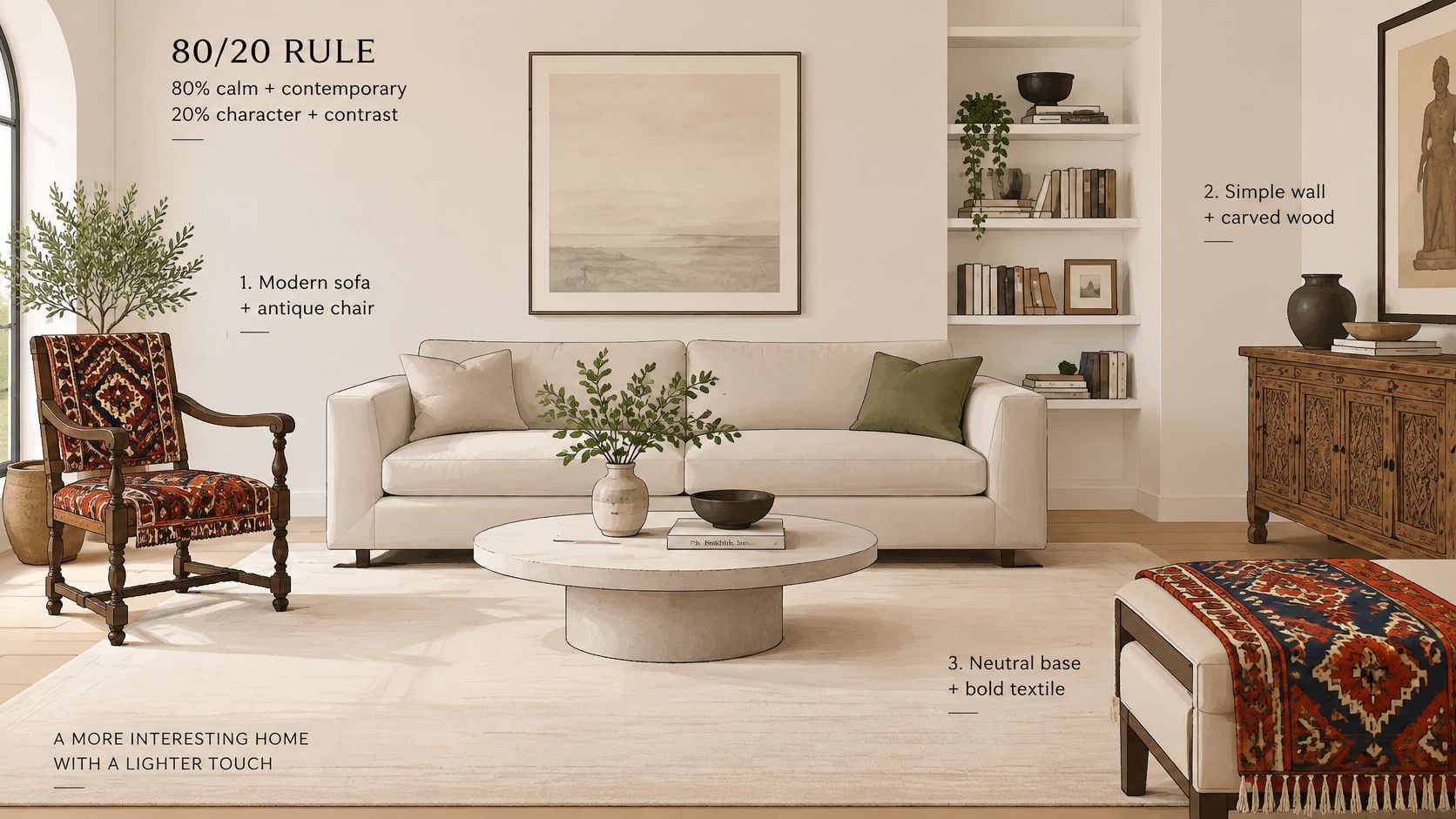
A room can hold an antique cabinet and a modern sofa without feeling like a showroom of unrelated finds. Start by choosing which style will lead, then use contrasting pieces as deliberate exceptions. The Archiweb guide to combining interior styles suggests an 80/20 balance: roughly 80% of the room follows a calm base style, while 20% introduces contrast. It also recommends a palette of three or four colors, with each accent repeated two or three times.
These proportions measure visual emphasis, so one large antique cabinet can outweigh several small modern accessories. In an older home, check that the arrangement also leaves clear routes through the room and access to storage.
Choose the foundation before the exceptions
Start with the piece used most. In a living room, the sofa usually sets the direction. A low sofa with straight arms and square legs suggests a contemporary foundation. Rolled arms and turned legs point toward a more traditional starting point.
Choose contrasting pieces for a reason. An heirloom solid-wood cabinet can add depth to a contemporary room. Check its height and width against the sofa, wall, and ceiling so it feels proportionate, not different for its own sake.
Keep the color range controlled. A vintage mirror, modern chair, and handmade textile are easier to combine when their colors belong to the same restrained palette.
Repeat accents across the room. A rust-colored chair feels connected when rust appears in artwork elsewhere. That small echo guides the eye through the space, while placing every expressive object in one corner makes the room feel lopsided.
A traditional room with a mid-century lamp gains a crisp silhouette while keeping its established character. A Shaker-style dining table beneath a vintage mirror pairs plain construction with a more decorative vertical element. For another way to identify which features distinguish each approach, see this guide to contemporary and traditional design styles.
Match visual weight, not birthdays
Furniture from different decades can share a room when their visual weight is balanced. A heavy cabinet needs nearby pieces with enough presence to hold their own, such as substantial upholstery or generously sized artwork. Otherwise, the cabinet can look like an isolated leftover rather than part of the arrangement.
Amish-made solid wood can anchor a modern setting through its craftsmanship and grain, without requiring ornate decoration. The balance is practical: too much contrast makes the room feel like separate purchases, while too little can leave it anonymous. In a compact room, let one substantial piece lead and keep its neighbors useful for seating, storage, or lighting.
A contrasting piece should change the conversation in a room, not interrupt every other piece.
How to Layer Textures and Patterns Without Chaos
Pattern mixing often fails because the motifs have similar scale, not because their subjects differ. A floral and a stripe can sit comfortably together when one reads as a broad design and the other reads almost like texture.
The Homes & Gardens guide to mixing pattern scale describes combining a large-scale motif on a rug or major upholstery, a medium design on curtains or a chair, and a smaller print on accessories. The difference in scale helps separate the layers.
Audit the patterns already present
Before buying fabric, list the room's recurring motifs. Include wallpaper, tile, wood grain, and artwork rather than counting only cushions and curtains.
A rug with broad botanical shapes may already provide the largest motif. A chair with a tighter geometric weave can support it, while a finely striped pillow adds detail without creating another focal point.
Trouble starts when a dense rug, densely patterned curtains, and busy upholstery all occupy major surfaces. Even coordinated colors won't necessarily make that combination restful.
A practical layering order is:
- Anchor the largest pattern first: Select the rug or principal upholstery before small accessories.
- Connect the supporting pattern: Choose a medium motif that shares a color with the anchor.
- Introduce tactile contrast: Add woven fiber, velvet, leather, or another clearly different texture.
- Finish with smaller details: Use fine prints and small objects where the composition needs interest, not on every available surface.
Let texture provide variety without more color
Wood, woven fiber, velvet, metal, glass, and ceramic each affect how a room feels. Matte pottery beside reflective glass creates light and shadow without requiring another bold hue.
Texture also needs restraint. A textured rug, nubby sofa, rough timber table, and heavily woven curtains can feel busy even when everything is beige. A smooth tabletop or plain linen panel gives the eye a quieter place to land.
Tip Top's guide to mixing and matching patterns can help narrow choices before upholstery and rug decisions become expensive.
As a starting rule of thumb, limit large-scale patterns to a pair and place solid surfaces between them. That's an editing technique, not a requirement: a compact room with ornate trim may need even less pattern, while an open room may accommodate more.
Room-by-Room Eclectic Plans for Capital Region Homes
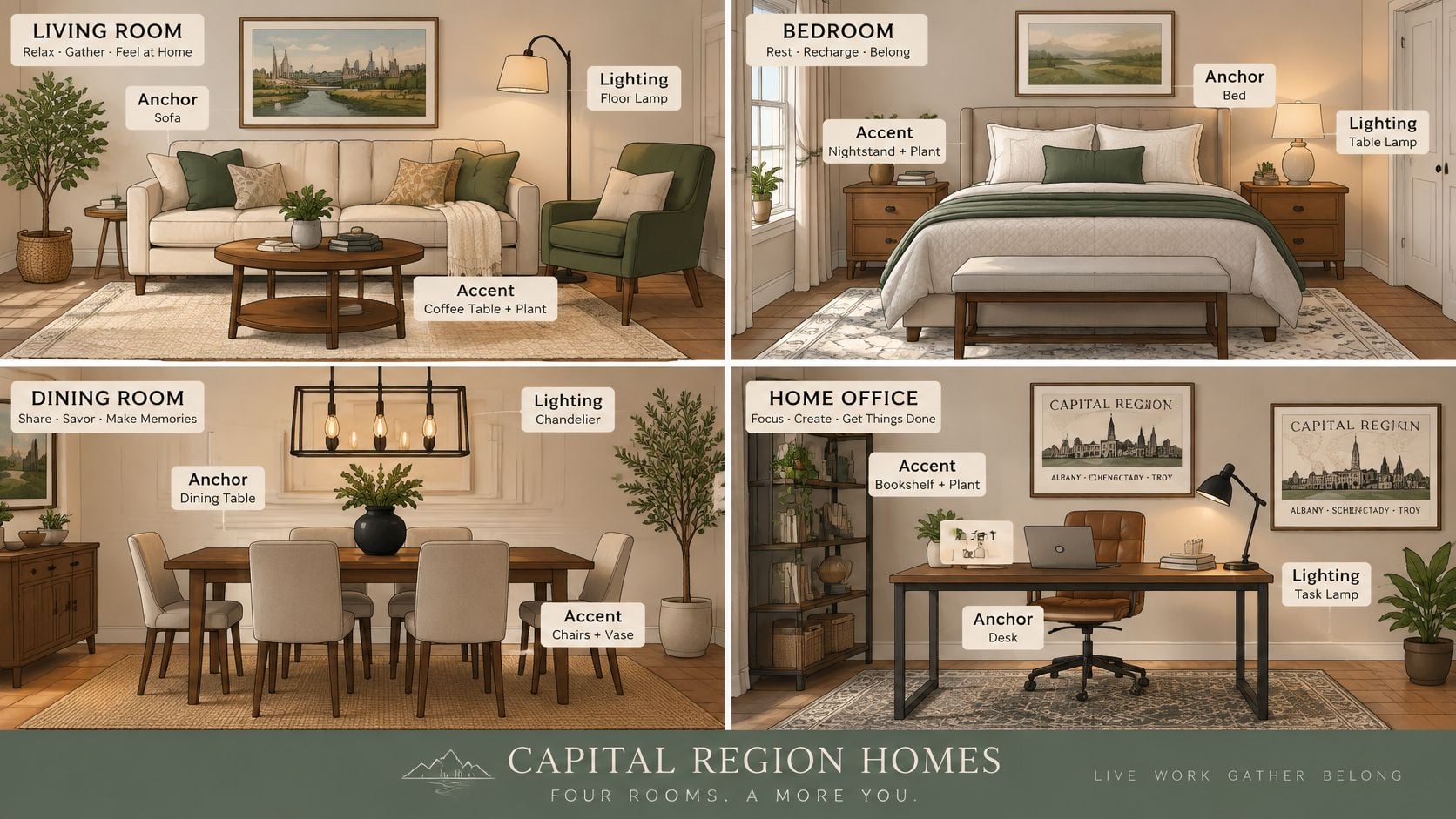
Each room needs an anchor, a supporting layer, and lighting suited to its activities. The decorative choices should follow the room's use, especially in older Capital Region homes where circulation routes, radiators, and door swings already limit placement.
Anchor, layer and watch-out for each room
| Room | Anchor piece | Layer to add | Watch for |
|---|---|---|---|
| Living room | Sofa or sectional in a neutral base | Mixed side tables, a patterned rug and layered lamps | Coffee table and rug scale that block walkways |
| Bedroom | Solid wood bed frame with a USA-made mattress | Calm textiles, a vintage bench and bedside lamps | Patterns competing with the headboard |
| Dining room | Solid wood dining table | Mismatched chairs in one finish family and a statement pendant | Chairs too wide for the table's clearance |
| Home office | Desk sized to the wall and task lighting | A bold chair, artwork or a patterned rug as the accent | Glare on screens from accent lights |
Living rooms should accommodate conversation without requiring furniture to move whenever someone stands up. Mixed side tables can work well, but their tops need to be reachable from the seating.
Bedrooms benefit from quieter textiles around a characterful headboard. A USA-made mattress should be selected for support, comfort, durability, and value rather than treated as another decorative purchase.
Dining rooms need compatible seat heights and enough room to pull chairs away from the table. A statement pendant can provide the small accent role without forcing every chair to become a feature.
Home offices need a functional desk and task lamp before decorative additions. A bold chair is useful only if it also suits the work being done.
Light activities and objects separately
Use ambient light for general visibility, task light for reading or work, and directional accents for selected artwork or architectural details. Test flooring, fabric, and paint samples in daylight and evening light, since warm wood and cool metal can look quite different as illumination changes.
Practical checks should include:
- Clear movement: Keep accent stools, plant stands, and lamp bases out of established walking routes.
- Accessible controls: Choose easy-reach switches and seating that allows comfortable sitting and standing.
- Useful storage: Give each room a closed cabinet, lidded bench, or another place for everyday belongings.
- Seasonal flexibility: Reserve storage for winter throws, boots, and items used only part of the year.
For a natural layer, Little Green Leaf's easy houseplant decor for beginners offers placement ideas; plant selection should still follow available light and household needs.
Older Upstate homes often need careful delivery measurements as well as room measurements. Tip Top's guidance on interior design for older homes helps frame decisions around existing architecture rather than against it.
Where to Source Pieces for a Collected Look
In an older Upstate New York home, a new cabinet must work with the room's existing floors, doorways, and circulation. Choose the anchor piece first, then compare supporting items with its dimensions, finish, and upholstery. A photograph can hide scale and color differences, so check measurements and samples against the room before ordering.
Eclectic rooms can combine new furniture with inherited, vintage, or repurposed pieces. Judge each by condition, everyday usefulness, and how it supports the room's color and material mix.
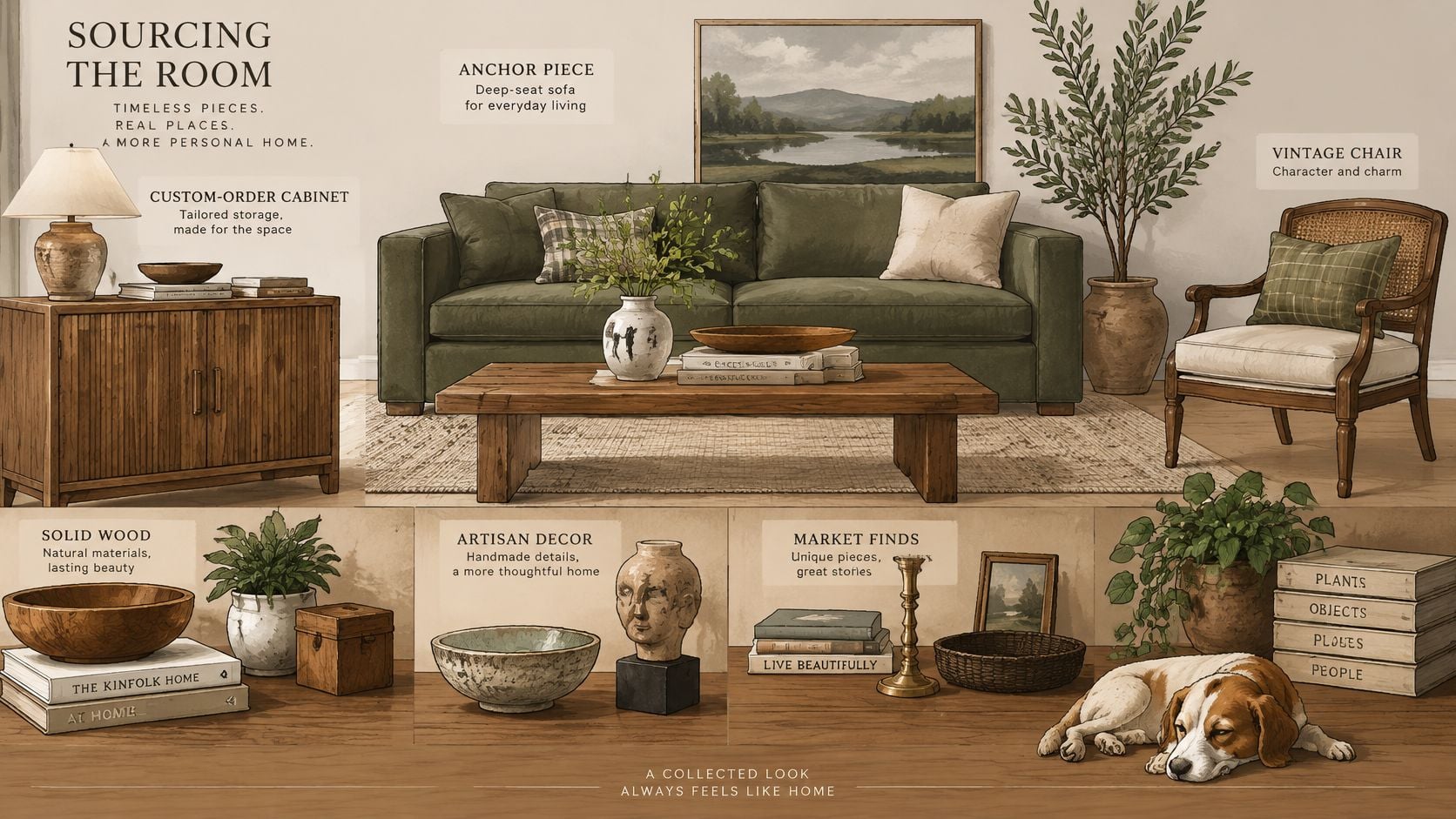
Sourcing options for an eclectic room
| Source | Best use | Trade-off | Check |
|---|---|---|---|
| Amish-made solid wood | A durable anchor piece | Higher upfront cost than mass-produced furniture | Compare wood type, finish, and lead time |
| Custom order | Matching a specific size, finish, or fabric | Longer wait than in-stock pieces | Confirm the design, dimensions, and materials before ordering |
| Clearance Corner | Filling a layer on a budget | Limited to what is on the floor | Check condition, dimensions, and whether the finish suits the room |
| Flooring | Connecting wood tones across rooms | Requires coordination with furniture | Compare hardwood, carpet, or laminate with existing finishes |
| Vintage or inherited | Adding character and history | Condition and sizing vary | Check joints, stability, and whether upholstery needs attention |
| USA-made mattress | Choosing a bedroom comfort anchor | In-person testing helps confirm support | Use the bed matching system to consider support level |
Coordinate new purchases without replacing everything
Tip Top's Freehold showroom offers Amish furniture, custom orders, flooring, and USA-made mattresses. For a custom piece, compare the size, wood type, finish, and fabric with what the room already has, and confirm the expected wait before committing. A photo or sketch can help communicate the intended style for suitable projects.
Clearance pieces can fill a gap quickly, but availability is only one part of the decision. Measure the space and check the item's condition first. A cabinet that blocks a walkway or a chair with a mismatched finish may cost less upfront yet make the room harder to use.
Check older pieces before building around them
Repurposed furniture brings its own wear, craftsmanship, and proportions, so the room can feel collected without adding imitation-age décor. If a cabinet still serves its purpose and can be repaired, keeping it may make more sense than replacing it.
Before relying on an inherited chair as a daily reading seat, check its joints, seat support, and height. Consider whether everyone who will use it can sit down and rise comfortably. The same practical test applies to any vintage piece: character should support everyday use, not get in its way.
Buying check: A bargain earns its place when it fits the room, serves a purpose, and needs only repairs the household is prepared to handle.
Common Eclectic Mistakes and How to Fix Them
A room that feels like a flea market usually has too many objects carrying equal visual weight. Replacing everything is rarely the first useful move; removing distractions makes the actual problem easier to identify.
The fix should match the symptom. Another pillow won't solve an oversized sofa, and a new rug won't correct lighting that leaves the reading chair in shadow.
Symptoms, causes and fixes in eclectic rooms
| Symptom | Likely cause | Fix |
|---|---|---|
| Room feels like a flea market | Too many equal-weight accents | Remove a third of the accents and repeat two colors |
| Every piece competes for attention | Patterns all at similar scale | Vary to large, medium and small motifs |
| Room feels flat or cold | Only overhead light | Add task and accent lamps at different heights |
| Wood tones clash | Five unrelated finishes | Limit to two or three wood tones and repeat one |
| Walkways feel tight | Furniture sized by eye, not measured | Check clearances in a scaled room plan before buying |
| Pieces look mismatched | No repeated color across the room | Repeat each accent two or three times |
These are troubleshooting starting points rather than rigid limits. Existing flooring, trim, and doors count toward the wood palette, so replacing a small side table may accomplish more than refinishing an important heirloom.
Fixes that fit into an afternoon
Rearranging accessories can reveal which pieces deserve attention. A busy pillow can move elsewhere, a plain throw can soften patterned upholstery, and a reading lamp can improve a neglected seat.
Useful short projects include:
- Reduce competition: Clear crowded tabletops, then return only objects that contribute to the arrangement.
- Correct a dark activity zone: Position a task lamp beside the reading chair, with the bulb shielded from seated eyes.
- Reconnect an isolated piece: Carry a color from an unusual chair into a print elsewhere.
- Open a route: Move the decorative stool before assuming the entire seating group needs replacement.
Fixes that need a planning cycle
An oversized sectional, unsuitable rug, or uncomfortable chair requires more than styling. Measure the space, compare alternatives, and confirm delivery access before placing an order.
Reupholstery also deserves a considered decision. Sound construction and comfortable proportions can justify new fabric, while a weak frame may not.
For a final editing audit, temporarily remove a substantial share of the accents. If the furniture and architecture become easier to appreciate, the room needed breathing space rather than another purchase.
Plan Your Eclectic Room Before You Buy
A written plan helps an eclectic room feel collected rather than crowded. Before buying anything, note what the room needs to do, which pieces should stay, and what currently gets in the way. That gives you a practical starting point for planning an interior design project for a room.
A practical buying sequence
Choose the room and its anchor. Start with a room the household uses often. Record what works, what should remain, and what no longer suits the room.
Write down the palette and base style. Keep fabric swatches, finish samples, and reference photos together. This makes it easier to compare new choices with the colors and materials already in the room.
Identify the deliberate contrasts. Choose the heirloom, vintage piece, or expressive contemporary shape that will draw the eye. Leave space around it so other objects do not compete for attention.
Map the layout. Use a room planner to check furniture footprints, door swings, and walking routes. In older homes, include radiators, vents, outlets, and projecting trim before deciding where a piece will fit.
Build a focused shortlist. Compare possible anchor pieces, custom options, clearance finds, and flooring against the same layout. Check which items are available and which require an order.
Test the actual materials. Put samples beside existing finishes and look at them under the lighting used for daily activities. Consider upholstery comfort and cleanability as well as appearance.
Schedule a Design Consultation. Tip Top's design services, available since 1984, can help coordinate furniture, décor, and flooring. Bring measurements, photos, and a short list of practical frustrations, such as a blocked route or limited storage.
Review payment and delivery arrangements. Ask about financing terms and confirm delivery access, timing, and the total commitment before proceeding.
Make the consultation useful
A design conversation is more productive when it starts with specific problems, not just inspiration images. Note which seats get daily use, where belongings tend to collect, and where people have to squeeze past furniture. Those details help keep style choices grounded in comfort, circulation, and storage.
For a household with an awkward entrance or inherited furniture, compare the room's measurements with the pieces being considered before choosing an anchor. A visit to Tip Top's family-owned Freehold showroom lets shoppers compare comfort, construction, and finishes in person. The showroom has served the Capital Region since 1978.
Bring room measurements and photographs when visiting, and use the layout plan to check each potential purchase against the same priorities. That way, an eclectic room can grow through considered choices rather than a series of unrelated buys.