
Window Blinds vs Shades: Which Fits Your Albany Home


A homeowner can walk into a Capital Region showroom convinced that window blinds are the practical choice, then remember the January draft coming through an older dining-room window and the sharp July glare across the living room. In Albany-area homes, appearance is only part of the decision. Winter heat loss, summer solar gain, privacy, cleaning, and child and pet safety can matter more than whether a treatment looks traditional or soft.
The right answer usually isn't one product for every room. A drafty bedroom, a busy kitchen, a south-facing family room, and a nursery each ask different things from a window covering. This guide compares blinds and shades through the conditions homeowners in Albany, Schenectady, Troy, Freehold, and the surrounding Greater Albany Capital Region live with.
| Criterion | Blinds | Shades |
|---|---|---|
| Construction | Hard slats that tilt and raise | Continuous fabric that rolls, folds, or stacks |
| Light control | Precise adjustment through slat angle | Broad control through fabric openness, liners, and position |
| Insulation | Limited with typical vinyl or aluminum designs | Strongest with cellular or honeycomb construction |
| Cleaning | Usually straightforward wipe-down care | Gentle dusting or vacuuming, depending on fabric |
| Privacy | Adjustable, but slat gaps can remain | Can provide strong privacy with suitable opacity |
| Best fit | Kitchens, dining areas, and rooms needing directional light control | Bedrooms, living rooms, offices, and drafty windows |
Why Capital Region Homeowners Are Rethinking Their Window Coverings
A Guilderland colonial built in the 1950s can make the decision feel very practical. In January, a homeowner may notice a cold wash of air near a dining-room casement, even with the heat running. In July, the same house can have a west-facing living-room window sending low afternoon sun directly across a sofa, making the room uncomfortable and forcing the occupants to close the treatment.
That homeowner isn't choosing between two decorative finishes. The choice affects comfort at the glass, daytime visibility, furniture exposure, and the amount of work required to keep the room usable. Older Albany-area homes also have irregular window sizes, deep trim, radiators, and casements that can complicate a standard installation.
The market reflects how substantial the category has become. The global blinds and shades market was estimated at USD 14.82 billion in 2024 and is projected to reach USD 24.63 billion by 2030, implying a 9.1% CAGR from 2025 to 2030. Blinds accounted for over 58% of 2024 revenue, while North America represented 39.25% of global revenue, according to Grand View Research's blinds and shades market analysis. Those figures don't identify the right treatment for a particular home, but they do show that blinds remain a major category even as specialized shades gain attention.
The local decision is room by room
A single winner doesn't exist because the two categories solve different problems.
- Cold rooms: Cellular shades create a stronger insulating layer than ordinary slatted blinds.
- High-glare rooms: Blinds let occupants redirect light by changing slat angle, while solar and filtering shades manage the window as a broader surface.
- Busy rooms: Faux wood or aluminum blinds are easier to wipe clean after cooking, crafts, or everyday activity.
- Family spaces: Cordless and motorized systems deserve priority where children, pets, or hard-to-reach windows are involved.
That makes a room-by-room plan more sensible than covering an entire house with one material. The window treatment guidance for Albany homes can help homeowners account for window orientation, trim, furniture placement, and operating needs before selecting a style.
Window Blinds and Shades Defined
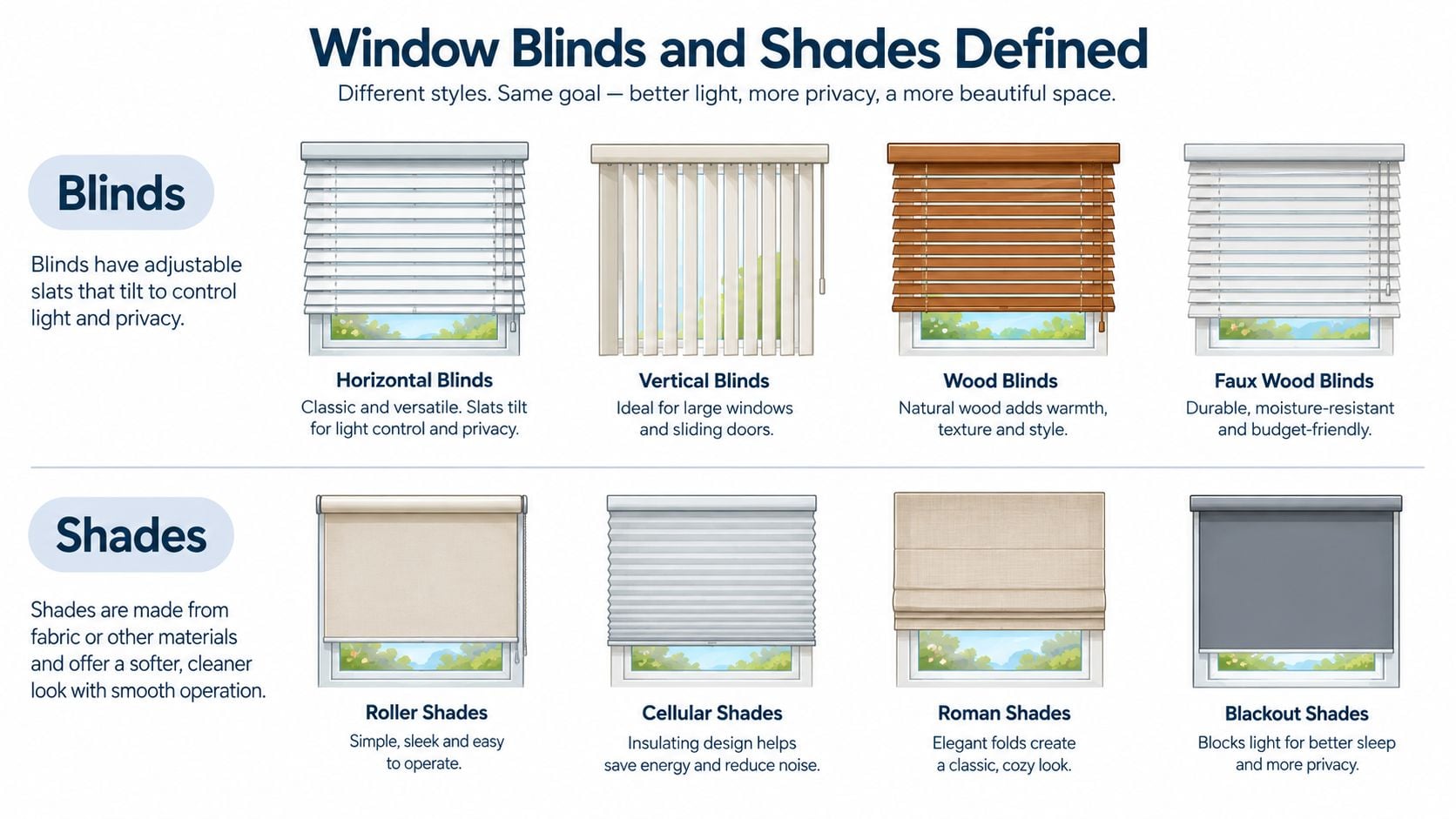
The simplest distinction is mechanical. Blinds use separate hard slats, while shades use one continuous covering. That difference controls how each product handles light, privacy, cleaning, and heat.
A Venetian blind uses horizontal slats that tilt open or closed and usually lift toward the headrail. Materials can include real wood, faux wood, aluminum, vinyl, or PVC. Vertical blinds use vertical vanes and remain useful for wide windows and sliding doors. In a showroom, a homeowner might see a cordless faux-wood blind with wand tilt, an aluminum Venetian, or a wood blind chosen to coordinate with furniture finishes.
Shades behave more like fabric panels attached to a lifting system. Cellular shades, also called honeycomb shades, use folded pockets that trap air. Roller shades move around a tube, Roman shades fold into stacked pleats, and solar shades use an open-weave screen to soften glare while preserving some view. Light-filtering, room-darkening, and blackout fabrics create different levels of privacy and brightness.
The product names become easier to understand when mapped to a practical need:
- Venetian blinds: Directional light control through slat adjustment.
- Vertical blinds: Coverage for wide openings and doors.
- Cellular shades: Insulation and a softer appearance.
- Roman shades: Decorative fabric, folds, and refined presentation.
- Roller shades: Clean, low-profile operation.
- Solar shades: Glare management and daytime view preservation.
Why hybrid products can confuse the comparison
Some products combine a shade-like body with layered bands, slats, or alternating fabrics. Those hybrids blur the visual line between blinds and shades, but the underlying construction still determines performance. A continuous honeycomb cavity insulates differently from hollow slats, even if both treatments appear simple from across the room.
Homeowners comparing terminology can also review Superior Home Improvement window insights for additional background on window-covering styles. For fabric-forward options, Roman shade installation is a useful starting point when the goal is a finished, refined look rather than a purely utilitarian treatment.
Blinds vs Shades Across the Criteria That Matter Most
A south-facing room may need glare control in July, while the same window feels cold beside the glass in January. In a Capital Region home, the better choice depends on that room's exposure, use, cleaning demands, and the safety setup your household can manage every day.
| Criterion | Blinds | Shades |
|---|---|---|
| Light control | Tilting slats redirect light and preserve some daylight | Fabric openness, liners, and positioning manage overall brightness |
| Privacy | Adjustable slats offer flexibility but may leave angled sightlines | Full coverage and selected opacity provide stronger nighttime privacy |
| Insulation | Typical vinyl blinds provide limited thermal improvement | Cellular construction offers stronger resistance to heat transfer |
| Durability | Faux wood and aluminum handle frequent use and wiping well | Fabric construction may need gentler care |
| Cleaning | Each slat needs dusting or wiping | Broad surfaces can be vacuumed gently, but fabric requires care |
| Safety | Cordless and wand-operated versions are the responsible choice | Cordless and motorized systems support simple, compliant operation |
Light control and privacy
Blinds are the practical choice when you want to steer daylight. Tilting the slats can cut glare without closing the window completely, which suits a dining room, home office, or south-facing space where daylight still matters. The trade-off is clear: slat overlaps and side gaps can admit light and leave angled views into the room.
Shades provide more consistent coverage across the glass. A cellular shade with a blackout liner can darken a bedroom more effectively than a standard slatted blind. Top-down bottom-up operation works especially well on street-level windows. It covers eye-level glass while leaving the upper section open for daylight.
For a living room, assess the treatment against seating height, screen glare, artwork, and changing afternoon sun. These factors matter more than choosing a style from a sample alone. Review the best window treatments for a living room with those room conditions in mind.
Insulation and durability
Pacific Northwest National Laboratory testing measured cellular shades over double-pane windows at U-values of about 0.2 to 0.43 and SHGC values of about 0.15 to 0.48. Fully closed typical vinyl blinds were expected to reduce the window-opening U-factor by only about 0.07 to 0.13 Btu/hr·ft²·°F, as detailed in the PNNL window attachment report. Lower U-values indicate less heat transfer. Cellular shades therefore have the stronger case for winter comfort and solar management, especially beside cold exterior walls or in rooms with strong summer sun.
Blinds take the lead in kitchens, dining rooms, and other high-use spaces. Faux wood and aluminum handle splashes, humidity changes, and routine wiping better than many fabrics. Their weakness is maintenance. Dust settles along every slat, so cleaning takes patience. Homeowners can use this guide to deep-cleaning blinds effectively without damaging the finish.
Practical rule: Choose blinds for precise directional light control and a hard-wearing surface. Choose shades when insulation, blackout performance, or a softer finish matters more.
Safety and operating systems
Traditional exposed lift cords create an entanglement risk. Current U.S. industry safety standards released in 2018 require stock window coverings to be cordless, have inaccessible cords, or limit operating cords to 8 inches, according to NBC News' coverage of child-safe window coverings.
Make cordless operation the baseline for nurseries, playrooms, and homes with curious pets. Motorization can improve access on tall windows and removes the temptation to leave a corded treatment in place. Both categories offer compliant options, but cordless roller and cellular shades often provide the simplest daily operation.
The showroom decision is straightforward. Put blinds in rooms that need adjustment, durability, and easy wipe-downs. Put shades where winter comfort, summer glare, privacy, or a softer presentation carries greater weight.
How Much Energy Each Treatment Actually Saves
A window treatment becomes an energy decision when a room feels cold beside the glass in winter or overheats under strong summer sun. Capital Region homeowners face both conditions, particularly in older homes with less efficient windows and rooms oriented toward the south or west.
Two measurements make the comparison clearer:
- U-factor: Indicates heat transfer through the window assembly. Lower values mean less heat loss.
- SHGC: Indicates how much solar heat enters through the window. Lower values mean less solar gain.
Independent U.S. Department of Energy and OSTI modeling used a baseline window with a U-factor of 1.67 and an SHGC of 0.296. Cellular shades reduced those modeled values to a U-factor range of 0.94 to 1.20 and an SHGC range of 0.094 to 0.172, while Venetian blinds remained around a 1.41 U-factor and 0.193 SHGC, according to the OSTI window attachment analysis.
| Treatment | U-factor, lower means less heat loss | SHGC, lower means less solar heat gain | Best Capital Region use |
|---|---|---|---|
| Baseline window | 1.67 | 0.296 | Comparison reference |
| Cellular shade | 0.94 to 1.20 | 0.094 to 0.172 | Drafty bedrooms and cold exterior walls |
| Venetian blind | About 1.41 | About 0.193 | Adjustable glare control |
| Typical vinyl blind | Opening reduction about 0.07 to 0.13 Btu/hr·ft²·°F | Not specified in the cited test | Basic light and privacy control |
What the numbers feel like indoors
On a January night, a cellular shade's air-trapping structure can make the area near the window feel less exposed to the cold than a typical hollow slat assembly. The shade won't repair a failed seal or replace a poorly performing window, but it can act as an interior thermal layer.
In July, a lower SHGC matters most on rooms that receive direct sun. A south-facing living room may benefit from a cellular shade, while a home office may need a solar-style fabric that reduces screen glare without forcing the room into darkness. The U.S. Department of Energy reports that window attachments can save about 15% of a household's annual HVAC energy use compared with vinyl blinds, and that cellular shades can save up to 20% on heating energy and up to 15% on total heating-and-cooling energy versus no shades, as explained in its cellular shades factsheet.
Homeowners looking for broader cooling principles can also consult this Arizona home cooling guide, then apply the same orientation-first thinking to Capital Region rooms. A practical selection guide for choosing window treatments can help connect those performance goals to fabric, opacity, and operating choices.
What You Really Pay Over the Life of the Window
The cheapest treatment at checkout isn't always the least expensive treatment to own. A homeowner comparing blinds and shades should account for the purchase, installation, replacement, maintenance, and any energy benefit that can be supported by verified performance information.
The available market commentary identifies lifecycle value as an underserved part of the decision, especially because buyers often focus on per-window price rather than replacement cycles and operating savings. It supports a qualitative conclusion, not a universal price sheet: a quality cellular shade can cost less per year than an inexpensive vinyl blind when durability and energy performance are considered. Exact local pricing depends on dimensions, fabric, mounting, controls, and installation.
What changes the ownership calculation
A low-cost blind may suit a temporary room or a tight furnishing budget. A higher-quality shade can make more sense for a drafty bedroom, a frequently used family room, or a window exposed to intense sun. The correct comparison should include:
- Initial purchase: Material, size, opacity, lift system, and motorization influence the invoice.
- Replacement exposure: Sun, humidity, handling, and cleaning habits affect how long the treatment remains attractive and functional.
- Energy performance: Cellular construction has stronger documented thermal behavior than ordinary vinyl blinds.
- Convenience: Cordless and motorized operation can add value on hard-to-reach windows.
- Coordination: A treatment that works with furniture, flooring, and room layout may avoid an expensive redesign later.
A five-to-ten-year ownership horizon makes this especially clear. A homeowner who installs a basic blind in a harshly sunny room and replaces it after wear may spend more than someone who chooses a durable, insulating shade at the beginning. That doesn't make every shade the economical choice, since fabric, controls, and installation vary, but it does make sticker price an incomplete answer.
How to compare quotes honestly
Ask whether each quote includes measuring, mounting hardware, installation, and the selected operating system. Then compare similar coverage levels. A light-filtering shade and a basic blind aren't equivalent if the room needs blackout privacy or substantial glare control.
The strongest value usually appears where the treatment solves an expensive comfort problem. In a cold bedroom or overheated west-facing room, the homeowner should weigh lifecycle performance more heavily than the lowest starting price. In a kitchen where wipe-clean durability matters most, a well-made faux-wood blind may remain the sensible purchase.
Matching the Right Treatment to Each Room in Your Home
Room conditions should decide the treatment. In a Capital Region home, that means accounting for cooking moisture, cold winter glass, strong summer sun, privacy, and the way each space is used. One window covering rarely performs every job well.
Kitchen and dining area
Cordless faux-wood or wood blinds suit kitchens where splashes, steam, and frequent handling are routine. The slats wipe clean more easily than delicate fabric, and tilt control lets you redirect glare while keeping daylight. Choose a finish that can tolerate regular cleaning, especially above a sink or work surface.
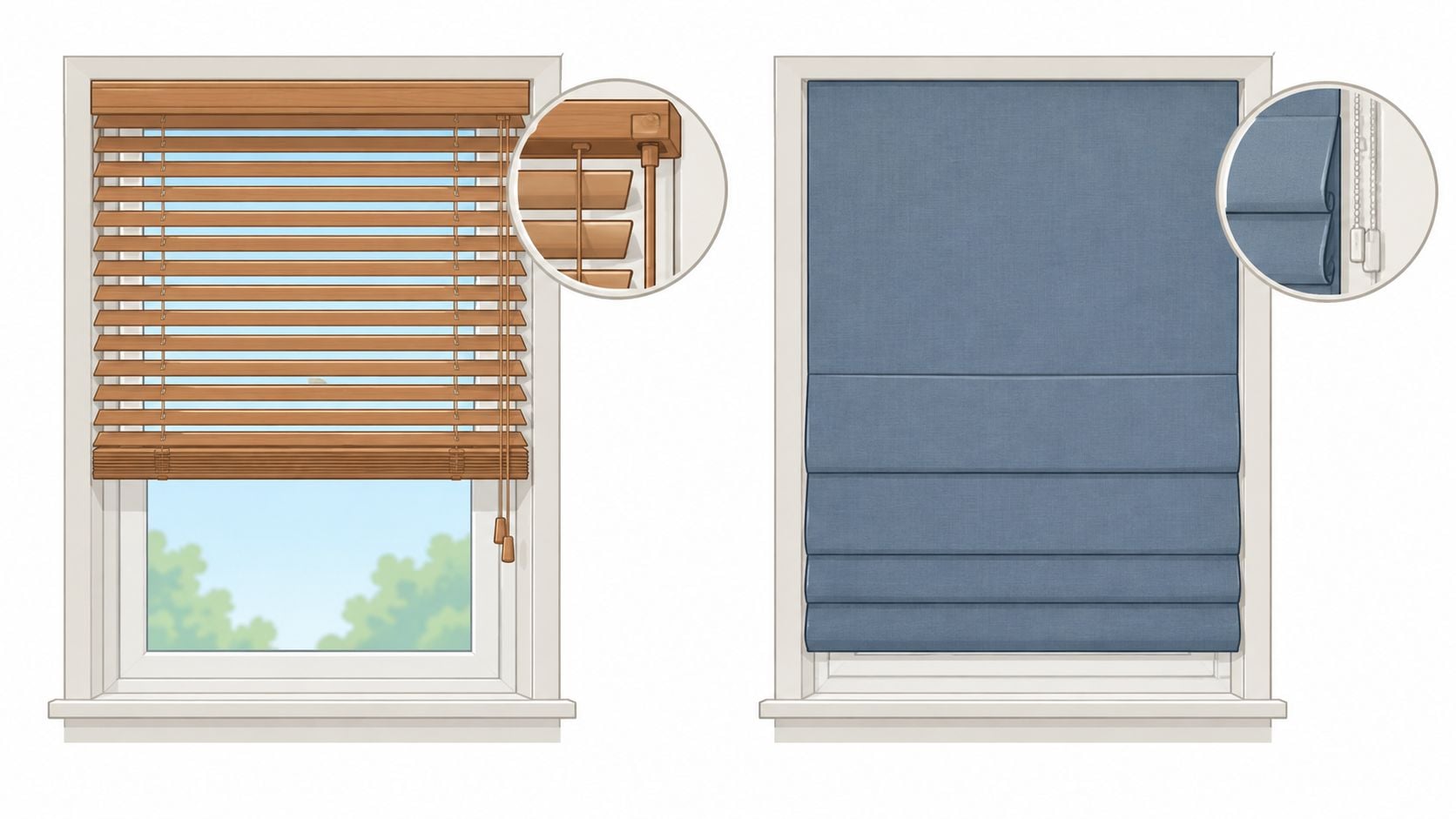
Dining rooms allow more flexibility. Roman shades work well when the room calls for a coordinated, upholstered appearance. Use blinds if easy maintenance leads the decision. Choose shades when the window treatment needs to contribute more strongly to the room's design.
Bedroom and nursery
For bedrooms, top-down bottom-up cellular shades provide practical privacy. Keep the lower portion closed at eye level while leaving the upper section open for daylight, a useful setup for street-facing homes. Cellular construction also suits rooms where winter drafts and cold glass affect comfort.
Blackout liners are the right choice for children who sleep during the day or adults with irregular schedules. In a nursery, remove exposed lift cords from a child's reach. Cordless and motorized systems align with current U.S. cordless safety standards for stock coverings, so older corded treatments should not remain in the room.
Living room
South- and west-facing living rooms need a plan for glare, fading, and seasonal temperature swings. Double-cell cellular shades provide insulation-focused performance, while solar roller shades soften harsh light and preserve a daytime view. For strong afternoon sun, prioritize glare control over a decorative match that leaves the room uncomfortable.
Large windows often work best with layers. Pair a solar or cellular shade with drapery to adjust light and privacy across the day and seasons. This approach also protects furnishings from direct sun without forcing one treatment to handle every condition.
Home office
A sheer or solar shade reduces screen glare while leaving enough daylight for calls and paperwork. Blinds make more sense when the desk position or work surface changes, because angled slats redirect light with greater precision. For a south-facing office, test the fabric or slat finish at the window before deciding.
The short decision rule
- Choose blinds for tilt-based light control, wipe-clean surfaces, and rooms with heavy daily use.
- Choose shades for insulation, softer design, privacy, and blackout performance.
- Choose cordless or motorized operation for children, pets, tall windows, and openings that are difficult to reach.
Choosing With Confidence at Tip Top Furniture and Mattresses
The most reliable selection starts with the window, not a catalog photograph. Homeowners visiting the Freehold showroom can bring rough window measurements, room photos, flooring samples, paint colors, and furniture details. An advisor can then evaluate mounting depth, trim, casement clearance, radiator placement, furniture interference, and the direction of incoming light.
Professional Design Services have been available since 1984, and the family-owned showroom has served homeowners since 1978. That local history matters for Capital Region houses, where older colonials and Victorians often have non-standard openings that need more than an off-the-shelf solution.
A consultation can move through the decision in a practical order:
- Identify the room's priority: Insulation, glare control, privacy, cleaning, or appearance.
- Review operating systems: Compare cordless, wand-tilt, and motorized options.
- Test materials: Look at fabric opacity, slat finishes, color, and texture in person.
- Confirm measurements: Use custom sizing for unusual windows and challenging trim.
- Coordinate the room: Match window treatments with furniture, décor, and flooring rather than treating each purchase separately.
Tip Top Furniture & Mattresses offers custom window treatment planning through its custom window treatment design service. The broader showroom also provides furniture for living rooms, bedrooms, dining areas, home offices, and youth spaces, along with décor, flooring, USA-made mattresses, Amish furniture handcrafted in the USA, custom ordering, delivery, professional design help, flexible financing, and a Clearance section. Its network includes over 50 trusted manufacturers, giving homeowners room to compare construction and finish without separating the window project from the rest of the room.
Free in-home measuring within the Greater Albany delivery area and professional installation can reduce mistakes on irregular openings. The Freehold location serves homeowners from Albany, Schenectady, Troy, Greene County, and surrounding Upstate New York communities, making it a practical place to compare real samples and operating systems before committing.
Tip Top Furniture & Mattresses helps Greater Albany Capital Region homeowners compare blinds and shades around comfort, safety, privacy, and room design, with custom options, delivery, installation, flexible financing, and coordinated furniture and flooring support. Visit Tip Top Furniture & Mattresses to review current options, explore Clearance value, or schedule a design consultation at the Freehold showroom.

