Corner Accent Chair Guide: Fit, Fabric and Placement


That empty corner beside the sofa looks like the easiest spot in the room to fill, until a chair arrives and blocks the walkway, crowds the radiator, or sits so deep the sitter slides forward. A corner accent chair earns its place only when the seat fits the person and the footprint fits the room.
Start the check at the corner and work outward: measure the walls, protect the walking routes, then judge style, fabric and finish. That order saves returns, and it matches the local, family-owned approach Tip Top Furniture & Mattresses has taken since 1978. Shoppers in Freehold, the Greater Albany Capital Region and Greene County do not need the narrowest chair on a listing. They need one that passes real clearance numbers before anyone talks about color.
Corner Accent Chair Dimensions to Check First
Fit a corner accent chair from the seat outward: first check the dimensions that determine comfort, then test the space needed for people to move around it. Seat height, seat depth, inside seat width and armrest height describe how the chair fits a person. Walkway and furniture clearances describe whether it fits the room.
| Measurement | Recommended range or check | Why it matters |
|---|---|---|
| Seat height | 40 to 55 cm (15.7 to 21.7 in) | Helps feet rest flat without pressure behind the knees |
| Seat depth | 33 to 43 cm (13 to 17 in) | Lets the sitter reach the backrest without sliding forward |
| Seat width | At least 45 cm (about 17.7 in) inside width | Allows room for hips and clothing |
| Armrest height | 17.3 to 27 cm (6.8 to 10.6 in) above the seat | Supports forearms without lifting the shoulders |
| Main walkway clearance | 36 in clear | Keeps the main route through the room open |
| Secondary path clearance | 30 in minimum | Leaves a short side route usable |
| Gap to a coffee table or sofa | 14 to 18 in | Leaves room to reach and walk between pieces |
The seat measurements are supported by anthropometric and ergonomic design research published through PubMed Central, which gives the listed seat-height and armrest-height ranges and calls for at least 45 cm (about 17.7 in) of seat width. That converts to less than 20 inches, so do not treat the table's minimum as a promise that every sitter will find the seat roomy. The research also notes that excessive seat depth can make shorter users slide forward and lose back support, while too little depth can limit thigh support.
Why outside width misleads shoppers
Listings often show outside width, measured from arm to arm. Comfort depends on the inside seat width between those arms. Two chairs with the same outside width can feel quite different when one has thick padded arms that take up more of the sitting area.
Thick arms can narrow the seat, push elbows inward and make standing harder for someone who presses down on the arms to rise. A wider frame with slimmer arms may provide more usable seat space without a major increase in floor footprint. Check the inside measurement, not just the overall width.
Pass or fail test: As working guidance, keep a chair in contention if its seat depth is 13 to 17 in, armrests are 6.8 to 10.6 in above the seat, and inside seat width is at least 45 cm (about 17.7 in). The width threshold reflects the cited research; it is a starting point, not a guarantee of personal comfort.
Applying the four seat checks
Seat height affects whether feet rest flat and whether the seat edge presses behind the knees. Seat depth affects whether the sitter can reach the backrest. Seat width allows hip clearance, while armrest height helps keep shoulders relaxed.
Record all four measurements beside the chair's room clearances before comparing listings. If a manufacturer does not publish inside dimensions, ask for them. A compact-looking chair can still feel cramped if the usable seat is too narrow.
How to Measure Your Corner Before You Buy
A corner that looks empty often measures smaller than it looks. Start at the inside corner and work outward with a tape measure, painter's tape and a pencil. Judge every listing by full in-use size, with base, legs, recline travel and swivel rotation included.
Measure both walls from the inside corner outward. Record baseboards, outlets, vents, window sills and radiators. A radiator projecting 4 inches from the wall leaves only 32 inches of usable depth inside a 36 inch corner, and that lost depth decides which chairs can pass.
Mark usable depth from wall to nearest obstacle. Lay tape for the chair footprint at full travel, then measure what remains to furniture, trim or the walkway line. Remaining inches are clearance. The bare wall to wall number is not.
Mark every door swing and drawer opening. Tape the arc of entry doors, closet doors and nearby storage drawers. A chair that fits with doors closed still fails if an arc clips an arm or leg the first time someone opens it.
Hold walkways and table spacing before choosing a style. An independent furniture-clearance guide identifies 36 inches as the recommended width for a main walkway, 30 inches as workable for a short secondary path, and 14 to 18 inches between a chair or sofa and a coffee table. Keep angled legs and a turned swivel base outside those taped lines, with room to reach a drink without turning sideways.
Test the swivel radius with tape. Find the seat center, then sketch a half circle to the widest point of the back or arms. If that arc touches a wall, lamp, radiator or walkway line, the chair cannot turn freely in daily use. Shoppers who want rotation need that full circle clear in every direction the chair faces.
Confirm the taped outline to scale. Photograph the tape from standing height, then check turns into and out of the corner. Readers who want the full room method can follow this step-by-step guide to measuring a room for furniture before ordering.
The go or no-go rule
Two mistakes fail corners again and again. Shoppers compare outside width instead of in-use footprint, and they forget fixed obstacles such as radiators and deep baseboards.
If any taped clearance line crosses the chair outline, do not force the fit. Choose a narrower, armless or higher-legged design instead.
Higher legs leave floor visible and ease cleaning underneath. Dropping the arms frees width for the seat itself. Either trade beats squeezing a bulky chair into the corner and narrowing the route everyone uses daily.
Popular Corner Accent Chair Styles
Style changes fit as much as it changes appearance. Arms add width, wings add depth, swivel bases add radius, and deep seats demand more floor in front of the chair. Match the silhouette to the measured corner, not the other way around.
Styles that support reading and conversation
Wingback chairs frame the sitter with a high back and side wings. They suit reading nooks and traditional rooms, but shoppers should check wing depth against the walkway line. A wing that projects forward can catch hips and bags in a tight route.
Slipper and barrel chairs bring a rounded, low profile that softens a hard corner. They work well in living rooms arranged for conversation because the curved back doesn't demand a square wall fit. Their width can surprise shoppers, so inside seat width still needs checking.
Swivel chairs improve access. The sitter can turn toward a sofa, window or television without dragging legs across the floor. That convenience costs space, since the taped half circle must stay clear in every direction the chair turns.
Slim and statement options
Armless and wedge designs free floor space and slide closer to side tables or sofas. The trade-off is less forearm support and less stability when standing. They're strong choices for occasional seating, less convincing for long reading sessions.
Angular and mid-century styles follow corner geometry with tapered legs and sharper lines. Visible legs keep the floor line open, which helps small rooms feel less crowded. Seat depth still decides comfort, regardless of how light the frame looks.
Amish-made solid wood chairs offer handcrafted construction in the USA, heirloom durability, and custom sizes and finishes. For an irregular corner that standard sizes don't serve, that flexibility matters more than any decorative detail.
The Freehold, NY showroom lets shoppers sit in these styles, compare inside widths and test arm height in person. A photograph can't show shoulder lift or pressure behind the knees.
Fabric, Frame and Finish That Hold Up Over Time
Corner chair materials compared for durability and care
| Material | Durability strength | Care | Best fit |
|---|---|---|---|
| Performance woven fabric | High abrasion resistance, hides light wear | Vacuum weekly, spot clean | Pets and daily use |
| Microfiber or faux leather | Wipes clean, can crack at seams over time | Damp cloth, mild soap | Children and high-traffic corners |
| Linen or cotton blend | Breathable, shows wear and crushing faster | Professional cleaning | Low-traffic decorative reading chairs |
| Solid hardwood frame | Strong joints, can loosen if not maintained | Dust and check joints yearly | Long-term heirloom pieces |
| Painted or distressed finish | Hides scratches, chips at high-touch edges | Touch-up kit | Accent pieces with vintage style |
The fire-safety check behind every cover
Fabric appearance doesn't show fire performance. The U.S. Consumer Product Safety Commission announcement of the federal upholstered furniture standard explains that 16 CFR Part 1640 requires covered upholstered furniture manufactured, imported, or reupholstered after June 25, 2021, to comply with TB 117-2013 smolder-resistance requirements. Testing evaluates the cover fabric, resilient filling, barrier material and decking for char length, sustained smoldering and transition to open flaming.
Compliance can come through a qualifying barrier that fully surrounds the filling or through compliant cover and filling materials. That's why the internal foam, batting and barrier matter as much as the fabric on display. Ask for the permanent compliance label and ask whether the chair uses a tested barrier system, especially with custom upholstery.
Buyers should verify that household cleaning agents won't damage the tested upholstery system before treating a stain.
Shoppers comparing covers can find easy-care fabrics for chairs through Lewis and Sheron Textiles, then use Tip Top's guidance on choosing upholstery fabric to match care codes to children, pets and daily traffic.
Choosing for the hardest use
Performance woven fabric handles abrasion and hides light wear, making it the safest default for pets and daily reading. Microfiber and faux leather wipe clean quickly, though seams can crack after years of flexing. Linen and cotton blends feel breathable and relaxed, but they'll show crushing and wear sooner in a busy corner. Reserve them for decorative chairs that don't carry daily traffic.
Frames and finishes decide what happens after the fabric choice. A solid hardwood frame with tight, well-fitted joints resists wobble and can be tightened or repaired instead of discarded. Painted and distressed finishes hide minor scratches well, yet high-touch edges around arms and front legs can chip and need touch-ups.
Joinery and finish protect the same investment from different directions. Strong joints keep the frame square under repeated sitting and standing. A sealed finish slows moisture and everyday abrasion on exposed wood. Either one neglected shortens the chair's useful life no matter how good the other is.
Select the cover for the hardest use the chair will face, and select the finish for how often hands, shoes and vacuum cleaners will touch it.
Placement and Styling for Small and Large Rooms
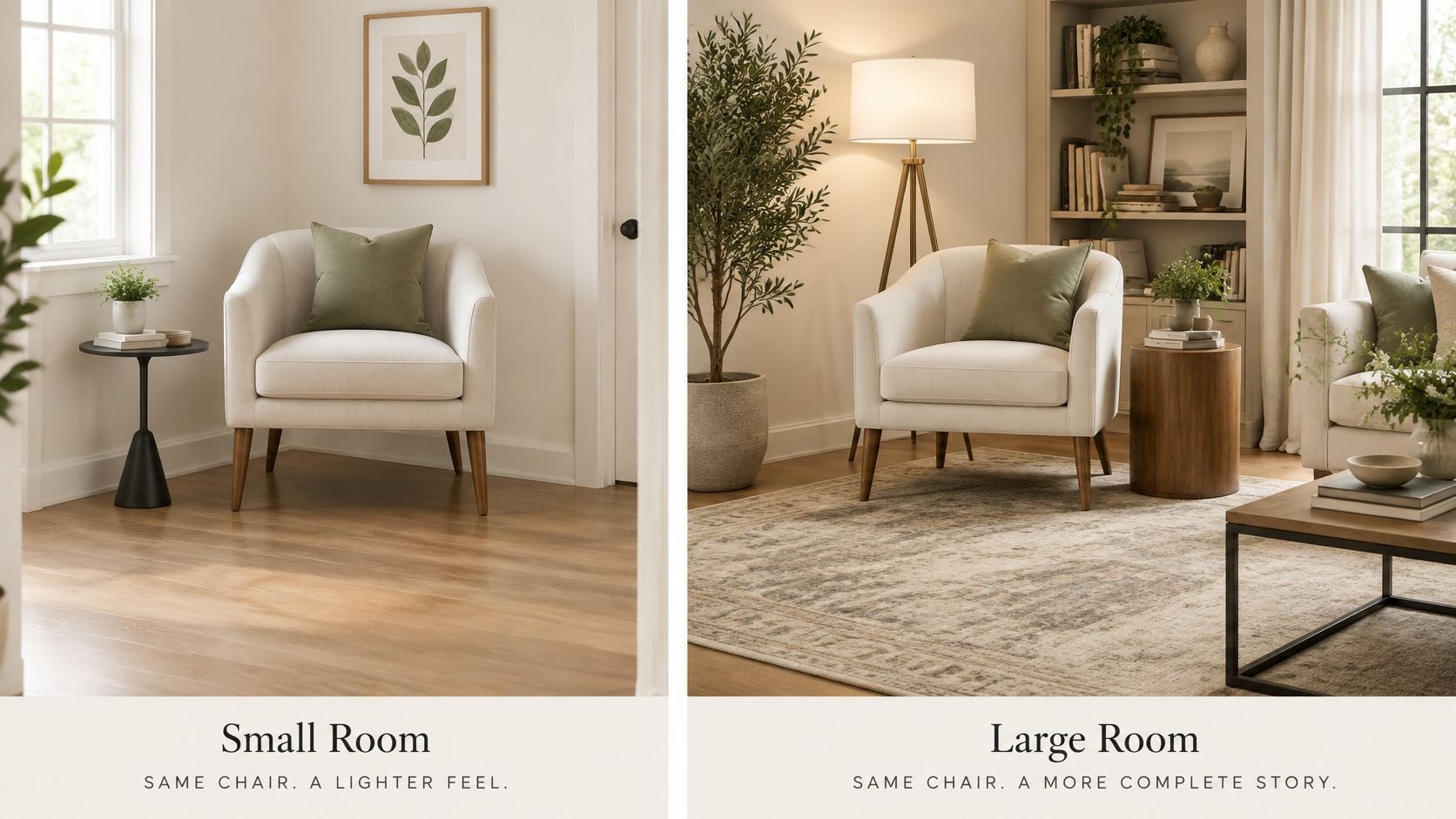
In a small room, a corner chair can add a reading spot without making the space feel crowded. Choose visible legs, lighter fabric and a slightly higher seat to keep more of the floor visible. If the corner borders a walkway, avoid a bulky skirted base.
Set the chair at an angle toward the sofa or window, then use painter's tape to mark its footprint and check the sightline from the seat. The back should stay clear of the walking route, while the chair faces the conversation or view. A slim floor lamp behind the chair can add reading light without taking up table space. For more layout ideas, see corner furniture ideas for the living room.
Anchoring a larger room
In a large room, an unanchored chair can look stranded. Place a rug under its front legs, add a floor lamp and keep a side table within arm's reach. A second matching or coordinating chair can form a reading or conversation area set apart from the main sofa group.
A deep seat gives room to settle in, but it can dominate a small room or leave too little space between knees and coffee table. Check that the chair's depth suits the surrounding furniture, not just the empty corner.
Connect the chair to one existing piece through wood tone, fabric color or texture. A single deliberate link can make the arrangement feel considered without requiring every finish to match. Keep lamps and side tables close enough to use, but leave the main route through the room clear.
Durability Limits and the Supplier Checklist
A weight capacity printed on a listing doesn't prove long-term quality. The 2025 European domestic-seating standard SIST EN 12520 addresses minimum strength, durability, stability, side-to-side durability, and finger-entrapment hazards, with testing based on adults weighing up to 110 kg. It doesn't cover ergonomics, upholstery ageing or flammability.
That gap matters when a decorative chair becomes the daily reading chair. A frame can pass a strength test while its cushion flattens, its fabric abrades, or its seat height makes standing difficult for an older adult. Passing a test is useful evidence, but it isn't a promise of comfortable everyday use.
Upkeep that protects the purchase
Rotate or flip removable cushions monthly so one side doesn't carry all the wear. Check and tighten bolts or accessible joints every six months, since small movements become wobble when ignored. Keep the chair out of direct sun where possible to slow fading and drying.
Readers weighing replacement against repair can review how long furniture should last before deciding that a tired cushion means the whole chair has failed.
Five questions for any supplier
- Frame material and joint type: Ask what the frame is made from and how stress joints are joined, not just whether construction is called sturdy.
- Cushion replacement or flip options: Confirm whether cushions can be flipped, refilled or replaced without replacing the chair.
- Fabric abrasion rating: Request the rating and compare it with the chair's expected daily use.
- Cleaning method and care code: Match the instructions to the household, especially where children or pets use the chair.
- Warranty and repair coverage: Ask what's covered, for how long, and who handles repairs locally.
Documented answers beat any single quality label. A chair without a published standard can still be well made when the seller documents materials, construction, warranty coverage and repair options.
Confirm Your Fit and Book a Consultation Near Albany
Before you order, the tape on the floor is your final test. Record both walls, baseboards, radiators and outlets, then check that the chair at full in-use size stays outside the main and secondary routes. Run the four-dimension seat check in inches, depth, width, height and armrest height, against the intended sitters, and add swivel clearance if the chair turns. Ask for the compliance label so upholstery construction is documented, not assumed from the cover fabric.
Tip Top Furniture offers a Custom Order service for custom pieces, with size, wood type, fabric and finish choices, and craftsmen can build from a photo or sketch. That route suits an irregular corner, a needed seat height, or a finish that must coordinate with existing wood.
Tip Top sells living room, bedroom, dining room, home office, entertainment and accessory furniture plus mattresses, including sofas, sectionals, recliners, lift chairs, sleeper sofas, beds, dressers, dining tables, desks, office chairs, rugs and lamps. That one-stop scope lets you coordinate the corner chair with nearby pieces, lighting and flooring without guessing at finishes.
Design consultations through Tip Top's interior design consultation services have been available since 1984. A consultant can match the chair to the room and coordinate décor or flooring so the corner works with the whole layout. Flexible financing can spread the cost when the chair is part of a larger room project.
If a standard size already passes every measurement, the Clearance Corner offers quality stock pieces at lower prices. Neither custom ordering nor clearance should override the fit test, since a discounted chair that blocks a walkway is not a bargain. Sit in the final candidate, test the arms, and stand up without assistance before buying.
Visit Tip Top Furniture & Mattresses to book a design consultation, use the free Online Room Planner, or plan a trip to the Freehold, NY showroom serving Albany, Schenectady, Troy and Greene County. Bring corner measurements and photos, and the family-owned team can help compare in-stock, Amish-made and custom-order corner accent chairs against the room they need to fit.