American Made Office Furniture: A Practical Buyer’s Guide

The U.S. office furniture manufacturing industry is projected to reach $30.2 billion in 2026, with 3,465 businesses competing in the category, so American-made office furniture is a substantial market, not a niche curiosity. Under FTC guidance, a genuine “Made in USA” claim means all or virtually all of the product comes from the United States, but the most common trap is mistaking domestic assembly or patriotic branding for domestic manufacturing.
A homeowner standing in a showroom aisle may see two handsome desks, notice a meaningful price difference, and wonder whether the American-made tag justifies it. The answer depends on what's underneath the finish, how the drawers are built, which certifications support the spec sheet, and whether the seller can explain the product's origin without dancing around the question.
That's the standard Tip Top Furniture & Mattresses brings to home office shopping in Freehold, NY, while serving homeowners throughout Albany, Schenectady, Troy, Greene County, and the broader Capital Region. A desk should outlast the next renovation, not become another disposable purchase when a drawer loosens or a veneer lifts.
What American Made Office Furniture Really Means
The phrase American-made office furniture sounds straightforward until a buyer asks what happened in the United States. A desk may be designed domestically, assembled domestically, or sold by a domestic company while many of its parts come from elsewhere. Those are different claims, and the label alone doesn't explain the difference.
The FTC's standard is the useful starting point. A product marketed as “Made in USA” must be made in the United States with all or virtually all of its components and processing of U.S. origin, as explained in this guide to Made in USA furniture manufacturers. For office furniture, that means the buyer should ask about the wood, hardware, drawer components, finishing work, and assembly, not just the location of the showroom or the brand's headquarters.

The label is a starting point, not the whole inspection
A careful buyer should request:
- Country-of-origin information: Ask where the major materials and components come from.
- Assembly details: Find out whether the desk is built domestically or just put together after arriving as imported parts.
- Product documentation: Look for clear language on construction, materials, and certifications.
- A straight answer: If a salesperson can't explain the origin, the claim deserves more scrutiny.
The most frequent mistake happens before the desk is even tested. Buyers see a flag, a phrase such as “built in America,” or a domestic brand name and assume the entire product qualifies as Made in USA. That assumption can be wrong when imported panels, hardware, or finished components make up a substantial portion of the piece.
Practical rule: A trustworthy origin claim should survive specific questions about materials, labor, and assembly.
American-made furniture also isn't automatically solid hardwood, heirloom quality, or free from engineered materials. Those characteristics must be checked separately. The origin label answers one question, while wood construction, joinery, emissions, and performance standards answer others.
Why Buyers Choose American-Made Pieces
A desk should still feel solid after the next office rearrangement, not just on delivery day. Buyers choose American-made office furniture for service life, visible construction quality, material accountability, and the economic value of keeping skilled work closer to home. Those benefits become meaningful only when you verify them at the showroom.
The domestic market is large and established. The U.S. office furniture manufacturing industry is estimated at $30.2 billion in 2026, includes 3,465 businesses, and grew at a modest 0.6% compound annual growth rate from 2021 through 2026, according to IBISWorld's office furniture manufacturing overview. This points to a category shaped by practical workplace demand and capital spending cycles rather than a short decorating trend.
Durability shows up in the details
Run the drawers. Press on the return. Check whether the desk stays steady instead of racking or rocking. A smooth drawer, controlled hardware, and a stable work surface reveal more than a front display tag.
Look for these floor-level clues:
- Heavier drawer glides: Smooth movement and stable hardware matter on drawers opened every workday.
- Solid-wood drawer boxes: Substantial sides, clean corners, and firm interiors signal better construction. For more guidance on material choices, review this solid-wood furniture brands guide.
- Country-of-origin labeling: Check the back, underside, and product documentation instead of relying on the front display tag.
- Consistent fit: Gaps should be even, doors should sit square, and the desktop should remain stable during normal use.
Domestic sourcing can make material and labor questions easier to pursue, especially when a local showroom has a direct relationship with the manufacturer. It does not guarantee perfect workmanship. It does give you a clearer route to answers, repairs, and replacement parts when those services are available.
Sustainability needs more than a flag
A shorter supply chain may simplify communication and reduce some transportation distance. Sustainability still depends on the wood or composite materials, finish, packaging, and manufacturing practices. A domestic desk with poorly documented composite wood is not automatically a responsible purchase.
Ask for low-emission documentation and inspect the construction together. A desk that remains useful through multiple room changes avoids waste from frequent replacement, while responsible material certifications address indoor air concerns more directly.
The local-economy case is practical, too. U.S. manufacturing supports a sizable labor base, with about 107,026 workers in 2025 and 107,640 in 2024, although employment declined by an average of 1.4% from 2019 to 2024, according to IBISWorld's industry data. Buying carefully made domestic furniture will not solve every industry challenge, but it directs your purchase toward work that still supports American communities.
How to Judge Office Furniture Quality by Hand
A desk can look impressive under showroom lights and still fail at the joints, drawer slides, or unfinished underside. Put your hands on the parts that carry daily use. You do not need woodworking credentials to spot weak construction, but you do need to inspect more than the desktop and stain.
Start with the material. Solid hardwood contains wood throughout the component, while veneer places a real wood surface over another core. Engineered panels can perform well when properly manufactured. Ask which material appears in the desktop, legs, drawer fronts, sides, and back, then compare those answers with the solid-wood furniture brands guide.
Inspect the places that take daily abuse
A home office desk has predictable stress points. The return takes pressure from leaning and repositioning. File drawers carry weight and get pulled repeatedly. A keyboard tray moves often, making weak hardware easy to find.
Use this sequence:
- Open every drawer. Check for smooth travel, square alignment, and excessive wobble.
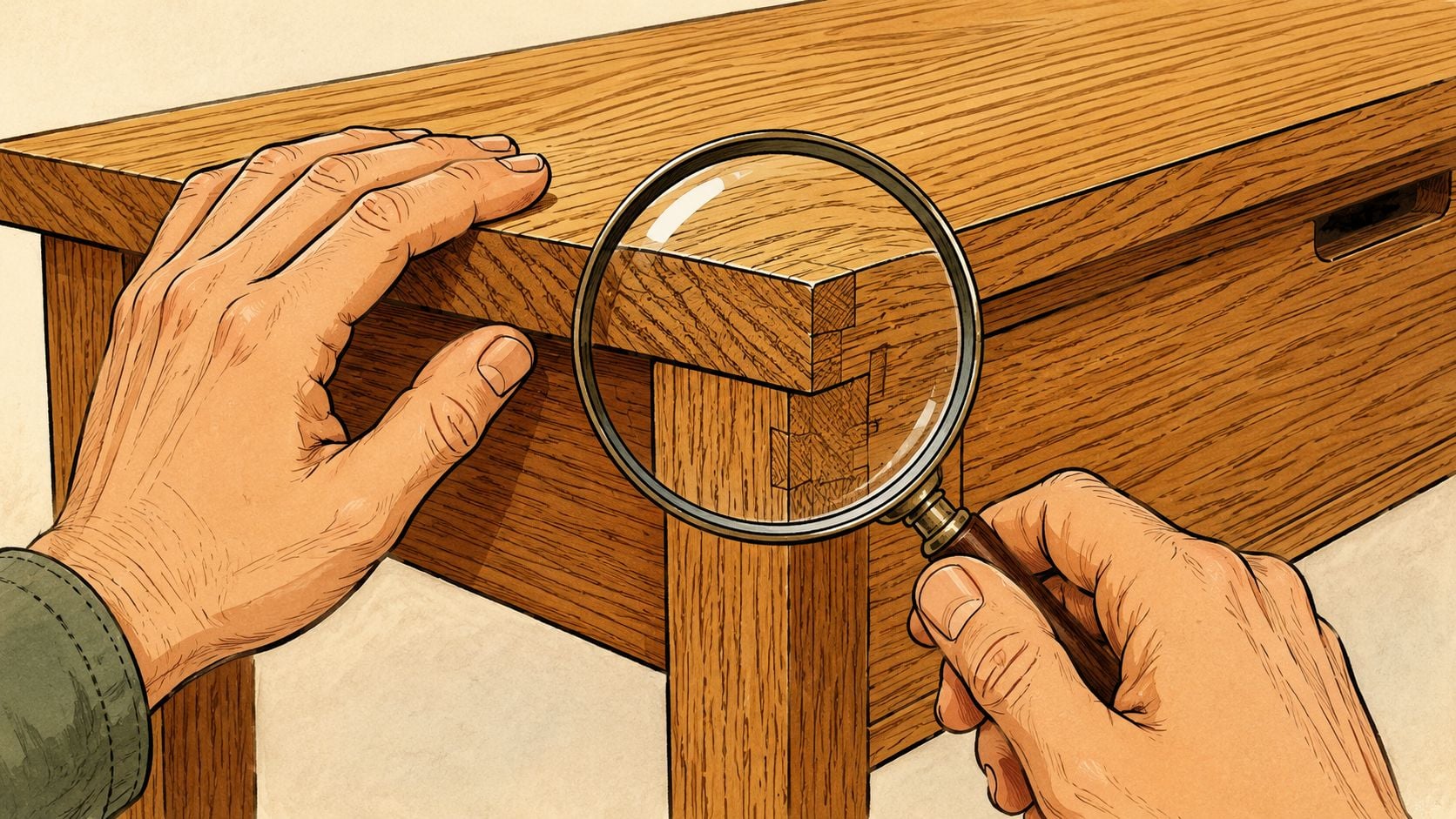
- Look inside the drawer box. Dovetail construction signals a strong mechanical connection, especially at the front and rear corners.
- Examine the underside. A sealed underside and consistent finish show that the manufacturer treated the piece as a complete object, not only a display surface.
- Test the return. Apply ordinary hand pressure. The desk should stay stable without twisting or rocking.
- Move the keyboard tray. It should run evenly and sit securely when extended.
- Inspect the back and corners. Reinforcement, clean fastening, and a finished appearance show care in areas many buyers overlook.
The guide to wood joinery types helps you recognize dovetails, mortise-and-tenon connections, reinforced corners, and other construction methods before a showroom visit.
Read the finish as evidence
A good finish looks even across exposed surfaces, without cloudy patches, rough edges, or abrupt color changes at joints. Stain should look deliberate rather than pooled in corners. Drawer interiors should not feel unfinished when the piece is presented as heirloom quality.
Veneer is not automatically a defect. A stable engineered core with a well-applied hardwood veneer can suit some surfaces. The concern is hidden substitution, thin construction, and vague marketing that leaves the buyer guessing.
Showroom test: Open the drawers, inspect the underside, and ask to see the specification sheet. Unseen surfaces often reveal more than the polished top.
Certifications That Actually Matter at the Desk
Certification labels become useful when each one answers a different buyer concern. They shouldn't be treated as interchangeable badges.
For office furniture, the most practical mental model is simple:
| Certification or standard | What it helps evaluate | Why it matters at home |
|---|---|---|
| ANSI/BIFMA | Structural performance, stability, load resistance, and durability testing | Helps assess furniture used repeatedly and under regular load |
| GREENGUARD Gold | Low emissions and indoor-air considerations | Relevant in enclosed rooms, bedrooms, and compact home offices |
| EPA TSCA Title VI | Formaldehyde emissions from composite wood | Confirms compliance for regulated wood substrates |
The BIFMA standards overview describes standards covering office chairs, desks, and worksurfaces. The practical value is consistency. A buyer can ask which exact test applies to the product instead of accepting a vague “commercial grade” statement.
Match the standard to the question
ANSI/BIFMA is primarily the structural filter. It can relate to load, stability, impact, and cycle durability, depending on the product category. A chair, desk, and panel system won't necessarily use identical tests, so the precise standard on the specification sheet matters.
GREENGUARD Gold and comparable low-emission criteria address indoor air quality. In a closed home office, emissions from particleboard, MDF, adhesives, and finishes deserve attention, particularly when the room has limited ventilation. The furniture guide from the Center for Environmental Health points buyers toward emissions criteria and documentation rather than relying on broad “eco-friendly” language.
EPA TSCA Title VI applies to regulated composite wood. Composite wood used in office furniture must be certified and labeled to the applicable formaldehyde emission limits. That documentation speaks to the substrate, while a finished-product emissions certification addresses the assembled furniture system.
The buyer's best question is direct: “Which exact standard or certification applies to this piece, and can the showroom provide the documentation?” If the answer remains general, the label isn't doing enough work.
Amish Craftsmanship and Custom Ordering for the Home Office
A standard desk works when the room is standard. Many home offices aren't. A hallway nook, converted bedroom, shared guest room, or sloped-wall workspace can make an ordinary desk look either undersized or jammed into place.
Amish furniture handcrafted in the USA offers a different approach. Solid-wood construction, careful joinery, and made-to-order options allow the buyer to solve the room instead of forcing the room to accept whatever dimensions happen to be available.
Custom details turn a difficult room into a usable one
A custom order can address:
- Size: A narrower depth for a passageway or a longer surface for two workstations.
- Storage: A credenza, file drawer, or bookcase designed around actual equipment.
- Wood and finish: A stain selected to coordinate with existing bedroom, living-room, or dining furniture.
- Hardware: Pulls and knobs chosen to suit the room's established style.
- Shape: A desk, return, library wall, or corner arrangement based on a sketch or photograph.
Tip Top Furniture & Mattresses describes Amish pieces as 100% American made, custom made to order, with choices that include style, size, wood type, and finish. The Amish furniture quality guide gives buyers a useful framework for evaluating the construction before committing to a custom piece.
Custom work requires patience. A made-to-order desk isn't a clearance item that can be loaded immediately, and the lead time should be part of the decision from the beginning. The payoff is a piece that can follow a family through a move, a renovation, or a change from remote work to a shared-use room.
Flooring deserves attention during the same planning conversation. A nearby resource such as this home office flooring guide from Flacks Flooring can help coordinate surface durability, chair movement, acoustics, and the furniture finish.
Why Buying Locally in Freehold and the Albany Capital Region Wins
A desk is one of the few furniture purchases that benefits from hands-on testing before delivery. Online photographs can't show how a drawer feels under load, how a stain looks in a room's actual lighting, or whether a return crowds the doorway.
A local showroom visit combines product inspection, room planning, professional design services, delivery, and financing in one conversation. Tip Top Furniture & Mattresses has operated as a family-owned business since 1978, with professional design services available since 1984. That history matters because home office decisions often involve the rest of the house, including flooring, lighting, mattresses, living-room furniture, and décor.

A showroom solves problems before delivery day
A design consultant can help a homeowner:
- Scale the layout: Check clearances around a desk, chair, return, and storage.
- Coordinate the room: Match wood finishes, upholstery, window treatments, and flooring.
- Test ergonomics: Sit in chairs, adjust surfaces, and compare working positions.
- Plan delivery: Identify stairways, narrow entries, and placement concerns before the truck arrives.
- Review custom choices: Confirm dimensions, finish, hardware, and storage in person.
The store serves customers from Freehold through Albany, Schenectady, Troy, Greene County, and surrounding Capital Region communities. That reach makes a Freehold showroom visit practical for homeowners who want local guidance without giving up access to domestic and Amish-made options.
Financing can also make a larger project easier to organize. The Synchrony HOME Credit Card offers promotional financing with 6 months on purchases from $299 to $1,998.99 and 12 months on purchases of $1,999 or more, while select retail partners may offer up to 60 months on qualifying purchases, as stated in the Synchrony HOME financing terms. Terms, eligibility, and deferred-interest conditions should be reviewed carefully before signing.
A one-stop showroom can also connect the desk purchase with USA-made mattresses, flooring, bedroom furniture, and clearance pieces. That coordination is especially useful for new movers and families furnishing more than one room.
A Practical American-Made Office Furniture Checklist
A good purchase starts before the showroom visit. The checklist below keeps the conversation focused and prevents a polished display from rushing the decision.
Before visiting
- Measure the room: Record wall lengths, door swings, windows, outlets, and the route from the entry.
- Photograph existing furniture: Finish matching is easier when the consultant can see the pieces already in the home.
- Set the full budget: Include delivery, installation, accessories, and any custom work.
- List daily needs: Note monitors, files, printers, writing space, and whether the room has multiple uses.
At the showroom
- Ask about origin: Confirm the source of major components, labor, and assembly.
- Inspect construction: Open drawers, test the return, examine joinery, and look underneath.
- Review the finish: Check consistency, sealed surfaces, drawer interiors, and edge treatment.
- Request certifications: Ask for the exact ANSI/BIFMA standard, emissions documentation, and TSCA Title VI information where applicable.
- Test the chair and desk together: A beautiful desk still fails if the working position is uncomfortable.
After ordering
- Confirm delivery details: Get the delivery window, access requirements, and placement expectations in writing.
- Review financing terms: Understand the promotional period, payment schedule, and conditions.
- Record custom specifications: Verify dimensions, wood species, stain, hardware, and expected lead time before approval.
Homeowners can begin with a free online room planner, then bring the measurements to the Freehold, NY showroom for a personal review.
Frequently Asked Questions About American-Made Office Furniture
How can buyers verify a true Made in USA claim?
They should ask whether all or virtually all components, processing, labor, and assembly are domestic. A desk assembled in the United States from imported parts may not meet the FTC standard for an unqualified Made in USA claim.
Is American-made office furniture worth the premium for a remote worker?
It can be, especially when the desk will serve as a long-term fixture in a multi-use room. The premium makes less sense when the buyer hasn't inspected construction, confirmed the origin, or compared the finish and storage to the actual needs of the space.
When does financing make sense?
Financing can be useful when a buyer is furnishing several rooms or choosing a custom piece that needs to be ordered together with delivery and design services. Promotional terms must be understood fully, and the purchase should remain affordable without relying on optimistic future income.
How do clearance and custom orders fit together?
They serve different priorities. Clearance suits buyers who want quality, a lower price, and immediate availability, while a custom order suits rooms that require exact dimensions, matching finishes, or specialized storage. A showroom can help determine which path fits the room before the purchase is finalized.
Tip Top Furniture & Mattresses offers American-made and Amish home office furniture, custom ordering, professional design services, delivery, financing options, flooring, USA-made mattresses, and clearance inventory from its Freehold, NY showroom. Homeowners across Albany, Schenectady, Troy, Greene County, and the Capital Region can bring room measurements and finish samples to Tip Top Furniture & Mattresses and shop with a plan instead of guessing from a screen.