
How to Choose a Mattress for Back Pain: Albany Tips

Most shoppers still hear the same lazy advice about back pain, buy the firmest mattress you can stand. That rule is outdated, and it sends a lot of people in the wrong direction. The better move is to choose a mattress that keeps the spine neutral, eases pressure points, and matches the way the body sleeps.
Why the Old Firmness Rules Don't Work Anymore
The old “firmer is better” idea sounds logical until the research is compared side by side. Controlled evidence points toward medium-firm mattresses for many adults with chronic low back pain, not the hardest surface in the store. A systematic review in Sleep Medicine Reviews concluded that medium-firm mattresses improve comfort, sleep quality, and spinal alignment, while an NCBI clinical summary also notes that medium-firm beds may reduce back pain and improve sleep compared with firmer mattresses.
That matters because the right mattress is not a plank. It has to hold the body in a neutral spine position while still cushioning the joints that take the load at night. Consumer-facing guidance from Consumer Reports and the other expert summaries named in the evidence base points shoppers in the same direction, medium-firm support, not extremes.
What the research actually changed
A widely cited clinical benchmark, repeated in later expert summaries, found that medium-firm bedding reduced back pain by about 48% and improved sleep quality by about 55% over roughly 4 weeks, as summarized in the medical literature. That is a practical lesson, not a showroom slogan. Results show up over weeks, so a mattress that feels strange for the first ten minutes might still be the right one once the body settles in.
A survey of 268 people with low back pain, reported by Harvard Health, found that people sleeping on very hard mattresses had the poorest sleep quality. That does not mean every soft bed is better, it means the wrong kind of firmness can make sleep worse, not safer. The target is support without punishment.
Practical rule: If a mattress feels like it's forcing the lower back into a rigid shape, it's probably too hard. If it lets the middle of the body sag, it's too soft.
For local shoppers comparing options at the Freehold showroom or anywhere in the Capital Region, the smart first filter is still medium-firm support. Tip Top's mattress firmness guide fits that evidence-based shift well, because it pushes buyers to think about support and comfort together, not as opposites.
Matching Your Mattress to Your Specific Pain Location
Back pain isn't one problem. Lumbar pain, upper-back pain, shoulder soreness, and side-sleeping pressure all behave differently, so a single firmness label won't solve every case. The best approach is to match the mattress to the body's pain pattern first, then to the sleep position second, which aligns with guidance from spine-health on choosing based on pain location, sleep style, and body type.
Start with where the pain shows up
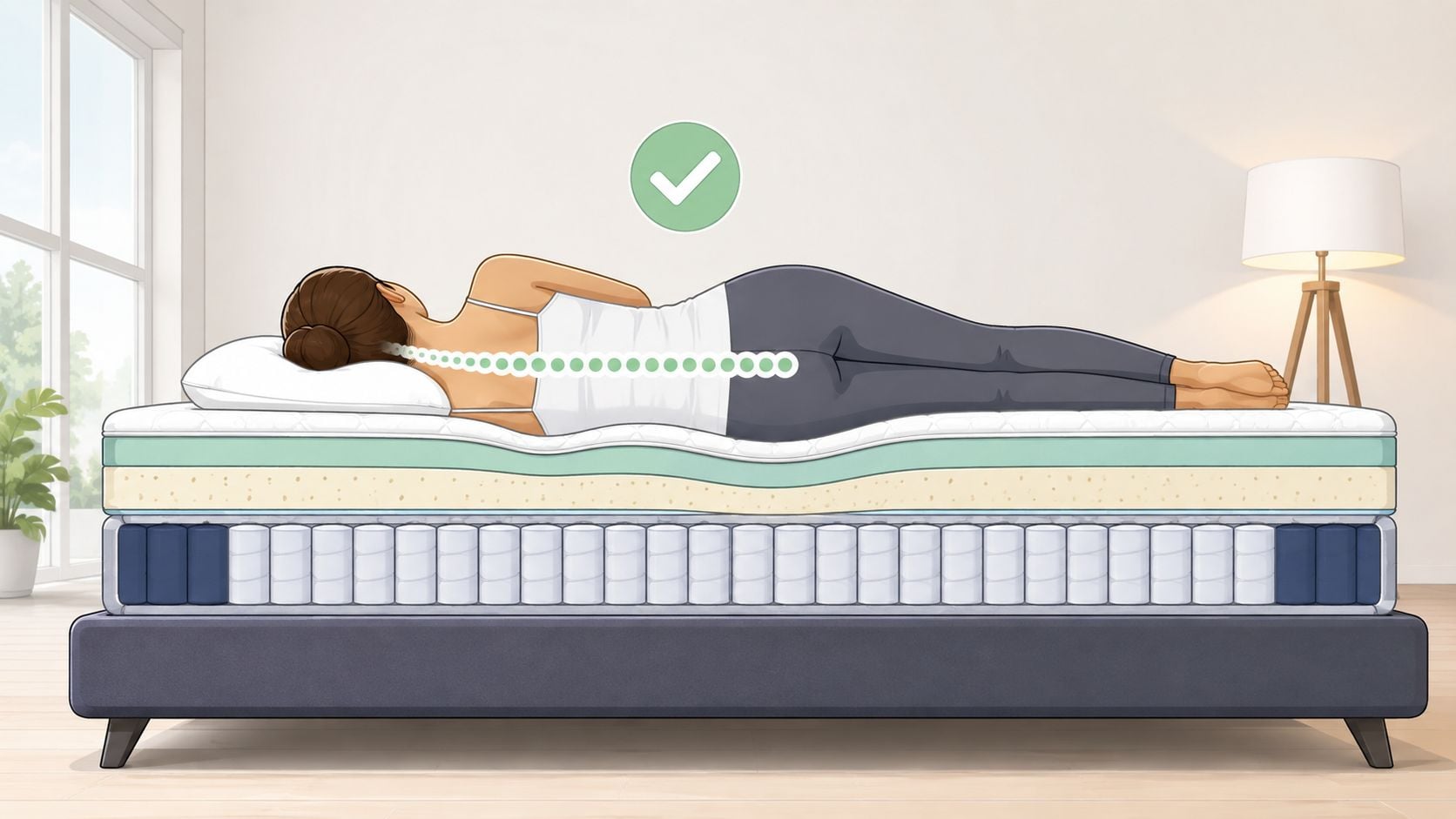
If the pain sits in the lower back, the mattress has to keep the pelvis from dropping while still letting the spine keep its natural curve. Zoned support can help here because it adds extra support where the torso needs it most without turning the whole bed into a board. That's the kind of construction worth asking about in Freehold or Albany, not just the word “firm” on a tag.
Shoulder pain is a different animal. The issue is usually pressure, not just support, so a mattress needs enough give at the top layers to let the shoulder sink a little while keeping the hips and waist from collapsing. Side sleepers feel that tradeoff the most, because the shoulders and hips take the load while the spine still has to stay close to straight.
Best question to ask in the store: “Does this mattress relieve pressure where the pain actually is, or does it just feel hard?”
Let sleep position decide the final fit
Back sleepers usually do best when the mattress holds the lower back in place without forcing the midsection upward. Side sleepers usually need more pressure relief around the hips and shoulders, while stomach sleepers need more support to keep the hips from dipping. That's why the same mattress can feel great for one person and wrong for another.
Tip Top's pressure-point guide is useful here because it focuses on body contact, not mattress hype. A good salesperson should talk about alignment, pressure relief, and ease of movement, especially if the pain changes when sleeping on the side versus the back. For shoppers in the Capital Region, that's the conversation that matters, not the name on the box.
The Evidence Behind Medium-Firm Support
The clinical case for medium-firm support is strong enough that shoppers should treat it as the starting point, not a compromise. The mattress should feel supportive under the torso, soft enough to avoid pressure buildup at the hips and shoulders, and stable enough that the body doesn't sink out of line. That balance is what the evidence keeps pointing to.
| Mattress Firmness and Back Pain Outcomes | |||
|---|---|---|---|
| Firmness Level | Pain Reduction | Sleep Quality | Best For |
| Medium-firm | Better outcomes in controlled research, including about 48% lower back pain over roughly 4 weeks | About 55% better sleep quality over roughly 4 weeks | Many adults with chronic low back pain |
| Very hard | Poorest sleep quality in the 268-person survey reported by Harvard Health | Worse than medium-firm in the same comparison | Rarely the best choice for chronic back pain |
| Very soft | Can let the spine drift out of neutral alignment | Can feel comfortable at first but fail overnight | People who need more cushioning, not most back-pain shoppers |
What those numbers mean in real life
The table is useful because it separates short-term comfort from overnight support. A mattress that feels plush for two minutes can still leave someone sore in the morning if the hips sink too far. The research window is measured in weeks, so the body needs time to tell the truth.
Body weight also matters. A person who weighs more usually compresses the comfort layers more, which can make a mattress feel softer than the showroom label suggests. A lighter sleeper may feel the same model as noticeably firmer, which is why two people can test the same bed and describe it differently.
Practical takeaway: Medium-firm is the default, but the right feel depends on how much the body sinks into the comfort layers and whether the spine stays level.
Tip Top's firmness guide article fits this reality better than any slogan. It reinforces the rule, choose the surface that preserves alignment and reduces pressure, then let the body decide over time whether the choice was right.
Testing Mattresses the Right Way In-Store and at Home
A five-minute showroom test is a bad judge. It tells shoppers whether the surface feels pleasant, not whether it will support a full night of sleep without triggering pain. The better method is slower, more mechanical, and much less romantic.
Check neutral alignment first
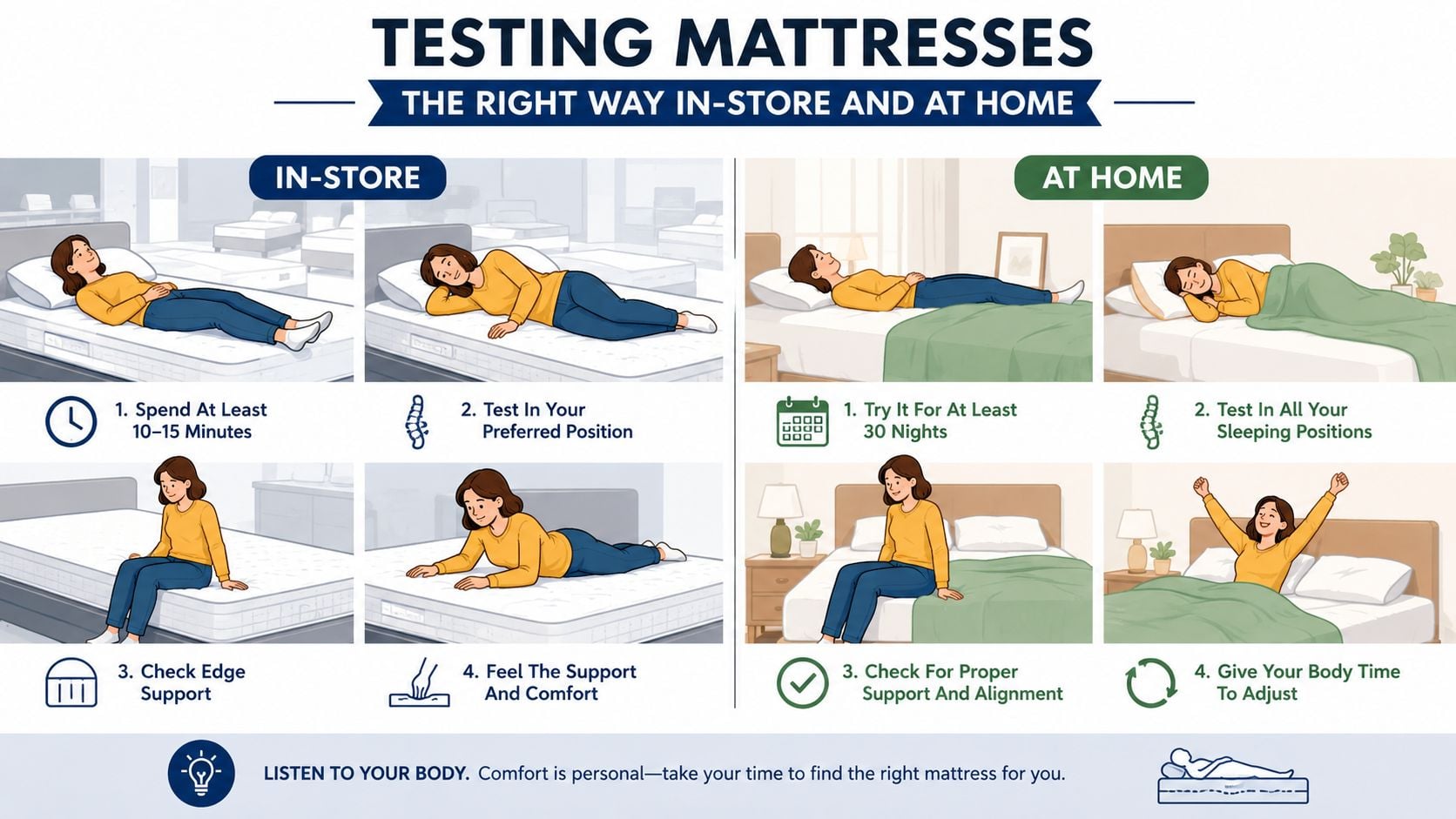
On the back, the lower back shouldn't float with a big gap, and the spine shouldn't be forced into a hard arch. On the side, the head, shoulders, hips, and knees should form a relatively straight line. Those are the signs that the mattress is supporting the body instead of fighting it.
Spend 10 to 15 minutes in the store in the position normally used at home, not a quick sit-down at the edge of the bed. That's the minimum serious test because it gives the body time to relax and show where the pressure points really are. If the shoulders go numb, the hips sink, or the lower back starts to strain, the mattress is wrong.
Use a real-world test, not a showroom fantasy
Harvard Health advises that a store test alone isn't enough for back pain, because a few minutes in a showroom don't replicate a full night's sleep. It also suggests comparing firmness away from home, such as on a hotel bed or a friend's guest room mattress, and trying a plywood board under the mattress or placing the mattress on the floor to see whether a firmer surface helps. Those are blunt tools, but they're useful because they reveal whether the body prefers less motion and more support. The Harvard Health guide is worth reading before a purchase.
For shoppers who also want context on spinal curvature issues, PosturaZen's scoliosis guide is a helpful companion, especially when pain patterns are tied to side-to-side asymmetry rather than general stiffness.
Tip Top's mattress shopping guide pairs well with that approach because it keeps the focus on body position, pressure points, and comfort over time. Ask for the trial terms before the sale, and don't leave until the mattress has been tested in the sleeping position.
Making the Most of Trial Periods and Return Policies
A mattress trial only helps if it's used like a test, not a waiting room for buyer's remorse. The timeline matters because the body can take time to adapt, and many retailers now give enough runway to make a real judgment. NY Spine Institute recommends a medium-firm mattress for back pain, notes that mattresses older than nine years may be due for replacement, and says many retailers now offer up to 100-day trial periods.
Track the same things every week
The right questions are simple and repeatable.
- Morning pain: Is the back looser, tighter, or unchanged after waking?
- Sleep interruptions: Is the sleeper waking less often or still shifting all night?
- Pressure points: Are the hips, shoulders, or lower back sore in the same place each morning?
- Ease of movement: Does turning over feel easier, or does the mattress trap the body?
A month is a sensible checkpoint because that's long enough for the body to adapt and long enough for patterns to emerge. If pain is improving slowly but sleep is still fragmented, that's a warning sign. If both pain and sleep quality are getting worse, the decision should be obvious.
Ask about the policy before the card is charged
The questions below save trouble later.
- Return window: How long is the actual trial once delivery happens?
- Restocking or pickup fees: Is there a fee if the mattress comes back?
- Exchange option: Can the feel be swapped, or is it a full return only?
- Adjustable-base compatibility: Will the mattress work with a base that raises the head or legs?
- Cooling and motion isolation: Does the model help hot sleepers or couples stay comfortable?
Those features matter because a mattress can be the right firmness and still fail in daily life. A hot sleeper who overheats on foam, a couple disturbed by movement, or someone who needs to prop up the legs at night can all end up rejecting a bed that looked perfect in the store. Tip Top's adjustable bed benefits page is useful for buyers who need that kind of setup.
Your Next Steps for Finding Relief in the Capital Region
The decision framework is straightforward. Start with pain location, then check sleep position, then confirm neutral alignment, and only then argue about firmness. For shoppers around Freehold, Albany, Schenectady, and Troy, that order keeps the focus on results instead of on marketing language.
Tip Top Furniture & Mattresses can help with that process in the showroom by matching a sleeper to a mattress, talking through comfort layers, and comparing options against budget and support needs. The store also offers professional design services, flexible financing, and a Clearance Corner for shoppers who want solid value without settling for a random bargain. For buyers who are also building a room from scratch, the one-stop approach makes it easier to coordinate the bed with the rest of the space.
If the mattress question is part of a bigger pain picture, persistent back pain deserves a medical conversation too. For some people, mattress choice is only one piece of a larger treatment plan, and regenerative therapy candidates is the kind of resource that can help people think through that possibility with a clinician. A mattress should support recovery, not replace care when pain keeps coming back.
Before heading out, bring a pillow if that's part of the normal sleep setup, wear comfortable clothes, and prepare to lie down long enough to judge alignment instead of appearance. Then ask for a mattress that fits the body's actual pain pattern, not the sales floor's loudest claim.
Visit Tip Top Furniture & Mattresses in Freehold, NY, and let the team help match the right mattress to back pain, sleep position, and budget. Shoppers across the Greater Albany Capital Region can test supportive, USA-made options in person, ask about financing, and compare clearance values before making the final choice.

