How to Choose Hardwood Flooring: Practical Guide 2026


A homeowner can spend an afternoon in a showroom comparing oak samples, warm stains, and wide planks, then discover that the decision was hiding underneath the floor. In the Capital Region, an older Albany house, a Greene County home over a crawlspace, and a newer slab-built property may need very different hardwood construction even when the rooms look alike.
The practical answer to how to choose hardwood flooring starts with the room, the subfloor, and the climate. Species, width, grade, and finish come afterward. That order protects the investment and helps a household choose a floor that can handle wet summers, dry winters, snow-covered boots, children, pets, and the movement common in Upstate New York homes.
Start with Your Room, Not the Wood Sample
A shopper standing in the flooring aisle at the Freehold showroom can easily feel buried under boxes of similar-looking planks. The better approach is to leave the sample rack alone for a moment and study the room that will receive the floor.
Build the room profile first
Four questions narrow the choice quickly:
- How much traffic does the room receive? Entryways, kitchens, halls, and open living areas need a more forgiving surface than a quiet bedroom.
- What sits beneath the room? A slab, basement, crawlspace, and older wood subfloor each bring different moisture and installation concerns.
- Where does sunlight enter? Strong exposure can make color changes more noticeable, especially on dark or highly uniform floors.
- Who uses the space? Dogs, children, mobility concerns, furniture movement, and snow-packed footwear all affect the right finish and grade.
A south-facing sunroom and a shaded bedroom shouldn't be evaluated with the same expectations. Neither should a dry upstairs room and a damp area above an aging crawlspace.
Practical rule: A floor sample shows appearance. The room determines performance.
Older housing stock across Albany, Schenectady, Troy, and Greene County often includes uneven subfloors, additions built at different times, and basements with changing moisture conditions. Those details can eliminate some products before color becomes relevant. A design consultant can help organize the constraints, but the homeowner should arrive with honest information about the room's habits.
Match the floor to the household
A busy family room may benefit from a textured, low-luster surface that makes small scratches less conspicuous. A formal dining room can accommodate a more refined grade if the household accepts more visible marks. For additional room-specific guidance, the living room flooring guide can help connect traffic patterns with design decisions.
Color still matters. Light floors can make a darker room feel more open, while deeper tones can give a large room a grounded, intimate character. Existing cabinets, upholstery, trim, and natural light should be assessed together rather than matched against one isolated plank.
The initial shortlist should include constraints, not just preferences: pets, children, a damp basement, radiant heat, intense sunlight, or a seasonal humidity problem. Once those conditions are clear, the wood sample becomes useful instead of distracting.
Solid Versus Engineered Construction
Solid and engineered hardwood can both look excellent, but they don't behave identically inside an Upstate home. Solid boards are milled from one piece of wood and offer substantial refinishing potential. Engineered boards use a real wood wear layer over a cross-laminated core, which generally limits movement across changing conditions.
That distinction matters over concrete, near basements, and in rooms where indoor humidity changes sharply. Solid hardwood usually makes the strongest candidate for stable, conditioned spaces with a suitable wood subfloor. Engineered hardwood is often the safer shortlist for a slab, a below-grade installation, or a home that struggles to maintain consistent humidity.
Solid vs Engineered Hardwood at a Glance
| Factor | Solid Hardwood | Engineered Hardwood |
|---|---|---|
| Core construction | One piece of wood | Real wood wear layer over layered wood construction |
| Movement | More responsive to seasonal moisture changes | Cross-laminated construction generally reduces expansion and contraction |
| Common fit | Stable, conditioned rooms with compatible wood subfloors | Slabs, some basements, radiant-heat applications, and higher-risk environments |
| Refinishing | Strong long-term refinishing potential, depending on remaining thickness | Depends on wear-layer thickness and manufacturer guidance |
| Main concern | Moisture and seasonal movement | Wear-layer limitations and installation compatibility |
The practical details matter more than the label. A thick engineered wear layer can support future refinishing, while a thin wear layer may be intended for maintenance coating rather than aggressive sanding. Solid wood can be refinished repeatedly over its service life, but improper installation can still create gaps, cupping, or crowning.
For a broader explanation of wood floor constructions and terminology, the Tiles Mate Pty Ltd floor guide offers useful background before a homeowner compares specific products.
Let the subfloor make the first decision
A Cape Cod-style home in Albany with a sound wood subfloor may be an excellent solid-floor candidate. A newer Greene County home built over a slab often points toward engineered construction. A basement installation requires moisture testing and careful product approval, not a casual assumption that any hardwood will work.
Radiant heat also raises the standard for product selection and installation planning. The homeowner should ask whether the specific flooring is approved for the system, how the installer will control moisture, and what indoor conditions must be maintained.
Tip Top's engineered hardwood flooring types resource gives shoppers a place to compare construction options before bringing room measurements and subfloor information to a consultation. The right question isn't which construction sounds more premium. It's which one fits the structure under the room and the climate inside the home.
Picking the Right Species for How You Live
Species selection should begin with dent resistance, not a popularity contest. The Janka hardness scale measures resistance to denting and impact, giving homeowners a concrete way to compare common flooring woods.
The familiar domestic options span a meaningful range. Red oak measures around 1,290 lbf, white oak around 1,360 lbf, hard maple around 1,450 lbf, and hickory around 1,820 lbf, according to this Janka hardwood rating guide. Brazilian cherry is about 2,350 lbf, while Brazilian walnut is about 3,680 lbf, placing those exotics in a much harder category.
Translate hardness into household use
- Red oak remains a dependable residential benchmark. Its familiar grain, broad finishing options, and moderate hardness suit many living rooms, bedrooms, and hallways.
- White oak offers slightly greater hardness than red oak, at 1,360 lbf versus 1,290 lbf, and is often favored where water resistance is a consideration, as described in this white oak and red oak comparison.
- Hard maple fits a calmer bedroom, office, or lightly used bright room where a cleaner, more consistent appearance matters.
- Hickory makes sense for a demanding mudroom, active kitchen, or household where dent resistance deserves priority.
- Brazilian cherry and Brazilian walnut appeal to buyers seeking exceptional hardness and a distinctive appearance, but they can be more demanding to cut, install, and refinish.
Hardness isn't a complete definition of durability. Very hard wood can still show scratches, finish wear, or movement if the room conditions and installation are wrong. The most sensible choice balances dent resistance with local availability, repairability, and the household's tolerance for natural variation.
Species availability can also affect scheduling, particularly for specialty or exotic selections. A homeowner planning a renovation in Albany or Greene County should confirm lead time before finalizing a design calendar. The hardwood longevity and style guide provides additional context for weighing wood character against long-term use.
Plank Width, Grade, and Finish That Fit Your Home
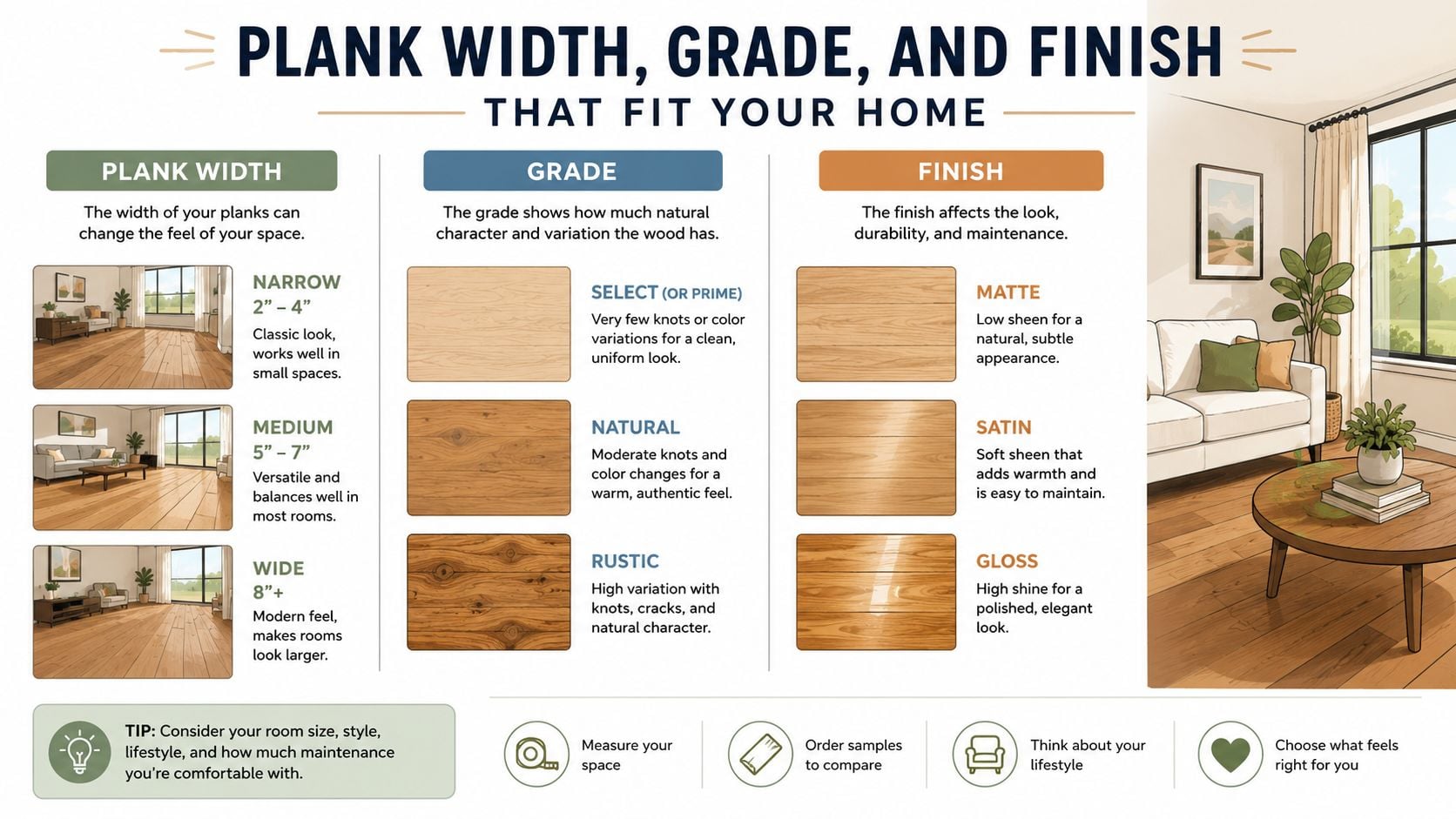
A floor's width, grade, and finish determine how it will look after years of ordinary living. These choices also influence whether dust, scratches, knots, and seasonal marks blend into the floor or call attention to themselves.
Choose width and grade with honesty
Wide planks create a calmer, more expansive visual field with fewer seams. They can suit an open Greene County floor plan or a renovated Capital Region living space, but the installer must confirm that the product and subfloor can handle the room's conditions. Traditional strip flooring creates more visual rhythm and can work well in older homes where narrower boards complement existing proportions.
Grade describes the amount of natural variation. Select grades tend to look more uniform. Character grades show knots, mineral streaks, and stronger grain. Rustic grades embrace even more variation and can be a smart visual choice for active households because everyday marks don't compete as sharply with the pattern.
A knot isn't automatically a defect, but it does change the floor's personality. Buyers who want a quiet, uniform appearance should inspect multiple boards rather than judging one showroom plank.
Read the finish as a maintenance decision
For most families with dogs, children, and winter boots, a matte or low-luster finish is the practical recommendation. It reflects less light and generally makes dust and small scratches less obvious than a glossy surface. Satin offers a middle ground, while gloss creates more shine but demands greater tolerance for visible daily wear.
Oil-based and water-based finishes also behave differently. An industry comparison of oil-based and water-based finishes describes oil-based finishes as creating a hard, plastic-like coating suited to heavy foot traffic, and notes that oil-based finishes can last 5 to 10 years depending on use. Water-based finishes tend to preserve a lighter appearance, while oil-based products can add warmth as they age.
Factory-applied aluminum-oxide coatings can provide a tough surface, but the homeowner should ask about future refinishing before choosing one. A finish that resists wear well may also require more specialized preparation when renewal becomes necessary.
Samples should be viewed near cabinets, trim, and furniture, then checked in morning and evening light. Tip Top's ordering process can help homeowners evaluate samples before committing to a full-room finish.
Climate, Moisture, and Acclimation in Upstate NY
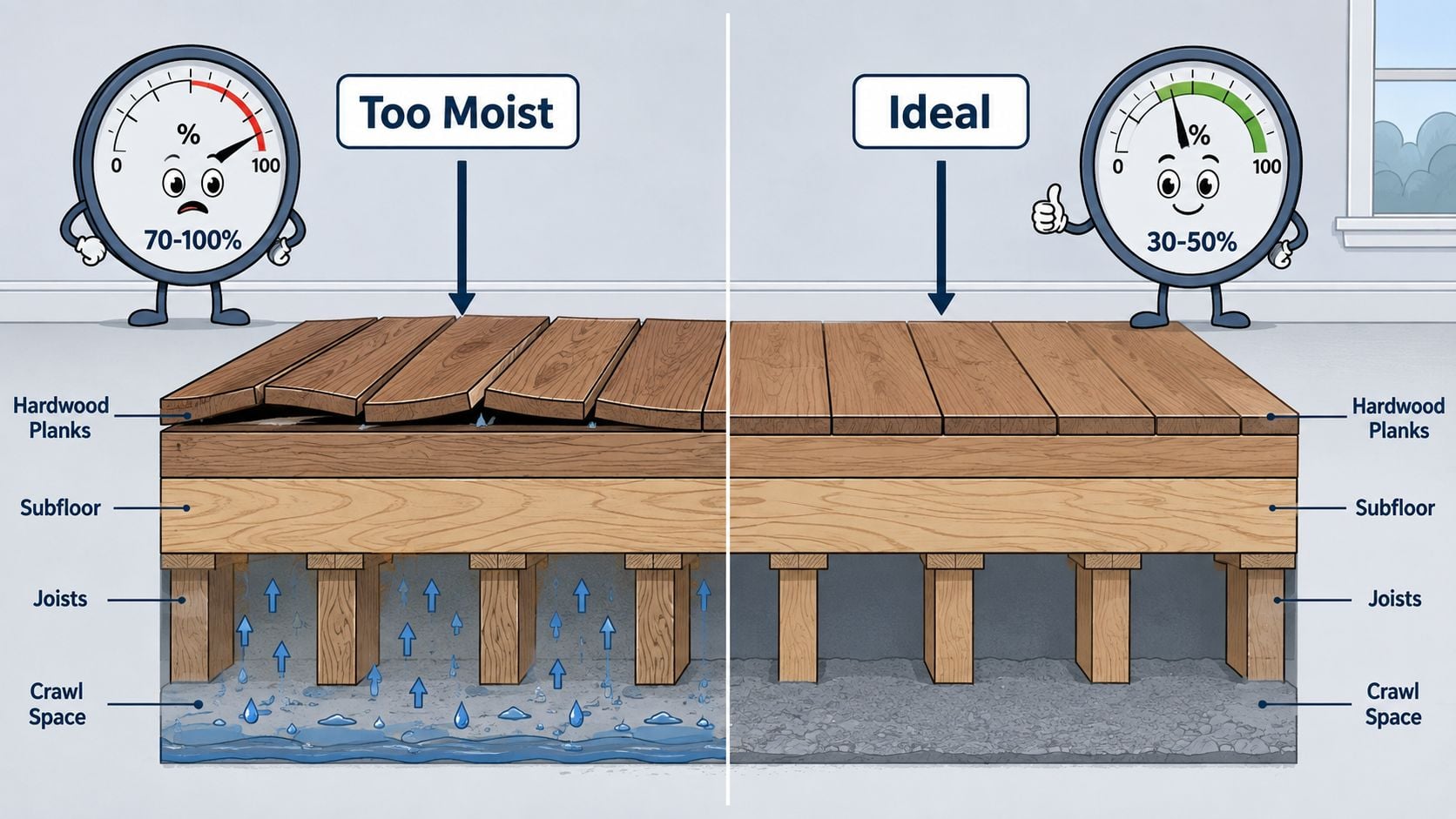
Hardwood failures in the Capital Region often begin before the first plank is cut. Wet summers, dry winters, older basements, and imperfect crawlspaces create conditions that can push wood beyond its stable range.
Many industry guides place interior hardwood flooring near 6% to 9% moisture content, and recommend keeping the flooring-to-subfloor difference within 2 percentage points for plank flooring or 4 points for strip flooring. The NWFA moisture-testing reference also describes representative testing at at least 20 readings per 1,000 square feet of subfloor.

Use a written pre-installation checklist
The installer should document:
- Room conditions, including relative humidity and temperature.
- Flooring readings, taken from representative bundles rather than one convenient board.
- Subfloor readings, including areas near exterior walls, plumbing, and basement or crawlspace transitions.
- Convergence, meaning the flooring and subfloor readings fall within the appropriate difference.
- Acclimation, continuing until the wood's moisture content stops changing.
A single favorable reading can hide a wet section beneath an exterior wall or near an older foundation. Homeowners who want background on measurement methods can review this explanation of pin and pinless moisture meters.
Indoor relative humidity guidance commonly used by flooring professionals is 35% to 55% year-round, as outlined in this wood moisture and installation guidance. If a home can't remain in that band, engineered construction deserves serious consideration because its layered structure generally tolerates dimensional change better than solid wood.
The homeowner should also ask how the installer will manage the dry winter air that can create gaps and the damp summer air that can encourage swelling. Conditioning the flooring isn't a scheduling inconvenience. It's part of the installation.
For related wood terminology, the kiln-dried wood explanation gives useful context about why moisture control begins before flooring reaches the room.
Budget, Lifecycle Cost, and What You Really Pay Over Time
The cheapest box of flooring rarely tells the full financial story. Material, preparation, installation, transitions, moisture correction, maintenance, and future refinishing all influence what the floor costs across its useful life.
Industry references commonly place properly maintained solid hardwood at about 75 to 100 years or more, while engineered hardwood is typically closer to 20 to 30 years, depending on wear-layer thickness and maintenance. Those lifespan benchmarks are summarized in this hardwood flooring lifespan and refinishing guide.
A Capital Region budget scenario
Consider a couple furnishing a Troy home. They have an entry-level material allowance, a mid-range allowance, and a premium allowance, but the decision isn't about buying the least expensive product.
The entry approach may prioritize a standard domestic species, a compatible engineered construction, and a straightforward finish. That can be sensible for a room over a slab, especially when moisture testing supports the choice. Saving on species while protecting installation quality is usually smarter than buying a beautiful product that the subfloor cannot support.
The mid-range approach may direct more money toward a thicker wear layer, stronger finish, or a species with more dent resistance. Many households get the best balance here. The floor gains useful performance without paying for a specialty appearance that may bring longer lead times or more complicated repairs.
A premium approach may favor solid hardwood in a stable room, a specialty species, custom detailing, or a construction with greater refinishing potential. The additional cost makes sense when the home's structure, maintenance habits, and long ownership horizon justify it.
Spend on the parts that prevent replacement
A properly prepared subfloor and careful moisture protocol deserve priority over a dramatic stain. Solid hardwood's long service life can make refinishing a better path than replacement, while engineered flooring's future options depend heavily on its wear layer.
Tip Top offers hardwood flooring installation cost guidance for homeowners building a project budget. Flexible financing can also help a growing family in Greene County or a first-time buyer in Troy separate the timing of a necessary flooring project from the timing of other room purchases. The right budget is the one that includes preparation and installation, not merely the visible product.
Choosing the Right Installer and Bringing It Home
The installer matters more than the brand name on the carton. A capable Capital Region flooring professional will ask about the subfloor, document moisture readings, explain acclimation, and put warranty terms in writing.
Homeowners should request:
- Training and experience: Ask whether the crew follows recognized wood-flooring installation practices.
- Moisture records: Request examples of how readings were taken and documented on prior work.
- Written coverage: Confirm what the warranty covers, who handles claims, and which homeowner conditions apply.
- Local references: Speak with customers in similar Albany, Schenectady, Troy, or Greene County homes.
- A complete estimate: Check that preparation, underlayment where appropriate, transitions, trim, delivery, and cleanup are included.
A low bid often leaves out the quiet work that protects the floor. Missing acclimation time, subfloor correction, or transition pieces can turn an attractive estimate into an expensive repair.
Tip Top Furniture & Mattresses has served the Freehold area and the Greater Albany Capital Region since 1978, with professional design services available since 1984 and flooring choices coordinated through its one-stop showroom. Homeowners can bring room measurements, photos, subfloor details, and finish preferences to a design conversation, then use a free online room planner to test the broader layout before ordering.
The strongest process is straightforward: inspect the room, identify the construction constraints, compare species by use, test samples in natural light, confirm moisture conditions, and choose an installer who documents the work.
Visit Tip Top Furniture & Mattresses in Freehold, NY, to compare hardwood flooring options, discuss engineered versus solid construction, and coordinate flooring with furniture and design services. The showroom also offers custom ordering, USA-made mattresses, Amish furniture, flexible financing, delivery, and a clearance selection for homeowners who want a complete project planned with local guidance.