Vinyl Plank Flooring Cost: 2026 Guide

Vinyl plank flooring cost usually lands around $4 to $10 per square foot installed, and a 500-square-foot room commonly comes in around $2,500 to $5,500 total. That's the number to keep in your head while you sort through quotes, because the final price mostly swings with product grade, labor, prep work, and room size.
A homeowner in Freehold or Albany can stand in a half-finished room with a tape measure, three different estimates, and still not know what a fair price looks like. That's normal. Vinyl plank flooring stays popular because it sits in the middle of the market, not at the luxury end, and the budget question is usually what gets added after the first estimate, not what the box costs on the shelf.
What Vinyl Plank Flooring Costs in 2026
A quote for vinyl plank flooring starts with the room in front of you, not the sample on a display rack. In an older Upstate NY home, a rough subfloor, hidden moisture, or old material that still has to come out can push the price up fast. If the room is already clean, flat, and ready for a click-lock install, the job stays much closer to the lower end.
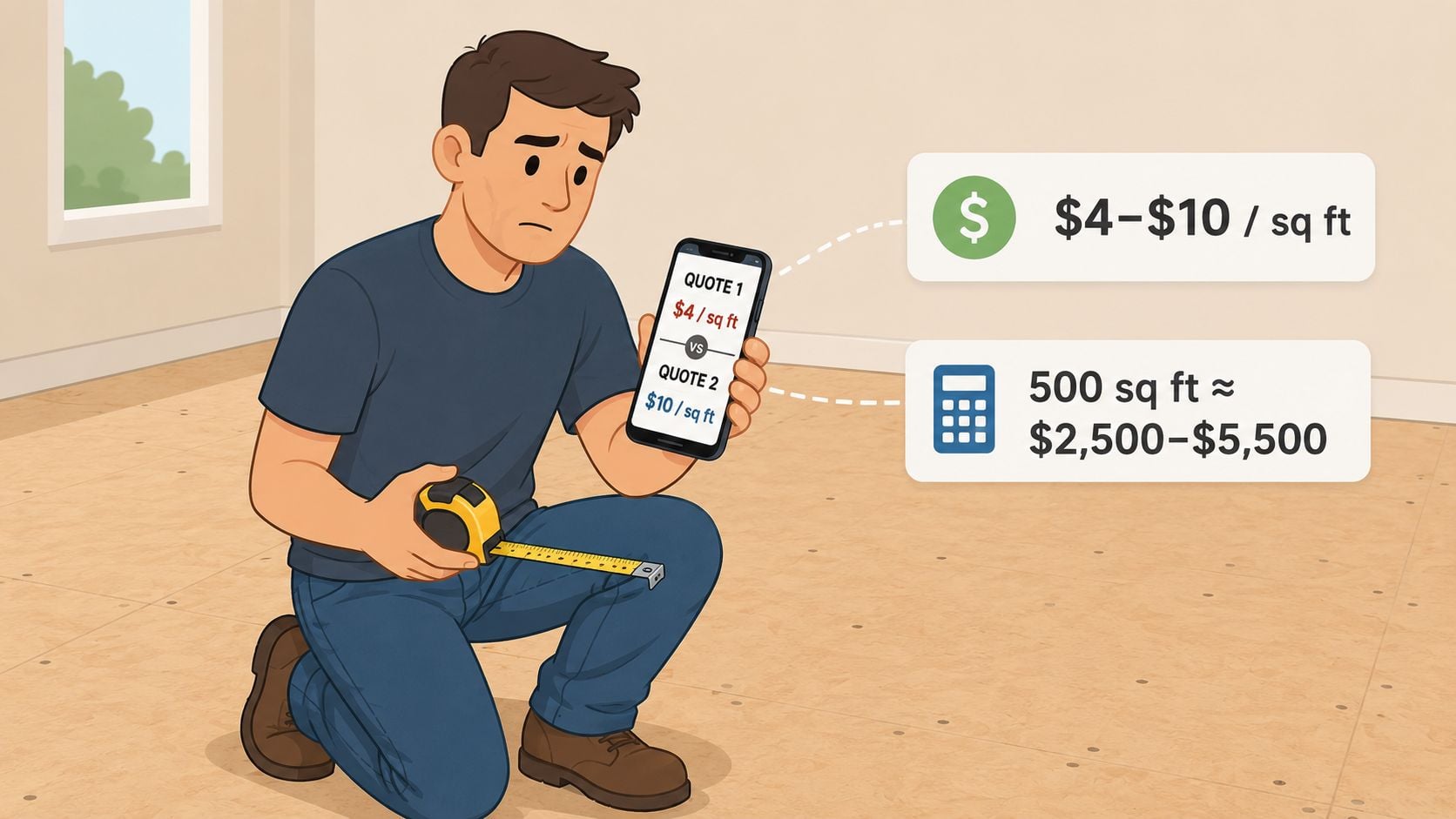
In the market, vinyl plank flooring is usually priced at $3 to $7 per square foot for materials, with professional installation adding about $2 to $4 per square foot. That puts a typical 500-square-foot room at roughly $2,500 to $5,500 total installed. The broad range reflects a simple fact, vinyl plank sits in the middle of the flooring market, not at the luxury end. When you compare it with other surface choices, the budget logic is much easier to see in a broader laminate flooring vs hardwood cost discussion.
Practical rule: if a quote sits well above the middle of that band, the extra money is usually going into the floor itself, not the plank box.
The cleanest way to read the budget is simple. Materials, labor, prep, and project size decide where a room lands. A 300-square-foot room can stay near $1,350 at the low end, while larger spaces push the total into the several-thousand-dollar range. That is why one homeowner calls the same product affordable and another calls it expensive.
Seasonal labor swings matter here too, especially in the Capital Region. Contractors get busy when homeowners want work done around weather changes, and older houses often need more prep than newer builds. A room that looks ready can still hide moisture issues, weak spots, or an uneven base that changes the quote once work starts. For shoppers who want flooring decisions tied to furniture and décor in one visit, Tip Top Furniture & Mattresses in Freehold keeps that planning under one roof instead of turning it into three separate errands.
For a rough material comparison, how cement tile stacks up shows how quickly the budget shifts once the surface choice changes. The plain takeaway is this. Vinyl plank is usually a smart spend, but the room conditions decide whether it feels like a bargain or a project.
Understanding Material Tiers and Wear Layers
The price tag makes more sense once you look at what sits under the finish. Budget LVP is usually thinner, with lighter wear protection, while mid-range and premium planks add thickness, tougher wear layers, and better core stability. The wear layer is the clear coat on a hardwood floor, the part that takes the abuse so the printed surface underneath does not get chewed up so quickly.
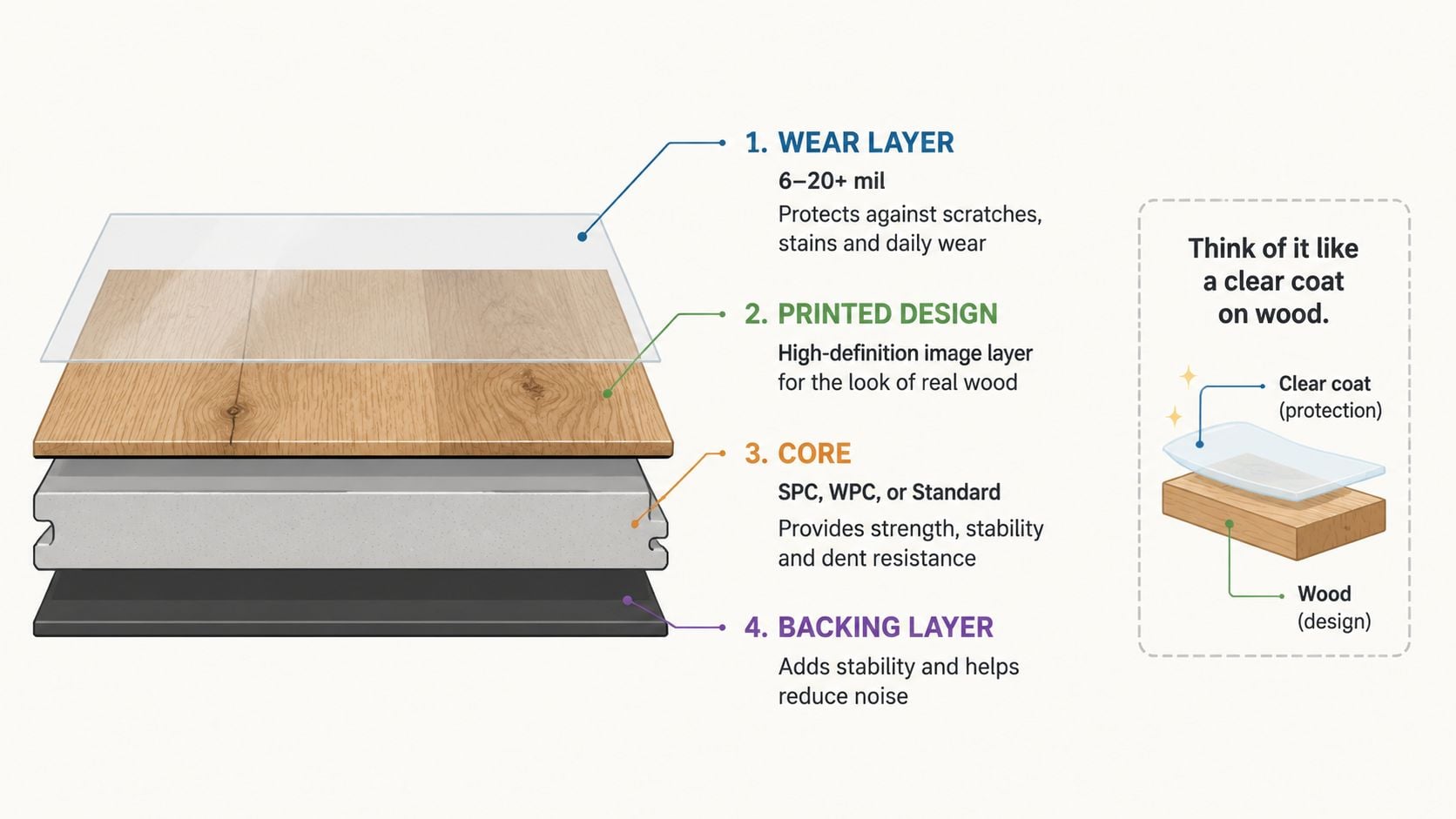
Budget products in 2026 run around $2.50 to $3.50 per square foot, usually with 4 to 5 mm thickness and 6 to 12 mil wear layers. Mid-range and premium options move up to $3 to $7 per square foot as wear layers climb into the 12 to 20 mil and 20+ mil ranges. Thicker cores and heavier wear layers usually increase scratch resistance, dent resistance, and expected service life. 2026 vinyl flooring tiers
A homeowner does not need to memorize every product acronym, but the core type matters. SPC tends to feel stiffer and more dent resistant, WPC usually brings a softer feel underfoot and better sound comfort, and standard glue-down LVT keeps things more traditional where a stable, glued installation makes sense. That is why the right tier is not about glossy samples, it is about household reality. Pets, kids, wheeled chairs, wet boots, and basement moisture all point the shopper toward a stronger product. For a plain-language comparison of how floor types differ, Tip Top's guide to flooring types and trade-offs helps put the choices side by side.
Tip Top's flooring department carries options across these tiers, which matters because one house in Greene County will not need the same floor as a downtown apartment or a family room in Troy. The right choice usually comes down to use, not bragging rights. If the space is light-use and dry, budget LVP can be fine. If the room sees heavy traffic or occasional moisture, paying more upfront usually makes sense.
Good flooring is bought for the room it has to survive, not for the sample board that looks best under showroom lights.
The clearest rule is this. Choose budget when the room is easy, mid-range when the room is busy, and premium when the room has to take a beating. That keeps the decision tied to value instead of appearance alone.
Hidden Line Items That Move Your Final Quote
A vinyl plank job can look straightforward on the shelf and turn messy on the floor. In older Upstate NY homes, the cost shifts when the installer finds soft subfloor spots, moisture in a basement slab, or trim that no longer fits the new floor height. Seasonal labor swings matter too, because scheduling in a busy stretch is not the same as booking during a slower one. That is why two rooms using the same plank can still land on very different totals.
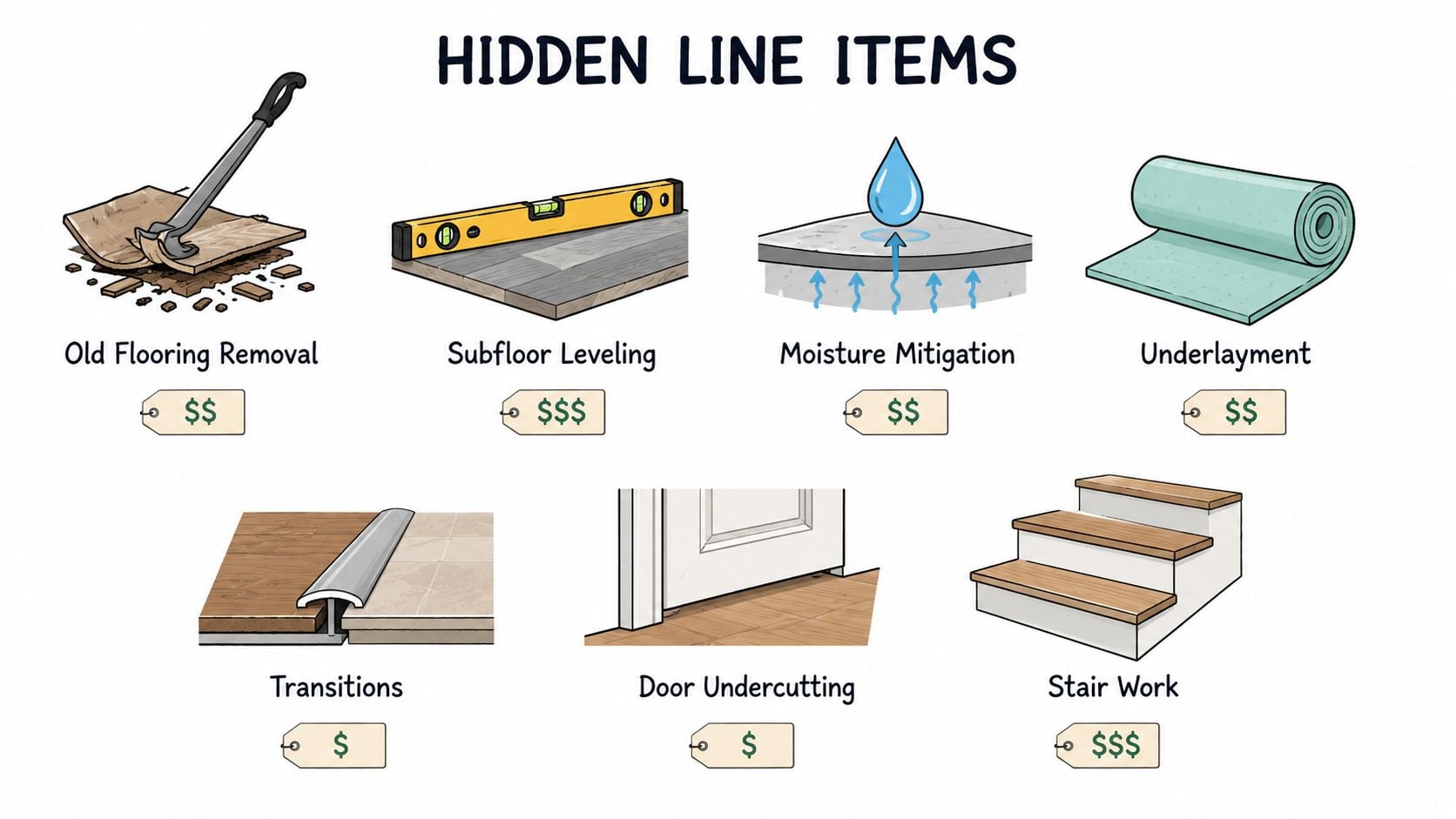
Installed vinyl plank is commonly quoted around $4 to $13 per square foot, while higher-end guides push total projects to $5 to $17+ per square foot once labor and typical surprises are included. That spread is what old-house realities do to a quote. A dry, flat room is one thing. A room that needs prep, drying, and finish work is another. Installed vinyl plank cost spread
| Common Hidden Line Items on a Vinyl Plank Estimate | Typical Range | When It Applies |
|---|---|---|
| Subfloor leveling | Varies by condition | When the floor has dips, humps, or transitions that need flattening |
| Old flooring removal | Varies by material | When carpet, tile, laminate, or old plank has to come out first |
| Moisture mitigation | Varies by condition | When basements, slabs, or older homes show dampness risk |
| Underlayment | Varies by product | When the chosen plank requires cushioning, sound control, or a smoother base |
| Transition strips | Varies by layout | When the new floor meets tile, carpet, or another finished surface |
| Door undercutting | Varies by doors | When doors won't clear the new floor height |
| Stair work | Varies by staircase | When the project includes steps instead of only flat rooms |
Homeowners get burned when they compare only the sticker price and ignore the work around it. Ask what the estimate includes, removal, underlayment, transitions, moisture testing, and floor flattening. Those are the line items that separate a fair quote from a stripped-down one. Tip Top's design consultants help plan the floor, the trim, and the rest of the room in one visit, which keeps the budget tied to the whole project instead of a single line on paper.
The practical read is simple. If a quote looks low, check what got left out. If a quote looks high, check whether it is covering the actual prep, finish work, and problem-solving the room needs.
For trim detail, baseboard molding installation deserves a look because flooring rarely stands alone once old baseboard and new height differences enter the picture. Clean edges depend on the full treatment, not just the planks.
Real Room-by-Room Cost Examples
A bedroom with simple walls and a clean subfloor is a different job from a wide living room with multiple doorways or a whole-house replacement in an older Upstate NY home. Vinyl plank flooring cost makes sense only when you tie it to the room in front of you, because square footage, prep, and layout all push the final number in different directions.
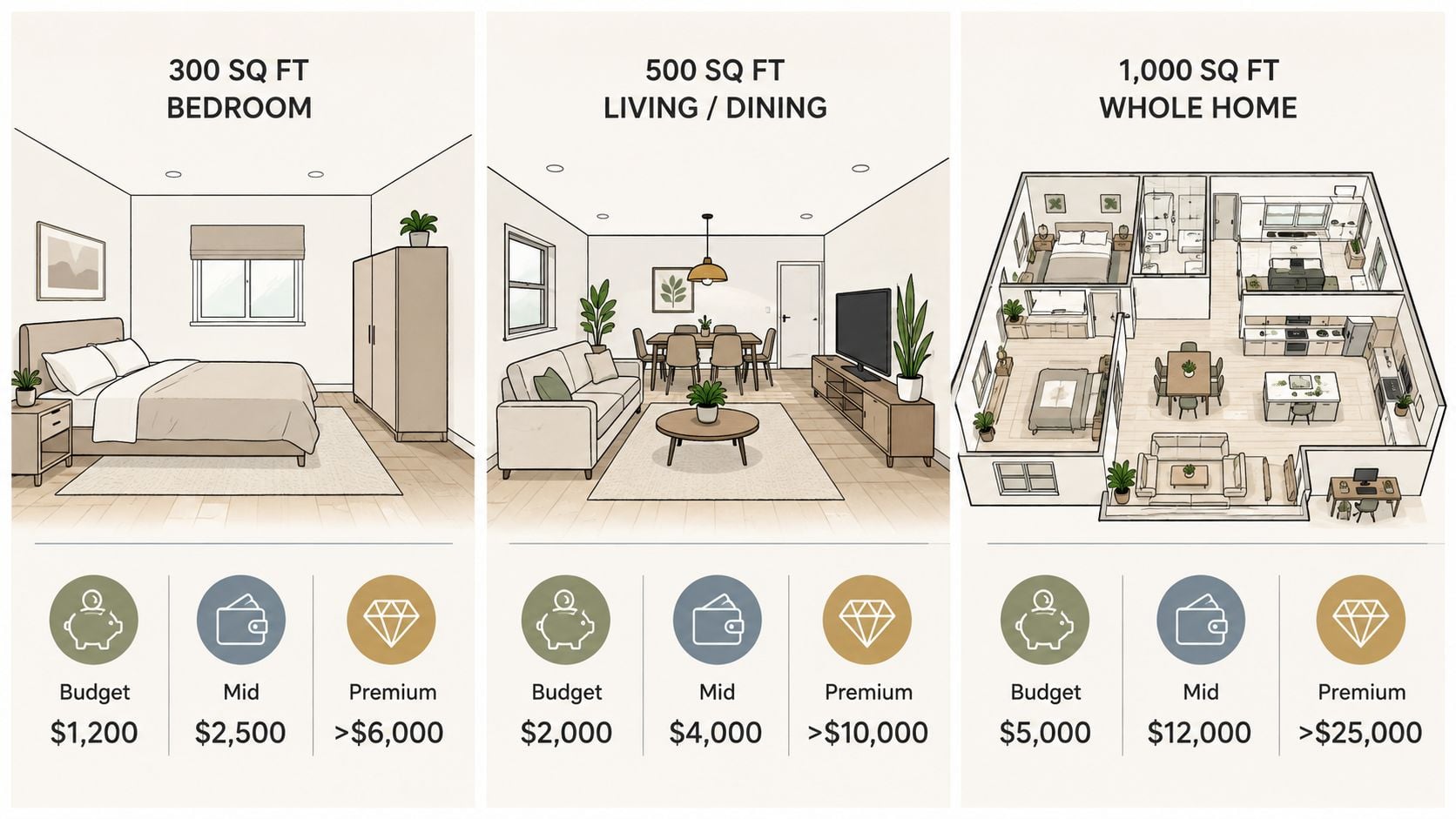
Luxury vinyl plank flooring is often estimated at $4 to $10 per square foot installed, with materials and labor included. A 300 square foot living room can land around $1,200 to $3,000, while a 1,000 square foot whole-house project can run about $4,000 to $10,000. Installed LVP cost examples
Side-by-side examples
- 300-square-foot primary bedroom. A basic install can stay near $1,200, especially if the subfloor is sound and the room has few transitions. Add better material and more prep, and the total rises fast.
- 500-square-foot living and dining area. This is the room where labor starts to matter more because the open footprint usually brings more cutting, more edge work, and more finish details.
- 1,000-square-foot whole-home project. Straightforward work can sit near the lower end of the range, but every doorway, threshold, and bit of prep adds up across the house.
A primary bedroom is usually the easiest place to keep a quote in check. A living room often needs more attention around furniture layout, edge detail, and how the floor ties into the rest of the house. A whole-home job is where the invoice grows, because each room brings its own transitions and prep needs, especially in older homes with uneven or tired subfloors.
Tip Top's free online room planner helps homeowners map the space before anyone starts pulling up trim or measuring cuts. That makes it easier to decide whether to do one room at a time or handle the project in one pass. It also helps when you are coordinating flooring with furniture and décor, since a living room floor should work with the rest of the room, not fight it. For that kind of planning, the best flooring for living room guide is a practical place to start.
A budget bedroom can stay near $1,200, while a premium whole-home install can push past $10,000 with no mystery. More square footage means more material, more labor, and more chances for the hidden stuff to show up in the final quote.
Regional Pricing Across the Albany Capital Region
A floor quote in Freehold, Greene County, Albany, Schenectady, or Troy rarely matches a clean national average. Older subfloors, damp basements, and awkward delivery access change the job before the first plank goes down, especially in older Capital Region homes. That is the local reality behind vinyl plank flooring cost.
Installed vinyl plank flooring usually lands around $4 to $10 per square foot overall, and labor often adds $1.50 to $5 per square foot depending on whether the job uses click-lock floating floors or glue-down systems. Click-lock floors usually cost less to install because they skip adhesive and go down faster on suitable subfloors. Glue-down work costs more because it needs adhesive, more prep, and a slower installation pace. Installation method pricing
Older homes across the region often need more work under the surface than the plank choice suggests. A house in Greene County can have tired subflooring that a newer build in Colonie does not, and that changes labor far more than the style of the plank itself. In those homes, a simple-looking floor often turns into a prep job first.
Moisture is another local variable. Basements, crawl spaces, and older framing can create conditions that raise the amount of patching, leveling, or drying work needed before installation starts. That kind of issue shows up often enough in Upstate homes that a careful estimate should account for it early instead of treating it as a surprise later.
Seasonal labor swings matter too. Flooring crews fill up fast in spring, when renovation demand picks up, and they usually have more room later in the year. The work does not suddenly become cheap in the off-season, but planning ahead gives homeowners a better shot at getting the timing, materials, and scope they want without rushing the decision.
Tip Top's Freehold showroom helps local homeowners estimate with Albany-area homes in mind instead of generic pricing assumptions. That matters when the quote has to reflect older framing, basement dampness, and the realities of moving material across the region. It also makes one-stop planning easier, because homeowners can look at flooring, room coordination, and nearby furniture and décor choices in the same visit.
Tip Top's free online room planner also helps homeowners map the space before anyone starts pulling trim or measuring cuts. That makes it easier to decide whether to split the job into phases or handle it in one pass. It also helps when you are choosing a floor that has to work with the rest of the room, not fight it. For that kind of planning, the hardwood flooring care tips page is a practical reference for long-term upkeep habits.
The bottom line is simple. In this region, the project price usually climbs because the house asks for more work, not because vinyl plank itself is a luxury product.
Lifespan, Maintenance, and the True Cost Over Time
Cheap flooring only looks cheap on day one. Judge vinyl plank by cost per year of service, because a lower sticker price means nothing if the floor wears out early and needs replacement sooner. That is the same logic people use with tires, and it applies just as hard here.
Installed pricing for standard vinyl plank often lands in a broad range, with material and labor varying by product grade and job difficulty. The useful question is not the spread itself, but the value behind it. A bargain plank that wears faster can cost more over time than a mid-tier product with a thicker wear layer and a steadier core. The long view matters most in Upstate NY homes, where older subfloors, basement moisture, and the challenge of moving materials across the region can shorten the life of a weak floor if the install is rushed or the product is too light for the space.
What usually pays back over time
- Thicker wear layers resist visible wear better in halls, kitchens, and family rooms.
- Waterproof construction helps in rooms where spills or moisture are part of life.
- Stronger cores hold up better when chairs, pet claws, and daily traffic keep hitting the same spots.
Maintenance is simple, and that is part of the value. Regular sweeping, vacuuming, and the occasional damp mop keep the floor in good shape, and the protective wear layer does most of the heavy lifting. For practical care habits that help finished floors last, the hardwood flooring care tips page is still worth a look, even though the surface type is different.
A homeowner planning to stay put should lean toward the better plank, not the cheapest one. A modest bump in upfront price often makes more sense than replacing a tired floor years earlier than expected. That is the whole point of buying for the room, the traffic, and the long haul.
Tip Top's approach fits that mindset because a floor is rarely a standalone purchase. It sits next to furniture, rugs, and décor, and a coordinated plan keeps the whole room from looking half-finished. That one-stop visit also helps homeowners make flooring decisions with adjacent furniture and décor choices in mind instead of treating each piece like a separate project.
Budgeting, Financing, and Next Steps
A flooring budget gets messy fast in older Upstate NY houses if you start with square-foot pricing alone. Old subfloors, moisture in basements or first floors, crooked transitions, and seasonal labor swings can move the final bill more than the plank itself. Start with the room, the condition of the floor below it, and the finish level you want.
Luxury vinyl plank flooring materials typically cost $2 to $10 per square foot with a national average around $3 to $6 per square foot for a mid-to-premium product, and professional installation adds about $2 to $6 per square foot, bringing the total installed cost for most homeowners to $5 to $12 per square foot and roughly $7,500 to $18,000 for a 1,500 sq. ft. home. Luxury vinyl plank cost range
The smart move is to get real numbers before the project starts. Measure the space, choose the plank tier that fits the room's use, and get two written quotes that spell out removal, leveling, underlayment, and transitions. If the project is spread across several rooms, phase it in a way that fits your cash flow instead of trying to force every space into one budget.
Homeowners who want to spread the spend should talk through home renovation financing options early, before the job is underway and pressure starts to build. Tip Top also offers flexible financing through the Synchrony Home Card, which can make a larger flooring purchase easier to handle without wrecking monthly cash flow.
Do the basics in this order.
- Measure first. Know the square footage before comparing quotes.
- Pick the right tier. Budget, mid-range, or premium should match the room's use.
- Ask what's included. Removal, leveling, underlayment, and transitions matter.
- Use clearance when the look works. Clearance inventory can cut cost without forcing you into a poor match.
- Consider custom ordering when the room needs a specific finish. That is the better path when the floor has to work with existing furniture or a defined style.
Visit the Freehold, NY showroom if you need a real number, not an online guess. Tip Top can help with flooring, furniture, décor, custom order options, and flexible financing in one visit, which makes it easier to judge the floor next to the sofa, rugs, and room décor before you commit.