Engineered Hardwood Flooring vs Hardwood Cost: 2026 Buyer’s

Most homeowners hear “engineered hardwood” and assume the lower price is automatic. That advice is incomplete. The engineered hardwood flooring vs hardwood cost comparison starts after delivery, subfloor preparation, installation, trim, and the years of maintenance that follow.
For Capital Region homeowners, the decision is even more practical. Humid summers, dry winters, older homes, concrete slabs, damp basements, and uneven subfloors can change which product delivers the better value. Engineered hardwood often wins on installation flexibility, while solid hardwood can win over a long ownership period because it can be refinished repeatedly.
| Cost factor | Engineered hardwood | Solid hardwood |
|---|---|---|
| Typical installed range in the U.S. | About $9 to $20 per square foot | About $11 to $25 per square foot |
| Material-only guidance | About $6 to $12 per square foot | Generally higher once labor is included |
| Installation labor guidance | About $3 to $10 per square foot | About $6 to $12 per square foot |
| Best cost advantage | Flexible installation and moisture tolerance | Long-term refinishing potential |
| Main cost risk | Prep, adhesive, and premium specifications | Labor, subfloor limits, and finishing work |
The ranges above come from current pricing guidance compiled by HomeGuide's engineered hardwood versus hardwood cost comparison and material and labor breakdowns for engineered flooring. The right choice depends less on the label and more on the room, subfloor, installation method, and expected ownership timeline.
Why Engineered Hardwood Is Not Always the Cheaper Choice
Engineered hardwood is often the lower-cost starting point, but the savings can disappear after installation. Adhesive, leveling, removal, transitions, trim work, and repairs to an older subfloor can narrow the gap quickly. A lower plank price does not guarantee a lower finished-project price.
Current U.S. guidance places installed engineered hardwood at about $9 to $20 per square foot, compared with $11 to $25 per square foot for solid hardwood, according to HomeGuide's cost guidance. Those ranges overlap. A premium engineered plank glued over a difficult slab can approach the cost of a lower-priced solid floor installed over a suitable wood subfloor.
Material-only quotes hide the complete decision
A plank-only quote leaves out the work that determines the final bill. Engineered materials are often priced around $6 to $12 per square foot, while solid hardwood costs more after nail-down labor and finishing are included, as outlined in the hardwood flooring cost comparison from Clean Invoice.
Ask for the complete, ready-to-live-on floor cost. The estimate should identify:
- Planks: Species, grade, thickness, finish, and wear-layer construction.
- Installation: Floating, glue-down, nail-down, or another approved method.
- Preparation: Leveling, patching, moisture control, or subfloor replacement.
- Finishing details: Baseboards, thresholds, transitions, stairs, and trim.
- Removal: Existing flooring, disposal, and adhesive cleanup.
Practical rule: A contractor's per-square-foot number is useful only when every quote includes the same scope of work.
Engineered hardwood still delivers a clear cost advantage in many homes. Its layered core accommodates more installation conditions, and prefinished products can reduce some site-finishing work. Those benefits matter in Capital Region homes with uneven subfloors, concrete slabs, or damp lower levels. They do not eliminate preparation costs.
Compare itemized installed totals, not a plank sample beside a solid wood sample. For construction, wear layers, and room suitability, Tip Top's guide to engineered hardwood flooring types provides a useful starting point before requesting project pricing.
Breaking Down Material and Labor Costs for 2026
The apparent savings of engineered hardwood often shrink after installation is priced properly. Current guidance places engineered hardwood materials at about $3 to $16 per square foot, with labor at $3 to $10 per square foot. Solid hardwood materials run about $5 to $25 per square foot, with labor at $6 to $12 per square foot, according to McMillan Floors' engineered hardwood cost guide.
Those ranges describe different installation demands. Engineered flooring may be floated, glued, or nailed, depending on the product and substrate. Solid hardwood generally requires a suitable wood subfloor and nail-down installation, so preparation and labor can erase much of the material-price gap.
Engineered vs Solid Hardwood Cost Breakdown
| Cost category | Engineered hardwood | Solid hardwood |
|---|---|---|
| Materials | About $3 to $16 per square foot | About $5 to $25 per square foot |
| Labor | About $3 to $10 per square foot | About $6 to $12 per square foot |
| Typical installed guidance | About $7 to $20 per square foot in current guides | About $11 to $25 per square foot in current guides |
| Installation flexibility | Floating, glue-down, or nail-down options may be available | Primarily nail-down installation |
| Biggest variable | Adhesive, underlayment, and prep | Labor, substrate requirements, and finishing |
The installed ranges appear in Modernize's engineered hardwood cost guidance and Decor Modern's 2026 flooring analysis. Market pricing can reverse the material-only relationship. One index reports median commercial pricing of $4.42 per square foot for engineered hardwood and $3.92 per square foot for solid hardwood. It places retail hardwood flooring between $3 and $14 per square foot, with a median of $6.19, according to Flume's flooring price index.
Where installation changes the equation
Engineered flooring is not automatically inexpensive to install. Floating installation can reduce labor in a straightforward room, while glue-down work adds adhesive and demands a flatter, better-prepared substrate. Nail-down engineered flooring may suit plywood, but it still requires a qualified installer.
Solid hardwood usually costs more to install because the crew must meet stricter subfloor conditions and complete more finishing work. In an older Capital Region home, leveling, patching, moisture control, or subfloor replacement can narrow the engineered option's apparent savings.
Price the entire project, not just the planks. Ask for removal, disposal, transitions, trim, stairs, preparation, and installation to appear separately in the estimate. A contractor's per-square-foot figure is useful only when every quote covers the same scope.
Homeowners planning a kitchen can also use kitchen flooring tips from Jennifer Gilmer when coordinating flooring with cabinets, appliances, transitions, and moisture exposure. For questions to bring to an installer, use Tip Top's hardwood flooring installation cost guide.
Installation Complexity and Moisture Tolerance in Upstate NY Homes
Upstate New York floors experience a demanding indoor climate. Summer humidity, winter heating, seasonal movement, tracked-in snow, and damp lower levels all affect hardwood performance. The product that works beautifully in a dry second-floor bedroom may be the wrong choice over a basement slab.
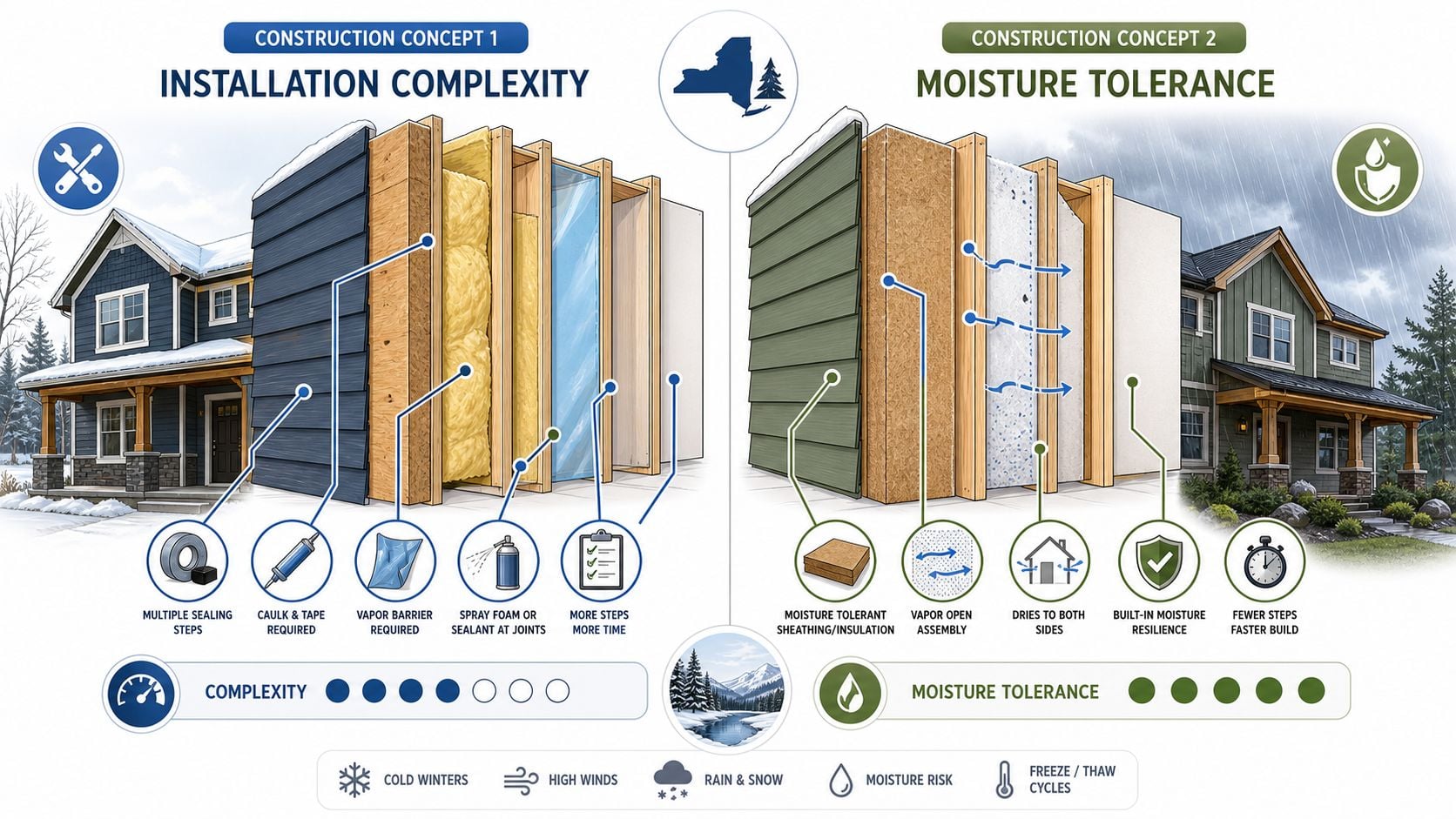
Engineered hardwood uses a real wood surface over a layered core. That construction limits the movement associated with one-piece solid boards, making engineered products more adaptable to humidity changes and certain difficult installations. Current cost guidance specifically identifies engineered hardwood as suitable for basements, radiant heat floors, and humid climates because it handles humidity better, as explained by Modernize's hardwood flooring guide.
Subfloor conditions matter more in older homes
A Schenectady ranch, Troy row house, or Greene County farmhouse may not have the flat, dry substrate that a new-build specification assumes. Solid hardwood's nail-down installation works best over an appropriate wood subfloor. If the existing surface is uneven, damaged, or affected by moisture, preparation can add both time and cost before the first board is installed.
Engineered hardwood gives installers more options. Depending on the product, it may be floated, glued, or nailed, and it can work over approved concrete or wood substrates. That flexibility doesn't remove the need for moisture testing or leveling. It gives the installer more ways to solve the conditions found in the home.
Before choosing any wood floor for a below-grade area, homeowners should address the source of moisture rather than covering it. A general resource on crawlspace moisture control with vapor barriers can help explain why vapor management and subfloor protection belong in the planning conversation.
Room-by-room recommendations
- Living rooms and bedrooms: Solid hardwood is a strong candidate when the floor is above grade and the subfloor is stable.
- Basements: Engineered hardwood is generally the more practical choice, provided the installation system and moisture conditions meet the manufacturer's requirements.
- Kitchens and entryways: Engineered flooring offers more tolerance for changing humidity and everyday spills, though standing water can damage either product.
- Radiant-heat rooms: Engineered hardwood usually fits the stability requirements more comfortably than solid boards.
- Older homes: The final choice should follow a professional subfloor assessment, not a showroom sample alone.
The broader strengths and limitations of both materials are summarized in Tip Top's flooring types pros and cons guide. For Capital Region homes, installation suitability often matters more than a small difference in plank pricing.
Lifecycle Value and Refinishing Potential Over Decades
Upfront cost is only one part of the ownership calculation. A floor that costs less today may become the more expensive choice if it reaches the end of its useful surface before the homeowner is ready to replace it. Solid hardwood has an important advantage here because its full-thickness construction can support multiple refinishing cycles.
Engineered hardwood can also be durable, but refinishing depends on the thickness of its real wood wear layer. A thinner surface offers fewer opportunities for sanding. A thicker, higher-quality engineered product may support refinishing, but it still doesn't provide the same depth of material available in a solid plank.
Ownership timeline changes the answer
A homeowner planning to sell after a shorter stay may prioritize installation flexibility, design, and controlled upfront spending. Engineered hardwood can make sense when a concrete slab, radiant heat, basement location, or seasonal humidity makes solid wood risky or impractical.
A homeowner settling into a long-term family home may place more value on restoration. Solid hardwood can be sanded and refinished as the surface accumulates scratches, dullness, and wear. That capability can preserve the floor through changing décor, new furniture, and multiple rounds of home improvement.
A floor should be judged by the years it serves, not only by the day it is installed.
The practical comparison is not "engineered versus solid." It is replacement versus restoration. If an engineered floor cannot be refinished when its surface is exhausted, replacement brings new material, new labor, removal, and disposal costs. If solid hardwood can be restored, the homeowner may avoid that full replacement cycle.
A better way to compare value
Homeowners can estimate lifecycle value by dividing the complete project cost by the number of years they expect the floor to serve. That calculation should include:
- Initial installed cost, including prep and finishing details.
- Expected maintenance, including professional cleaning or restoration when needed.
- Refinishing potential, based on the actual engineered wear layer or solid construction.
- Replacement exposure, especially in high-traffic rooms and homes with pets.
- Resale priorities, including whether buyers in the local market value restorable solid flooring.
Current guidance emphasizes this tradeoff, noting that solid hardwood can be refinished many times while engineered hardwood generally offers fewer refinishing cycles because of its thinner wear layer, as discussed in Modernize's engineered flooring cost overview.
For cleaning and preventive care, homeowners can also use Tip Top's hardwood flooring care tips. The recommendation is straightforward. Choose engineered hardwood for conditions that demand stability, and choose solid hardwood when long-term restoration is the priority.
How to Choose the Right Flooring for Your Home and Budget
The best material depends on the room and the building, not on a universal claim that one product is superior. A useful decision starts with the conditions under the floor and ends with the homeowner's ownership plan.
Start with the room
Ask where the flooring will go. Above-grade bedrooms and formal living rooms with stable conditions can support solid hardwood when the subfloor is appropriate. Basements, kitchens, radiant-heat areas, and rooms exposed to seasonal moisture generally point toward engineered hardwood.
Then inspect the substrate. Concrete, older plank subfloors, repaired plywood, and uneven surfaces each affect installation choices. A flooring professional should identify moisture concerns, level changes, and transition requirements before the homeowner commits to a product.
Use this selection checklist
- Choose engineered hardwood when: installation flexibility, humidity stability, or a concrete substrate drives the decision.
- Choose solid hardwood when: the room is stable, the subfloor supports nail-down installation, and repeated refinishing matters.
- Choose a thicker engineered wear layer when: the project is intended for long ownership and future restoration is important.
- Compare installed totals when: the project needs adhesive, leveling, trim, removal, or other preparation.
- Request samples when: species, plank width, finish, and furniture coordination will influence the final appearance.
Budget-conscious shoppers shouldn't limit the search to the least expensive plank. A product with an appropriate construction, finish, and installation method can prevent an expensive mismatch later.
Tip Top Furniture & Mattresses' flooring department offers selections from more than 25 manufacturers, with flooring coordinated alongside furniture and décor. Its Freehold showroom serves homeowners throughout Albany, Schenectady, Troy, Greene County, and the wider Capital Region, while flexible financing can help structure a larger project within a household budget.
The same one-stop approach can help when a flooring project is part of a broader room update. Homeowners can coordinate an Amish-made solid wood dining table, a USA-made mattress, living room furniture, window treatments, and flooring instead of making each decision in isolation. Custom ordering is also available when a specific wood, finish, size, or style needs to match the home.
Real Homeowner Scenarios from the Capital Region
The cost decision becomes easier when the property's conditions are placed first. The following examples are planning scenarios, not claimed customer case studies. They show how a homeowner can reason through the same choices faced in Greater Albany homes.

A Schenectady ranch with a below-grade basement
A young family renovating a 1960s ranch wants wood flooring through the main level and a finished basement. The basement introduces moisture and substrate concerns, while the main level may have a more suitable wood subfloor.
The sensible plan is engineered hardwood downstairs, with the main-level decision based on the subfloor inspection. Choosing one compatible engineered product throughout could simplify transitions and design coordination. Choosing solid hardwood upstairs could make sense if the family expects to remain in the home and values future refinishing.
A historic Troy row house with original planks
A couple updating a Troy row house discovers original plank subfloors beneath older floor coverings. The home's character favors solid hardwood, but the existing boards may need repair, leveling, or reinforcement before nail-down installation.
In this case, the right decision depends on the condition of the original structure. Solid hardwood can preserve the traditional feel and offer long-term restoration potential, but engineered hardwood may solve unevenness or installation constraints more efficiently if the approved system allows it.
A Greene County home with radiant heat
Empty nesters planning wide-plank flooring over radiant heat need stability more than tradition. Engineered hardwood is the clear starting point because its layered construction is better suited to temperature changes beneath the floor.
The couple may also prioritize a thicker wear layer, a finish that hides everyday marks, and a layout that coordinates with existing furniture. A longer ownership timeline makes lifecycle value important, so the product's refinishing specifications should be reviewed before purchase.
For living rooms that combine flooring, seating, tables, and décor, Tip Top's guide to the best flooring for a living room provides another design-oriented reference. Each scenario leads to the same conclusion: the room's conditions should choose the product before the material price chooses the room.
Get Expert Flooring Guidance at Tip Top Furniture and Mattresses
Flooring decisions rarely happen alone. A new floor changes how a living room feels, how dining furniture sits in the space, how rugs coordinate with wood tones, and how a bedroom renovation comes together. A showroom that handles furniture, mattresses, décor, and flooring can help homeowners make those choices as one project.
Tip Top Furniture & Mattresses is a family-owned showroom in Freehold, NY, serving Albany, Schenectady, Troy, Greene County, and the broader Capital Region since 1978. Its professional design services have been available since 1984, giving homeowners a local resource for coordinating flooring with room dimensions, furniture scale, color, and finish.
A practical consultation can answer the expensive questions
A flooring consultation should address more than color. Homeowners should bring room measurements, photos of the existing floor, information about the subfloor, and a clear idea of how long they expect to stay in the home.
The conversation should cover:
- Installation method: Whether floating, glue-down, or nail-down installation fits the substrate.
- Moisture exposure: Whether the room needs greater dimensional stability.
- Wear layer and refinishing: Whether future restoration matters.
- Project scope: Removal, prep, trim, transitions, and delivery.
- Budget structure: Whether flexible financing or clearance inventory can keep the project manageable.
Tip Top also offers a free online room planner for testing furniture layouts before purchase. The showroom's flooring department includes choices from more than 25 manufacturers, while its broader inventory includes over 50 trusted manufacturers, USA-made mattresses, handcrafted Amish furniture, custom orders, décor, and clearance pieces.
That combination suits homeowners who want local advice without separating every purchase. A design consultant can help coordinate a wood floor with an Amish dining set, a living room arrangement, a new bedroom, or a USA-made mattress selected through sleep-matching technology. Flexible financing is available, and delivery options can help simplify the final project.
The direct recommendation is simple. Choose engineered hardwood when moisture, radiant heat, concrete, or installation flexibility controls the decision. Choose solid hardwood when a stable room and long-term refinishing potential justify the additional installation demands. Then request an itemized quote and review the options with a local flooring professional before ordering.
Tip Top Furniture & Mattresses offers flooring from more than 25 manufacturers, along with furniture, décor, custom ordering, delivery, flexible financing, clearance values, and design support from its Freehold showroom. Homeowners comparing engineered hardwood flooring vs hardwood cost can visit Tip Top Furniture & Mattresses to review samples, discuss subfloor conditions, and plan a floor that fits both the Capital Region home and the household budget.