
Pet Friendly Upholstery Fabric: The Complete Buyer’s Guide

A dog jumps onto the sofa with muddy paws. A cat settles on the armrest and sharpens its claws against the side panel. By evening, the furniture has collected hair, a damp spot, and a row of pulled threads. The fabric may have looked beautiful in the showroom, but pet friendly upholstery fabric has to do more than look good on day one.
The right choice depends on the animals' habits, the household's cleaning tolerance, and how often the furniture is used. A heavy shedder creates a different problem from a clawing cat, while a drooling dog needs quick liquid recovery. Buyers in Albany, Schenectady, Troy, Greene County, and throughout the Capital Region can use the same practical standards when comparing ready-made furniture or selecting a custom piece at the Freehold, NY showroom.
Why Your Current Sofa Might Not Survive Your Pets
A family can buy a sofa described as durable and still find claw marks along the front edge within a short time. The problem usually isn't that the furniture was poorly made. It's that general durability and pet durability aren't the same thing. Standard upholstery may tolerate ordinary sitting, but repeated claws, damp fur, shedding, and accidental spills create a much harsher routine.
One household may notice pilling where a dog repeatedly turns in circles before lying down. Another may see a pale stain that remains after a quick wipe because the fabric absorbed the liquid instead of allowing it to bead. A cat's claws can catch loose yarns, while long pet hair can lodge in open textures and make routine vacuuming frustrating.
The three tests that matter most
A fabric earns serious consideration for a pet home when it performs in three areas:
- Abrasion resistance: Repeated contact should not quickly wear the seat, arms, or edge panels.
- Stain release: Liquids and food should remain manageable instead of sinking immediately into the textile.
- Cleaning compatibility: The care code must allow the type of cleaner the household can safely use.
A tight weave helps because claws have fewer loose loops to catch. Low-absorption surfaces also give owners more time to blot an accident before it reaches the cushion interior. Cleaning guidance specifically warns against rubbing and against saturating upholstery, since liquid can travel into foam and leave persistent odors if it isn't removed promptly. Pet-accident upholstery cleaning guidance supports that basic response.
Practical rule: A “pet-friendly” label is only a starting point. The specification should show abrasion performance, the cleaning code, and the actual surface construction.
Why behavior matters more than the label
A microfiber sofa may suit a heavy shedder because its smooth surface releases hair easily. A clawing cat needs a fabric with a tight, stable construction, while a dog that drools on the cushion needs a surface that supports fast blotting and approved water-based cleaning. Multi-pet homes usually need a combination of strong abrasion performance and forgiving maintenance.
That's why shoppers shouldn't choose by color or marketing language alone. The fabric should be matched to the damage pattern already visible on the current sofa, then tested against the family's preferred cleaning routine.
Understanding Durability Standards and What the Numbers Mean
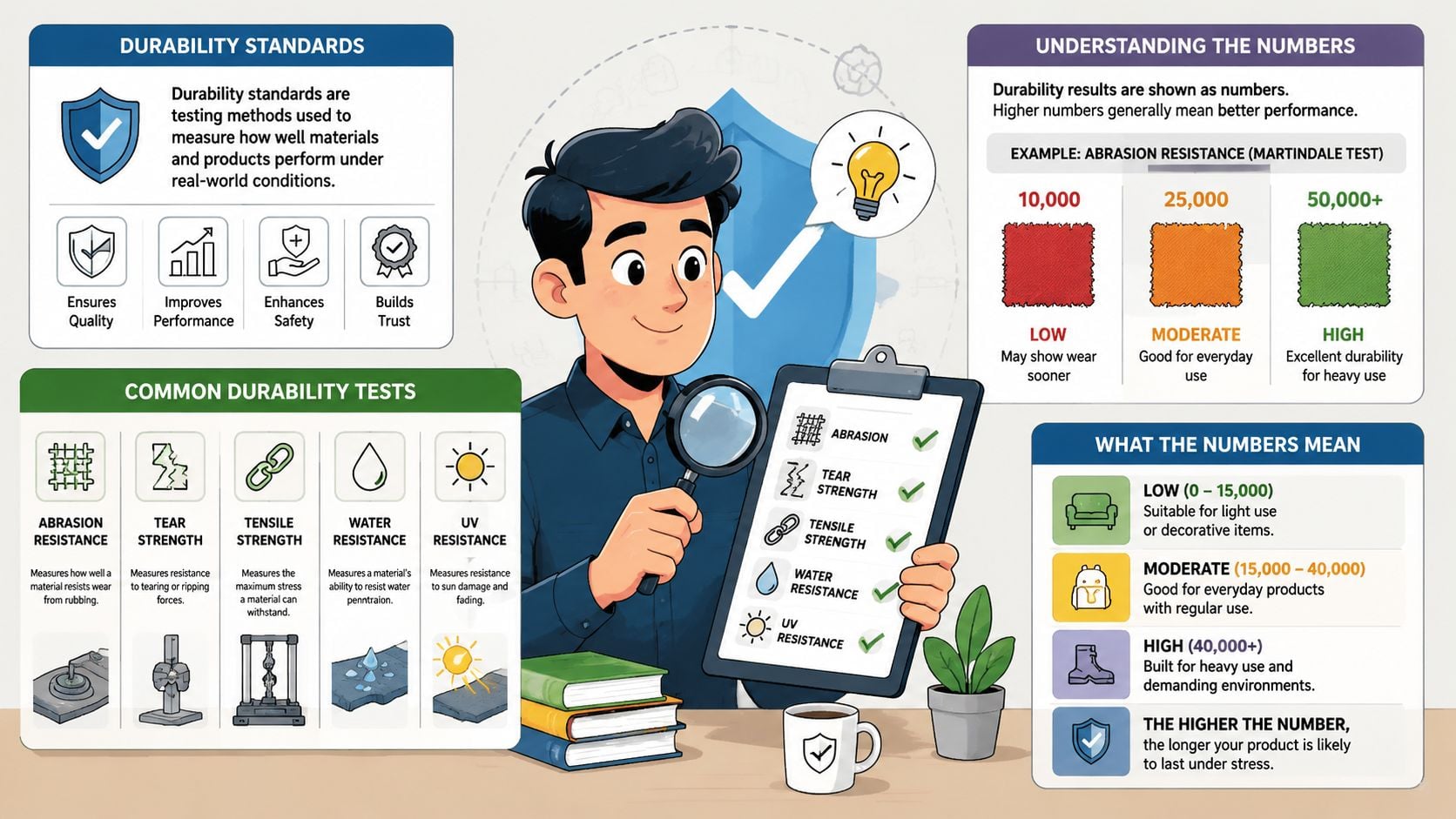
Upholstery durability numbers describe resistance to repeated rubbing, not immunity from every kind of damage. The Martindale abrasion test measures wear in cycles and became one of the foundational methods used to evaluate upholstery fabrics. It was developed in the early twentieth century and later formalized through standards including ASTM D4966 and ISO 12947-2.
A double rub uses one back-and-forth motion as one test movement. Standardized textile guidance explains that testing continues until visible wear or yarn breaks appear, making the result useful for comparing fabrics under repeated contact. Industry abrasion guidance identifies 30,000 double rubs as a meaningful durability threshold.
How to read the practical ranges
Residential guidance commonly places 12,000 to 29,000 double rubs in the standard range. Fabrics rated at 30,000 to 50,000 double rubs are generally treated as heavy-duty, while 50,000 or more is commonly considered commercial-grade in residential upholstery guidance. Residential upholstery reference ranges provide those classifications.
Martindale guidance uses a different testing expression, but the buying logic is similar. Common benchmarks place 10,000 to 15,000 cycles in the private-use range, around 20,000 cycles around domestic or light-use suitability, and 40,000 or more for heavy commercial use. ISO 12947-2 information explains the broader standard behind this measurement.
For pet households, 30,000 or more double rubs is a practical starting point for frequently used seating. Pet-focused guidance also commonly places the target above roughly 25,000 to 35,000 Martindale rubs, while 40,000 cycles is often treated as a heavy-duty marker. A fabric specification rated at more than 70,000 Martindale cycles demonstrates how far some pet-oriented textiles extend beyond ordinary domestic expectations. Example pet-friendly fabric specification
What shoppers should ask for
A fabric card or product page should identify:
- The abrasion method, such as Martindale cycles or double rubs.
- The cleaning code.
- Whether the fabric is woven tightly or has exposed loops.
- Whether stain resistance comes from the fiber, a finish, or both.
- The manufacturer's care instructions.
The phrase heavy-duty means little without a test result. The same applies to performance fabric, which is a broad marketing category. Buyers comparing materials can review Tip Top's guide to upholstery materials and then ask a furniture specialist to interpret the specification for the household's actual use.
Comparing Popular Pet-Friendly Fabric Options
No single upholstery material solves every pet problem. Smooth microfiber, solution-dyed acrylic, protected leather, and outdoor-style textiles each respond differently to fur, claws, moisture, and daily wear. The useful question isn't “Which fabric is best?” It's “Which fabric fails least under this pet's behavior?”
The comparison below gives a practical starting point. Cost is qualitative because the final price depends on construction, furniture design, customization, and manufacturer.
| Fabric Type | Best For | Durability Rating | Cleaning Ease | Cost Range |
|---|---|---|---|---|
| Microfiber | Heavy shedders and households wanting a smooth surface | Strong when tightly constructed | Usually easy, subject to care code | Moderate |
| Performance fabric | Mixed pet behavior and frequent family use | Strong to very strong | Often easy, subject to care code | Moderate to premium |
| Protected leather | Families needing a wipeable surface and a tailored appearance | Strong, though claws remain a concern | Easy for surface spills, follow care guidance | Premium |
| Vinyl | High-moisture areas and straightforward wipe-downs | Strong surface resistance | Easy for approved cleaners | Moderate |
| Boucle blends | Decorative rooms with low claw exposure | Variable, often less forgiving of claws | More demanding | Moderate to premium |
| Chenille | Soft comfort where pets have limited access | Variable, depending on construction | Moderate | Moderate |
Matching material to pet behavior
Heavy shedders: Smooth microfiber and some tightly woven performance fabrics make hair removal less tedious. Open, nubby textures can trap fur, so a sample should be brushed and vacuumed before purchase.
Clawing cats: Protected leather and vinyl can wipe clean, but neither should be treated as claw-proof. A cat that targets furniture needs a tight woven textile, stable upholstery construction, and a scratching alternative positioned nearby. Boucle can look inviting but may offer loops that catch claws.
Drooling dogs: Performance fabrics with low liquid absorption are usually more forgiving, especially when paired with a compatible W or WS cleaning code. The surface still needs immediate blotting because no upholstery should be saturated.
Mud-prone pets: Outdoor-style performance textiles and tightly woven synthetics can be practical choices when the care instructions permit water-based cleaning. Color also matters. Mid-tone, heathered, or patterned fabrics tend to disguise ordinary residue better than very pale solids.
A useful cotton and linen fabric guide can help buyers understand the visual and tactile differences between natural textile options, but natural fibers still need to be judged against the household's pet behavior rather than chosen for appearance alone.
For a broader look at engineered textiles, Tip Top's performance fabric collection gives shoppers a category to discuss with a furniture specialist. Performance fabric can be an excellent answer, but the specification still matters more than the label.
Cleaning Protocols That Actually Work for Pet Accidents
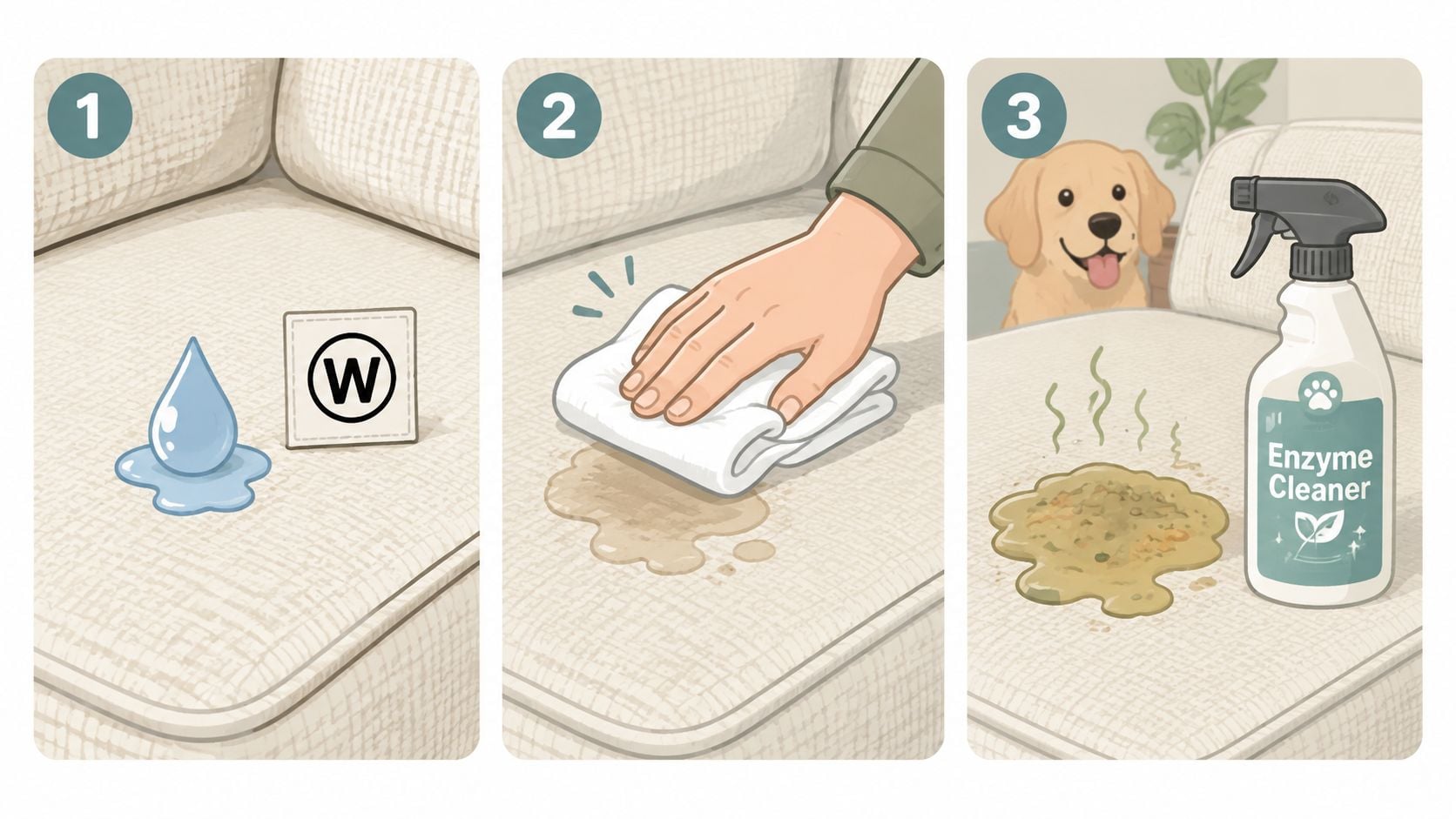
Pet accidents become harder to fix when the first response pushes moisture deeper into the cushion. Upholstery guidance recommends blotting immediately instead of rubbing, then using an enzyme cleaner only when the care label permits water-based treatment. Saturation is especially risky because liquid can move through the cover into foam, where odor can persist.
The care code controls the cleaning strategy:
- Code W: Water-based cleaners are permitted.
- Code S: Solvent-based cleaners are required.
- Code WS: Water-based or solvent-based cleaners may be permitted.
- Code X: Vacuuming or professional cleaning is generally the safe route, subject to the manufacturer's instructions.
W and WS fabrics are often the most practical for pet accidents because they allow water-based cleaning when the label permits it. Buyers should always test an approved cleaner in an inconspicuous area first.
The response for common messes
Urine: Remove solids or surface moisture first, then blot from the outside toward the center. On W or WS fabric, an approved enzyme cleaner can address organic residue, but it shouldn't be poured into the cushion.
Vomit: Lift solid material with a dull edge, blot remaining moisture, and use only a cleaner allowed by the care code. A strong scrubbing motion can spread the stain and roughen the surface.
Mud: Let heavy residue dry enough to lift without smearing it across the weave. Vacuum or brush away loose material, then follow the label for spot cleaning.
Food and grease: Remove crumbs before applying any product. Greasy marks may require a compatible solvent on Code S fabric, while a water-based product may be appropriate for Code W or WS material.
For broader household hygiene considerations, this couch cleaning guide offers additional context, but upholstery care codes still control what can safely be applied to a specific fabric.
Prevention beats rescue
A washable throw can protect the favorite seat, but it shouldn't replace proper fabric selection. Removable cushions, reversible seat designs, and a fabric protector approved for the upholstery can also reduce daily stress. Tip Top's furniture protection guidance can help families compare preventive options before an accident occurs.
Cleaning rule: Blot first, check the code second, and apply the smallest effective amount of approved cleaner.
Custom Upholstery Solutions for Pet-Friendly Homes
Custom ordering changes the decision from “Which sofa can survive?” to “How should the sofa be built for this household?” A furniture specialist can help match the fabric to the pet's behavior, then coordinate the color, cushion configuration, finish, and scale with the room.
That matters in homes where one seat receives most of the traffic. A family may need a darker, tighter textile on the main sofa, a different texture on an accent chair, and performance fabric on a window seat where a dog watches the yard. Custom selection lets those choices work together instead of forcing every piece into the same compromise.
Questions worth asking before ordering
- What will the fabric resist? Ask whether the specification addresses abrasion, stains, moisture, or only appearance.
- What does the care code allow? The household's actual cleaning habits should fit the material.
- Where will the pet sit? Edge wear, arm contact, and cushion compression may require different construction choices.
- Can the cushions be reversed or replaced? Serviceability adds practical value over time.
- Will the finish coordinate with the room? Upholstery should work with flooring, window treatments, case goods, and lighting.
Protective furniture covers can also help during training, travel, or high-mess periods. A guide to stylish furniture covers for dogs offers ideas for adding protection without turning the room into a utility space.
Tip Top Furniture & Mattresses has offered professional design services since 1984, and its custom-order process allows shoppers to discuss style, size, wood type, finish, and upholstery choices. Families can learn more about getting started with custom order furniture before visiting the Freehold showroom.
The store's family-owned history reaches back to 1978, and its selection includes Amish furniture handcrafted in the USA, along with pieces from over 50 trusted manufacturers. Those options make it possible to balance heirloom-quality construction with upholstery selected for real pet traffic.
Health and Safety Considerations Beyond Durability
A fabric can be practical around pets and still deserve questions about finishes, coatings, and indoor air quality. Stain resistance may come from tightly engineered fibers, a surface treatment, or a combination of construction and chemistry. Buyers who care about children, allergies, or household wellness shouldn't assume that “pet friendly” automatically means “pet safe.”
Certifications can provide useful screening information. Buying guidance increasingly points shoppers toward certifications such as OEKO-TEX and GREENGUARD when lower emissions are a priority. These labels don't eliminate the need to read care instructions or ask what a finish does, but they give families a clearer starting point than a vague low-toxicity claim.
Questions for health-conscious households
Ask the retailer or manufacturer:
- Does the fabric carry OEKO-TEX or GREENGUARD certification?
- Is the stain resistance built into the fiber or applied as a finish?
- What maintenance products does the manufacturer approve?
- Are the cushions and upholstery materials documented separately?
- What ventilation or care recommendations accompany the product?
The strongest decision often balances durability with restraint. A household may not need the most heavily treated surface if a tightly woven, cleanable textile already meets the pets' demands. Another family with frequent spills may reasonably prioritize easier stain recovery, then verify available certifications.
Emerging eco-positioned choices, including vegan leather and hemp-based materials, offer alternatives for shoppers who want to consider sustainability alongside performance. Texture, comfort, repairability, and cleaning compatibility still matter. “Natural” or “eco” is not a substitute for a verified care code or a suitable abrasion specification.
Making Your Final Fabric Decision
The final choice should come from observed behavior, not showroom enthusiasm. For one week, household members can note where pets climb, scratch, shed, drool, and sleep. That record reveals whether the main problem is hair removal, claw abrasion, liquid absorption, or repeated friction at a particular edge.
A simple decision path keeps the purchase focused:
- Start with the highest-risk behavior. Clawing puts weave stability first. Drooling puts liquid recovery and care code first. Heavy shedding puts surface smoothness and vacuuming ease first.
- Set a performance floor. For frequently used pet seating, look for 30,000 or more double rubs, supported by guidance on choosing upholstery fabric.
- Confirm the cleaning code. Choose a material whose approved cleaner matches the household's willingness to respond quickly and carefully.
- Test a fabric sample. Rub it with a clean cloth, place pet hair against it, inspect the weave for loose loops, and check whether the surface changes when brushed.
- Consider the whole room. Upholstery should coordinate with flooring, décor, and existing furniture, especially in an open-plan home.
- Compare long-term value. A stronger fabric may cost more at purchase, but replacement, professional cleaning, and daily frustration also carry a cost.
Ready-made furniture suits families that need immediate availability, while custom ordering makes more sense when room dimensions, fabric requirements, or design coordination are unusually specific. Local design support can also help households compare fabric samples in natural light and see how seating works beside flooring and case goods.
Flexible financing may make a higher-quality choice easier to plan, while a clearance section can provide immediate furniture at a lower price when the right material and construction are available. Families furnishing a full home can also coordinate living room seating with bedroom furniture, USA-made mattresses, flooring, and décor through one local showroom rather than solving every room separately.
Tip Top Furniture & Mattresses helps pet-owning families compare upholstery materials, review custom fabric and finish options, and plan coordinated furniture, flooring, décor, and USA-made mattresses from its Freehold, NY showroom. Customers from Albany, Schenectady, Troy, Greene County, and the wider Capital Region can visit Tip Top Furniture & Mattresses to see fabric choices in person, discuss design needs, and ask about delivery, clearance availability, and flexible financing.

