Wood Joinery Types: Essential Guide to Quality


A shopper in Freehold picks up two dressers that look almost the same from ten feet away. The finish is similar, the color is close, and both fit the room on paper. The difference shows up when a drawer comes out, when a corner gets pressed, and when someone asks how the piece will feel after a few New York winters of dry heat, summer humidity, and daily use.
That hidden difference is joinery. In furniture, the joints are the primary buying signal, because they tell the story of how the piece was built, how it carries load, and how long it's likely to stay tight. For shoppers across the Greater Albany Capital Region, that's the useful question, not just what the wood looks like in a photo, but how the parts are connected in the showroom, in the delivery truck, and years later in the home.
A good eye can learn a lot fast. The next step is knowing which joints are common, which ones point to heirloom-level construction, and which details separate careful work from shortcuts. For readers comparing solid wood pieces and learning how to judge them in person, this guide to choosing hardwood for long-term style and durability gives helpful context before the first drawer is even opened.
Why the Joints Inside Your Furniture Matter More Than the Wood
A dresser can have beautiful grain and still be built like a shaky box. Another piece can use a plainer wood and feel solid for years because the joints were chosen well and cut cleanly. That's why seasoned buyers look past the surface first, because the connection points decide whether a table stays square, a bed frame stays quiet, and a cabinet door keeps lining up.
What a showroom price often hides
The price tag usually reflects more than appearance. It often reflects how much hand work went into the corners, drawer boxes, table bases, and frame supports. A piece that looks simple from the front can take far more skill underneath than a flashier one.
Practical rule: if two pieces look similar, check the corners, drawers, and underside before comparing finishes.
That habit matters for homeowners in the Capital Region, where furniture has to handle real seasonal swings, not just look good on delivery day. A table that seems fine in the store can loosen later if its joints were chosen mainly for speed. A more carefully built piece may cost more, but it often earns that difference by staying true to shape.
Why the hidden structure matters in real homes
Furniture gets pushed, rocked, opened, closed, dragged, and cleaned. Those actions stress the joint first, not the stain. If the joint was built to resist that kind of use, the piece feels steady longer.
For shoppers in the Freehold showroom, seeing the construction in person removes the guesswork that comes with product photos. The joint tells the story that a polished image can't. The rest of this guide breaks down what those signals mean, what common joints look like, and how to read them without needing a workshop background.
What Wood Joinery Is and How It Evolved
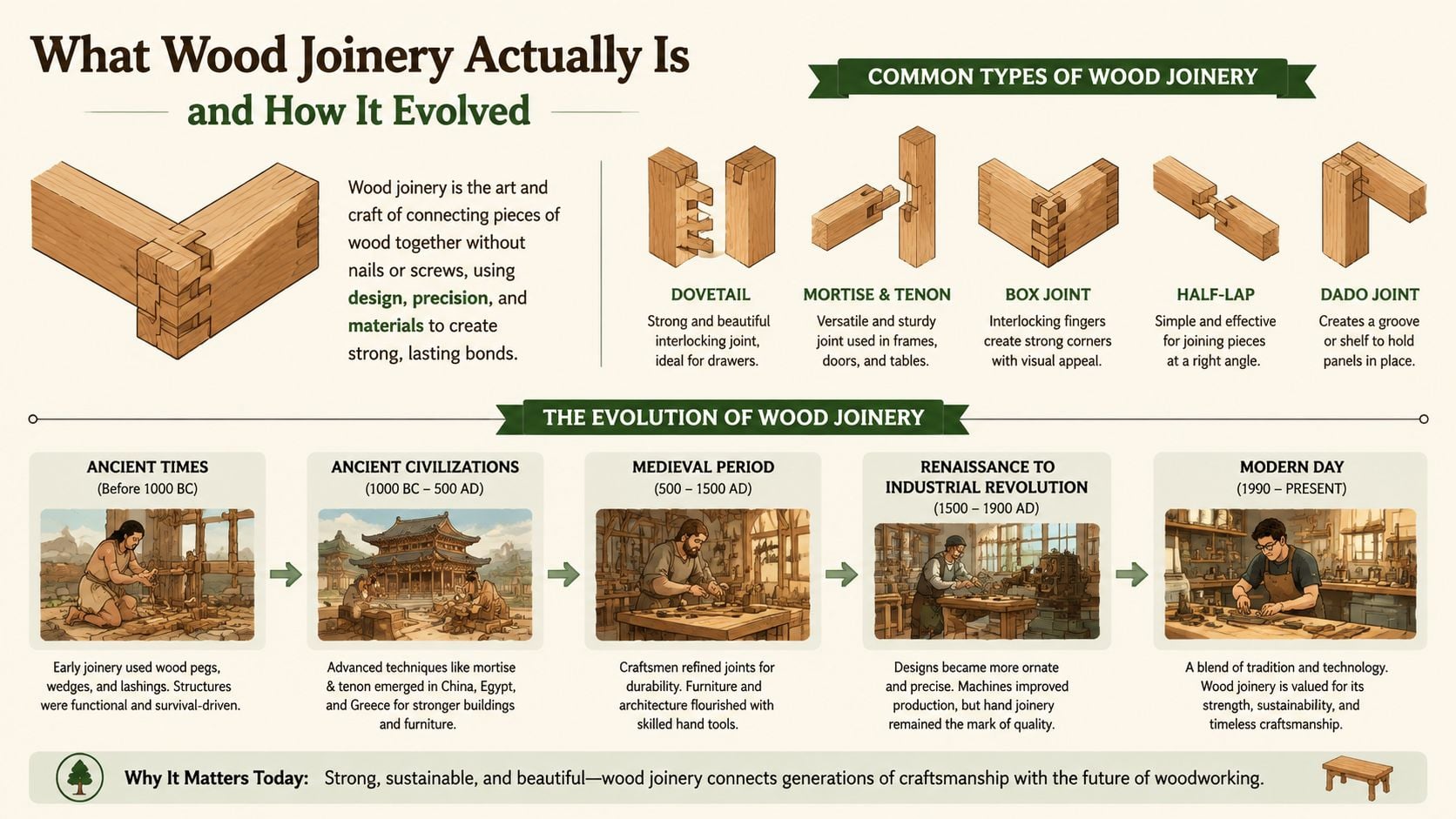
Wood joinery is the way two pieces of wood are connected so the finished piece has strength, shape, and stability. Sometimes the connection relies on the wood itself, sometimes on pegs, dowels, adhesive, or metal fasteners, and often on a mix of those methods. The point is simple, the parts need to work together, not just sit side by side.
From pegs and dowels to precision-fit structure
A table or dresser can look fine from across the showroom and still be built with joints that tell a very different story up close. Early woodworkers relied on pegs or dowels because those methods were practical and available. As furniture making and timber framing matured, the mortise-and-tenon became one of the main structural joints, and that shift reflects a move toward tighter fits, better load-bearing, and longer service life, according to the historical summary at Joinery.
That older logic still shows up in modern handcrafted pieces. A buyer looking at USA-made furniture manufacturers often sees the same pattern repeated in a cleaner, more refined way. Cabinetmaking, furniture making, and timber framing keep returning to a small set of proven joints because those forms solve the same problems over and over. Builders still need structure, repairability, and clean alignment.
Why the list stays small
Modern woodworking guides still organize the craft around a limited group of joints. One guide lists 9 basic joints, while another lists 18 types overall, and the recurring foundation includes butt, miter, lap, mortise-and-tenon, dovetail, tongue-and-groove, dado, biscuit, dowel, and pocket-hole joints, as summarized in the craft reference from Heritage Crafts. That small list persists because each joint solves a different job, strength, appearance, speed, or movement.
The trade split also helps. Joinery usually means workshop-made wooden components, while carpentry covers on-site construction and installation. That is why some joints appear in fine furniture and others show up more often in building work. The categories are old, but the logic still holds.
The Everyday Joints You Will See in Most Furniture
Most shoppers don't need a museum of obscure joint names. They need to recognize the workhorses that show up in normal furniture, from budget-friendly pieces to better-built casegoods. These joints are common because they're practical, not because they're glamorous.
The joints that do the day-to-day work
A butt joint is the most basic connection, where one piece meets another, usually at a right angle, and it's often held with nails or screws rather than interlocking geometry, as described by The Spruce Crafts. It's fast and inexpensive, but it doesn't do much by itself.
A miter joint uses angled cuts that meet cleanly at a corner. Bob Vila notes it often appears in picture frames and in the upper corners of some doorway casing trim, which is why it's a favorite for visible corners that need a neat look, as covered by Bob Vila.
A dado joint uses a groove cut into one board so another board fits inside it. That makes it useful for shelves and cabinet parts, where alignment matters as much as strength.
Tongue-and-groove is different. The boards lock together along their edges, which makes it useful for panel work and surfaces that need to stay aligned. Biscuit, dowel, and pocket-hole joints are reinforcement methods that speed assembly and help hold parts in place, especially when a shop needs efficiency.
A strong-looking furniture piece can still use a simple joint in a hidden spot. That isn't automatically a flaw, because smart builders mix methods where each one fits best.
| Everyday Wood Joinery Types at a Glance | Best For | Strength | Watch For |
|---|---|---|---|
| Butt | Basic framing, hidden supports | Low on its own | Loose corners, visible fasteners |
| Miter | Decorative corners | Moderate with reinforcement | Open seams, gaps at the corner |
| Dado | Shelves, cabinets, bookcases | Strong for alignment | Sloppy grooves or movement |
| Tongue-and-groove | Panels, tabletops, cabinet backs | Strong interlock | Poor fit across the seam |
| Biscuit | Alignment during assembly | Helpful, but not structural by itself | Overreliance on glue alone |
| Dowel | Reinforced alignment | Solid when drilled accurately | Misaligned holes, wobble |
| Pocket-hole | Fast shop assembly | Good for many uses | Visible screw paths, weaker look |
A buyer doesn't need to memorize every detail. The useful habit is to ask what role the joint plays in the piece. A dining table can mix more than one type, and that's normal if the builder chose each one for a reason.
Mortise-and-Tenon and Dovetail, The Joints That Signal Heirloom Quality
A showroom finish can look convincing from across the room. The ultimate test is inside the joinery. A piece built for years of use usually gives itself away in the joints, because that is where the maker decides whether a table, chair, dresser, or bed frame will stay tight after regular movement, seasonal changes, and years of loading.
Mortise-and-tenon and dovetail are the two names buyers hear most often when craftsmanship matters. They do different jobs, and that is part of the point. One tells you how well a frame holds together. The other tells you how well a drawer or box resists coming apart after repeated pulls.
The frame joint and the drawer joint
Mortise-and-tenon is the classic structural joint for tables, chairs, and bed frames. A tenon fits into a mortise, so the connection has broad long-grain-to-long-grain contact instead of depending on a weak end-grain edge. In plain terms, that gives the joint more to hold onto, which helps the frame resist racking, wobble, and the kind of everyday stress that shows up when people lean on a table or shift weight in a chair.
Dovetail is the drawer joint people look for in casegoods. The interlocking tails and pins resist being pulled apart, so the corner stays locked when a drawer is opened and closed again and again. Buyers who are checking drawers should also look at how drawers are built for cabinets, because the joint style tells you a lot about how much care went into the carcass and the drawer box itself. The Stated Home specifically recommends looking for dovetail or French dovetail joinery in drawers and notes that glue squeeze-out can be a warning sign of poor assembly, as discussed in their furniture joinery guide.
What each joint tells a buyer in the room
A frame joint and a drawer joint are not asking the same thing from the wood. Mortise-and-tenon is usually about structure and resistance to side-to-side stress. Dovetail is usually about keeping corners locked under repeated pull. If you are standing in a showroom and testing a piece by hand, that difference matters more than the label itself.
A buyer in an Upstate New York home should care about that distinction in a practical way. Dry winter heat and humid summer air can tug on wood year after year, much like framing for log wall settlement has to allow a structure to move without losing its shape. A frame joint that stays square and a drawer joint that stays tight both send the same message. The maker expected the piece to keep working, not just look good on day one.
| Premium Joint | Best For | Strength Signal | What Buyers Notice |
|---|---|---|---|
| Mortise-and-tenon | Tables, chairs, bed frames | Strong frame support | Solid feel, less racking |
| Dovetail | Drawers, boxes, case goods | Strong resistance to pull-out | Tight corner fit, clean corners |
What to look for up close
A rushed joint can still spoil a good design. Visible glue squeeze-out, misaligned pins, and gaps are the details that often reveal hurried assembly, even when the joint type itself is respected. Those signs matter because they tell you whether the work was fitted carefully or pushed through too fast for the finish to hide.
The strongest takeaway is simple. These two joints are not interchangeable, they are clues about different parts of the build. One points to frame quality, the other to drawer quality, and together they tell a shopper far more than a polished exterior ever will.
Why Two Identical Joints Can Perform Very Differently Over Time
Two joints can look nearly identical on the showroom floor and behave very differently after a season of use. The difference usually comes down to wood moisture content, adhesive choice, and clamp pressure, not just the shape of the cut. A careful buyer looks at the build system, not just the joint name.
Moisture and glue change the outcome
A joint can look sound and still fail if the wood is too wet or the adhesive never cured properly. One technical guide warns against using standard PVA glue above 16% MC, while polyurethane (PUR) adhesives are specified for higher-moisture or exterior conditions because their cure mechanism needs about 8–10% MC to begin cross-linking, as noted in BuildMat Insight's joinery quality guide. That is the sort of detail a shopper never sees from across the room, but it can decide whether a chair rail stays tight or starts to drift.
Seasonal movement makes that matter even more in Upstate New York homes. Dry heated winters and humid summers push wood and glue lines through repeated change, so a joint that was fine in the warehouse can start showing stress later. For care habits that help limit that strain, how to care for wood furniture is worth reviewing before the first winter sets in.
Why pressure has to match the wood
Clamp pressure also needs to fit the species. The same technical guide gives approximate targets around ±0.005 in. for installation precision, adhesive performance in the 150 to 200 PSI range, and clamp pressure tuned by wood density, about 100 to 150 PSI for softwoods, 125 to 175 PSI for medium hardwoods, and 175 to 250 PSI for dense hardwoods, all from BuildMat Insight's mortise-and-tenon installation guide. Too much pressure on softwoods can crush the fibers and starve the glue line, while too little on dense hardwoods leaves the bond weak.
A good joint is geometry plus material fit plus environment. Miss one of those, and the piece may look right while slowly losing strength.
That same logic appears in other building situations too. The discussion of framing for log wall settlement shows why structure has to account for natural expansion and shrinkage, not pretend it will not happen. Furniture faces the same reality, just on a smaller scale.
How to Spot Quality Joinery in a Showroom
A showroom visit gives buyers the best chance to tell the difference between a carefully built piece and a pretty one that only looks sturdy. The trick is to inspect the places where shortcuts hide, not just the finish on the front. A few minutes of close checking can reveal a lot.
The quick inspection routine
- Open every drawer: Look at the corner construction, the way the sides meet, and whether the joints line up cleanly.
- Rock the piece gently: Tables and chairs shouldn't wobble or twist easily when pressure is applied.
- Run a finger along visible corners: Gaps at miters often feel as roughness or tiny steps.
- Look underneath and inside: Hidden areas often show staples, thin reinforcement, or rough fitting that the top surface conceals.
- Check for glue marks: Excess glue can point to rushed assembly, especially near dovetails and frame corners.
What the clues mean
A drawer with crisp corner joints usually says more about the maker than a polished face panel does. Misaligned dovetails suggest poor cutting or hurried assembly, while staples used where dowels should be can signal a shortcut in a place that should have held alignment better. Those details don't always mean the piece is bad, but they do tell a buyer where the maker saved time.
A showroom associate who can point to the joint and explain it clearly is worth listening to. In the Freehold area, that kind of walkthrough helps shoppers compare Amish-made and USA-made pieces without guessing from a catalog photo. It also helps remote shoppers know what questions to ask before a delivery is scheduled.
For buyers who want a broader checklist on shopping behavior, this guide to smarter furniture shopping pairs well with a joint inspection routine. Good buying is rarely one big decision. It's usually a series of small checks that add up.
Matching the Right Joint to the Right Room and Buyer
The right joint depends on how the furniture will live in the home. A dining table, a bed frame, and a cabinet do different jobs, so they should not be built the same way. That's where joinery knowledge becomes useful, because it points a buyer toward the right category with less guesswork.
Which joint suits which room
Solid-wood dining tables and bed frames often benefit from mortise-and-tenon because the frames need strength and stability more than speed. Drawer-heavy casegoods usually point to dovetail construction, since drawers get opened, closed, and pulled on constantly. Panel cabinetry often uses tongue-and-groove and dado joints because those methods keep large surfaces aligned.
Custom ordering becomes valuable when a buyer wants the new piece to match an heirloom or an existing room set. A shopper can ask for a style, size, wood type, and finish that fit the room, but the deeper question is whether the joinery should match the way the piece will be used. That matters especially for handcrafted pieces, where the construction method is part of the value, not just a hidden detail.
The same logic also explains why Amish-made and USA-made furniture often appeals to buyers who want repairable, traditional construction. Traditional joints were designed to be serviceable and durable, not disposable. That makes them a natural fit for homes where furniture is expected to last.
A buyer doesn't need every piece in the house to use the same joint. The smarter move is matching the joint to the job.
For a complete room plan, shoppers often pair that thinking with bedroom, living room, and dining choices, plus design help, room planning, and financing when a project needs to come together at once. The joinery question is the foundation. The rest is matching the piece to the room and the budget.
Common Questions About Wood Joinery Types
What joint is easiest to repair
The most repairable joint usually depends on access and how the piece was built, but framed construction with traditional joinery tends to be easier to service than hidden fastener-heavy shortcuts. When a joint can be reached, cleaned, and reassembled without destroying the part, it usually gives a better chance of repair. That's one reason buyers who want long life often favor traditional construction.
How long should quality joinery last in an Upstate New York home
There isn't a single number that fits every piece, because wood species, use, moisture, and care all matter. A well-made joint that's matched to the job and kept in a normal indoor environment should stay tight far longer than a weak joint that only looks good on day one. The inspection routine matters because good joinery starts with the right build and continues with sensible care.
Does visible joinery always mean better joinery
No. Visible joinery can signal craftsmanship, especially in drawers or exposed frame work, but some of the best construction is hidden inside the piece. What matters is whether the visible joint is clean, consistent, and suited to the load. A visible gap is a warning sign, but visibility alone is not proof of quality.
Should wood species matter more than joinery
Both matter, but joinery is often the first place to judge structure. A strong wood species won't rescue a sloppy joint, and a well-made joint can't fully overcome a bad material choice. The better question is how the wood species and the joint work together for the room, the humidity, and the way the piece will be used.
What should a buyer do if the right joint isn't on the floor
Ask about custom ordering. If a standard piece doesn't match the room, the use case, or a matching set, a custom build may be the better path. That keeps the buyer focused on fit, function, and long-term value instead of settling for the closest-looking option.
Tip Top Furniture & Mattresses helps homeowners compare furniture by how it's built, not just how it looks, with guidance on solid wood construction, Amish-made pieces, custom ordering, and room-by-room planning. Visit Tip Top Furniture & Mattresses to explore furniture that fits your home, your style, and the way real life puts a piece to use.