Shell Back Dining Chairs: How to Choose the Right Fit


The dining table still works, but the chairs have become the problem. Crumbs collect around the back rails, a cushion never stays put, and the chair that feels comfortable to one family member leaves another shifting through dinner. Shell back dining chairs can look like a straightforward replacement, until differences in seat depth, back shape, and construction make the decision less simple.
For households across Freehold and the Greater Albany Capital Region, the best starting point isn't a finish sample. It's understanding who will sit in the chairs, how the chairs fit the existing table, and what can be repaired after years of everyday use.
What Makes a Shell-Back Dining Chair Different
Consider a family with three children whose spindle chairs collect crumbs in every gap. A smooth, cupped chair looks appealing because there are fewer openings to clean. But that change also means trading separate back supports for a surface with a more definite shape.
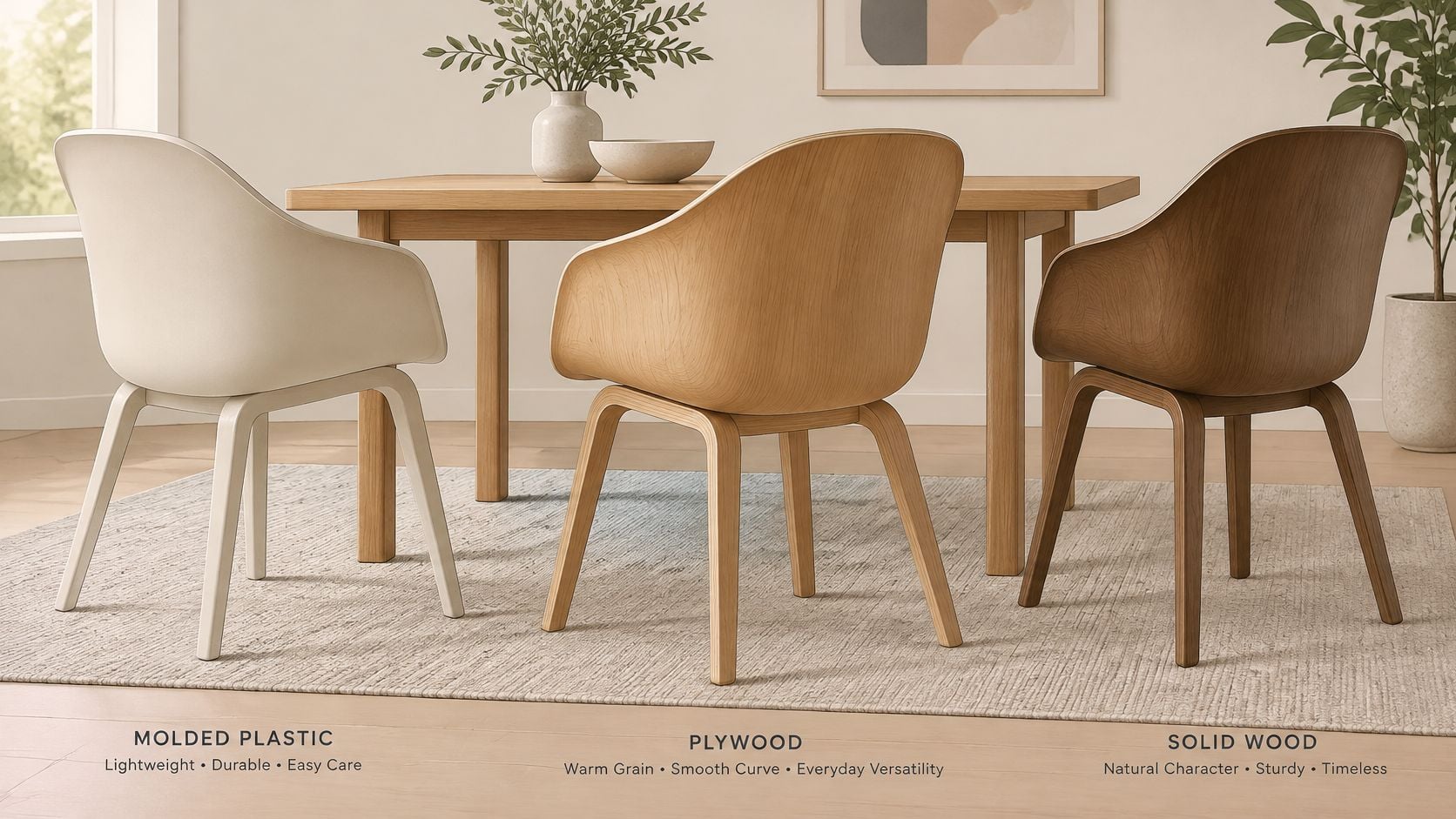
A shell-back dining chair generally has a continuous seat and back formed into a supporting shell, commonly from molded plastic or plywood. Some listings also use the term for solid-wood chairs with a carved, shell-shaped back, so photographs and construction details matter more than the label alone.
The difference is like a cupped hand versus a set of fingers. A shell supports a broad area at once, while spindles contact the back at separate points. Neither approach guarantees comfort, but they feel distinctly different.
The parts that matter in a listing
- Shell: The shaped supporting surface, sometimes covered with fabric.
- Seat pan: The portion beneath the sitter, including its depth and front edge.
- Base or legs: The supporting structure beneath the shell.
- Attachment points: The places where the shell connects to its base.
- Optional cushion: A removable pad or permanently upholstered layer.
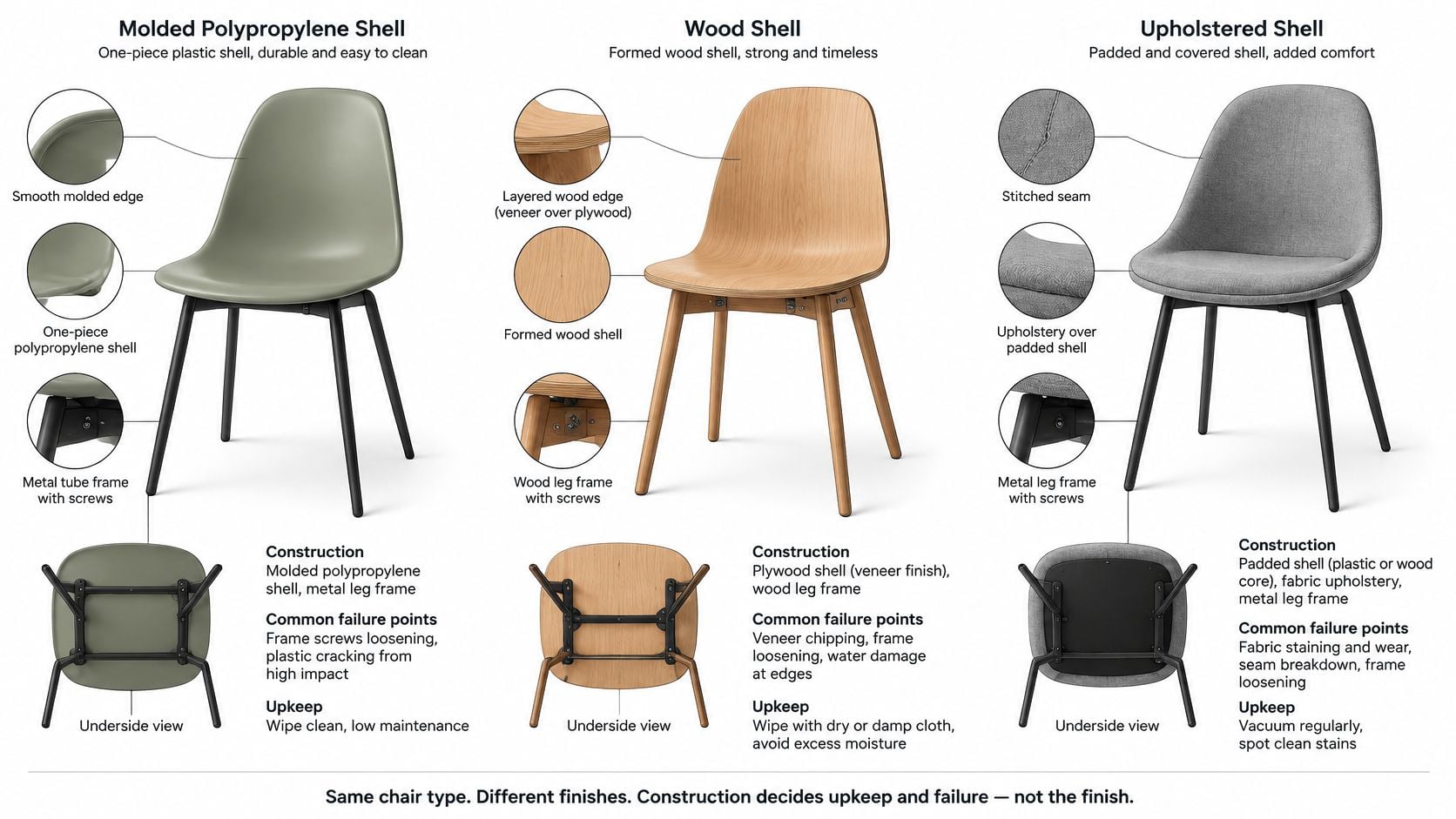
Common versions include molded polypropylene, shaped plywood with a veneer finish, carved solid wood, and upholstered shells with fabric-covered backs. A smooth, unupholstered surface simplifies crumb cleanup, while fabric adds another maintenance consideration.
Practical rule: A continuous surface is easy to recognize, but comfort still requires a seated test.
At a showroom, gentle hand pressure can help identify the continuous back and its flexibility. The more important test comes afterward: whether that curve supports the sitter without pinching, crowding the shoulders, or forcing an awkward posture.
Fit Measurements to Check Before You Buy
A chair can look right beside the table and still leave a sitter cramped. Check seat height, depth, width, and the shell's curve with the people who will use it in mind. The University of Melbourne's ergonomics guidance supports these practical starting points: seat height of 406–432 mm (16.0–17.0 in) and seat depth of 406–419 mm (16.0–16.5 in).
Shell-back dining chair fit targets
| Measurement | Target range | How to check it |
|---|---|---|
| Seat height | 406–432 mm (16.0–17.0 in) | Measure floor to front edge of seat; confirm feet rest flat |
| Seat depth | 406–419 mm (16.0–16.5 in) | Sit fully back; the front edge shouldn't press behind the knees |
| Seat width at front | About 457 mm (18.0 in) | Measure across the front seating area and check the shell's outer width separately |
| Seat slope | Level, or down toward the back by no more than about 25 mm | Compare front and rear seat levels; check for sliding or uncomfortable tilt |
| Backrest recline | No more than about 5° for formal dining | Sit upright; the shell should support without pushing the torso forward |
| Seat-to-tabletop clearance | 25–30 cm (10–12 in) | Subtract seat-front height from tabletop-underside height; thighs must clear |
The Melbourne ergonomics guidance informs the seat-width, slope, and recline figures in this table. The 25–30 cm (10–12 in) clearance is a practical starting point. These targets help narrow the choice, but they cannot predict how every person will fit.
A molded shell fixes the relationship between the seat pan, lumbar curve, and backrest. Unlike an adjustable task chair, it has no separate controls to correct a shape that presses the sitter forward or leaves the back unsupported.
Measuring the table and chair together
- Measure underneath: Record the distance from the floor to the tabletop underside and to any lower apron.
- Measure the seat: Record floor-to-seat height at the front edge.
- Subtract: Seat height subtracted from underside height gives the available vertical clearance.
- Confirm in person: Have the intended sitter check thigh room in a natural sitting position.
A typical 730–760 mm (28.7–29.9 in) dining table generally pairs with a 430–460 mm (16.9–18.1 in) seat under the Melbourne guidance. That pairing is broader than the narrower ergonomic starting range above. It shows why a chair's suitability depends on both the table and the person, not on one measurement in isolation.
An apron reduces usable thigh clearance. Cushions also change occupied seat height as they compress, so check the chair under actual sitting conditions. The guide to dining table heights explains the difference between overall table height and the space beneath the tabletop.
Reading dimensions correctly
A product listing may give overall width, depth, and height, but those measurements do not reveal usable seat depth. For example, a chair's total depth includes the shell and may not show how much room remains between the backrest and the front edge. Check seat dimensions separately whenever they are available.
For the final fit check, have the sitter sit fully back with feet flat, knees approximately at a right angle, and thighs clear of the table. A gentle lumbar curve and room behind the shoulders matter too. The shell should support the sitter without pinching or crowding them.
Plastic, Wood and Upholstered Shells Compared
A shell-back chair's surface tells only part of the story. The material affects daily cleaning, how the chair may age, and what can be repaired if a fitting or finish wears. Check the construction as well as the look, since a wood-like surface may be veneer and an upholstered shell may cover a molded base.
| Construction | Everyday advantage | Main inspection point |
|---|---|---|
| Molded polypropylene | Smooth surface without exposed upholstery seams | Mounting holes, shell-to-base connections, and care instructions |
| Solid wood | Potential for finish repair and refinishing | Grain, joints, and allowances for seasonal movement |
| Plywood or veneer | Curved form with a wood surface | Sealed edges and intact bonded layers |
| Upholstered shell | A softer contact surface | Fabric condition, cushion resilience, and access for replacement |
For busy meals, molded polypropylene is straightforward to wipe with a damp cloth, including around the shell's exposed surface. That convenience does not show whether the shell is firmly attached to its base, so inspect the connection separately.
Plywood and veneer need a close look at the edges. Raised veneer, rough seams, or layers starting to lift may allow moisture to reach the material beneath. Solid wood raises a different question: whether the joints and finish can accommodate seasonal movement and be maintained over time.
Softness comes with maintenance choices
Upholstery can make a shell feel more welcoming over a long meal, provided the chair's shape already suits the sitter. Padding cannot reliably compensate for a seat that is too deep or a back curve that meets the body in the wrong place.
Choose fabric with meals, pets, and everyday rubbing in mind. The guide to choosing upholstery fabric explains fabric characteristics to consider alongside appearance. If removable protection would help during messy meals, the dining chair protection tips from Meliusly offer ideas for covers. A cover should stay secure and leave the shell's support unobstructed, without making the seat slippery.
Inspecting the connection beneath the seat
The shape and surface are easy to judge at a glance; the fittings deserve the same attention. Check how the shell joins the base, whether the connection moves during ordinary sitting, and whether the hardware can be inspected or replaced. Look around mounting holes for cracks, whitening, or distortion.
- Secured attachment points: Look for a stable connection between shell and base.
- Movement under normal sitting: Notice looseness or unexpected flexing near the fittings.
- Mounting-hole condition: Check for cracks, whitening, or distortion around stressed areas.
- Hardware access: Confirm that fasteners can be inspected without damaging the chair.
Plastic shells need protection from prolonged direct sunlight, especially beside a south-facing window, where exposure can affect the surface over time. Avoid leaving them in very cold conditions unless the maker's care instructions allow it. Use the product's guidance to determine where the chair is intended to be used.
Before buying, ask what load the chair is designed to support, which test standard applies, what the warranty excludes, and whether replacement hardware is available. These details help you judge whether the chair fits the people who will use it and can be maintained as it ages.
Which Capital Region Households Will Find Shell-Back Chairs Comfortable
A chair that feels comfortable while sitting isn't necessarily easy to leave. That distinction matters in multigenerational homes, aging-in-place renovations, and family dining areas shared by children and grandparents.
A study of aged-care seating found that higher seats can help users stand, that armrests were considered essential for entry and exit, and that overly deep seats can prevent firm foot contact and encourage slumping. These findings don't establish a universal chair prescription, but they challenge the assumption that a sleek, armless chair suits every guest.
A shaped shell may provide useful lower-back and lateral support. Yet a low, deep version can leave an older sitter leaning forward and searching for something to push against.
A mobility check beyond ordinary comfort
A supervised showroom trial should establish whether the intended sitter can:
- Begin standing safely: Rise without pulling or pushing against the dining table.
- Maintain foot contact: Sit against the back while both feet rest firmly on the floor.
- Avoid edge pressure: Keep the front edge from pressing behind the knees.
- Use suitable support: Push up through stable armrests when needed, without relying on another person.
The test shouldn't become an exercise in proving independence. If standing feels uncertain, the chair isn't an appropriate choice merely because it matches the set.
A coordinated dining room doesn't require every person to use an identical chair.
A taller seat may help one person but leave another with dangling feet. A shallower seating configuration, a supportive cushion, or an arm-supported chair at the head of the table may be a better compromise. Any added cushion must remain secure and preserve stable sitting.
Planning for the whole household
Children introduce different priorities, including cleanup and suitable seating support. The guide to kid-friendly and pet-friendly furniture helps place the chair decision within the household's broader needs.
For Albany, Schenectady, and Troy families, a visit to the Freehold showroom is most useful when the regular users can attend together. Tip Top Furniture & Mattresses' design team can help compare measurements and configurations, while the people who will use the chairs make the comfort judgment themselves.
Matching Shell-Back Chairs to Your Table and Room
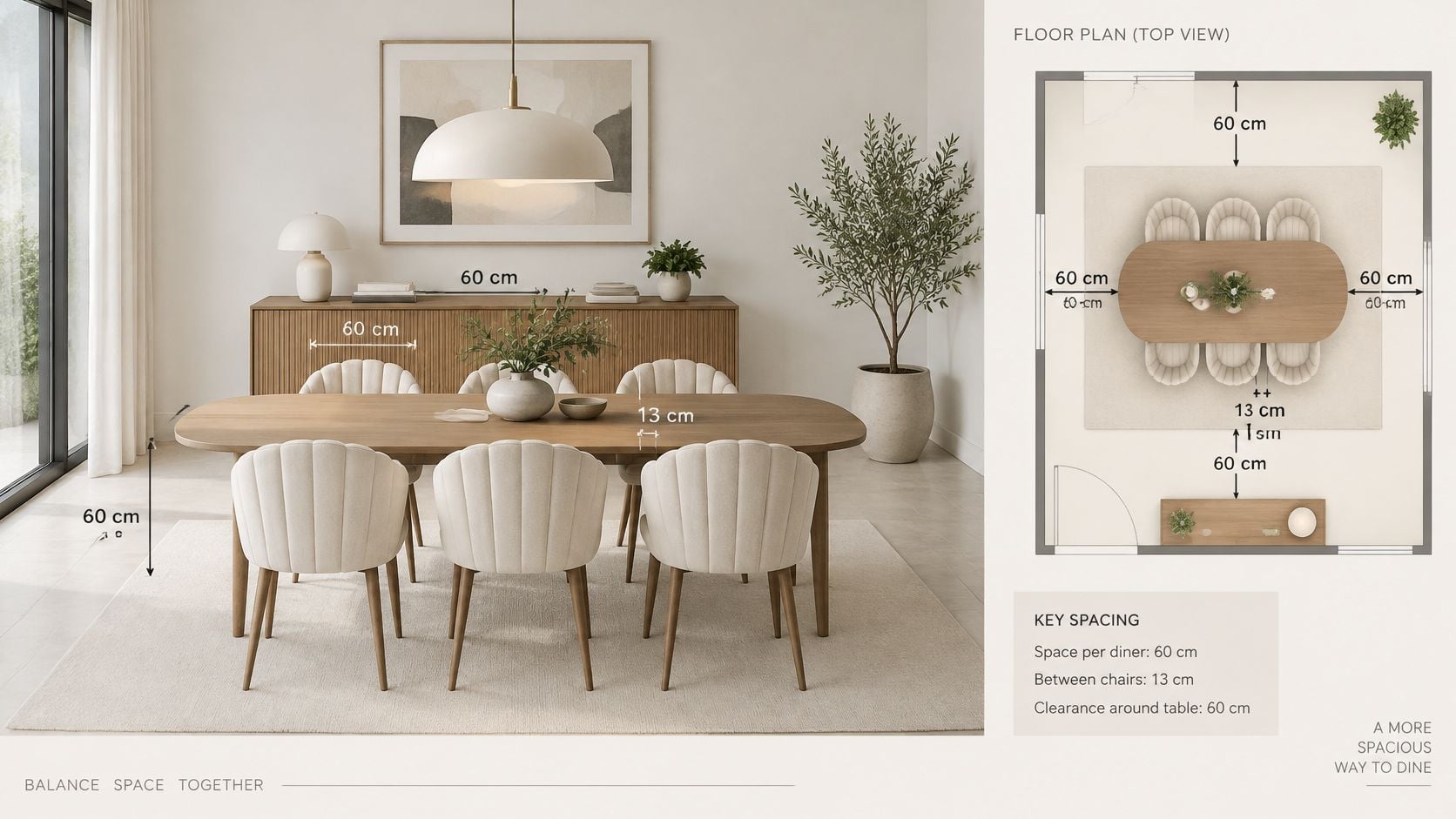
When you arrange shell-back chairs around a dining table, allow for more than the seat width. Wraparound sides and broad backs need room too, much like a door needs space to swing beyond its frame.
For a compact arrangement, allow approximately 60 cm (23.6 in) of table width per diner and 13 cm (5.1 in) between adjacent chairs. A more spacious layout uses approximately 75 cm (29.5 in) per diner and 25 cm (9.8 in) between chairs. The same dining-room planning guide recommends at least approximately 70 cm (27.6 in) of clearance from the table edge, including roughly 40 cm for a seated person and 30 cm for pulling out the chair.
Treat these measurements as a starting point. A route used by someone carrying dishes or using a mobility aid needs a practical check of its own.
A worked example without the seating confusion
Suppose four diners sit along the same side of a table, with the more generous allowance. Multiply four by the per-person allowance: the hypothetical arrangement needs approximately 300 cm, or 3 m, of table length.
That example does not set the length required for every four-person table. Place diners on opposite sides and at the ends, and the layout changes. Table legs can also limit where people can sit, regardless of the tabletop's length.
A guide to table shapes and seating arrangements can help compare configurations before settling on a chair count.
Checking the full movement path
A floor plan should show how chairs move, not just where they sit when tucked in:
- Mark the footprint: Use painter's tape to outline the table, chairs, and nearby storage.
- Pull chairs out: Check the room needed to enter and leave each place.
- Watch the shell edges: A broad back may reach a wall or sideboard before the chair legs do.
- Open nearby furniture: Leave usable space for buffet doors and drawers.
- Walk the route: Test the path between the dining area and kitchen with chairs occupied.
To coordinate the room, choose a wood tone or finish family that links the chairs and table without making them identical. An upholstered armchair at an end position can add contrast and suit a different seating preference.
An online room planner can show the arrangement to scale. A floor-level trial still reveals awkward turns or collisions that a drawing may miss.
Caring for and Repairing Shell-Back Chairs
Wooden chairs respond to the room around them. According to Purdue University Extension's guidance on wood moisture, hardwood intended for interior furniture is commonly kiln-dried to approximately 6–8% moisture content; Purdue's furniture-materials guidance also notes that a six-percentage-point moisture-content change in sugar maple can produce approximately 2.5% dimensional change in a furniture part.
The practical issue isn't that wood is unsuitable for dining chairs. It's that a well-built chair needs joints and components that accommodate movement, while its owner needs to avoid extreme conditions.
Solid-wood shells shouldn't sit beside radiators, in damp basements, or in unusually dry heated spaces. Small seasonal gaps can occur without immediate structural failure, but an opening load-bearing joint, a split, or persistent movement needs assessment.
Matching the response to the symptom
Shell-back chair symptoms, causes and fixes
| Symptom | Likely cause | Fix |
|---|---|---|
| Gaps or squeaks at the joints | Wood moving with humidity or loose hardware | Tighten accessible fixings appropriately and stabilize indoor humidity; assess opening glued joints |
| Cracking or looseness where shell meets legs | Repeated load at the attachment point | Stop using a cracked or unstable chair; inspect and obtain suitable replacement hardware or components |
| Yellowing or fading on a plastic shell | Prolonged ultraviolet exposure from a sunny window | Move away from direct sun; clean with mild soap, recognizing that cleaning won't reverse fading |
| Scratches on a finished surface | Abrasive cleaning, contact, or dragging | Use a compatible touch-up treatment or have the surface refinished |
| Compressed or cracked seat pad | Cushion wear over time | Replace the pad or arrange reupholstery |
Routine home jobs include gentle cleaning, replacing compatible floor glides, and tightening accessible mechanical fasteners without overtightening. Structural cracks, stripped attachment points, delaminating plywood, and failed glued joints call for a repair specialist or manufacturer-approved replacement.
The wood-furniture care guide provides useful maintenance context. Harsh abrasives and experimental solvents are poor starting points on an unfamiliar finish.
For rooms with wood floors, the hardwood care tips for homeowners from Flacks Flooring add practical guidance on protecting the surface beneath moving chairs. Glides should also be checked for trapped grit and wear.
Repairability belongs in the buying decision
A wipe-clean chair isn't automatically the greener choice. If a damaged shell or proprietary fitting can't be replaced, an otherwise usable base may become waste.
A wood chair that accepts refinishing, or an upholstered chair with a replaceable pad, may remain serviceable through changing décor and ordinary wear. That possibility depends on construction and available parts, not material alone.
Useful ownership questions include:
- Separate components: Can the shell, base, hardware, and upholstery be replaced independently?
- Parts access: Can a damaged component be ordered without replacing the chair?
- Finish performance: What exposure limits and fading exclusions apply?
- Material identification: Is the shell material identified, and does a local recycling service accept it?
Long-term value: The most useful repair option is one confirmed before damage occurs.
Photographs of underside labels, fittings, and the original receipt make later parts enquiries easier. Keeping that information with the care instructions takes little effort and avoids guessing when the chair eventually needs attention.
What Shell-Back Dining Chairs Cost Before You Buy
A dining chair's price makes more sense when you compare the same kind of purchase. A single chair, a custom finish, and a set bought with a table are different budget decisions, much like comparing one ingredient with a full meal.
Use the budget worksheet below to keep those differences clear:
| Budget step | What to include |
|---|---|
| Set a per-chair allowance | Include the comfort and construction features your household needs. |
| Multiply by the seat count | Count occasional dining places too if you may want matching chairs later. |
| Add associated costs | Include delivery, optional pads, and any replacement components you already know you need. |
| Check available stock | Look at clearance choices before committing to a new order. |
The total depends on material, construction, fabric or finish choices, and whether the purchase includes a table. Compare like with like: a basic chair and a custom-finished chair may serve the same room but reflect different choices.
Before settling on a budget, ask who will use the chairs and how often. A household with daily family meals may weigh comfort and sturdy construction differently from one that mainly uses its dining room for guests. For shell backs, the shape and material affect how the chair feels, while the fit around the table affects whether everyone can sit comfortably.
Financing should be judged by the full purchase cost and the specific payment terms, not just the monthly amount. A smaller payment can still add up to a larger total, so compare the terms before choosing.
Choose Your Shell-Back Chairs at the Freehold Showroom
Before visiting the showroom, gather a few details about the dining area and the people who use it. Measurements help narrow the choices, while photos make it easier to discuss how a chair will work with the table and room.
Bring the table's overall height, underside height, apron position, and leg placement. Note the seat height and depth that feel comfortable for the intended sitters, along with any mobility concerns. Room dimensions should include doorways, walkways, windows, and nearby storage.
Photos of the full dining area and the table base can clarify what measurements alone may miss. A finish sample, if available, can also help you decide whether a close match or a deliberate contrast will suit the room.
Local guidance with the household in mind
Tip Top Furniture & Mattresses is a family-owned showroom in Freehold, NY, serving the Greater Albany Capital Region since 1978, including Greene County and beyond. Its Professional Design Services have been available since 1984, offering guidance on room coordination and furniture choices.
That support can be useful when an existing table needs to work for several people with different seating needs. The right choice may be a coordinated mix rather than a matching set.
Tip Top's dining collection includes tables, chairs, benches, and buffets. Its broader selection also covers furniture for other rooms, home décor, flooring, and mattresses. Shoppers can explore pieces from over 50 trusted manufacturers, including a curated assortment of heirloom-quality Amish furniture handcrafted in the USA.
Making the selection specific
Custom ordering lets shoppers select a piece's style, size, wood type, and finish. Skilled craftsmen can also accommodate custom designs based on a picture or sketch. These options are most helpful when you can describe the fit or room issue you want the chair to address.
Design consultants can help coordinate furnishings, décor, and flooring needs. Tip Top's free online room planner lets you visualize furniture layouts to scale, which can help clarify whether chairs will fit around the table and leave enough room to move.
A design consultation gives your measurements a practical purpose. You can discuss support, ease of standing, room clearance, and the household's day-to-day needs before settling on a style.
Tip Top Furniture & Mattresses offers design guidance and custom-order options for households choosing dining chairs. Bring your table measurements, room dimensions, and seating needs to Tip Top Furniture & Mattresses in Freehold, NY, to discuss which shell-back chairs may suit your table, room, and everyday users.