Accent Table for Living Room: Size, Height and Layout


The remote is on the floor again, the water glass is balanced on the sofa arm, and the little table beside the seat is either too low to reach or stuck in the path to the hallway. That is the usual living-room problem an accent table for living room seating is supposed to solve. It is a daily surface, measured against the arm, the walkway, and the people who sit there.
A slightly larger, sturdier table that holds a lamp and a drink often beats a tiny decorative piece that only looks right in a photo. Homeowners around Freehold, Albany, Schenectady, Troy, and Greene County can check that fit in person. Tip Top Furniture & Mattresses, a family-owned showroom in Freehold since 1978, has offered professional design help since 1984 for rooms that have to work on a Tuesday night, not just on a styling board.
Accent Table Height and Size Guide for Living Rooms
Set the tabletop level with the sofa or chair arm, or no more than 2 inches lower.
That single rule keeps a drink, a remote, a book, and a lamp switch in a relaxed reach. Adorno's accent-table guide puts typical side-table heights for living-room seating at about 20 to 26 inches, and it still tells you to measure the furniture you own. A catalog "standard" is only a guess. A deep sectional in a Troy apartment and a high-arm chair in a Greene County farmhouse will not share one number.
Measure from the floor to the top of the arm, including the cushion compression when you sit. Then leave roughly 2 to 4 inches between the table and the cushion so the top does not crowd the seat. The end table dimensions guide is a useful cross-check before you commit to a width.
| Seating type | Target tabletop height | Gap from seat | Typical table height |
|---|---|---|---|
| Sofa or loveseat arm | Level with arm, up to 2 in lower | 2-4 in | 20-26 in |
| Armchair or accent chair | Level with arm, up to 2 in lower | 2-4 in | 20-26 in |
| Recliner | Level with arm when reclined | Clear of the footrest | Match the reclined arm |
| Chair with no arms | Near seated elbow | 2-4 in | 20-26 in |
Read the chart as a start, not a law
A rolled arm and a track arm change the reach even when both sofas are "standard." A recliner is the outlier. Height has to work in the reclined position, and the footrest has to miss the base. A chair with no arms needs the top near the elbow, not floating at coffee-table height.
Sit in the seat and reach toward the table without leaning. If your hand lands on the top with a relaxed arm, the height works.
If you have to shrug a shoulder or twist your wrist, the table is too low, too far, or both. Fix the height before you argue about finish.
How to Measure, Clear Space and Check Safety
A table that looks perfect in a catalog can still block the path from the front door to the hallway. Measure the room you walk through, not the room on the floor plan.
- Measure usable width. Subtract baseboards, radiator covers, and the door swing, because nominal room width is wider than the path you can use.
- Tape the footprint. Mark the top and the base with painter's tape so a pedestal that flares outward shows up before delivery day.
- Walk the route. Go from the entrance to the hallway or dining area and note every spot where you have to turn sideways.
- Open the recliner. Extend the footrest and confirm it still clears the table, including the base, not just the top.
- Record finished height. Include the glides. Feet change the match with the arm by enough to matter.
Clearance minimums that keep the room usable
A secondary path beside the table needs about 30 inches. A primary route, where two people pass, needs about 36 inches. The same 36-inch figure is the practical target when mobility or universal design is part of the brief. Local rules still control public or fully accessible spaces.
| Clearance | Minimum width | When it applies |
|---|---|---|
| Secondary path beside the table | 30 in | One person passing at a time |
| Primary route through the living room | 36 in | Two people pass comfortably |
| Accessible route | 36 in | Universal design or mobility needs |
| Space beside a reclined recliner | Full footrest depth | Footrest fully extended |
The room measuring guide walks through tape, door swing, and traffic before a purchase.
A short safety check after the tape comes up
Press each corner down and sideways. A narrow, light base that rocks on an old Freehold floor will slide when someone bumps it. Keep climbable objects and a television off a lightweight top. Route lamp and charger cables along the back edge.
Tip-over research from NC State found a prevention device raised the force needed to tip furniture by 29.9% when its support was fully extended, with effectiveness from 17.5% to 54.3% by use case. Accent tables are lower risk than tall dressers, and a stable table can still be a bad one if it blocks the walk or forces a long reach. Rounded or softened edges are the better buy in homes with children, older adults, or limited mobility.
Shapes and Storage That Fit Your Layout
A tight corner usually calls for a round or drum table. There is no sharp corner in the walkway, and a chair can pull in from more than one side. In a conversation group, that same shape lets people set down a glass without aiming for a rectangle. The trade-off is surface area: a round top can hold a lamp and a drink, but it runs out of room once a laptop and a stack of books arrive.
Storage is the second decision, though in a family room it often becomes the first one people ask about. The multifunctional furniture market was estimated at $11.95 billion in 2025 and is projected to reach $17.56 billion by 2031, with residential users at 81.2% of demand and small-furniture purchases among 39% of surveyed consumers. That scale says compact pieces are selling. It does not say the piece fits your sofa. A small upgrade only pays off if the table does a real job.
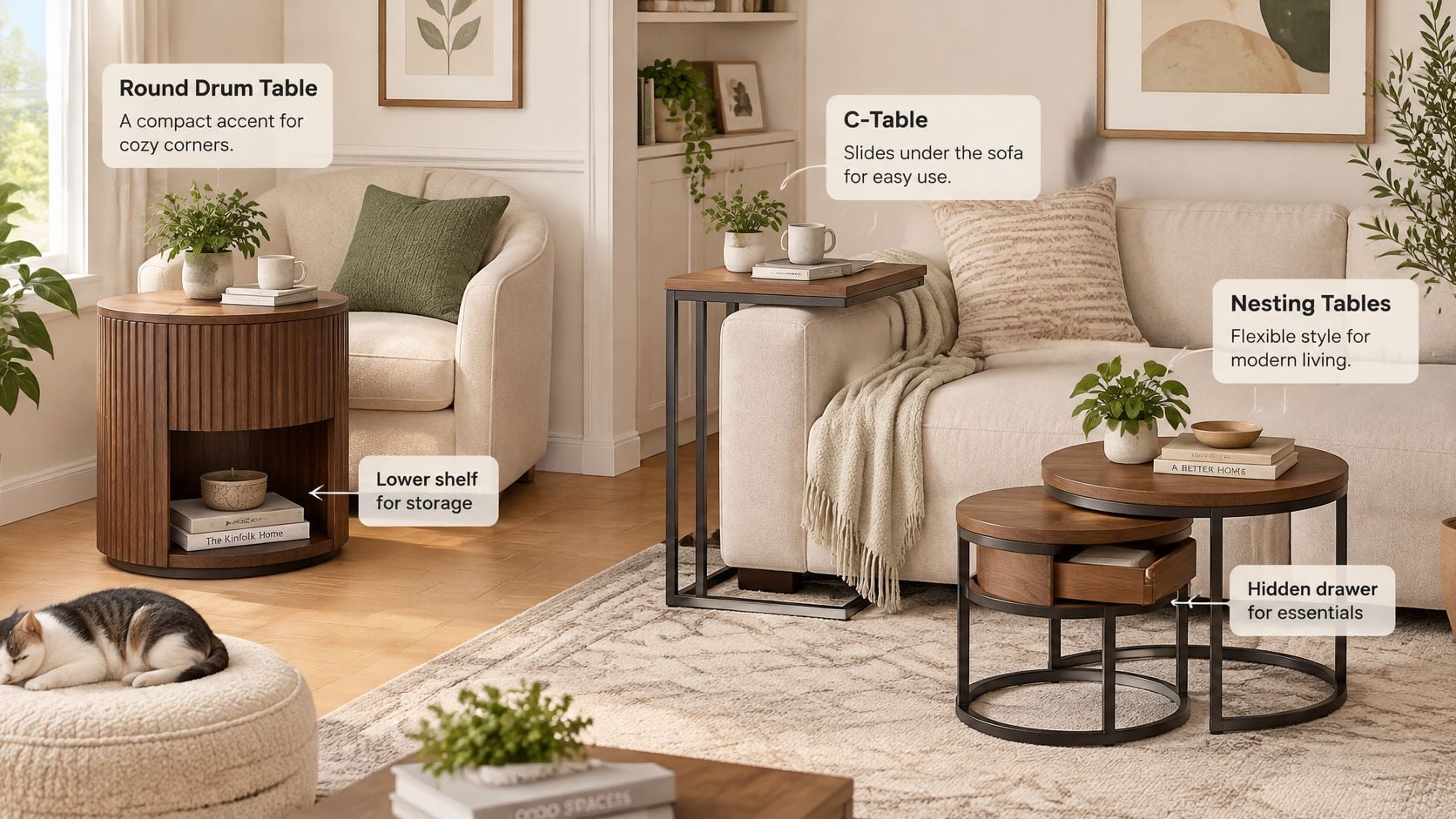
List what the top must hold before you fall for a silhouette. A lamp, a drink, a book, and a charging spot is a normal load beside a sofa that also serves as a desk. If that list does not fit, the table is too small, no matter how pretty the finish is. A square top is more forgiving than a round one when you add a second book, but it eats more floor and catches the eye as a box in the walkway.
| Shape or style | Best for | Storage or function | Watch for |
|---|---|---|---|
| Round or drum | Tight corners and conversation groups | Surface only | Narrow base can tip when loaded at the edge |
| C-table or sofa table | Sectionals and low-back sofas | Surface, sometimes a lower shelf | Can intrude into seat space |
| Nesting pair | Small rooms and flexible guest seating | Surface, combined or separated | Two pieces to keep steady |
| Lift-top | Laptop work or eating beside the sofa | Hidden surface under the lid | Lift mechanism needs clearance |
| Drawer or shelf table | Remotes, books and cables | Closed storage | Top must still be sturdy under weight |
Pick storage, then let the shape follow
A C-table slides under a sofa arm and keeps a laptop off your knees, but the upright can steal cushion space. Check the height from floor to sofa arm before you buy. A top that sits below the cushion line turns the table into a knee-knocker, and a top that sits too high forces a long reach. Nesting tables stack for a small Albany apartment and split when guests arrive, as long as both pieces sit flat and the smaller top clears the larger one when nested. A lift-top turns the sofa into a work or snack spot, and the lid needs room to rise without hitting the lamp. Measure the lamp height plus the lid swing, not just the closed table.
A drawer or an open shelf hides remotes and cables. Accent tables with drawers earn their place in a mixed-use room where the surface has to stay clear. One shallow drawer is enough for a remote, charger, and pen. A deep drawer on a small table usually means the apron is too low for your knees.
A nesting pair earns its keep when one table holds the lamp all week and the second pulls out for a guest's glass. The two-job test is whether the piece still works when the lamp is unplugged and someone needs a place for a drink.
A narrow drum that tips when a book lands on the rim will be replaced. A solid top with one drawer usually will not.
Build Quality, Materials and Amish-Made Options
Two tables can look identical in a photograph and behave nothing alike after a year of daily use. Turn the piece over and read the underside the way a builder would. Where the leg meets the apron you want a cut joint and glue, not staples and a bracket holding the whole thing square. Corner blocks should be screwed and glued rather than tacked. A thick top on a braced base stays quiet under a leaning elbow, and a thin top on a pedestal that flexes never tightens up again.
The material decides how the piece ages, and it limits what you can do about wear later.
- Solid wood: It takes daily wear and can be refinished years later, which suits a table that will sit beside the same sofa for a long time.
- Veneer: It looks crisp and even, and it chips if a corner takes a hit.
- Metal bases: They pair well with distressed or industrial tops, and they still need a wide enough footprint to spread the load.
Floor-protective glides should match hardwood, carpet or laminate. Skip a lightweight accent table as a TV stand; the top is not built for a screen's weight or for the reach of a child.
A proof you can run before you pay
Set the lamp you intend to use on the top, add two books, and listen. A creak at the apron means the joint is moving under load, and it will only loosen from there. Grip the top and try to twist it against the base; flex you can feel in the showroom becomes a wobble on an older plank floor. Then slide the table a few feet and set it down again. If it now rocks, the glides or the floor are the issue, not the frame.
Ask for the applicable test documentation. ANSI/BIFMA X6.5-2022 is a common basis for safety, durability and structural performance of occasional-use tables, with emphasis on stability and leg strength. Those tests assess a new product under controlled loads. They offer no protection against a base that gets altered later or a table used as a step stool.
Materials and a custom match
Ordering custom lets you set the size, the wood and the finish against furniture you already own. Amish furniture quality in solid wood, handcrafted in the USA, is the stronger buy when the table is meant to last for decades rather than one decorating season. Heirloom construction costs more up front and costs less in replacements. If the room gets hard use from kids, guests or a dog, I would put the money into the joint and the top thickness before the finish.
Styling the Table in Your Room
Keep the top to three or four things: a lamp, a coaster, one decorative object, and a small tray for remotes. Function stays, and the surface still looks finished.
Choose one dominant material in the room. A solid wood table and a wood sofa frame should share a tone instead of fighting. Metal can be the contrast, not a third competing finish.
- Match one finish. Pull a color from the sofa legs or the rug border so the table reads as part of the seating group.
- Place the lamp away from the reading arm. The switch stays reachable, and the shade does not bump your shoulder.
- Use warm wood or a metal base as the tie. One repeated tone is enough. Matching every accessory is not.
- Set one low object in the middle. A tray or a small stack keeps the top from looking empty without covering the drink spot.
Heirloom Amish-made pieces in solid wood take this edit well, because the wood is the visual weight and the accessories can stay quiet. During a custom order, the Freehold team can match a finish to a frame you already have.
A single art object often does more than a cluster of small souvenirs. Buddhist displays with HD Asian Art shows how one considered piece can sit in a living room without turning the table into a shrine or a clutter shelf.
Run the lamp cord and any charging cable along the back edge, out of the walking path. Then sit down. If the top looks styled and you can still set a glass down without moving three objects, stop. Walk from the entrance once more. The path should still read as open.
Confirm the Fit Before You Buy Near Albany
Bring four checks to the showroom: finished height against the sofa arm, clear walkway width, a base that will not tip, and a finish that ties to the frame or rug. Those four decide whether the table works in daily use. Style comes after.
Tip Top Furniture & Mattresses in Freehold, NY keeps 35,000 square feet of furniture, flooring, bedding, and window treatments under one roof. The living room collection includes sofas, sectionals, chairs, tables, power lift chairs, recliners, and sleeper sofas, so you can set a candidate table beside the seat it has to serve. Buyers from Albany, Schenectady, Troy, and Greene County can compare widths in the aisle rather than guess from a screen.
Drop the footprint into the free online room planner before you commit. A discounted piece that already hits your height and path is the faster purchase, and the Clearance section carries marked-down furniture that can put a solid table within budget. If the right size is not on the floor, custom ordering covers size, wood, and finish, including a match to an existing frame. That matters when the sofa has a low arm and most stock tables sit too high.
Flexible financing spreads a full living-room project, table included, instead of forcing a flimsy stand-in that wobbles after a year. Design consultations, available since 1984, coordinate the table with the sofa and with flooring from the same visit. Furniture, mattresses, decor, and floors can be handled in one stop, which saves a second trip for the rug or lamp that sets the table's tone. The showroom draws on more than 50 trusted manufacturers, so the base and finish are not limited to one look.
Amish furniture near Albany gives buyers solid wood sized to the arm they measured at home. Bring a tape measure and that arm height. A short design visit focuses on fit, and the tape measure does most of the talking.
The Freehold showroom helps Capital Region homeowners choose an accent table that matches the sofa arm, clears the walkway, and holds up to daily use, with custom sizes, Amish-made solid wood, clearance finds, and flexible financing. Design help has been part of the Freehold showroom since 1984. Visit the Freehold showroom with your arm height and a tape measure, and book a design consultation before the table blocks the hall.