Bookcase on Wheels: A Complete Buyer’s Guide for 2026


A room in a Capital Region home usually feels finished right up until the books, school binders, and decorative pieces start fighting for the same wall. Then the furniture has to earn its keep, and a bookcase on wheels becomes the kind of piece that solves more than one problem at once. It stores what needs storing, moves when the room changes, and does it without forcing a full redesign.
That flexibility matters in Freehold, Albany, Schenectady, and Troy, where homes range from older layouts with awkward corners to newer spaces that need room to multitask. A well-built rolling bookcase can serve a reading nook one day, a home office the next, and an entertaining space on the weekend. The catch is simple, though. Not every piece with casters is stable, and not every attractive shelf belongs on wheels.
Why Albany Homeowners Are Choosing Mobile Bookcases
A family finishes dinner, clears the table, and the living room has to become a homework zone. A bookcase on wheels handles that shift because the storage moves with the activity instead of forcing the room into one fixed purpose. That is why these pieces keep showing up in homes across Albany and the surrounding Capital Region, they let one room work harder without feeling crowded.

The practical appeal is about flexibility, not novelty
Historic homes in Albany often have tight circulation paths and rooms that were never set up for today's mixed-use living. A bookcase on wheels gives homeowners a way to change a room without dragging a heavy unit across the floor or locking themselves into one wall arrangement forever. That matters in spaces that need to shift between storage, display, and open floor area.
For smaller homes, the case is even stronger. Mobile storage can free up a corner, open a walkway, or move away from a heat register or window when needed. A helpful companion resource for tight layouts is best storage for tiny spaces, and best furniture for small spaces points in the same direction, use pieces that earn their footprint instead of taking over the room.
When the room changes, the furniture should keep up
A mobile bookcase is a strong fit for:
- Home offices: It keeps reference books, supplies, and printers within reach without making the room feel locked into office use.
- Growing households: It shifts from toy storage to school storage without forcing a second purchase.
- Entertaining spaces: It can roll back to open up floor space when guests arrive.
- Historic rooms: It avoids the visual heaviness that can make static furniture feel out of place.
The best part is that the storage still reads as furniture, not equipment. A well-chosen unit can feel intentional in a living room and practical in a den. That balance is why rolling storage keeps winning over homeowners who are tired of pieces that only work in one season of life.
Understanding the Engineering Behind Rolling Bookcases
A rolling bookcase has to do more than sit there and look finished. Once it is loaded with books, someone has to tip it over a threshold, turn it in a tight room, or move it across an uneven floor without the whole unit twisting under the weight. Good engineering makes that feel controlled. Poor engineering makes every move feel unstable.
Frame strength and load control matter more than looks
A mobile bookcase should be built like a piece of working furniture, not just shelving with wheels attached. Frame strength, shelf construction, and caster mounting all need to work together so the unit stays square under load. For buyers who want a clearer sense of how the structure is put together, wood joinery types are worth understanding because the way a frame is joined has a direct effect on how well it resists twisting and racking.
That is where solid construction shows its value. A better unit keeps the shelves aligned, spreads weight across the frame, and lets the casters do their job without putting extra strain on the body of the piece. Good looks matter, but they come second to the way the bookcase carries weight and stays true when it moves.
Some commercial mobile units show what serious engineering looks like. One example uses 16-gauge, 1-inch tubular steel, ball-bearing casters, a powder-coat finish, and a 500-lb capacity with 12-degree sloped shelves and 12 inches of clearance between shelves (Biofit book truck specifications). Those choices are functional. The sloped shelves help keep books from sliding while the unit is in motion, and the steel frame helps reduce sway and protect floors from a heavy, shifting load.
Practical rule: if the unit is going to move with weight on it, the frame has to be designed for that use from the start. Wheels added later do not fix a weak structure.
Stability starts with the center of gravity
Height changes everything. A taller bookcase on wheels carries more of its mass above the floor, so the center of gravity has to be managed carefully or the unit will feel top-heavy the moment it starts rolling. Mobile shelving built for residential and institutional use often falls within a broad size envelope, about 30 to 72 inches high, 36 to 72 inches wide, and 20 to 36 inches deep in library applications (Southwest Solutions on shelving on wheels). A taller rotating wooden example measures 66.14 inches high by 31.5 inches wide and deep, with 5 shelves and about 65 lb per shelf.
Those dimensions make the tradeoff clear. More vertical storage gives you room to hold more, but it also raises the load higher off the floor. Keep the heavier books on the lower shelves, use locking casters that hold firmly once set, and place the unit on level flooring whenever possible. A mobile bookcase that respects weight distribution feels steady in daily use. One that ignores it feels nervous every time someone bumps it.
A well-built wooden unit also depends on the way its parts are joined. Tight joints keep the frame from loosening as the bookcase rolls, stops, and starts over time. That is one reason custom Amish craftsmanship matters. Skilled builders can match the joinery, shelf thickness, and caster placement to the actual load, which solves mobility problems that mass-produced units often create before the buyer even notices them.
Comparing Types and Materials for Every Need
Not every rolling bookcase should solve the same problem. Some are built for heavy-duty transport, some are meant to rotate in a corner, and some are better treated as flexible display furniture. The right choice depends on how much weight it has to hold, how often it will move, and how much visual presence it should have in the room.
Materials change the entire job
Wood brings warmth and a more finished look, which makes sense in living rooms, bedrooms, and other visible spaces. Steel brings brute strength and a more utilitarian feel, which is the better fit for dense storage and repeated movement. Mixed-material pieces can split the difference, but the buyer still needs to check the frame, shelf construction, and caster quality before trusting the unit with a full load.
For homeowners trying to match the tone of existing furniture, wood species and finish matter just as much as weight rating. A good guide to that larger decision process is kitchen cabinet wood types, because the same reasoning about durability, grain, and finish carries over to storage pieces elsewhere in the home. For a deeper furniture-specific contrast, the internal guide on solid wood vs particle board is useful for anyone deciding whether a rolling unit should be built for years of use or short-term convenience.
The main categories worth comparing
| Type | Best For | Weight Capacity | Material | Price Range |
|---|---|---|---|---|
| Rotating wooden bookcase | Corners, display, compact rooms | About 220 lb maximum shelf weight on one walnut example (Target product listing) | Wood | Varies by build |
| Steel book truck | Heavy loads, libraries, offices | 500 lb capacity on one commercial unit (Biofit) | Steel | Varies by commercial spec |
| Library-style cart | Flexible room-to-room movement | Up to 120 lbs per tier on one model (Target product listing) | Steel | Varies by model |
| Caster-base mobile bookcase | Everyday residential storage | 200-pound shelf capacity on one welded-steel model (Southwest Solutions) | Steel or mixed build | Varies by model |
The honest takeaway is simple. A rolling piece that looks residential may still be engineered like light-duty storage, while a steel truck may be overkill for a den. Custom Amish craftsmanship fits a middle lane better, because it can be built to the room, the load, and the look instead of forcing one compromise onto all three.
Choosing the Right Casters and Ensuring Safety
Casters decide whether a mobile bookcase feels controlled or frustrating, safe or shaky. Plenty of buyers focus on shelves and finish, then treat the wheels like an afterthought. That is a mistake. The wheel setup carries the load, shapes how the piece turns, and decides whether it stays planted once you stop moving it.
Start with the wheel type, then check the lock
Swivel casters make tight turns easier, which helps in small rooms and around furniture legs. Fixed casters track more predictably on longer, straighter runs, so they make sense when the bookcase mostly moves in one direction. Ball-bearing casters roll more cleanly under load than basic wheel hardware, and that matters once the frame is carrying real weight.
Rubber wheels are the better choice for many floors because they are gentler on wood and tile and do less marking. Hard plastic wheels can work, but they feel less forgiving and are more likely to catch on uneven surfaces. A locking mechanism should hold the unit without creeping, especially on taller pieces or anything sitting where people walk often.
Caster geometry matters more than most shoppers realize. Wider spacing helps resist wobble, while a narrow footprint can make a loaded bookcase feel top-heavy even if the shelves themselves are solid. The frame above the wheels has to match the hardware below it, or the whole unit feels sloppy under real use.
Use the dimensions to judge safety, not just storage
Earlier sizing guidance still matters here, because a bookcase that sits near the upper end of a mobile shelving range needs closer attention to how weight is placed, how strong the casters are, and whether the floor stays level. Height changes the way a rolling unit behaves. A taller bookcase puts more stress on balance, especially if the load sits high.
Heavier books belong on the lower shelves. Always. Put the densest load at the top, and the unit becomes harder to control and easier to tip. That is the kind of mistake homeowners make when they fill the display shelves first and treat the lower shelves like dead space.
A related internal reference on bed frame with casters is useful for anyone comparing how moving hardware behaves on larger furniture. The same principle applies here, the structure above the wheels has to stay balanced, or the mobility hardware cannot do its job safely.
Custom Amish craftsmanship solves a problem mass-produced units usually ignore. It lets the builder match caster placement, frame strength, and shelf layout to the actual load instead of forcing one generic setup onto every room. That gives you a rolling bookcase that moves when you want it to, then settles securely when it should stay put.
Sizing Your Mobile Bookcase for Albany Spaces
A good rolling bookcase should fit the room before it ever gets loaded. That sounds obvious, but plenty of people measure the wall and forget about turning radius, door clearance, and the space needed to pull the unit away from trim or furniture. In Albany homes, where layouts can be compact, formal, or unusually tall, those details make or break the purchase.
Measure for movement, not just for placement
Start with the spot where the bookcase will live most often. Then measure the path it has to travel, including doorways, hallway turns, and any tight edges near baseboards or radiators. A unit that fits the corner can still be a bad buy if it cannot clear the route in and out of the room.
The internal guide on how to measure a room for furniture perfectly is a smart companion here, because furniture sizing is always about more than a single wall. Width, depth, and height all matter, but the test is whether the unit can move without scraping or forcing a room rearrangement every time it rolls.
Match the height to the house, not just the catalog
Victorian homes with higher ceilings can handle taller mobile storage more gracefully than a low apartment or a compact bonus room. That does not mean bigger is always better. It means the right proportions need to match the architecture and the use.
A few practical sizing rules make the choice easier:
- Lower profiles for traffic-heavy rooms: Easier to see over and easier to move.
- Taller units for dead corners or open walls: Better when storage density matters more than visual lightness.
- Deeper units for books plus decor: Useful, but only if the room can spare the floor space.
- Custom sizing for odd layouts: Often the cleanest fix when standard dimensions waste space.
For many Capital Region homes, custom dimensions solve the problem standard furniture cannot. That is especially true when a room has trim details, unusual proportions, or a doorway that limits what can roll through. A piece that fits the home properly will always look more intentional than one that merely fits the wall.
Styling and Room Placement Strategies
A rolling bookcase can either look like a smart design choice or an afterthought. The difference comes down to placement, proportion, and finish. When the piece fits the room visually, mobility stops being a gimmick and starts feeling like part of the layout.
Put the piece where movement helps the room
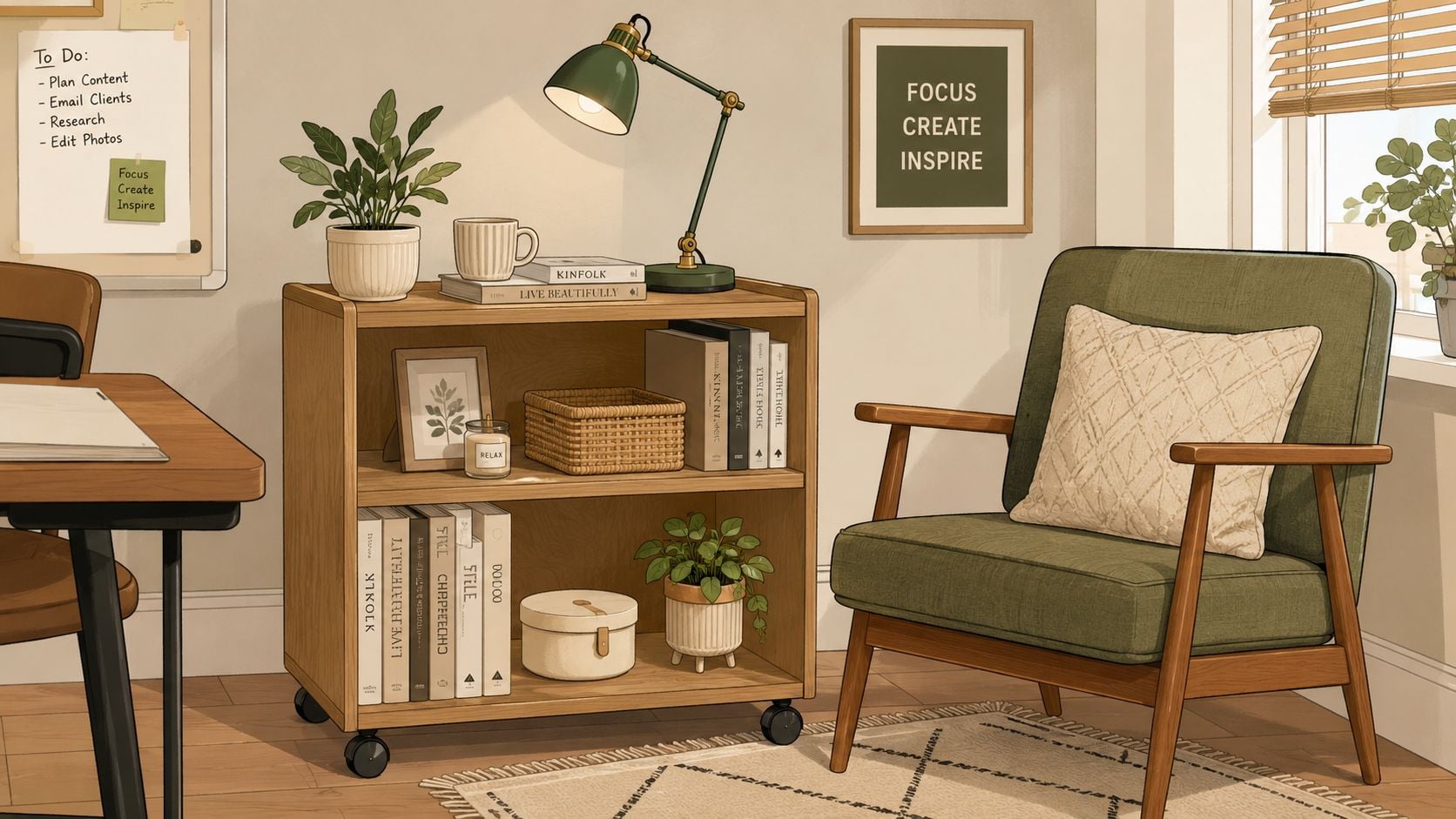
In an open floor plan, a mobile bookcase can act as a flexible divider without permanently closing off the space. In a living room, it can anchor a reading corner or hold decor that would otherwise scatter across several surfaces. In a bedroom, it can replace a fixed cabinet when the room needs to stay visually lighter.
Styling should stay disciplined. Heavy items belong on lower shelves, and decorative objects should be grouped so the piece still reads as balanced when it moves. A rolling shelf should not look stuffed. It should look edited.
Custom finishes make the difference in real homes
Solid wood, custom finishes, and hardware choices let a bookcase on wheels coordinate with nearby casegoods instead of clashing with them. Mass-produced units usually force homeowners to choose between an acceptable size and an acceptable look. Custom work can solve both at once.
For smaller bedrooms, placement matters even more. A useful reference for that kind of space planning is maximize every inch of your bedroom, which aligns with the same strategy of using furniture that supports the room instead of crowding it. The strongest design move is often the simplest one, a mobile unit that looks intentional from across the room and still performs when someone rolls it aside.
The Custom Advantage with Tip Top's Local Services
Online shopping makes it easy to click on a bookshelf and hope for the best. That works until the piece arrives too large, too flimsy, or too awkward for the room it was supposed to improve. Local service solves the problem earlier, when the dimensions, materials, and layout can still be matched properly.
Why local expertise beats guesswork
Tip Top Furniture & Mattresses has served the Capital Region since 1978, and that kind of long-term presence matters when a purchase has to fit a real home, not just a product page. The showroom in Freehold gives homeowners a chance to see scale, feel construction quality, and compare finishes before committing. That is a better process for a mobile bookcase than relying on photos and hope.
Custom ordering is the biggest advantage. A homeowner can match the style, size, wood type, and finish, and skilled craftsmen can even work from a picture or sketch. That matters when a room needs a piece built for an unusual alcove, a narrow doorway, or a cleaner match to existing furniture.
Local design support is not a luxury on custom furniture. It is the part that keeps a beautiful piece from becoming an expensive mistake.
Why the rest of the project gets easier too
Tip Top's Professional Design Services have been available since 1984, and that experience helps connect the rolling bookcase to the rest of the room, not just the wall it sits beside. The free online room planner lets shoppers visualize scale before buying, which is especially helpful for mobile storage that has to clear doors and corners. Flexible financing also makes custom work easier to approach without forcing the whole project into one payment.
The one-stop-shopping model matters here as well. A homeowner can coordinate furniture, décor, flooring, and even mattress decisions in one visit instead of juggling separate stores and separate delivery schedules. For a heavy or custom piece, local delivery and setup are not extras. They are part of getting the job done right.
Maintenance and Long-Term Care Tips
A good rolling bookcase should not become annoying after the first month. If the wheels stick, the frame loosens, or the unit starts wobbling, the problem is usually maintenance, not mystery. Clean hardware lasts longer, and better construction makes upkeep easier.
Keep the casters clean and the hardware tight
Dust, pet hair, and grit collect around wheels fast. That buildup makes rolling rough and can wear down the caster surface over time. A quick cleaning routine, plus occasional lubrication where appropriate, keeps the movement smooth and reduces squeaks.
Check the fasteners regularly. Movement naturally loosens hardware, especially on pieces that are rolled often or loaded heavily. If one wheel begins to sit differently from the others, stop using the unit until the problem is corrected. A tilted rolling base turns a convenience into a hazard.
Fix problems before they spread
If the bookcase rolls unevenly, the load is probably off balance or one caster is failing. If it wobbles, the weight may be too high or the frame may need tightening. If the lock slips, the caster is no longer doing its job and should be repaired or replaced.
A few simple habits keep the unit performing well:
- Wipe the wheels often: Remove grit before it grinds into the floor or the caster.
- Load the lower shelves first: Keep the center of gravity low.
- Protect the flooring: Use mats or felt where the unit rests most often.
- Inspect seasonal changes: Dry indoor air, humidity shifts, and heating cycles can all affect hardware and wood movement.
The best long-term investment is a solidly built piece from the start, especially one made with quality wood and dependable casters. A well-made bookcase on wheels should feel calmer, not fussier, than the room around it.
Tip Top Furniture & Mattresses helps Capital Region homeowners find storage that fits the room, the lifestyle, and the budget. Visit Tip Top Furniture & Mattresses to explore custom furniture, Amish-made options, financing, and local showroom support from a team that knows how to solve real space problems in Freehold and across the Albany area.