3 Seat Recliner: Your Ultimate Buyer’s Guide

The search for a 3 seat recliner often begins similarly. The old sofa has one good spot, one lumpy spot, and one seat everyone avoids. Movie night turns into a quiet negotiation. Someone ends up stretched on the floor with a pillow, someone claims the corner cushion, and someone says, “We need a better couch.”
That’s a familiar situation in homes all across the Albany area, from first apartments to family rooms in Greene County. A 3 seat recliner often solves that problem better than people expect because it combines shared seating with the comfort people usually associate with a single recliner. It also fits the way many households live. You want one sofa that works for reading, watching TV, hosting family, and taking a quick afternoon nap.
The Search for Shared Comfort in Your Living Room
A living room works best when nobody has to fight it.
If your current seating looks fine but doesn’t feel good after an hour, that matters. If one person likes to sit upright, another wants their feet up, and a third wants to stretch out, a standard sofa can start to feel limiting very quickly. That’s where a 3 seat recliner sofa stands out. It gives a family one connected piece instead of a mix of mismatched chairs, while still offering more personal comfort than a fixed couch.

That appeal isn’t just local. The global recliner sofa market is projected to reach USD 33 billion by 2024, reflecting strong demand for comfortable, stylish furniture that fits modern homes, according to Arizton’s recliner sofa market report.
Why families keep circling back to this style
A 3 seat recliner solves a few common problems at once:
- Shared seating matters when you want everyone on one sofa instead of spread around the room.
- Comfort gets more flexible because reclining seats let different people sit different ways.
- The room stays visually tidy since one coordinated sofa usually looks calmer than multiple recliners.
- Daily use feels easier for TV time, visiting with friends, or just unwinding after work.
Practical rule: If a room has to serve both everyday family life and occasional company, one well-chosen reclining sofa often works harder than several separate seats.
For many Albany and Capital Region homes, that balance is why this category has staying power. People aren’t just shopping for plush cushions. They’re trying to make one room do more, without making it feel crowded or overfurnished.
What often confuses shoppers early on
The term itself can be misleading. Some people assume all three seats recline. Others think a reclining sofa will always look bulky. Neither assumption is safe.
A 3 seat recliner is really a category, not one single design. Some models recline only on the ends. Some include power controls. Some are made for tighter rooms with space-saving motion. Some lean traditional, and others look surprisingly clean and sleek.
That’s why it helps to slow down and look at the details before choosing by appearance alone.
What Exactly Is a 3 Seat Recliner Sofa
At the simplest level, a 3 seat recliner sofa is a sofa built for three people where one or more seats recline. That sounds straightforward, but the useful part is understanding how it differs from other seating you may be comparing.
A standard sofa stays fixed. A row of three separate recliners gives flexibility, but it can take over the room and break up the look. A 3 seat recliner sits between those two options. You get the feel of one sofa, with at least some of the comfort features of recliner seating.
How it differs from similar furniture
People often compare a 3 seat recliner with these:
A traditional sofa
Better for formal rooms, usually simpler in shape, but it won’t give you footrest support or reclining comfort.A sectional
Great for larger layouts, but it can be too deep or too dominant for many living rooms.Three individual recliners
Very comfortable, but they can make conversation harder and often create a busier look.
If you’re still sorting out sofa size and proportions, this ultimate guide to the perfect 3 seat sofa gives helpful general context on how three-seat sofas function in real rooms.
The most common configurations
Many shoppers frequently misunderstand this detail. “Three seat” describes the seating width. It does not automatically describe the reclining setup.
You’ll usually see one of these layouts:
End seats recline, center seat stays fixed
This is one of the most common arrangements. It gives two loungers and one stationary middle seat.All three seats recline independently
Premium models can do this, and they’re ideal for households where everyone wants equal comfort options.Manual reclining design
Usually operated with a side lever or push-back motion.Power reclining design
Uses buttons for smoother, more precise positioning.
Why this style works so well in everyday life
The biggest strength of a 3 seat recliner is that it’s both social and personal.
You can sit close together for a movie, but each person doesn’t have to sit the same way. One seat can stay upright for conversation, another can recline for TV, and another can support someone who just wants their feet up after a long day. That kind of flexibility is hard to get from a standard couch.
A good reclining sofa doesn’t just add comfort. It reduces compromise.
That’s why this piece often ends up in the busiest room of the house. It supports real use, not just a showroom look.
Decoding Reclining Mechanisms and Power Options
The mechanism is the part most shoppers can’t see well, but it shapes the entire experience of owning the sofa. It affects how the recliner opens, how much effort it takes, where the sofa can sit in the room, and how smooth the motion feels over time.
Often, the first big decision is manual or power.
Manual recliners in daily use
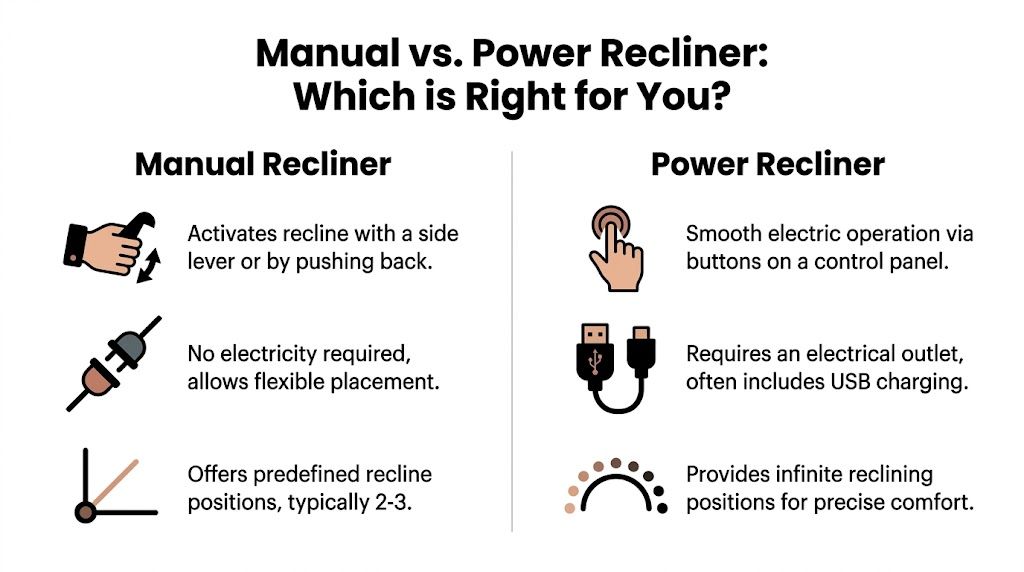
A manual recliner usually works with a side lever or a push-back action. People like them because they’re straightforward and don’t need to be near an outlet.
That makes them useful in older Albany homes where outlet placement isn’t always ideal. If your room layout is awkward, or you like rearranging furniture now and then, manual seating can be easier to live with.
Power recliners in daily use
A power recliner uses electric controls, usually buttons placed near the seat. The biggest advantage is control. Instead of moving from upright to one or two fixed positions, you can adjust more gradually and stop where you feel comfortable.
That’s especially helpful if different people use the same sofa in different ways. Some want just a little leg support. Others want a deeper recline for watching a long movie.
For a broader look at feature differences in powered seating, this guide to types of power reclining seating is a useful companion.
Manual vs Power reclining mechanisms
| Feature | Manual Recliner | Power Recliner |
|---|---|---|
| Operation | Side lever or push-back motion | Button-controlled electric movement |
| Electrical needs | No outlet required | Requires access to power |
| Placement flexibility | Easier to place anywhere | Best where cord routing is practical |
| Feel of movement | More direct and simple | Smoother and more adjustable |
| Best for | Shoppers who want simplicity | Shoppers who want convenience and precision |
Why wall clearance matters more than people think
One of the easiest buying mistakes is measuring only the sofa in its closed position. Reclining furniture has to move somewhere. If you don’t account for that travel, the back can hit the wall or the footrest can crowd a walkway.
Some modern wall-hugger designs solve this nicely. According to the recliner history and mechanism overview on Wikipedia, wall-hugger mechanisms slide the seat forward on a track and can need only 10 to 14 inches of wall clearance, instead of the several feet a standard recliner may require. The same source notes that the modern recliner was patented in 1959 by Daniel F. Caldemeyer, and that his design legacy was trusted enough for use by NASA.
Before you buy, measure for the reclined position, not just the parked position.
How to choose between them
If you’re stuck, use your habits as the tiebreaker.
Choose manual if you want:
- Simple placement in a room without worrying about nearby outlets
- Straightforward operation with fewer electronic parts
- A familiar feel that many people already know
Choose power if you want:
- Fine-tuned comfort with smoother position control
- Easier operation for people who don’t want to push back or work a lever
- A more feature-rich seat that often includes convenience add-ons
The best mechanism isn’t the one with the most features. It’s the one that fits how you live.
A Guide to Materials and Construction Quality
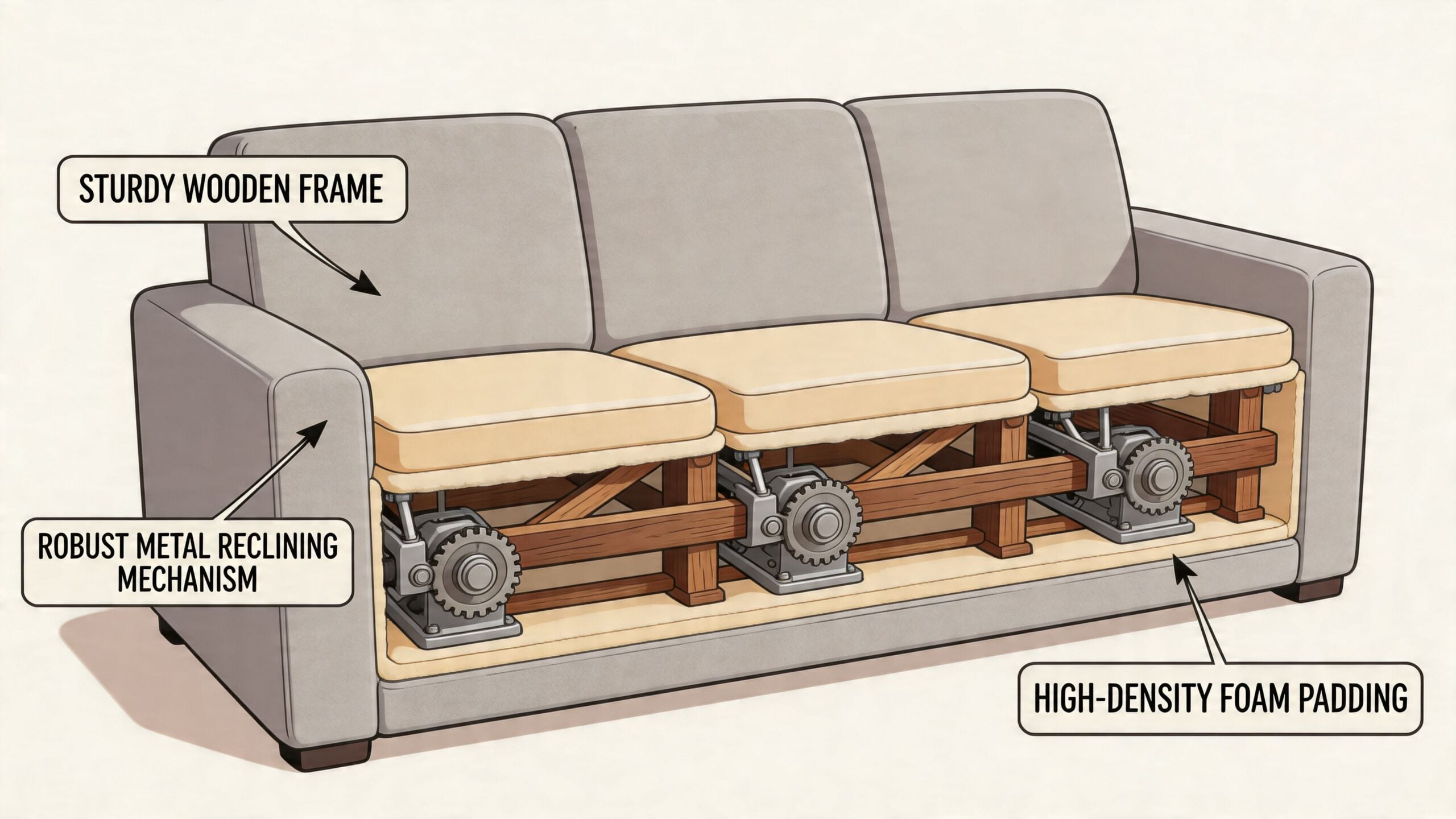
A 3 seat recliner can look impressive on the sales floor and still disappoint later if the materials underneath aren’t strong enough. This is the part buyers should learn to inspect. The frame, mechanism, cushions, and upholstery all work together, and weakness in one part usually shows up long before the whole sofa is officially “worn out.”
Start with the frame
The frame is the skeleton. If it flexes too much, everything else suffers. Seats can feel uneven, reclining parts may work less smoothly, and the sofa can start making noise earlier than expected.
One useful benchmark from a premium model listing is durability at the mechanism level. The Jerome’s Triplex sofa page states that premium reclining mechanisms are engineered to withstand over 300,000 reclining cycles, and it also notes that kiln-dried hardwood frames can improve resistance to warping by up to 40%. In an Upstate New York climate, where humidity and heating seasons can pull materials in different directions, that frame preparation matters.
What to look for under the cushions
If you can, sit down and pay attention to more than softness. Soft isn’t always supportive.
A better-made recliner often shows its quality in these ways:
- The seat feels stable and doesn’t sag sharply toward the center.
- The arms feel solid when you press down or shift your weight.
- The motion feels consistent on both sides rather than loose on one side and tight on the other.
- The footrest closes cleanly without needing extra force or a second try.
For a practical overview of fabric and surface options, this guide on upholstery materials is worth reading before you narrow down colors and textures.
Upholstery changes how the sofa lives with you
The best cover material depends less on trends and more on your household.
If you have kids, pets, snacks in the living room, or a sofa that gets used every night, performance-minded fabric can be a very sensible choice. It tends to feel approachable and easy to live with. Leather offers a different appeal. Many people like the cleaner look, the smoother surface, and the way it develops character over time.
Neither is automatically better. The better choice is the one that matches your home.
Under the hood matters: A beautiful cover can hide a weak build, but a strong build usually feels strong the moment you sit down.
Cushions, support, and long-term comfort
Cushion quality is one of the hardest things to judge quickly because almost every new sofa feels comfortable for five minutes. The true test is how it feels after long use.
Look for a seat that supports you without swallowing you. If you stand up and the cushion takes a long time to recover, or already shows a strong body impression on the floor model, pay attention. That can be an early clue that comfort may not hold its shape well.
A well-built 3 seat recliner should also feel balanced from seat to seat. If one end feels dramatically firmer or softer than the other, ask why. Some variation can come from design. Too much variation can point to inconsistent construction.
A short quality checklist you can use in the showroom
- Open and close each reclining seat and notice whether the motion feels smooth.
- Sit in every position you expect to use, not just the middle.
- Check the back height and seat depth for the people who’ll use it most.
- Press on the arms and front rail to get a sense of sturdiness.
- Ask what the frame is made from and whether the wood has been kiln dried.
Good recliners aren’t only about plushness. They’re about repeatable comfort, dependable motion, and construction that keeps doing its job year after year.
Choosing the Right Recliner for Your Albany Home
A beautiful recliner that doesn’t fit your room, your doorway, or your routines isn’t the right recliner. This part of the process is where practical choices save the most frustration.
The first question isn’t color. It’s fit.
Measure the room the way a recliner actually works
People often measure wall width and stop there. For reclining furniture, that’s only the beginning.
Take these measurements before you shop:
- Wall width where the sofa will sit
- Room depth so the footrest won’t block traffic when open
- Doorways, stairwells, and hallways the sofa must pass through
- Nearby furniture spacing such as coffee tables and side tables
A helpful next step is to sketch the room to scale. This article on how to choose living room furniture offers practical planning guidance if you’re trying to balance seating, tables, and walkways.
Measure your tightest doorway before you fall in love with any sofa.
Match the recliner to how your home is used
Not every 3 seat recliner belongs in the same kind of room.
If your living room is where kids sprawl with blankets and snacks, easy-care upholstery and a forgiving surface matter. If your room doubles as a more polished entertaining space, you may care more about sleek arms, a cleaner silhouette, and a cover that looks refined from every angle.
If you’re furnishing a den or media room, reclining depth and head support can move higher on the priority list. In a smaller city living room or an older Capital Region home with tighter dimensions, compact motion and easier wall placement may matter more.
Use frame strength as a reality check
One useful indicator of build quality is how much weight the structure is designed to support. A sturdy example from Aosom’s manual triple recliner listing shows a total weight capacity of 770 lbs, or about 256 lbs per seat. That kind of capacity matters in real life because reclining sofas often hold shifting weight from more than one person at once during everyday use.
Think about who uses it most
A good choice becomes clearer when you identify the primary users.
For families
Prioritize durability, easy cleaning, and stable seat support.For older adults
Focus on seat height, ease of entry and exit, and controls that feel easy to operate.For frequent hosts
Look at overall style from across the room, not just comfort from one seat.For movie watchers
Give extra attention to head support, footrest position, and how the recline feels after a longer sit.
Don’t ignore the room around the sofa
A recliner isn’t just a product choice. It’s a layout choice.
Leave enough space so the room still feels easy to move through when the seats are open. Check that a coffee table won’t trap knees or block footrests. Think about lamp placement, outlet access for power models, and whether side tables stay reachable when someone is reclined.
That’s the part many big online listings can’t solve for you. Your room is always more specific than the product photo.
Your Investment How to Buy and Maintain Your Recliner
A 3 seat recliner is one of the harder-working pieces in most homes. People sit on it daily, recline it repeatedly, snack on it, nap on it, and ask it to keep looking good through all of that. It makes sense to treat the purchase as a long-term investment rather than a quick style decision.
What usually affects price and value
Price differences often come from a few practical factors:
Mechanism quality
Better motion hardware usually feels smoother and more substantial.Frame construction
Stronger internal materials tend to hold alignment and support longer.Upholstery grade
Cover choices change both appearance and upkeep.Customization
Special-order fabrics, finishes, or upgraded features can change the final cost.
Value isn’t always the lowest ticket. Value is getting a sofa that fits your room, holds up to your routine, and doesn’t leave you wanting to replace it too soon.
If you don’t find the exact right one
This happens often. You find the right size but not the right fabric. Or the right comfort but the wrong arm style.
That’s where custom ordering can make sense, especially if you’re trying to match existing wood tones, coordinate with other furniture, or choose something more personal than a standard floor sample. It’s also worth checking locally available in-stock and clearance pieces if timing matters and you’d like to bring something home sooner.
Maintenance is simpler than many people think
Most recliners last better when owners stick to a few consistent habits.
- Vacuum creases and seat gaps so grit doesn’t grind into the upholstery.
- Use the mechanism gently instead of forcing it shut with momentum.
- Rotate use across seats when possible, especially if one spot is the obvious favorite.
- Follow the maker’s care guidance for leather or fabric cleaning.
For a general household refresher on cleaning the furniture, that resource gives a useful overview of day-to-day care habits. For seasonal upkeep ideas specific to home furnishings, this fall furniture maintenance checklist is also a practical read.
A recliner usually wears out faster from neglect and misuse than from ordinary sitting.
Ask about warranty details before delivery day
Warranty language matters most before anything goes wrong.
Ask what’s covered on the frame, the reclining mechanism, the power components if applicable, and the upholstery. Also ask who handles service if there’s a problem after delivery. The answer tells you a lot about what ownership will feel like after the excitement of buying has passed.
A good purchase experience doesn’t end at checkout. It includes knowing how to care for the piece and knowing what support looks like if something needs attention later.
Find Your Family's New Favorite Spot at Tip Top
A good 3 seat recliner does more than recline. It helps a room function better. It gives people a place to gather, relax in different ways, and use one space more comfortably every day. The best choice usually comes down to four things: the right fit for your room, the right mechanism for your habits, strong construction, and materials you’ll be happy living with.
For families around Freehold, Albany, Schenectady, Troy, and the wider Capital Region, it helps to test these details in person. Comfort is personal. Seat height, cushion feel, motion, and scale are easier to judge when you can sit down, recline, and compare options side by side. If you’re also weighing larger living room layouts, browsing living room sectionals can help clarify whether a reclining sofa or a sectional better suits your space.
If you're ready to move from research to real comfort, Tip Top Furniture & Mattresses is a great next stop. Visit the Freehold, NY showroom to try different 3 seat recliner styles in person, talk through room planning for your Albany-area home, explore custom order options, browse clearance finds, or ask about flexible financing for a project that needs to fit your budget as well as your space.