Hallway Coat Racks: 2026 Styling Guide for Albany Homes

Every home has a drop zone. In plenty of Albany-area houses, it isn’t a designed space at all. It’s the chair by the door with two coats on it, the shoes spread under a console, the tote bag leaning against the wall, and the umbrella nobody remembers until it leaks onto the floor.
That kind of clutter builds slowly, especially in Upstate New York where outerwear changes with the weather and the entryway works hard almost every day. Historic farmhouses, compact city apartments, split-levels, and newer suburban homes all have the same basic problem. The stuff of daily life lands near the door, and if there’s no real system, the hallway starts doing too many jobs badly.
A good hallway coat rack fixes more than storage. It creates a routine. Coats go in one place, bags in another, shoes stop drifting, and the front of the house starts feeling calmer the minute you walk in.
Taming the Entryway Chaos in Your Capital Region Home
Some of the most frustrating rooms in a house aren’t really rooms. They’re transitions. The front hall, the side entry, the narrow passage between the kitchen and the back door. Those are the spaces where families in the Capital Region tend to feel clutter first.
In older homes around Albany, Troy, and Greene County, closets often weren’t designed for modern routines. In apartments, the issue is usually the opposite. There may be almost no dedicated entry space at all. Either way, coats, hats, bags, and boots need a home.
That’s why hallway coat racks have lasted so long. They’re not a trend piece. They’ve been solving a practical household problem for generations.
A classic solution with real staying power
Hallway coat racks emerged as a significant piece of furniture around 1840, and they became the most important piece of furniture in front halls during the mid-19th century, with an approximate 80-year peak from 1840 to 1920 according to the history of the hatstand. That history matters because it explains why a well-made hall tree still feels so natural in an entryway. It was built for that job from the start.
In practical terms, that old idea still holds up. A hallway coat rack gathers the loose pieces of everyday life into one spot, and that’s exactly what many entryways need.
Local insight: The right entry piece doesn’t just hold coats. It tells everyone in the house where things belong the moment they walk in.
If you’re trying to build a more complete landing zone, pairing a coat rack with a surface for keys or mail helps a lot. A guide to entry table elements that make a foyer work harder can help you think through that second layer of function.
When a coat rack works better than more closet space
A closet is hidden storage. A coat rack is active storage. That’s a meaningful difference in a busy household.
Use a hallway coat rack when:
- Your family needs speed: People can hang and grab outerwear quickly without opening doors or shifting things around.
- Guests need a clear cue: A visible rack makes the entry feel welcoming instead of uncertain.
- The closet is already overloaded: A rack can take the daily-use items while the closet handles overflow and off-season gear.
- You’re improving an older home gradually: Sometimes the smart move is to add function first, then tackle built-ins later. If that’s on your list, these Bulls Eye Repair for closet upgrades offer useful ideas for expanding storage in stages.
The goal isn’t to pack more furniture into a small space. It’s to give the busiest part of the house a simple job and let it do that job well.
Finding Your Perfect Match Types of Hallway Coat Racks
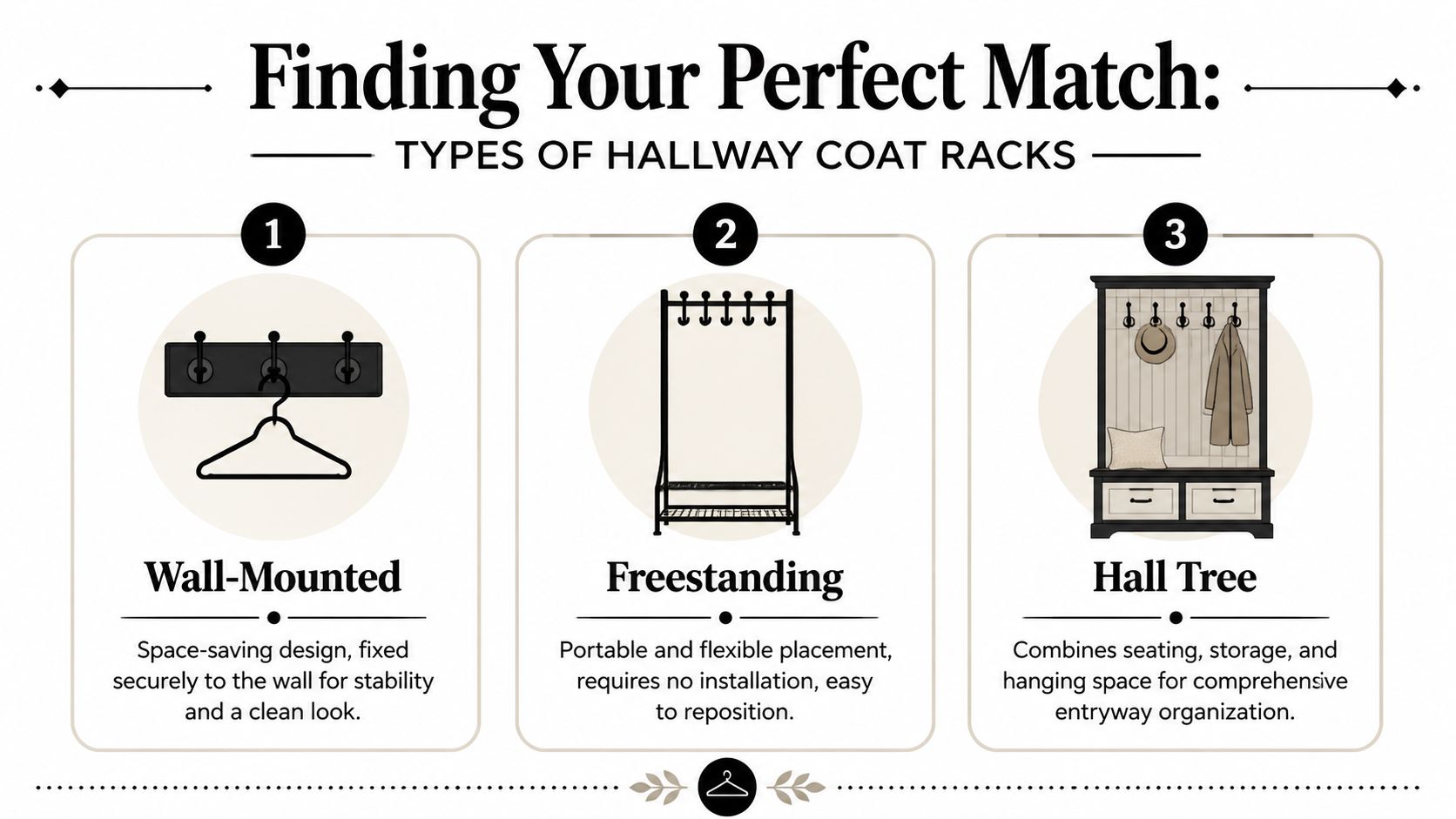
There isn’t one right kind of coat rack for every home. A narrow apartment hall needs something different than a mudroom-style back entry in a family house. Most shoppers are deciding between three broad categories, and each has its place.
A visual comparison helps first.
Wall-mounted racks for tight footprints
Wall-mounted hallway coat racks make sense when floor space is precious. They keep the walkway clear and can look clean and architectural, especially in narrow corridors or entry-less living spaces.
What works:
- They save floor area: You’re using vertical space instead of asking the hallway to hold another piece of furniture.
- They feel lighter visually: That matters in smaller apartments and older homes with narrow passages.
- They pair easily with a bench or basket: You can build a custom-looking setup over time.
What doesn’t:
- Installation matters: If the hardware is poor or placement is rushed, the rack won’t age well.
- They don’t solve everything on their own: You still need a plan for shoes, bags, or wet accessories.
Freestanding coat racks for flexibility
Freestanding models are the easiest to move and the easiest to try. If you’re renting, rearranging, or unsure where your entry system belongs, they’re often the least disruptive option.
Their strength is flexibility. Their weakness is capacity. Once a family starts hanging winter coats, scarves, backpacks, and handbags all on one vertical piece, a simple stand can start to look crowded fast.
This type tends to work best for:
- Singles or couples with lighter storage needs
- Guest rooms or secondary entrances
- Homes where permanent installation isn’t ideal
Hall trees for the all-in-one approach
Hall trees are the workhorses. Hooks, shelves, bench seating, and shoe storage all in one piece. For many households, they solve the whole entryway problem at once instead of piece by piece.
Benchmarks for multifunctional hallway coat racks show 20 to 30 percent better entryway organization in homes using hybrid bench-rack designs, and some models provide about 15 to 20 square feet of effective storage within a 10 square foot footprint according to this hybrid hallway coat rack product reference. That lines up with what many families notice in real life. Once the bench and shoe storage are built into the piece, the floor usually gets cleaner.
The most useful entry furniture handles the whole routine. Arrive, sit, remove shoes, hang the coat, drop the bag, move on.
A quick way to compare the three:
| Type | Best for | Main drawback |
|---|---|---|
| Wall-mounted | Narrow halls, apartments, minimalist layouts | Needs installation and separate storage pieces |
| Freestanding | Flexible placement, renters, lighter use | Can look crowded sooner |
| Hall tree | Families, busy daily routines, all-in-one storage | Needs dedicated floor space |
If you want to compare actual configurations, storage hall trees in different layouts make it easier to see how bench depth, hook placement, and lower storage change the way a piece functions.
Built to Last Materials and Finishes That Endure
A coat rack in an Albany entry has a harder job than the same piece in a mild climate. It gets brushed by wet sleeves in February, loaded with heavier coats for half the year, and bumped by boots, bags, and school gear on the way in.
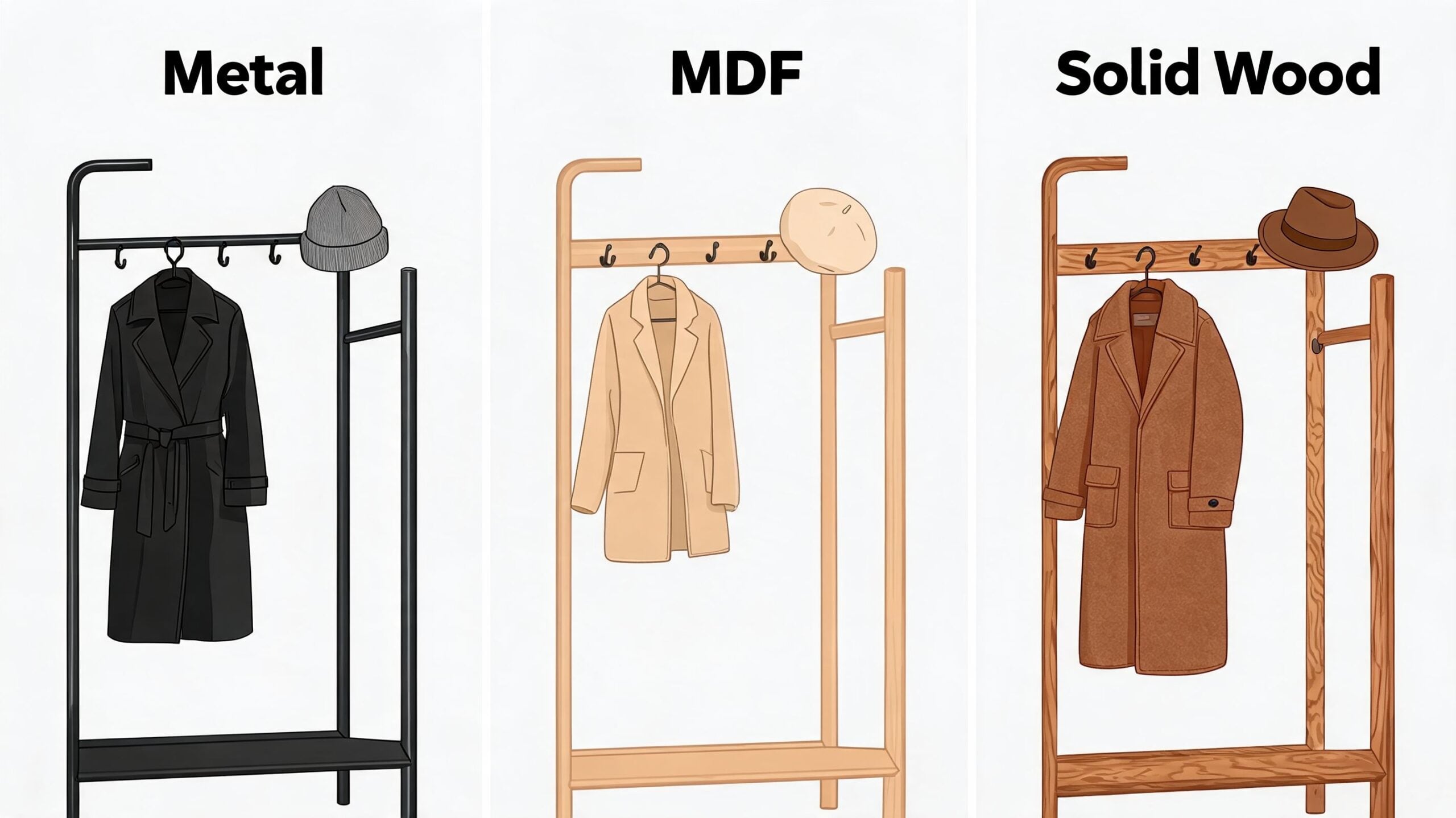
That daily wear shows up fast if the piece is built from the wrong material or finished poorly.
What each material does well
Metal earns its keep in slim, practical designs. A powder-coated steel frame usually handles everyday hanging weight well, and it suits apartments, contemporary homes, and side entries where a lighter visual footprint helps. The trade-off is feel. In older Capital Region homes, especially farmhouses and colonials, metal can read a little stark unless it is balanced with wood.
MDF has a place too. It helps create painted hall trees, wider panels, and storage-heavy designs at a lower price than all-hardwood construction. In my experience, MDF works best in drier interior spots and in households that want the look and function without expecting heirloom longevity. Around a busy door that sees tracked-in snow and damp boots, edge sealing and finish quality matter a lot.
Solid wood usually gives the best long-term return. It holds fasteners better, feels sturdier under daily use, and can be repaired or refinished years later instead of replaced.
Why wood often makes sense in Upstate homes
Homes around Albany, Troy, Saratoga, and the surrounding towns go through seasonal swings. Dry indoor heat in winter and humid summer days put more stress on entry furniture than many shoppers expect. Material movement is normal. Cheap construction is the problem.
That is why I tell customers to pay attention to build quality as much as species. Solid wood with good joinery generally holds up better over time than thin panels, loose hardware, or heavily laminated parts in a high-use entry. For many local homes, especially older ones with uneven floors and narrower halls, that extra stability is worth paying for.
Material rule: In a wet, busy entry, choose structure first, then color and style.
Custom Amish-made pieces are often a strong fit here because the construction is straightforward and honest. Real hardwood, dependable joinery, and durable finishes tend to age better in a working entry than trend-driven pieces built to hit a low price.
Finishes that age gracefully
Stained wood remains one of the most forgiving options. Small scratches, hook wear, and day-to-day scuffs usually blend into the grain instead of announcing themselves from across the room. That matters in family entries where the piece is used hard every day.
Painted finishes can still be a good choice. They work especially well in cottage homes, bright farmhouses, and entryways that need a lighter look. They just show chips and rub marks sooner, particularly around edges, bench fronts, and hook rails.
Sheen matters too. A soft matte or satin finish usually hides fingerprints and light wear better than a high-gloss surface.
If you are comparing oak, cherry, maple, and other hardwood options, this guide on choosing the right hardwood for furniture lays out the differences clearly.
One good example is the Margaret Solid Wood Coat Rack. It keeps the design simple, offers multiple finish options, and focuses on durable wood construction instead of trying to pack every storage feature into one wall. For an Upstate entry that already has a nearby bench or shoe cabinet, that kind of straightforward piece often wears better and looks right longer.
The Right Fit Sizing and Placing Your Coat Rack Correctly
Most mistakes with hallway coat racks happen before the piece ever arrives. People measure the wall, but they don’t measure how the entry works. Doors swing. People pass each other. Winter coats stick out farther than expected. A beautiful piece can still be wrong for the space.
Start with the path, not the furniture
The first measurement isn’t width. It’s movement. Stand at the main entry and pay attention to what happens when someone comes in carrying groceries, a backpack, or a winter coat. If the rack interrupts that path, the hallway will always feel cramped no matter how attractive the piece is.
Measure:
- The available wall or floor span
- The door swing area
- The walking path past the rack
- Nearby obstacles such as vents, radiators, trim, and light switches
Then think about what hangs from the rack. Heavy coats add bulk. Bags stick out. A bench invites shoes underneath. The rack doesn’t live at its listed dimensions. It lives at its working dimensions.
Match the piece to the entry style
Different spaces ask for different placement logic.
| Entry type | Usually works well |
|---|---|
| Narrow hallway | Wall-mounted rack or slim profile piece |
| Small square foyer | Compact hall tree or freestanding rack |
| Side entrance or mudroom zone | Bench-and-hook combination |
| Awkward corner | Corner-friendly rack or custom-sized solution |
This is also where a room-planning tool earns its keep. It’s much easier to judge fit before buying than to guess from memory. For homeowners trying to avoid a costly misstep, how to measure a room for furniture properly is the right place to start.
Bring in the real-world variables. Coat bulk, boots on the floor, the dog leash by the door, and the fact that two people may use the space at once.
Placement habits that tend to work
A few placement patterns are consistently reliable:
- Keep the rack close to the natural drop point: That’s where people already remove coats.
- Don’t center it blindly: Centering on a wall can look nice but function poorly if it conflicts with the door or traffic flow.
- Use companion pieces carefully: A mirror, tray, or small table should support the rack, not crowd it.
- Respect older houses: Period homes often have trim, narrow passages, and uneven walls. A slightly smaller piece usually performs better than one that fills every inch.
Good sizing feels boring in the best way. Nobody notices it because the hallway works.
Secure Mounting and Simple Long-Term Maintenance
A coat rack gets tested hardest in an Upstate New York winter. Wet parkas get dropped on one hook, boots bump the base, kids tug at scarves on the way out, and everything gets used in a hurry. If the rack is poorly mounted or loosely assembled, that wear shows up fast.
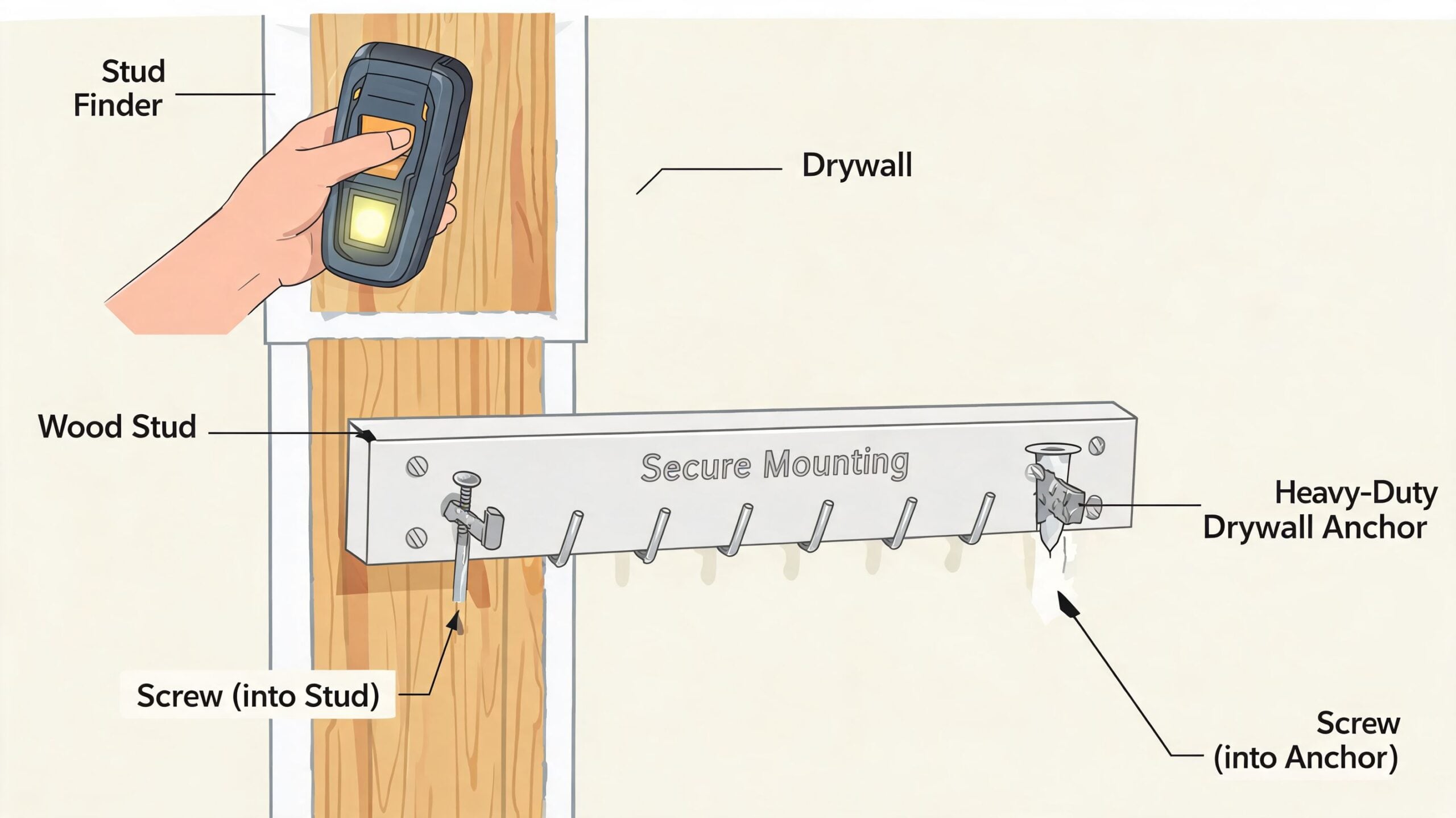
Secure installation starts with the wall and the floor
Wall-mounted racks should be fastened into framing whenever possible. In older Albany homes, that can take a little patience because plaster, patchwork drywall, and uneven studs are common. Freestanding hall trees need a level footing and a quick stability check after assembly, especially on older wood floors that slope a bit.
A simple rule helps. If a piece will hold heavy winter coats, loaded tote bags, or backpacks, install it for the heaviest day of the year, not the lightest.
For wall-mounted units:
- Fasten into structure when you can: Studs give the best long-term support.
- Match the hardware to the wall type: Drywall, plaster, masonry, and shiplap all need different fasteners.
- Check for movement before full use: A slight wiggle at installation usually turns into a problem later.
- Keep it out of the door swing: Repeated impact loosens screws and scars the finish.
If you’re comparing mounting hardware and support options, this Value Tools buyer's guide gives a helpful overview of bracket considerations that carry over well to sturdy wall storage planning.
Freestanding pieces need attention too. Set the rack in place, load a few coats on one side, and see how it reacts. If it rocks, fix that before the piece becomes part of the daily routine. In family homes, I usually recommend securing taller units to the wall if the design allows it.
Routine care is simple if you stay ahead of moisture
Most coat racks do not fail because of age alone. They fail because water sits on the finish, screws loosen gradually, or grit gets ground into joints and corners.
For wood:
- Dry wet spots promptly: Melted snow and damp gloves can cloud a finish over time.
- Clean around hooks and trim: Dust mixed with road salt gets abrasive.
- Use a mild cleaner: Strong sprays can soften or dull protective topcoats.
For metal:
- Wipe down the base and hardware: Slush tends to collect low.
- Tighten screws now and then: Seasonal use puts a lot of stress on connection points.
- Touch up chipped areas early: Small finish breaks are easier to address before rust starts.
One quick check each month is usually enough.
Protect the wall as well as the furniture
The wall behind the rack often takes more abuse than people expect. Coat sleeves rub against paint, umbrella tips leave marks, and narrow entries leave little margin for error. That is especially true in Capital Region houses with tighter hallways and close-set trim.
Leave a little breathing room around the rack, and mount nearby mirrors or artwork with the same care. For homeowners finishing the whole setup, this guide to hanging wall pieces with precision is a practical reference.
A properly mounted coat rack should feel steady, quiet, and easy to live with for years. That is usually the difference between a piece that merely fits the entry and one that earns its place.
Styling Ideas for Small and Awkward Entryways
Small entryways usually aren’t failing because they lack style. They’re failing because too much is being asked of too little space. Once that’s clear, styling gets easier. The goal is to make the entry feel intentional without making it work harder than it can.
Narrow hallways need restraint
A common pain point for homeowners in tight spaces is the lack of guidance for selecting coat racks for narrow hallways or awkward corners, and that gap can be addressed with custom sizing options and specialized room planning, as noted in this overview of space-constrained coat rack challenges. That’s especially true across the Albany Capital Region, where older homes often have slimmer passages and less forgiving layouts.
In a narrow hallway, the mistake is usually overbuilding. Too many hooks, too much projection, too much visual weight. What tends to work is a quieter composition.
Try this approach:
- Keep the profile slim: The rack should support movement, not interrupt it.
- Limit visible storage: Open storage looks charming until every daily item is on display.
- Use one accent finish: Wood tone, black metal, or a painted color can anchor the space without noise.
Awkward corners can become useful
Corners near doors often get ignored because standard furniture doesn’t fit them well. That doesn’t mean they’re wasted.
A corner rack can turn dead space into active storage, and a custom-sized piece can solve the common problem of a wall that’s too short for a hall tree but too important to leave empty. For these situations, local design help is worth considering. Professional design services can tie the coat rack to flooring, wall color, nearby furniture, and lighting so the whole entry feels coherent instead of patched together.
In small entries, styling works best when every decorative choice also supports function.
Build a welcoming vignette, not a storage pile
Even a hardworking hallway coat rack should feel like part of the home. A mirror, a small rug, framed art, or a narrow tray for keys can warm up the area quickly.
A few combinations that usually work well in Upstate homes:
- Farmhouse or traditional: Solid wood rack, woven basket, muted rug, framed art
- Apartment modern: Wall hooks, floating shelf, clean-lined mirror, compact bench
- Historic home: Warm wood finish, antique-style mirror, simple umbrella stand
- Family side entry: Bench-based hall tree, washable runner, baskets for gloves and hats
If you want the hallway to feel less like a utility strip and more like part of the home, ideas that turn your corridor into a gallery can help balance storage with personality.
Custom ordering also becomes useful here for reasons beyond size. Sometimes the issue isn’t just fit. It’s matching the house. A hallway coat rack may need the right wood tone, the right finish, or the right proportions so it looks as though it belongs there. In many older or smaller homes, that difference matters more than people expect.
Create Your Perfect Entryway with Tip Top Furniture
The right hallway coat rack does more than catch coats. It settles the front of the house. It gives shoes a stopping point, bags a landing spot, guests a clear cue, and busy mornings one less thing to fight with.
For homeowners in Freehold, Albany, Schenectady, Troy, and across the Capital Region, the challenge is rarely just picking a style. It’s finding a piece that matches the home itself. Older houses need proportion. Family homes need durability. Apartments need restraint. Awkward entries need planning.
That’s where local furniture guidance still matters. Since 1978, a family-owned showroom can learn the patterns of local homes in a way a generic product listing can’t. And when you add design services that have been available since 1984, custom ordering, flooring coordination, delivery, and flexible financing, the entryway project becomes easier to solve as part of the whole home.
For shoppers comparing quality levels, materials, and practical fit, Tip Top Furniture & Mattresses offers access to custom ordering, Amish furniture, design help, and room-planning support from its Freehold showroom serving the Greater Albany area. That’s useful when the answer isn’t a standard piece off the floor, but a rack or hall tree shaped around the way your household lives.
If your project is part of a larger home update, it also helps to keep related needs in one place. Entry furniture often connects to flooring, wall décor, bedroom storage, or nearby living room pieces. One-stop shopping can save a lot of second-guessing.
A good entryway should feel easy. You walk in, things go where they belong, and the house greets you properly.
If you’re ready to solve the daily pileup by the door, visit Tip Top Furniture & Mattresses to explore hallway storage options, try the room-planning tools, ask about custom Amish and solid wood pieces, or speak with the design team at the Freehold showroom serving Albany and the Capital Region.