Barn Door Room Divider The Complete Buyer’s Guide

Open layouts sound great when you're touring a house. Then real life starts. One person needs a quiet spot for work, kids spread toys across the living area, and the dining space never quite feels separate from everything else.
That’s where a barn door room divider starts to make sense. It gives you a way to divide space without building a permanent wall, and it does it with more personality than a standard interior door. For many homes around Albany, Troy, Schenectady, and the rest of the Capital Region, that matters. Older homes often have quirky openings, and newer homes often need flexible zones instead of rigid rooms.
Homeowners are paying attention to that balance of style and function. The U.S. barn door hardware market is projected to grow to $287.0 million by 2032 according to this barn door market overview. That doesn’t surprise me. People want rooms that can change with the day.
If you're sorting through layout ideas first, it helps to look at broader open plan living room ideas alongside your divider options. And before you fall in love with a door style, it’s smart to sketch the room flow using a room layout planning guide. A good divider solves a space problem. A bad one just creates a new one.
Introduction From Open Concept to Smart Spaces
Saturday morning in a Capital Region home can change the way a room needs to work. Breakfast ends, someone opens a laptop at the table, kids spread out a puzzle in the living area, and by evening that same space needs to feel calm again. A barn door room divider gives you a way to shift with that rhythm without committing to a new wall.
We see that question often in our showroom. Homeowners from Albany, Troy, and Schenectady want open rooms to stay airy, but they also want a little control over noise, privacy, and visual clutter. In older Upstate homes, the challenge is often an unusual opening or a room that was never designed for modern life. In newer homes, the challenge is different. One large shared area has to do the work of three smaller rooms.
A barn door room divider helps because it acts a bit like a movable boundary. Open, the home feels connected. Closed, the room gets definition and purpose. That balance fits the way many families live now, especially when one room has to serve two jobs in the same day.
Why this style keeps showing up
Traditional interior doors are fixed in their role. A barn door divider is more flexible, and that is a big reason shoppers keep coming back to it.
- Create separation without a major remodel, so the layout can still change as your needs change
- Bring in character through natural wood, painted finishes, glass, or metal details
- Support open floor plans instead of chopping them into smaller boxed-in rooms
- Work well in tricky traffic areas where a swinging door would waste space or bump into furniture
In a family furniture business, you learn quickly that good design has to earn its keep. A divider should look right, but it should also solve a daily problem. Custom Amish craftsmanship is especially appealing here in Upstate New York because many homes are not perfectly standard. A well-built door can be sized, styled, and finished for the opening you have, not the opening a big-box store assumes you have.
Barn doors work best when you want privacy part of the time, not a permanently closed-off room.
That point clears up a lot of confusion. If you need full sound control and the feel of a standard enclosed room, a framed wall and hinged door may still be the better fit. If you want a room to open up for gatherings and close off for work, guests, or storage, a barn door divider often makes more sense.
What often confuses shoppers
Sliding doors get grouped together, but they are not all built the same. A barn door room divider slides along the outside of the wall on a visible track. A pocket door disappears inside the wall. That difference affects both the look and the installation.
Before you choose a style, it helps to sketch how people move through the space with a room layout planning guide. If you're still weighing whether your home should feel more open or more defined, these open plan living room ideas can help you compare the feel of each approach.
Three early questions make the shopping process much easier.
- Do you have enough clear wall space beside the opening?
- Do you want the track and rollers to stand out or blend in?
- Are you trying to block sightlines, soften a transition, or create real privacy?
Once those answers are in place, the choices stop feeling overwhelming. They start to feel practical.
What is a Barn Door Room Divider and Why Choose One
A barn door room divider is a sliding door panel mounted on a track above an opening or passage area. Instead of swinging into the room, it glides sideways along the wall.
That sounds simple, but the practical payoff is big.
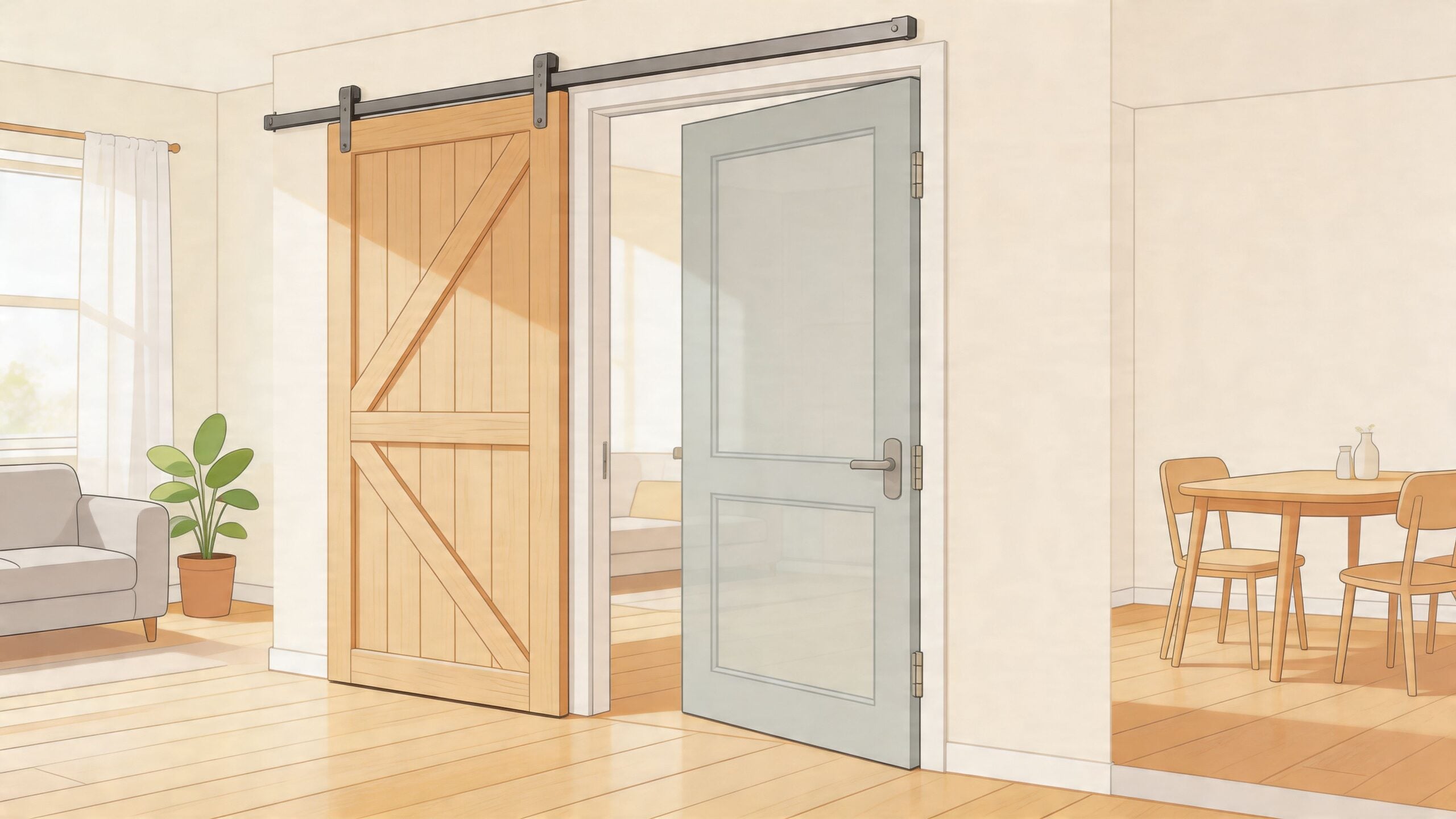
A standard hinged door needs clear floor area to open. A barn door doesn’t. According to this comparison of barn doors and traditional doors, hinged doors can encroach on up to 20 to 30 square feet of floor space, while barn doors offer nearly 100% floor space recovery because they slide along the wall.
Why homeowners choose one
That floor-space difference is the first reason people switch. The second is flexibility.
A barn door room divider works well when you want to:
- Close off a home office during meetings or focused work
- Separate a play area from the main living room
- Hide a pantry, laundry zone, or storage nook
- Create a softer division between two connected rooms
Some shoppers also like the history behind the design. Barn doors trace back to American farm buildings, where wide sliding openings made practical sense for daily work. That heritage still shows in the sturdy look of plank construction, exposed hardware, and simple joinery.
The core benefits at a glance
Space savings
You keep more usable floor area for rugs, chairs, sideboards, or traffic flow.Visual impact
The door becomes part of the room’s architecture, not just a utility item.Flexible privacy
Open when you want connection. Closed when you want separation.Less disruption than building a wall
You can change how a room functions without taking on a full remodeling project.
Practical rule: If a swing door would hit furniture, crowd a walkway, or force you to leave empty space, a barn door room divider deserves a close look.
Where it works best
In my experience, the best spots are the ones where the room already wants a boundary but doesn’t need a permanent one. Think between a kitchen and pantry, a bedroom and office nook, or a living room and den.
Where it works less well is a place that demands a tight seal. Bathrooms and highly noise-sensitive spaces usually need more than a typical barn door can offer unless you’re choosing a specialized divider system and accepting its limits.
Choosing Your Perfect Barn Door Style and Material
A barn door works a lot like a dining table. The finish catches your eye first, but the material underneath decides how it wears, how heavy it feels, and whether it still looks right ten years from now.
That matters in the Capital Region, where one customer may be fitting a divider into a restored farmhouse near Saratoga and another is trying to soften a newer open floor plan closer to Albany. After more than 45 years helping local families furnish their homes, we have learned that the best choice usually comes from matching the door to the house, the room, and the way the family lives.
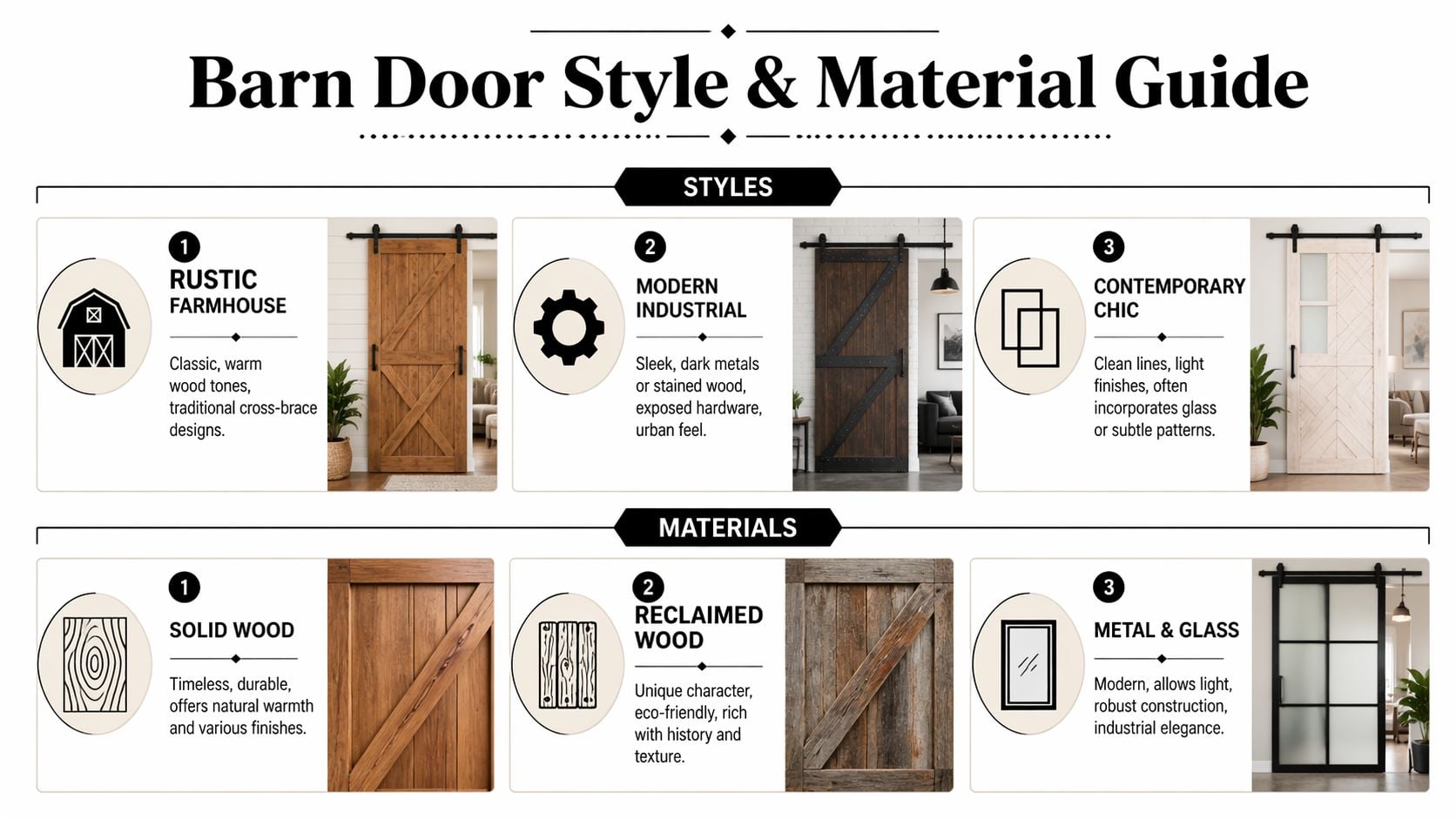
Popular styles that fit real homes
Rustic farmhouse
This is still the style many homeowners ask about first. It usually features visible wood grain, warm stain tones, and details like X-braces or plank construction. In an older Upstate home, that look can feel right at home with wide trim, wood floors, and sturdy case pieces.
It also pairs naturally with Amish-made furniture because the door has the same honest, grounded character.
Modern industrial
Modern industrial pulls the look in a cleaner direction. You will often see flatter surfaces, darker finishes, black metal hardware, and a stronger contrast between wood and metal. If your room already has iron lighting, sleek seating, or a loft-like feel, this style tends to look intentional instead of out of place.
Contemporary chic
Some homeowners want the function of a barn door without the country look. A contemporary design solves that. Flat panels, painted finishes, narrow rails, or glass inserts help the divider blend into a more current interior, especially in homes where the furniture is lighter and the lines are simpler.
Material changes how the door feels day to day
Style sets the mood. Material shapes the daily experience.
Solid wood has depth, warmth, and the kind of weight many shoppers associate with quality furniture. Reclaimed wood adds texture and age marks that give the piece personality, though it is less uniform. Engineered wood can be a practical choice for painted doors or tighter budgets. Glass keeps light moving between spaces, which helps in homes that already feel a little dark during long Upstate winters.
Market reporting on residential sliding barn doors points to that same split in buyer preferences. Wood remains the leading choice, while interest in glass designs has grown quickly, as noted earlier. We see that in the showroom too. Families still want the comfort and substance of wood, but many also ask for ways to keep rooms feeling open.
If you want a custom look that coordinates with existing casegoods, trim, or Amish-made furniture, a custom order furniture option can make a big difference. Matching species, stain depth, and hardware tone is often what separates a door that fills an opening from one that looks like it was always meant to be there.
Barn Door Material Comparison
| Material | Best For | Durability | Typical Cost |
|---|---|---|---|
| Solid Wood | Long-term use, classic interiors, heirloom feel | High | Higher |
| Reclaimed Wood | Rustic spaces, one-of-a-kind character | High, with natural variation | Higher |
| Engineered Wood | Budget-conscious projects, painted finishes | Moderate | Lower |
| Metal | Industrial looks, bold design statements | High | Moderate to higher |
| Glass | Spaces that need light flow and visual openness | Moderate to high depending on frame design | Moderate to higher |
How to choose without overthinking it
Start with the room and the furniture already in it.
- For a living room divider, solid wood usually feels warmer and sits more naturally with tables, hutches, and upholstered seating.
- For a home office, a clean panel design often looks sharper and less distracting on video calls.
- For a pantry or utility zone, a simpler finish that wipes clean easily is often the smarter buy.
- For a dim room, glass inserts or a lighter paint color can prevent the divider from making the space feel closed in.
One more point often surprises shoppers. Solid wood is not limited to rustic spaces. With the right profile and stain, it can work beautifully in transitional, classic, and even fairly modern interiors.
A good barn door should relate to the trim, flooring, and furniture around it. That is why custom Amish craftsmanship makes such a difference for many local homeowners. You are not choosing from a generic box. You are choosing proportions, wood character, and finish details that fit your home in a way mass-produced doors often do not.
Sizing Privacy and Practicality for Your Upstate NY Home
A barn door room divider needs to do two jobs at once. It has to fit the opening, and it has to fit the way you live in the room. In our showroom, this is often the point where Capital Region homeowners realize the prettiest door on the floor is not always the right size for the wall at home.
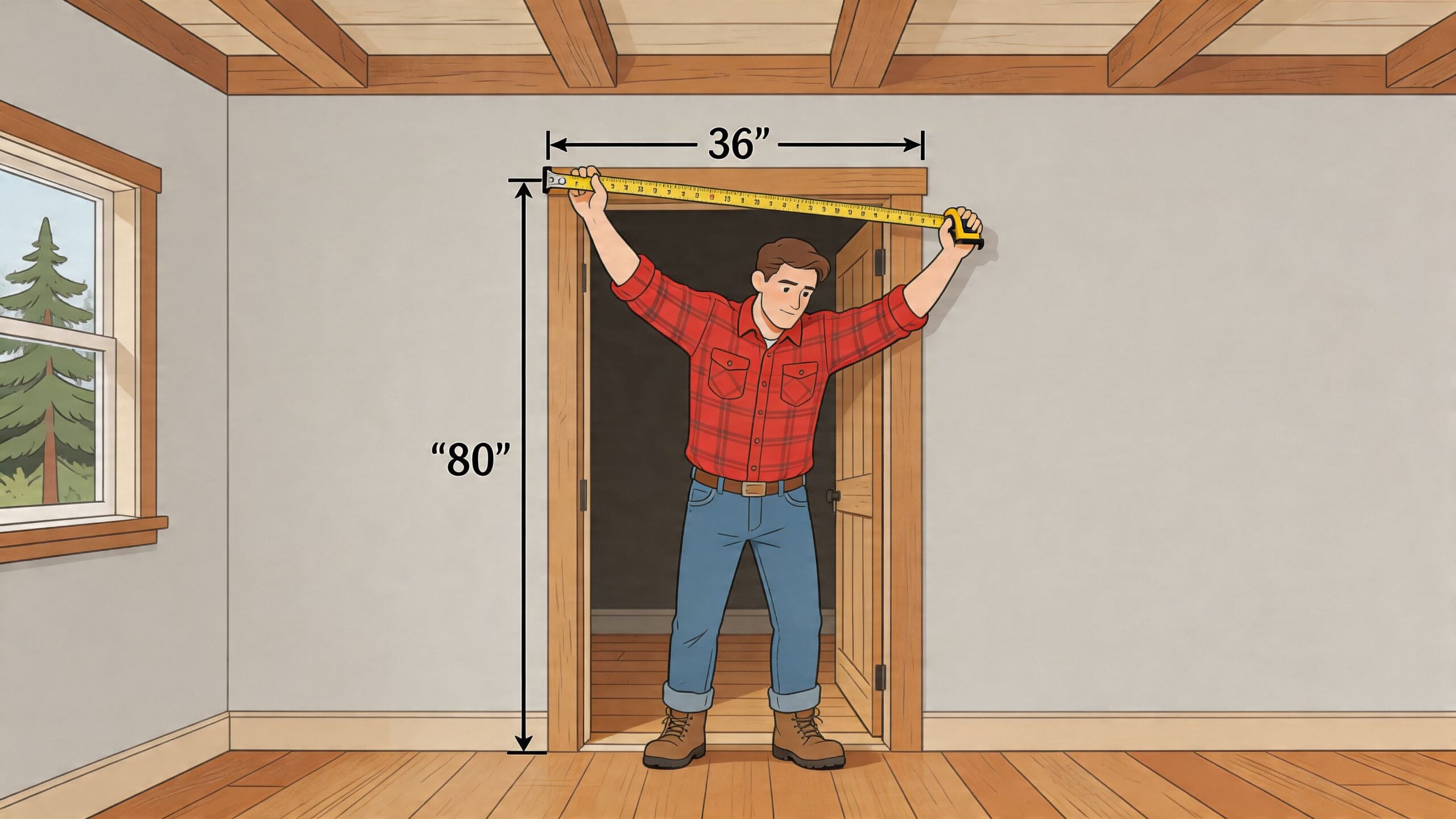
A divider that is too small leaves awkward gaps. One that is too large can crowd trim, block switches, or run into furniture. Good sizing solves both problems before you order.
A simple way to measure the opening
For a standard 36-inch wide opening, the door should usually be 38 to 40 inches wide so it overlaps the opening enough to reduce visible gaps, according to this barn door sizing guide. The same guide notes that the track should usually be at least double the door width, so a 40-inch door needs an 80-inch track or longer.
That wider-than-the-opening measurement confuses many shoppers at first. It helps to picture the door like a lid covering a container. If the lid only matches the exact opening, the edges stay exposed.
Start with these five measurements:
- Opening width from one side of the trim or finished opening to the other
- Opening height from the floor to the top of the opening or trim
- Side overlap so the door covers more than the exact opening
- Wall space next to the opening so the door has room to slide fully open
- Obstacles in the travel path such as vents, switches, artwork, or tall casegoods
If you are also arranging seating, storage, or traffic paths, this room measuring guide for furniture layouts can help you avoid placing a chair, console, or lamp where the door needs to park.
What privacy really means with a barn door
Barn doors give strong visual separation. They do not close up like a traditional hinged door with a full jamb and weatherstripping. That difference matters.
For many homes, visual privacy is the main goal. You may want to hide a home office during dinner, screen a pantry area from the kitchen, or create a guest zone in a loft-like space. In those cases, the right overlap and height usually make a big difference.
Privacy usually depends on four practical details:
- Enough width to cover the opening fully
- Enough height to avoid a skimpy look
- A floor guide that keeps the door tracking straight
- A door construction that matches the room’s purpose
A pantry opening and a work-from-home nook do not need the same level of coverage. That is why we guide customers room by room rather than handing out one standard formula for every house.
Local sizing questions Upstate NY homeowners should ask
Older homes around Albany, Troy, Saratoga, and the surrounding towns often bring a few surprises. Openings may be slightly out of square. Baseboards can project farther than expected. Floors may slope enough to affect the gap under the door.
Custom Amish craftsmanship helps here because you are not forced into a one-size-fits-all slab. You can order a door sized for the opening you have, not the opening a factory assumed you had. That is often the difference between a divider that looks settled into the home and one that always feels added on.
Budget matters too. A larger custom door uses more material and may require a longer track, so sizing has a direct effect on project cost. We would rather help you measure carefully at the start than see you pay twice for a door that looked right online but not in your room.
Common sizing mistakes
Picking the door by opening width alone
That often leaves side gaps and makes the divider look undersized for the wall.
Forgetting the wall beside the opening
Every sliding door needs a clear parking area. If that wall already holds a thermostat, artwork, sconce, or tall cabinet, the plan may need to change.
Ignoring the room’s real job
A divider for a reading nook can be more forgiving. A divider for an office used during video meetings usually needs fuller coverage and more careful placement.
Understanding Hardware and Installation Options
A barn door can look beautiful in the showroom and still disappoint at home if the hardware is wrong. We see that in our store from time to time. A customer falls in love with the wood, finish, and panel style, but the track is undersized, the rollers feel rough, or the wall was never a good candidate for that setup in the first place.
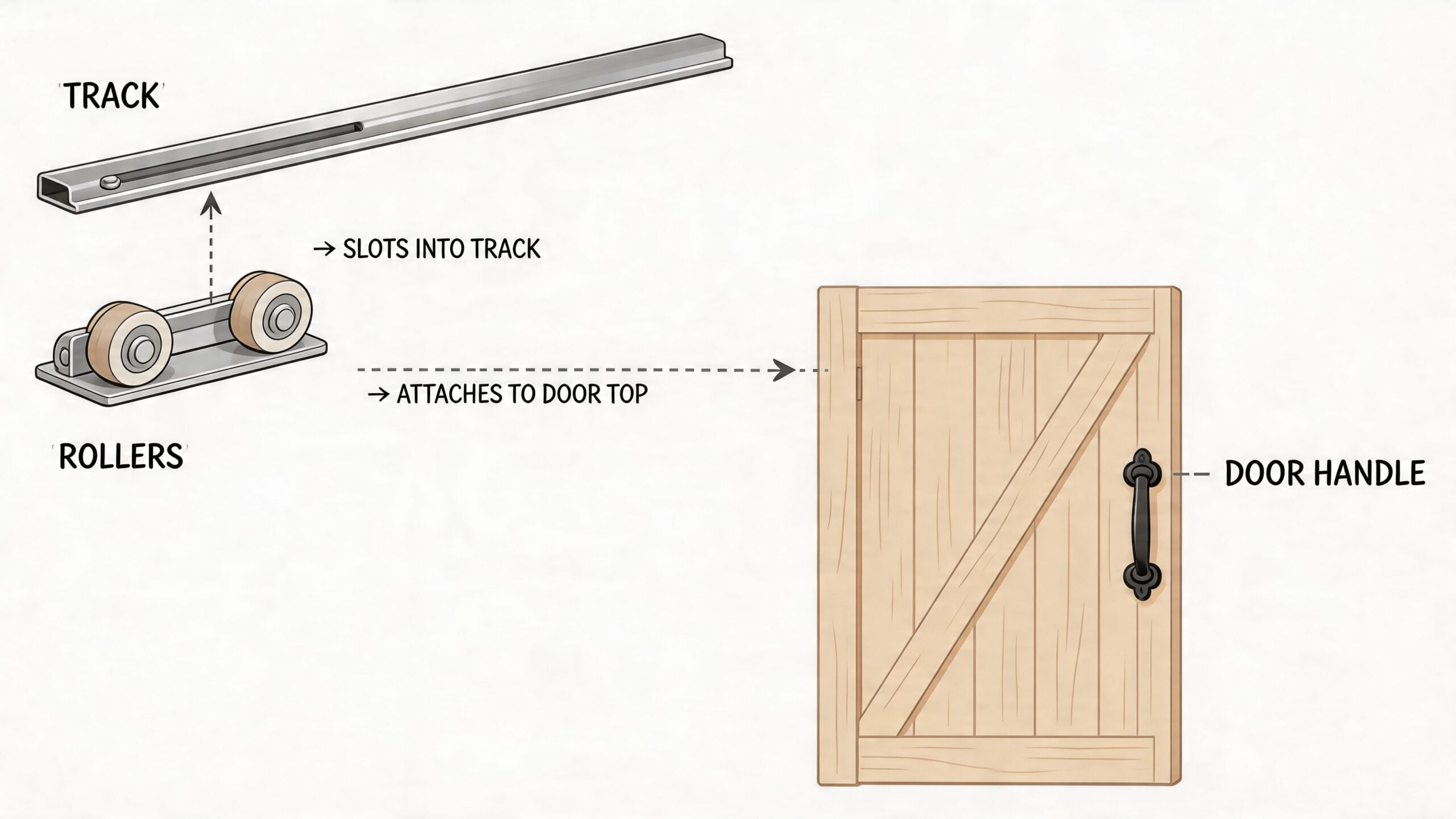
Hardware is the working part of the system. The door is the face you notice first. The hardware is what makes that door glide straight, stop where it should, and stay pleasant to use year after year. In older Capital Region homes, that matters even more because plaster, trim, and framing are not always as predictable as they look.
What’s in a typical hardware set
A standard setup usually includes five main parts, and each one has a job.
Track
The horizontal rail above the opening. It carries the door’s weight and determines how steady the motion feels.Rollers
The wheel assemblies attached near the top of the door. Better rollers usually move with less noise and wear more evenly over time.Stops
Small pieces at the ends of the track that keep the door from rolling too far in either direction.Floor guide
The guide near the floor that keeps the bottom of the door from swinging out into the room. Without it, a wide door can feel loose during daily use.Handle or pull
The part your hand meets every day. It sounds minor, but comfort matters if the divider gets opened and closed often.
Style matters here too. Strap-style rollers bring a more traditional farmhouse look. Top-mount hardware feels cleaner and more contemporary. Matte black fits a wide range of interiors, while stainless or bronze can shift the mood warmer or sharper depending on the surrounding furniture and finishes.
What to check before installation
Customers often ask whether barn door hardware is mostly about the track length and door weight. Those are big pieces of the puzzle, but they are not the whole puzzle.
Wall strength comes first. The track needs secure fastening into framing or proper blocking. Clearance above the opening matters too, especially in homes with lower ceilings, crown molding, or trim details. Then there is the wall beside the opening. The door needs room to park fully open without running into switches, vents, artwork, or tall case goods.
That is one reason custom projects tend to go better than off-the-shelf guesses. After 45 years helping local families furnish their homes, we have learned that a smart installation plan starts with the existing wall in front of you, not a perfect wall in a product diagram.
DIY or professional help
Some homeowners can handle a barn door install themselves, especially if the opening is straightforward and the wall framing is easy to locate. A practical way to preview the process is to read a guide on how to install sliding doors before buying the hardware.
DIY usually makes sense when:
- The wall is flat and solid
- Studs are easy to find
- The door is moderate in weight
- You are comfortable drilling, leveling, and measuring carefully
- A little paint or trim touch-up is acceptable
Professional installation usually makes sense when:
- The home has older walls or uneven surfaces
- The door is large, heavy, or custom built
- Trim and flooring leave very little margin for error
- You want soft-close hardware adjusted properly
- You want the finished result to look clean from every angle
A related project such as adding doors to a bookcase shows the same lesson. Precision shows. A door that is even slightly out of level will remind you every day.
Hardware and performance go together
Privacy is not only about the door slab. It is also about how firmly and consistently the system holds that slab in place. As noted earlier in the article, some room divider designs are built with stronger sound-control features than others. Those features work better when the track, stops, and floor guide keep the door moving true and resting where it should.
A loose guide or poorly aligned track will not turn a good divider into a bad one overnight, but it can create rattling, uneven gaps, and extra wear. If you want a quieter office corner, a calmer guest space, or a divider that feels solid instead of wobbly, choose the hardware with the same care you give the wood species and finish.
That is how we walk customers through it in the showroom. The door and the hardware are one working system, and the best results come when both are chosen for your room, your wall conditions, and the way your household lives.
Design Inspiration Room by Room Ideas
A barn door room divider isn’t just a product. It’s a solution to a specific room problem. The easiest way to know if it’s right for your home is to picture it in the places where daily life gets messy, noisy, or visually cluttered.
In the living room
Large living spaces often need one small area to feel more defined. A barn door can close off a reading nook, toy zone, or work corner when guests come over, then slide open so the whole room feels connected again.
If you’re planning around sofas, accent chairs, and media pieces, it helps to view your divider as part of the full seating plan rather than a stand-alone feature. Looking at living room furniture options can help you judge how the door will interact with scale, walkway clearance, and storage.
In the bedroom
Bedrooms benefit from barn doors when there’s a closet opening, dressing area, or attached nook that needs a cleaner look. Wood doors make the room feel grounded and warm. Glass-panel options can feel lighter if the bedroom is smaller.
This is also where finish coordination matters most. A door that picks up the tone of your bed, dresser, or nightstands feels settled in. A door that fights those pieces feels like an afterthought. Browsing bedroom furniture collections can help you compare wood tones and decide whether your divider should blend or stand out.
In the home office
A Capital Region home office often has to do double duty. It may be part guest room, part study area, part zoom background. A barn door room divider helps you shut away visual distractions without making the room feel permanently boxed in.
For this use, cleaner panel designs tend to read better than heavily rustic styles. If you need more inspiration beyond barn doors alone, these innovative room wall divider ideas can help you compare sliders with screens, shelving, and other separation methods.
The best office divider doesn’t just look good closed. It leaves the room easy to live in when it’s open.
In kitchens and utility areas
Pantries, laundry zones, and storage openings are some of the most satisfying places to use this feature. The door hides visual clutter quickly, and it can add character to a part of the home that’s usually all function.
For broader style inspiration, design galleries from publications such as Architectural Digest home design coverage can be useful for seeing how designers balance hardware, wood finishes, and adjacent cabinetry.
In open family spaces
One of my favorite uses is between two connected family areas where you don’t want a hard wall. A barn door lets you create a quieter zone without losing the flexible feel that made the open layout appealing in the first place.
That’s often the sweet spot for this kind of divider. It brings order without overbuilding.
Budgeting Your Project with Tip Top Furniture
Budget questions usually come down to three parts. The door itself, the hardware, and the installation. Material choice tends to drive the door cost most, while wall conditions and door weight often shape the installation side.
A simple painted engineered panel with straightforward hardware will usually land differently than a custom solid wood slab with premium rollers and a soft-close setup. That’s why it helps to think in project tiers instead of chasing one “average” price that may not apply to your home.
What affects the cost most
Material
Solid wood, reclaimed wood, glass, and mixed-material designs all carry different price points. Heavier and more detailed doors usually need sturdier hardware too.
Size and customization
A standard opening is usually easier to work with. Wider spans, taller doors, unusual finishes, and matching an existing furniture wood tone can all change the budget.
Installation conditions
A clean, open wall is one thing. Uneven surfaces, trim conflicts, older plaster, or nearby switches and vents can add labor and planning.
How to keep the project realistic
Start by deciding which part matters most to you:
- Appearance first if the divider is a focal point
- Privacy first if the door is solving a daily function issue
- Budget first if you want the look without a fully custom build
From there, ask whether you want immediate availability or are open to ordering something designed for your room. If keeping the monthly payment manageable matters, flexible furniture financing options can make a larger room update easier to plan.
Don’t forget the value side
A barn door project often sits inside a bigger room refresh. You may be changing the divider, adding a rug, replacing a sofa, or updating bedroom storage at the same time. Bundling those decisions can make the room feel coherent instead of half-finished.
If you're trying to stretch your budget, the clearance furniture section is also worth checking for in-stock values that free up room in the budget for the custom or architectural parts of the project.
Spend where the room touches every day. Save where the choice won’t change how the space functions.
That’s usually the best budgeting lens. If the divider solves the actual problem in the room, it’s money better spent than a purely decorative upgrade.
Your Local Partner for Custom Barn Doors Near Albany
A barn door room divider works best when it’s chosen as part of the room, not as a stand-alone trend piece. The style has to fit the house. The size has to fit the opening. The material has to fit how you live.
That’s why local guidance matters. Homes around Albany, Troy, Schenectady, Greene County, and the surrounding Capital Region don’t all follow one template. Some have generous wall space and straightforward trim. Others need more careful planning because every inch counts.
For homeowners who want a more furniture-grade look, custom solid wood options are often the strongest path. If you’re drawn to handcrafted character and long-term durability, it’s worth exploring Amish furniture near Albany to see how that level of craftsmanship can translate into a divider that feels substantial and lasting.
What good guidance looks like
A helpful showroom team should be able to walk you through:
- Whether a barn door is the right divider at all
- Which style fits your home’s architecture
- How the finish should work with your existing furniture
- Whether custom sizing is the safer choice
- How the divider fits into the full room plan
Why local homeowners often prefer seeing options in person
Online photos can show color and style, but they don’t show weight, texture, hardware feel, or finish depth very well. Those details matter with a door because this piece gets used and noticed every day.
That’s especially true if you’re balancing the divider with flooring, bedroom furniture, living room pieces, or a whole-room update. The best result usually comes from seeing how those elements work together rather than picking each one in isolation.
A barn door room divider should feel like it belongs to the house the day it goes up.
If that’s the goal, hands-on planning beats guesswork every time.
If you're ready to sort through styles, measurements, and custom possibilities, Tip Top Furniture & Mattresses is a smart local place to start. Visit the Freehold, NY showroom to explore quality furniture, Amish craftsmanship, and coordinated room solutions for homes across the Greater Albany Capital Region. If you’re still in planning mode, try the online room planner, ask about a complimentary design consultation, or look into financing and clearance options to make the project easier to complete on your timeline.