Cherry End Tables: Amish Quality in Freehold, NY

You can have the sofa, rug, lamps, and wall art right, and the room still feels unfinished. Usually the missing piece is the one that has to do two jobs at once. It needs to look intentional, and it needs to work hard every day for coffee cups, remotes, books, reading glasses, and a lamp within easy reach.
That's where cherry end tables earn their keep. They don't read as trendy, but they also don't feel stuck in the past. In homes around Albany, Schenectady, Troy, and the surrounding Capital Region, cherry works especially well because it can sit comfortably in a lot of different interiors, from older farmhouses and colonials to cleaner, newer living rooms that need warmth.
Families shopping our Freehold area have been asking the same practical questions for decades. Is this solid wood or veneer? Will the color work with what I already own? Is the table the right size for my sofa, or is it going to look awkward the minute it gets home? Those are the questions worth answering before you buy.
Finding the Perfect Finishing Touch for Your Living Room
A good end table should solve a problem, not create one. If the top is too small, it won't hold what you need. If it's too bulky, it crowds the walkway. If the finish is wrong, the whole room starts to feel off even when you can't quite say why.
Cherry end tables tend to succeed because they bring both function and visual warmth. Cherry has long been associated with finer accent furniture, and that didn't happen by accident. As furniture design moved away from fixed, heavy medieval forms, smaller movable tables became more practical in daily life. Britannica's history of tables notes that large medieval dining tables were often trestle-built from massive oak or elm boards, and by the 16th century a “draw top” device could double a table's length. That broader move toward adaptable furniture helps explain why cherry later became a favored wood for smaller, high-quality pieces.
Why cherry still feels current
Cherry has heritage, but it isn't stiff. It works in:
- Traditional rooms with upholstered sofas, patterned rugs, and lamps
- Transitional spaces that mix classic wood with simpler silhouettes
- Modern homes that need a natural wood tone to soften metal, glass, or painted finishes
A well-chosen end table should disappear into your routine and stand out in the room.
That balance matters. Homeowners rarely shop for an end table because they want a “statement piece.” They shop because the room needs a place to land, and they want that solution to look better five years from now, not worse.
What experienced shoppers check first
Before you focus on style, check the basics:
- Daily use. Is this table for a lamp and one drink, or does it need a drawer and lower shelf too?
- Construction. Solid wood, veneer, and cherry-colored finishes are not the same thing.
- Scale. A beautiful table that's too short or too deep will annoy you every day.
That practical approach has guided family-owned furniture service in this region since 1978. It's also why local shoppers often do better with real advice than with a national product grid that only shows finish names and staged photos.
Why Choose Cherry Wood for Your Home Furniture
Cherry earns its reputation the old-fashioned way. It looks refined, it finishes cleanly, and it ages in a way many homeowners enjoy. Some woods peak on the showroom floor. Cherry often looks even better after you've lived with it.

Cherry is built for daily living
For a living room table, appearance matters, but performance matters more. Cherry is a strong hardwood with a fine, closed grain that machines and finishes cleanly, which is one reason it's widely used for higher-quality accent furniture. If you want a deeper comparison of species and how they behave in real furniture, this guide to the best wood for tables is a useful place to start.
What works well with cherry:
- High-contact rooms where people use the table instead of just looking at it
- Homes that value repairability over disposable furniture
- Buyers who want wood grain to show naturally, not get buried under a heavy artificial look
What doesn't work as well is expecting cherry to stay exactly the same shade forever. That isn't a flaw. It's part of the point.
The patina is part of the value
One of cherry's biggest advantages is how it changes with time. A Living Spaces note on cherry furniture explains that cherry develops a deeper reddish-brown patina as it's exposed to light and oxygen. That gradual shift can help the wood gain visual character and let minor scuffs blend more gracefully than they might on a flatter, more uniform finish.
Another practical detail matters here. A woodworking source cited in the verified data notes that new cherry often starts as a pale salmon or pinkish-tan and can reach about 80% of its total darkening within the first 6 to 12 months as oxidation and UV exposure deepen the color. If you've never owned cherry before, that's useful to know up front.
Practical rule: Buy cherry because you like where it's going, not just where it starts.
That's one reason cherry is so often tied to heirloom-style furniture and Amish-made pieces. People who choose it usually aren't shopping for fast furniture. They want a table that will settle into the room and develop character instead of just surviving there.
Solid Wood vs Veneer Identifying Quality Construction
Many shoppers get tripped up at this point. “Cherry” can mean very different things depending on the label. Some pieces are solid cherry throughout. Some use a cherry veneer over an engineered core. Others are stained to look like cherry and contain no cherry wood at all.

What each construction type really means
| Type | What it is | Strengths | Trade-offs |
|---|---|---|---|
| Solid cherry | Cherry wood throughout major components | Better repairability, stronger long-term value, natural aging | Usually costs more |
| Cherry veneer | Thin layer of real cherry over an engineered core | Real cherry appearance, often lower cost, can be stable in panel surfaces | Less forgiving if deeply damaged |
| Cherry-finished | Another wood or substrate stained to resemble cherry | Budget-friendly, broad style range | Doesn't offer the same grain, aging behavior, or identity as genuine cherry |
A lot of retail listings blur those lines. That's why the wording matters. Terms like “rich cherry finish” sound fine until you realize they may only describe color.
Vermont Woods Studios' cherry accent table collection directly points to that confusion by emphasizing “No red staining or cheap veneers.” That speaks to a real issue in the market. Many sellers use attractive finish language without clearly explaining what the customer is actually buying.
How to inspect a table in person
If you're trying to tell the difference, start with the places marketers don't photograph.
Check these areas:
- The underside. Solid wood usually gives you more honest clues than the polished top.
- Edges and corners. Veneer can show itself where a thin surface layer meets the substrate beneath it.
- Drawer interiors and joinery. Better-built pieces often reveal their quality once you open them.
- Grain consistency. Real wood grain should behave naturally, not look printed or overly uniform.
If a tag says “cherry finish,” treat that as a color description first, not a material description.
Which option makes sense for most buyers
If you want the longest service life and the easiest path for touch-ups down the road, solid cherry is usually the safer choice. Verified product guidance in the provided data also notes that solid cherry offers superior repairability and better resistance to denting, especially when paired with traditional joinery.
Veneer isn't automatically bad. It can make sense when the design, budget, and intended use line up. But if the table is going beside the family sofa, where kids, pets, and everyday traffic are part of the equation, solid wood tends to be the more forgiving material.
For shoppers comparing material categories before they narrow down a custom piece, this overview of engineered wood furniture helps clarify where engineered cores fit and where they don't.
Finding the Perfect Size and Style for Your Albany Living Room
Most end table mistakes come down to scale. The table may be beautiful on its own and still feel wrong beside your seating. In Albany apartments, Greene County farmhouses, and suburban family rooms around the Capital Region, the room layout changes, but the sizing logic doesn't.
Start with height, then depth
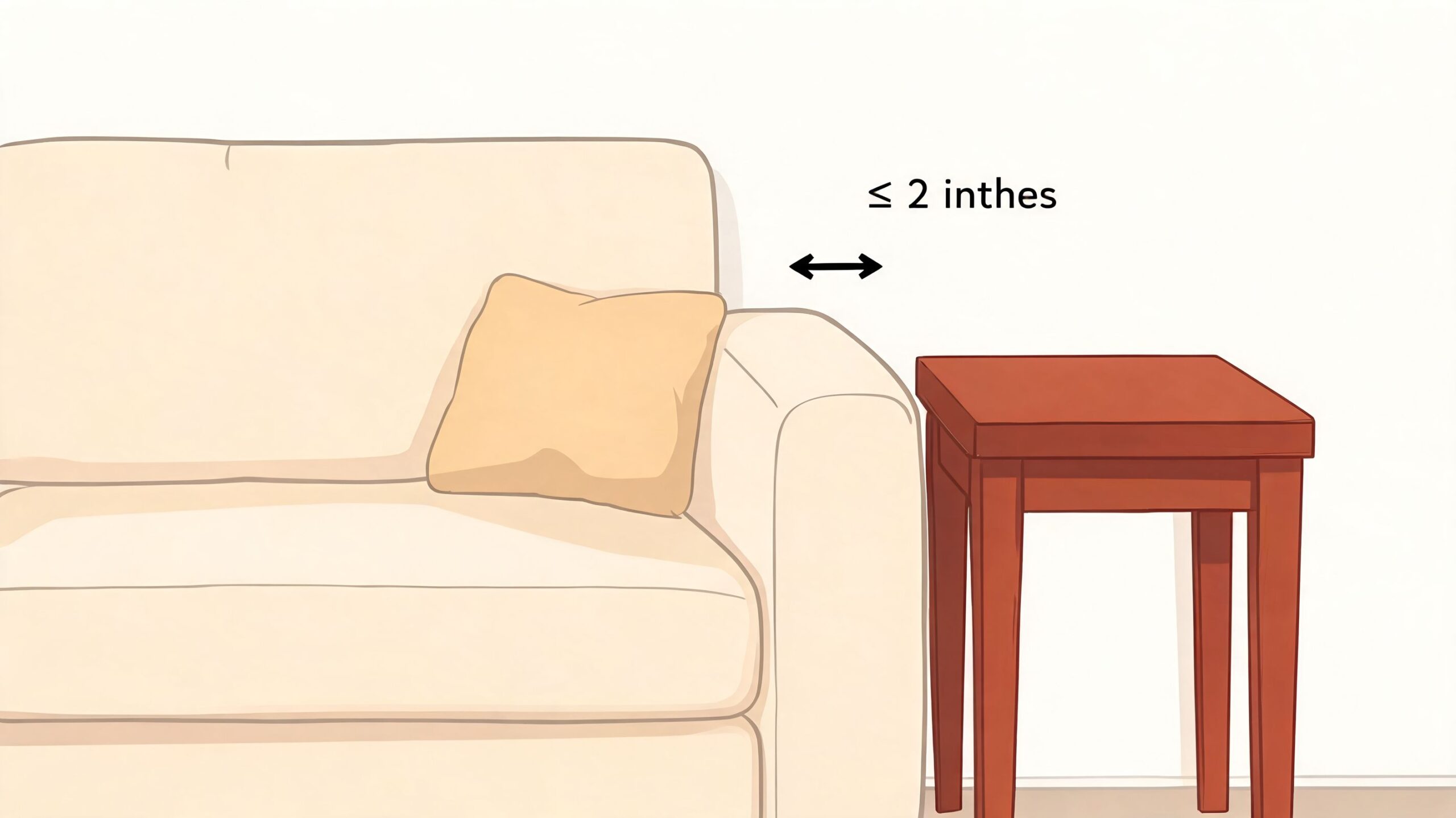
The most useful rule of thumb is simple. Your end table should sit within 2 inches of your sofa arm height. If it's much lower, reaching for a drink feels clumsy. If it's much higher, the table looks detached from the seating instead of connected to it.
Depth matters just as much, especially in tighter rooms. A table that sticks too far into a walkway can make a room feel cramped fast.
Use this checklist before you shop:
- Measure the sofa arm height
- Measure the open space beside the arm
- Account for traffic flow, especially near recliners, entry paths, and narrow living rooms
- Decide whether you need storage before you fall in love with a simple open table
For planning a room properly before delivery day, this guide on how to measure a room for furniture perfectly is worth using.
Match the shape to the room
Different shapes solve different problems.
- Round cherry end tables work well where traffic is tight or where you want softer lines near a sectional. They're also a comfortable choice in homes with young children because there aren't sharp corners at knee height.
- Square tables fit cleanly beside standard sofas and chairs when you have enough floor space.
- Rectangular or narrow tables help in smaller rooms where every inch counts.
- Nesting styles make sense in multipurpose spaces where you sometimes need more surface area and sometimes need the floor back.
The verified retail guidance in the provided data points to strong shopper interest in compact, storage-friendly pieces with drawers or shelves, especially for sectionals, recliners, and small-space living. That tracks with what many households need now. People want one piece to do more than one job.
Storage changes how the table lives
An end table with a drawer or shelf isn't just about hiding clutter. It changes how relaxed the room feels.
A drawer helps when you want remotes, chargers, coasters, or reading glasses close by but not visible. A lower shelf works better for baskets, books, or decorative pieces you use.
Choose the simplest style that still handles your real daily habits. Extra features help only if you'll use them.
If you want to test layouts before stepping into a showroom, room-planning tools can save a lot of backtracking. They're especially helpful when you're furnishing around an existing sofa you're keeping rather than starting from scratch.
Matching Cherry End Tables with Your Existing Décor
Cherry has personality, but it's easier to decorate with than many people expect. The mistake is trying to make everything match perfectly. Rooms usually look better when the woods and fabrics relate to one another instead of repeating the exact same tone everywhere.

Colors that work naturally with cherry
Cherry's warmth plays well with a lot of common interior palettes in Upstate homes.
Good pairings include:
- Creams and beiges for a softer, traditional feel
- Grays when you want cherry to warm up a cooler room
- Blues and greens because they balance the red undertone nicely
- Muted golds for a layered, classic look
If your room already has neutral upholstery, adding cherry often gives the space depth without making it feel busy.
Mixing wood tones without making a mess
You don't need your coffee table, media console, floor, and end tables to be the same wood. In fact, that often makes a room feel flat. What you want is a sense that the woods belong in the same conversation.
A practical way to do that is to repeat warmth elsewhere in the room. That could be in picture frames, lamp bases, flooring undertones, or fabric accents. Since professional design help has been available through the Freehold showroom since 1984, some local shoppers use that service to coordinate furniture with rugs, window treatments, and even flooring so the room feels tied together without looking overplanned.
Cherry looks strongest when the room supports it. Let it be one warm note among several, not the only one.
This is especially useful if your home already mixes painted pieces, oak floors, or black metal accents. Cherry can bridge old and new well as long as you give it a few supporting materials around the room.
Caring for Your Cherry Furniture to Last a Lifetime
Cherry doesn't need fussy maintenance, but it does reward steady care. A solid cherry end table is well-suited to long service because cherry is a strong hardwood with a fine, closed grain, and with proper joinery and finish it resists denting and racking in busy living rooms, according to the verified product guidance from Countryside Amish Furniture.
Daily care that actually matters
Most of the upkeep is simple:
- Dust with a soft, dry cloth so grit doesn't build up and dull the finish
- Wipe spills promptly instead of letting moisture sit
- Skip harsh cleaners that can work against the finish rather than help it
- Use coasters and felt pads where practical, especially under lamps and décor
For a broader maintenance overview, this guide on how to care for wood furniture covers the basics clearly.
Manage light with intention
Cherry changes with exposure, so placement matters. If you want the color to develop as evenly as possible, avoid extreme direct sunlight and move decorative objects from time to time so one patch doesn't darken around them. If you like the idea of cherry gaining character naturally, let that process happen, just don't be surprised by it.
The homeowners who are happiest with cherry usually understand one thing from the start. This isn't static décor. It's a living material that settles in over time.
Your Local Source for Custom and Amish Cherry End Tables
Cherry end tables make the most sense when you buy them with clear eyes. Know the size you need. Know the construction you want. Know whether you're buying for a quick fix or for long-term use in the room you live in.
That's why local shopping still matters for this category. Photos can show finish color, but they don't tell you much about weight, joinery, drawer fit, edge detail, or whether the piece feels right beside your own seating. For shoppers in Albany, Schenectady, Troy, and the wider Capital Region, the ability to compare woods, ask direct questions, and discuss custom options face-to-face is often what turns a maybe into the right purchase.
For buyers focused on solid wood and USA-crafted furniture, Amish furniture near Albany and Freehold is one practical route to explore. The same goes for custom ordering when standard dimensions or finishes don't fit your room. Tip Top Furniture & Mattresses also works with custom orders, financing options, and clearance inventory, which gives shoppers different paths depending on whether they want a personalized build, a planned monthly budget, or something available sooner.
A good cherry end table should feel useful on day one and still feel right years later. That's the standard worth holding onto.
If you're comparing cherry end tables for your home in Albany, Troy, Schenectady, Greene County, or nearby, Tip Top Furniture & Mattresses is a practical place to continue the search. Visit the Freehold, NY showroom to see wood species and construction in person, ask about custom Amish-made options, or explore financing and clearance choices if you want more flexibility while furnishing your living room.