8 Top Floor Trim Ideas for Albany Homes


You notice floor trim most when it’s wrong. The flooring may be beautiful, the wall color may be right, and the furniture may fit the room well, but if the baseboard feels too small, too ornate, too plain, or poorly matched, the whole space looks slightly off.
That’s why floor trim matters. It covers the wall-to-floor transition, protects the wall, and suggests what style the room is aiming for. In older Albany homes, trim can support the architecture or fight it. In newer homes across the Capital Region, it can add character that builder-grade finishes often miss. If you’re remodeling a historic city home, updating a ranch, or finishing a newer farmhouse in Greene County, trim is one of those details that changes the room from acceptable to intentional.
At Tip Top Furniture & Mattresses in Freehold, we’ve been helping local homeowners make coordinated home decisions since 1978, with professional design services available since 1984. Floor trim is one of those choices that works best when you stop looking at it as an isolated product and start seeing it next to the floor, wall color, room lighting, and furniture scale.
If you’re painting existing trim, this guide on tips for painting trim in Western Washington is a useful companion for prep and finish planning.
1. Traditional Colonial Baseboard with Quarter Round
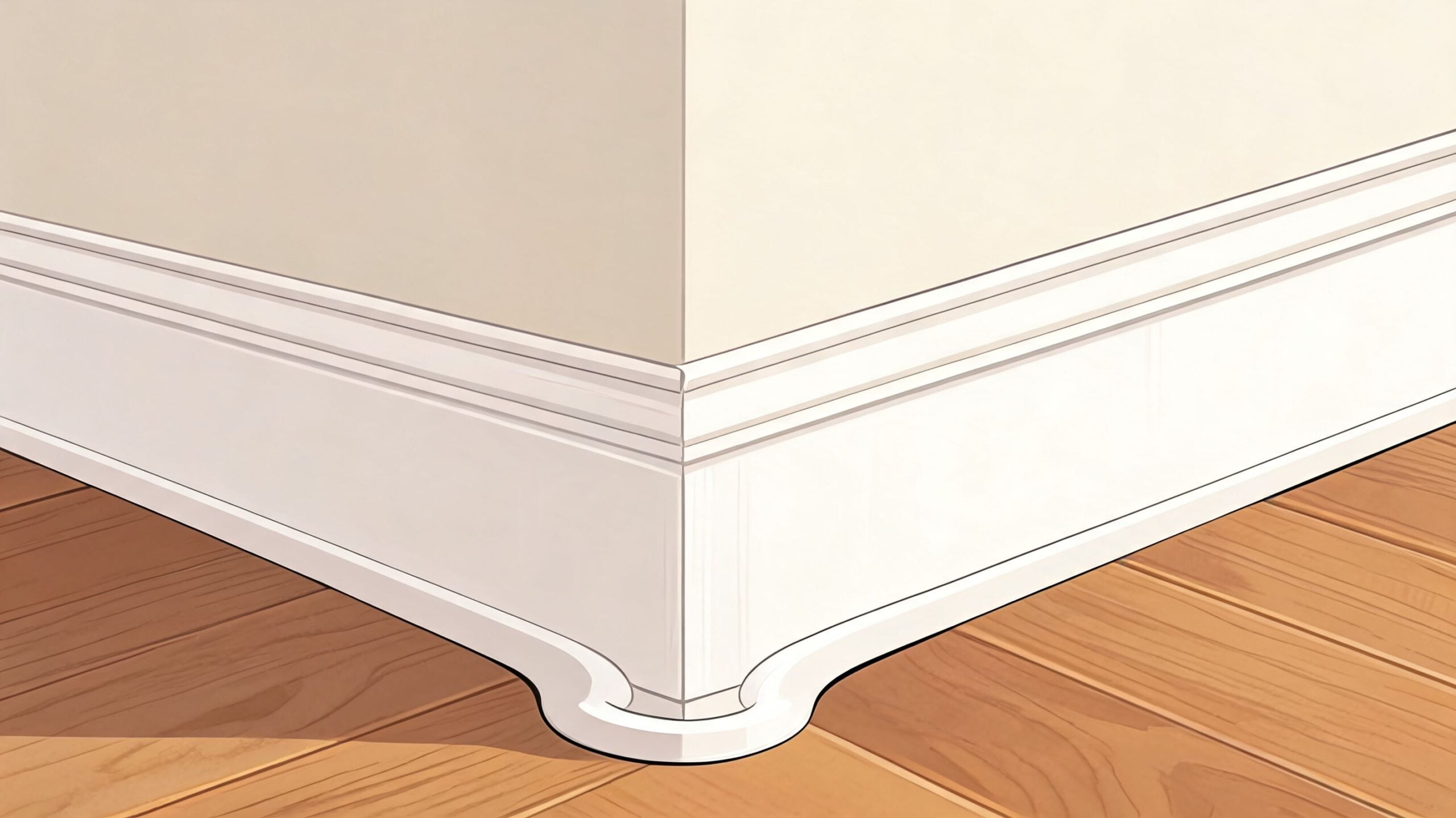
A traditional colonial baseboard is one of the safest floor trim ideas if you want a room to feel established, not trendy. It has enough shape to read as finished, but not so much ornament that it takes over the room.
This profile works especially well in Albany-area homes with older casings, six-panel doors, formal dining rooms, and mixed-era renovations where you’re trying to respect the house without turning it into a museum. If the rest of the trim package has some detail, a simple square baseboard often looks underdressed. Colonial trim fixes that.
Where it works best
Use this style when the room already has some traditional cues:
- Older door casings: Colonial baseboards relate better to existing milled casing than flat stock does.
- Hardwood floors: The quarter round helps hide small floor-edge irregularities, especially in older houses.
- Formal furniture layouts: Dining rooms, studies, and front living rooms benefit from the extra visual weight.
A lot of homeowners replacing just one damaged section run into the same problem. New trim looks too crisp and too different from the original profile. Matching the existing shape matters more than picking the “nicest” board at the lumber rack. That’s especially true when patching one wall in an older home.
If you’re pairing this look with a full flooring update, it helps to think through the transition details at the same time as the floor choice. Tip Top’s guide to carpet vs hardwood flooring is useful if you’re trying to decide how formal or relaxed the room should feel overall.
Practical rule: In traditional rooms, trim should feel related to the doors and windows. If the baseboard is much simpler than everything above it, the room loses balance.
Finger-jointed primed boards are a practical option for painted installs. They give you a cleaner finish than lower-grade stock and usually behave better than boards with more movement. Pre-finishing before installation also saves a lot of touch-up time later, especially if you’re working room by room while living in the house.
2. Modern Minimalist Flush Baseboard Trim
Some rooms look better when the trim nearly disappears. Flush baseboard trim does exactly that. Instead of framing the room in a traditional way, it keeps the eye moving across the wall and floor without interruption.
This approach fits contemporary homes, Scandinavian-inspired interiors, and newer renovations where the cabinetry, lighting, and furniture all lean clean-lined. It can also work in an older home, but only if the rest of the room has been simplified enough to support it.

What makes this one tricky
Minimal trim isn’t forgiving. The fewer visual details you have, the more every flaw shows.
A flush profile asks a lot from the drywall finisher, painter, and installer. Any wave in the wall, uneven seam, or rough paint line stands out immediately. In practice, this means the labor standard has to go up as the trim profile gets simpler.
The style itself has roots in the broader move away from ornate Victorian trim toward simpler forms. The shift began in the early 20th century with Craftsman trim’s cleaner rectangular profiles, continued through the mid-century ranch era, and eventually led to modern wall-to-floor reveal concepts, as outlined in this history of interior trim styles.
Best use cases in Albany-area homes
This style tends to work best in:
- Open kitchens and living areas: It supports a cleaner visual flow.
- Homes with simple cabinetry: Flat-panel doors and slab fronts pair well with it.
- Tone-on-tone paint schemes: Flush trim painted to match the wall creates a quiet, architectural finish.
For homeowners updating both trim and flooring, it’s smart to evaluate the room as one system. Tip Top’s advice on how to choose flooring helps when you’re trying to coordinate trim style with plank width, surface texture, and overall room tone.
Use flexible caulk sparingly and only where it helps hide tiny imperfections. Too much caulk on a minimalist profile does the opposite of what you want. It softens the crisp line and makes the trim look amateurishly installed.
3. Shiplap-Style Baseboard
If standard baseboard feels flat and plain, but ornate trim feels too formal, shiplap-style baseboard lands in a useful middle ground. It adds texture near the floor and gives the room a handcrafted look without needing heavily profiled molding.
This is one of the better floor trim ideas for farmhouse interiors, casual cottages, mudrooms, and relaxed family spaces in Greene County and the surrounding area. It also works in homes where you’ve already used paneling or wood detail elsewhere and want the trim to feel connected.
Why people like it
Shiplap-style trim softens the transition between wall and floor. Instead of one hard line, you get a layered edge that feels warmer and more custom.
It can also help bridge style gaps. That matters in homes where the kitchen leans farmhouse, the living room is transitional, and the furniture is a mix of painted pieces and stained wood. This profile doesn’t demand strict period accuracy. It just needs consistency in finish and proportion.
A practical material note matters here. If you’re building this look from wood components, stable stock gives you fewer headaches at the seams. Tip Top’s article on what kiln-dried wood is is worth reading if you want to understand why some boards move less after installation.
Small seam gaps are what usually ruin this look. Fill, sand, and repaint them before you call the project done.
What works and what doesn’t
A few trade-offs are worth knowing before you commit:
- Works well with painted finishes: White, warm cream, greige, and muted sage all suit this style.
- Works in casual rooms: Entry areas, kids’ rooms, guest rooms, and informal dining spaces wear it well.
- Doesn’t work with fussy trim packages: If your house already has ornate casing and formal crown, this can feel mismatched.
- Doesn’t hide sloppy cuts: Texture creates shadow lines, and shadow lines expose mistakes.
Pre-primed finger-jointed pine is usually the easiest path for painted installs. Apply filler at seams, then sand them flush before final paint. If you skip that step, the finished trim can read like separate parts instead of one designed detail.
4. Cove Base Trim
Cove base trim has a softer look than standard square or stepped profiles. Instead of stopping the eye at a hard corner, it rounds the transition and makes the base of the wall feel smoother.
That’s one reason it shows up in practical spaces. Kitchens, baths, laundry rooms, and lower-level rooms all benefit from a trim profile that feels clean and easy to maintain. In residential design, it’s especially useful when you want trim that’s subtle but not invisible.
Why it makes sense in moisture-prone rooms
Material matters more here than profile alone. In spaces where water, humidity, or frequent mopping are part of daily life, wood can become the wrong answer even if it looks beautiful on day one.
The market has moved strongly toward resilient flooring materials. In 2024, vinyl represented 34.2% of the U.S. flooring market, and the renovation segment accounted for 52.3% of the market, according to U.S. flooring market data. That same practical mindset carries over to trim, especially in bathrooms, kitchens, and basements where moisture resistance matters.
PVC cove base is often the most sensible pick in those rooms. It won’t give you the warmth of stained wood, but it does solve real performance problems.
Where homeowners get this wrong
Cove base can look excellent, or it can look like a commercial shortcut. The difference usually comes down to context.
Choose it when the room already supports a cleaner, utility-minded finish. Don’t force it into a formal dining room or a front parlor and expect it to feel elegant. It usually won’t.
For best results:
- Use PVC in wet rooms: It handles splashes and damp cleaning better than wood.
- Seal the edges: Caulk the top and bottom so water and dust don’t collect.
- Match the floor tone carefully: A slightly off white or gray is more obvious on curved trim than on profiled wood.
This style is practical first. That’s its strength, not a weakness.
5. Layered Baseboard with Cap Molding
Layered baseboard with cap molding is what you use when standard trim feels too basic, but you don’t want the full complexity of restoring historic millwork. It gives you depth, shadow, and a custom-built look by combining a flat or simple base with a separate cap profile.
In Albany brownstones, larger center-hall homes, and formal renovations, this approach can look right at home. It also helps when the room has tall walls that make ordinary trim seem undersized.
A style with historical logic
This idea has real historical precedent. During the 1890s, three-part floor molding became a popular design choice in homes, often measuring about 30 to 40 cm in height, with a profiled lower section and smoother sections above, as described in this overview of 1890s woodwork. That broader Victorian and Queen Anne period favored tall baseboards and more decorative interior trim.
You don’t need to recreate a full Victorian assembly to borrow the logic. A layered base with cap molding gives you some of that vertical presence in a more flexible form.
Design note: If the room has taller ceilings or larger door casings, layered trim often looks more convincing than a single oversized board.
How to make it feel intentional
This style succeeds when the layers look related, not stacked as an afterthought. Before cutting your final material, make a mock-up from scrap pieces and hold it against the wall next to the door casing.
That quick test tells you a lot:
- Check projection: If the cap sticks out too far, the trim can feel bulky.
- Check casing relationship: The base should complement, not overpower, the vertical trim.
- Check finish consistency: Mixed woods or mismatched paint sheen can make custom trim look improvised.
This is also where custom ordering helps. If you’re already furnishing with solid wood pieces or planning Amish-made furniture for the room, repeating that sense of craftsmanship in the trim package makes the space feel coherent rather than pieced together.
6. Contrasting Painted Trim
Contrasting trim changes the room fast. White walls with dark baseboards, warm neutral walls with deep green trim, or soft greige walls with black trim all create stronger architectural lines without changing the floorplan.
This approach works well when the trim itself is worth highlighting. If the profile has shape, if the room has good natural light, or if you want the walls and furnishings to feel more graphic, contrast can be the move.
Why this idea works
Paint turns trim into part of the design palette instead of leaving it as default background. That can be useful in newer homes where the millwork is simple and the room needs more identity.
It also helps tie trim to furniture and finishes. A dark baseboard can relate to black metal lighting, darker table legs, walnut casegoods, or framed artwork. A softer contrast can make a room feel more cohesive without being loud.
If you’re trying to settle on a trim color that works with your floors, walls, and furnishings together, Tip Top’s guide to picking the perfect paint color for your home is a strong starting point.
What to watch out for
High contrast shows everything. Dents, caulk lines, brush marks, and uneven joints all stand out more when the trim color is bold.
Use a high-build primer when you’re covering stained or uneven existing trim, and don’t rush prep. Glossy or darker finishes especially need cleaner sanding and better surface correction before paint goes on.
A few situations where it tends to work best:
- Modern or transitional rooms: Contrast feels deliberate here.
- Rooms with simple trim profiles: Color gives plain trim more presence.
- Homes with repeated dark accents: The trim feels integrated, not random.
Dark trim looks sharp when the room has enough daylight. In a dim hallway with weak lighting, it can just look heavy.
If the room already feels busy with patterned rugs, strong wallpaper, and decorative furniture, contrasting trim may push it too far. In those spaces, quieter trim usually wins.
7. Integrated LED Baseboard Trim
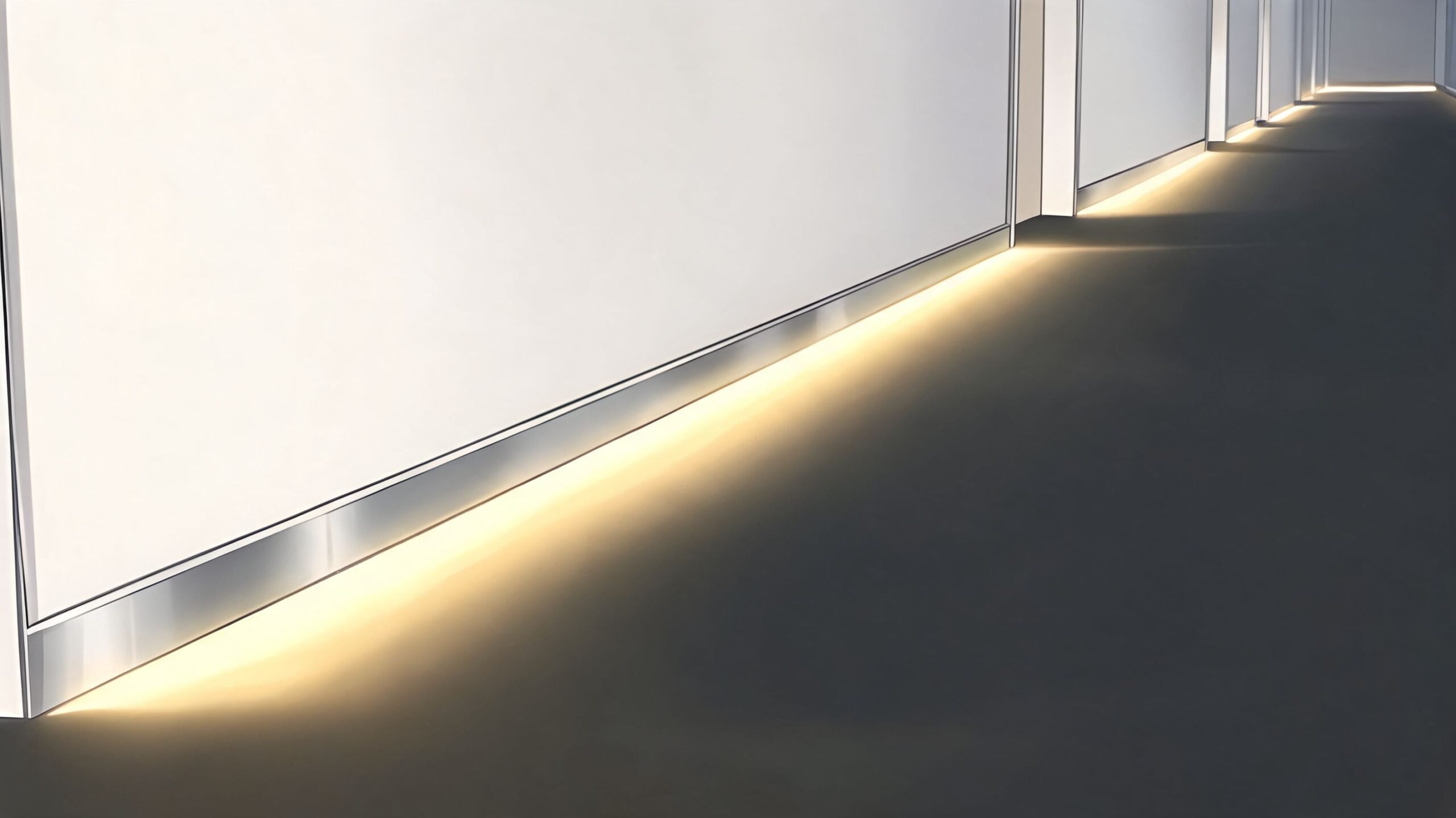
Integrated LED baseboard trim is one of the more specialized floor trim ideas, but in the right room it’s excellent. It adds low-level illumination that can make a hallway, media room, stair landing, or night path feel more polished and more usable.
This isn’t a replacement for general lighting. It’s accent lighting with a practical side. The trim glows at floor level, which can help define edges and create atmosphere without blasting overhead light.
Where it makes sense
The best locations are spaces used in lower light:
- Hallways: It creates a softer path than ceiling cans alone.
- Home theaters or TV rooms: Floor-level light reduces glare and keeps the mood.
- Open-plan modern homes: It reinforces a clean, architectural look.
A lot depends on planning. You want wiring and any necessary channels decided before finish surfaces are complete. Retrofitting after the fact is usually more work than homeowners expect, especially if the walls are already painted and the flooring is in.
If you’re dimming the system, compatibility matters. This guide to selecting compatible LED dimmers is a useful outside reference before you buy components.
What separates a clean install from a gimmick
The light should feel integrated, not flashy. Warm light usually works better in living spaces with wood furniture, textiles, and softer color palettes. Cooler light can fit a sharper, contemporary interior, but it goes sterile quickly if the rest of the room isn’t equally modern.
Keep these trade-offs in mind:
- Looks best with simple trim forms: Ornate profiles fight the technology.
- Needs thoughtful electrical planning: Don’t leave this decision for the painter or trim carpenter alone.
- Should connect to the room’s design language: If the home is very traditional, LED base trim often feels out of place.
Done well, this detail feels custom. Done poorly, it feels like a novelty.
8. Natural Wide Wood Baseboard
Natural wide wood baseboard has presence. It doesn’t rely on ornate milling or paint contrast. Instead, it lets wood grain, board width, and finish carry the look.
This style works especially well in craftsman, rustic, organic modern, and higher-end farmhouse interiors. It also pairs beautifully with solid wood furniture, which is one reason it can be such a strong fit for homeowners shopping in Freehold and throughout the Albany area who want the room to feel grounded and lasting.
Why wood species matters
With natural trim, the species choice is visible all the time. Grain, color variation, and hardness all affect the final result, so this isn’t the place to pick material casually.
If you’re coordinating wood trim with furniture pieces in the same room, Tip Top’s guide to the best wood for tables can help you think through how oak, walnut, and other species read in finished interiors.
The trim doesn’t have to match the furniture exactly. It should look related. A room feels better when the undertones of the wood are cooperating, even if the pieces come from different makers.
How to keep it from looking heavy
Wide wood baseboard can look rich and architectural, or it can feel bulky. The difference usually comes down to profile simplicity and room context.
A square or lightly eased edge tends to work best. Once you’re using a broad natural board, you don’t need a lot of extra shape. Let the wood do the work.
Installer’s reminder: Bring the wood into the house and let it acclimate before installation. Natural trim shows movement more than painted trim does.
A few practical notes matter here:
- Seal both sides when appropriate: It helps the board behave more evenly.
- Use this style where wood is already part of the story: Beams, wood floors, solid wood furniture, or paneled details all support it.
- Avoid forcing it into very formal painted interiors: It can feel disconnected.
This is one of the strongest floor trim ideas if you want warmth without decorative fuss.
8-Style Floor Trim Comparison
| Style / Item | Implementation Complexity 🔄 | Resource Requirements ⚡ | Expected Outcomes ⭐ | Ideal Use Cases 📊 | Key Advantages 💡 |
|---|---|---|---|---|---|
| Traditional Colonial Baseboard with Quarter Round | Moderate, precise mitering and fitting | Common milled boards, moderate labor | Timeless, elegant visual weight; conceals gaps | Traditional, transitional, historic homes | Versatile, widely available, hides floor imperfections |
| Modern Minimalist Flush Baseboard Trim | Moderate, requires ultra-smooth drywall and concealed fasteners | Low-profile materials (MDF), careful finishing | Seamless, streamlined look | Contemporary, Scandinavian, lofts | Clean aesthetic, easy maintenance, unobtrusive |
| Shiplap-Style Baseboard | Higher, multiple narrow pieces and joint work | More material & labor (slats, primed pine) | Textured, rustic depth and character | Farmhouse, cottage, shiplap-accented rooms | Adds charm, complements paneling, hides minor irregularities |
| Cove Base Trim | Low–Moderate, one-piece install but needs accurate fit | PVC or wood cove profiles, minimal joints | Smooth continuous transition; easy to clean | Bathrooms, kitchens, commercial/wet areas | Hygienic, continuous look, moisture-resistant options |
| Layered Baseboard with Cap Molding | High, multi-tier assembly and precise layout | More material and skilled millwork; higher cost | Rich, dimensional architectural presence | High-end interiors, formal rooms, restorations | Highly customizable, strong visual impact, coordinates with crown |
| Contrasting Painted Trim | Low–Moderate, painting precision and taping required | Paint/primer, possible semi/gloss finishes | Bold graphic accent that emphasizes lines | Design-forward homes, feature walls, modern eclectic spaces | Instant visual impact, easily changed by repainting |
| Integrated LED Baseboard Trim | High, electrical planning and professional install | LED strips, extrusions, wiring, electrician; higher cost | Ambient floor-level lighting and safety | Hallways, home theaters, modern open plans | Functional accent lighting, energy-efficient, enhances ambiance |
| Natural Wide Wood Baseboard | Moderate–High, heavy material handling and acclimation | Solid hardwood planks, machining, higher material cost | Warm, premium natural grain and durable finish | Craftsman, rustic, and high-end interiors | Showcases wood grain, durable, customizable stain match |
Bring Your Vision to Life in the Capital Region
Choosing floor trim gets easier once you stop treating it like a final add-on. The best trim choice depends on the room’s architecture, your flooring material, how much visual weight the furniture carries, and whether you want the trim to stand out or disappear. A colonial profile can support an older Albany home beautifully. A flush or LED-integrated option may make more sense in a newer, cleaner-lined renovation. In a basement bath or laundry room, moisture resistance may matter more than decorative detail.
That’s also why homeowners often get better results when they make these decisions together instead of one at a time. Flooring, trim, paint, and furniture all affect each other. A wide oak baseboard will look different next to pale carpet than it will next to medium-tone hardwood. Black trim that looks crisp with modern seating can feel too harsh beside a softer traditional furniture package. The trim choice isn’t just about trim.
At Tip Top Furniture & Mattresses, that whole-room thinking is part of the process. From the Freehold showroom, the team serves homeowners across the Greater Albany Capital Region with furniture, mattresses, décor, custom ordering, and flooring options that can be coordinated instead of pieced together later. For shoppers who want handcrafted wood furniture, Amish-made pieces can also help shape the trim and finish direction of a room in a way that feels consistent and intentional.
The store’s long local history matters here too. Tip Top has served the region since 1978, and professional design services have been available since 1984. That experience is useful when you’re trying to solve real rooms, not just collect inspiration photos. Sometimes the right answer is historically respectful. Sometimes it’s practical and low-maintenance. Sometimes it’s a bold painted trim that gives a plain room some life.
If you’re planning a room update or a full-home refresh, it helps to see materials in person and talk through the trade-offs with someone who understands how the pieces fit together. That’s especially true if you’re weighing custom order furniture, coordinated flooring, or financing options for a larger project. Floor trim may be one detail, but it often tells the room how to finish.
Visit Tip Top Furniture & Mattresses to explore flooring, furniture, custom order options, and design support for your Albany-area home. If you’re building a room from the floor up, stop by the Freehold showroom, ask about a complimentary design consultation, or review available financing options to make the project easier to complete on your timeline.