Optimize Your Home Office Desk Placement for Productivity

You can feel a bad desk location within a week.
The chair catches on the rug every time you push back. Afternoon glare hits the screen just as your meeting starts. Someone walks behind you on camera. Papers pile up because there's nowhere sensible to put them. What started as a temporary work corner becomes the spot where you spend a big part of your day, and suddenly home office desk placement stops being a decorating question and becomes a daily comfort question.
Around Freehold, Albany, Troy, and the rest of the Capital Region, I've seen that shift firsthand for years. Families don't just want a desk that fits. They want a workspace that helps them think clearly, work comfortably, and still feel at home.
Why Your Desk Placement Matters More Than Ever
A lot of people began working from home with whatever they had on hand. A spare table in the guest room. A desk shoved against a wall in the bedroom. A chair borrowed from the dining room. That setup can get you through a week or two, but it rarely holds up for months.
That change happened fast across the country. Before the pandemic, about 20% of U.S. workers worked from home. By late 2020, 71% were working from home, and studies found that up to 88% were using a dedicated desk, which made desk location a real part of household planning rather than an afterthought (Pew Research Center).
For homeowners in the Capital Region, that tracks with what many families already know from experience. The home office now has to do real work. It has to support focus, calls, storage, lighting, and movement, often in a room that also has to serve another purpose.
A desk that looks fine on day one can still be wrong if it creates glare, blocks traffic, or leaves you feeling boxed in by day ten.
That's why placement comes first. The right desk in the wrong spot is still the wrong setup.
What changed in real homes
In a well-used home office, the desk becomes the anchor piece. It determines where your chair rolls, where cords run, how light falls across the screen, and whether the room feels settled or scattered.
That's also why planning matters before shopping. If you're still working out the room itself, this guide to creating an inspiring home office is a helpful place to start.
What good placement actually does
When desk placement is right, people usually notice the same practical wins:
- Less visual strain because the monitor isn't fighting a bright window or dim corner
- Better posture habits because the chair and screen can sit where they belong
- Cleaner circulation so you're not squeezing past furniture all day
- A calmer room feel because the desk works with the architecture instead of against it
That's not design theory. It's what makes the room easier to live with.
Before You Move Anything Assess Your Space and Needs
The biggest desk placement mistakes happen before the desk moves an inch. People measure one wall, decide “it fits,” and then discover the door hits the chair, the floor lamp blocks the file drawer, or the best outlet is six feet away on the wrong side of the room.
Start by slowing down and reading the room the way a planner would.
Ask how you actually work
A home office for bookkeeping looks different from one used for client calls, design work, or school schedules. Before you think about walls and windows, answer a few practical questions.
- Focus or conversation. Do you need quiet, heads-down work, or are you on calls throughout the day?
- Paper or mostly digital. Do you need room for files, notebooks, and a printer, or just a laptop and one monitor?
- One user or shared use. Does the room belong to you alone, or does someone else need access after hours?
- Formal or flexible. Do you need a polished background for meetings, or can the space stay more casual?
Those answers shape placement more than style trends do.
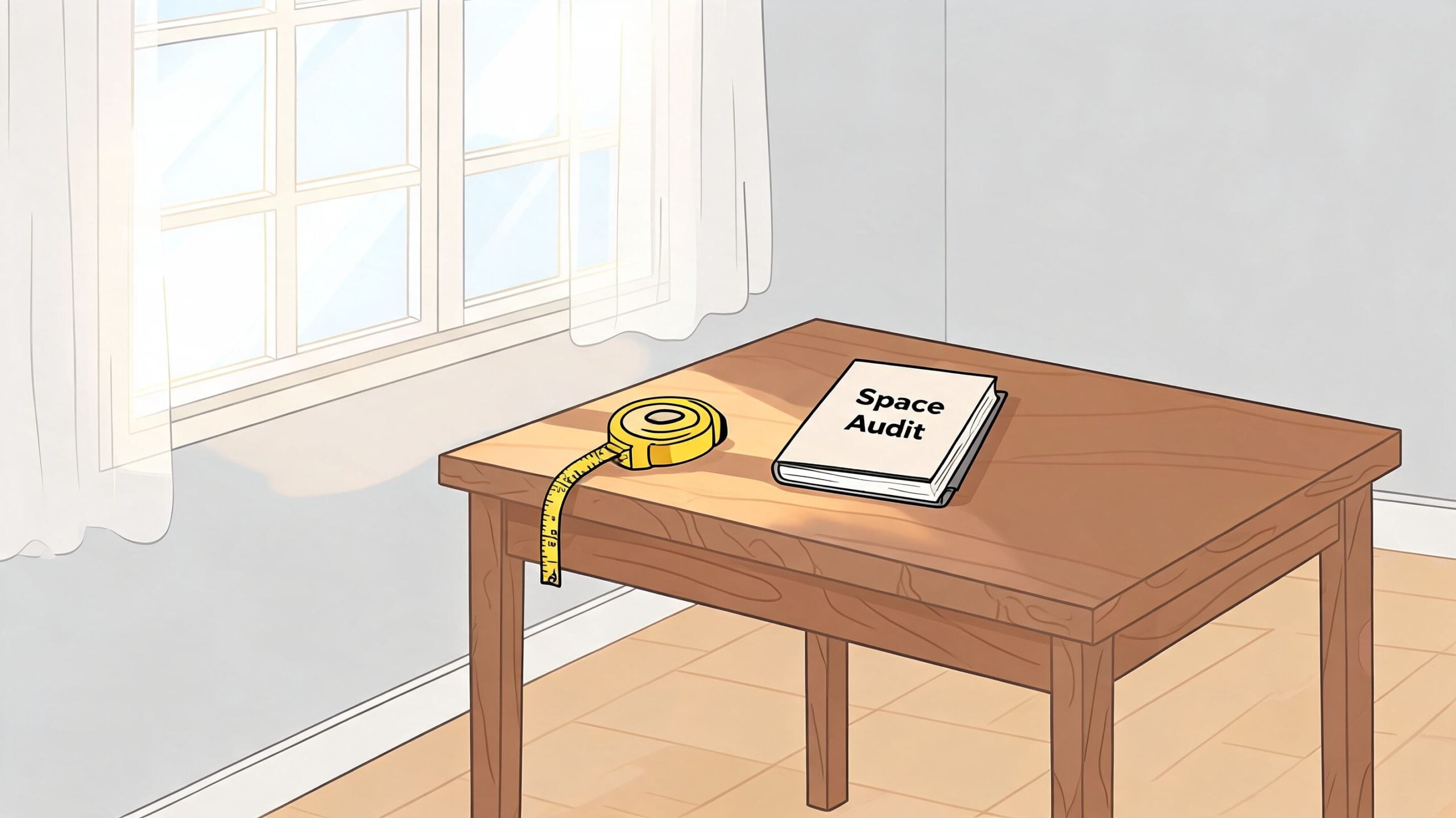
Measure the room like you mean it
A useful floor plan includes more than length and width. It should show the things that interfere with furniture in real life.
Use this checklist before you lock in a location:
- Door swing. Mark where the door opens and how much clearance it needs.
- Windows. Note size, sill height, and where direct light falls during your workday.
- Outlets and vents. A desk shouldn't block heat or force cords across a walkway.
- Traffic paths. Track how people move through the room to reach closets, windows, or adjoining spaces.
- Floor surface. Chair movement changes a lot depending on hardwood, carpet, or an area rug. If you're weighing materials, this workspace flooring comparison for homeowners gives a good practical overview.
For many rooms, a rough sketch on graph paper is enough. For awkward spaces, it helps to use a scaled tool so you can test more than one option before lifting furniture. If you need a measuring refresher, how to measure a room for furniture perfectly lays out the basics in a straightforward way.
Practical rule: Measure the room, then measure the room as you use it. A clear wall isn't really clear if a radiator, baseboard, floor vent, or doorway steals part of that footprint.
Look for constraints that decide the layout for you
Some rooms give you freedom. Others don't. In smaller homes and multipurpose rooms around Greene County and the Capital Region, the layout often gets decided by one stubborn reality, like a window centered on the only long wall or a closet door that must stay accessible.
When that happens, don't fight the room. Work with it.
A good placement plan usually balances three things:
| Priority | What to check | Why it matters |
|---|---|---|
| Comfort | Light, posture, chair clearance | You'll feel this every day |
| Function | Outlet access, storage reach, work surface | It affects how easily you can get through tasks |
| Flow | Doorways, walk paths, visual openness | The room needs to work for the whole household |
If one of those is ignored, the setup tends to feel wrong even when the furniture looks good.
The Three Core Desk Placement Strategies
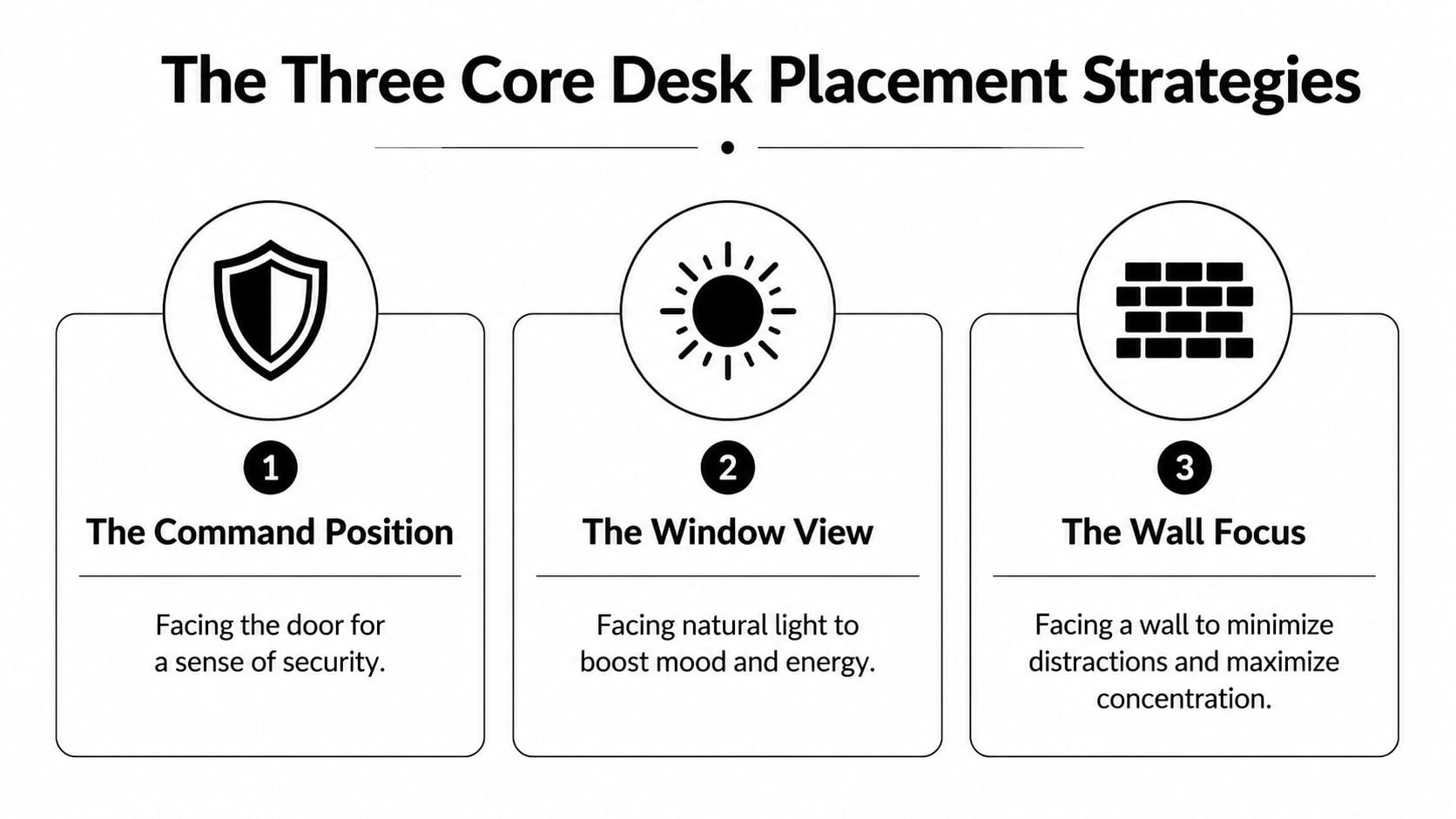
Most home office layouts fall into three broad categories. None is automatically right for every room. The best one depends on the room shape, your work habits, and what trade-offs you can live with.
The command position
If the room allows it, this is usually the strongest starting point. In the command position, the desk faces the room entrance, but it isn't jammed directly in line with the door. Research cited in ergonomic and workplace design guidance found that this orientation can reduce low-back and neck strain by up to 22%, and wall-facing setups can correlate with higher anxiety (Work Design Magazine on the command position).
In plain terms, people often feel better when they can see who's coming in without twisting around or working with their back exposed to the room.
This placement works especially well for:
- Frequent meetings because you tend to sit more upright and feel more settled
- Shared households where people may enter the room during the day
- Larger home offices with enough depth to float the desk away from the wall
The drawback is space. In a smaller room, this strategy can eat up valuable floor area.
The window view
Many people instinctively place a desk to face a window. It feels uplifting, and for some kinds of work, that outward view can be welcome. But it needs care. A direct face-to-window setup can create glare and visual fatigue if the light is too strong or the screen angle is wrong.
A better version often places the desk near the window instead of directly confronting it. That gives you daylight without turning the monitor into a mirror.
For readers also setting up a recreation zone or teen study-and-gaming corner, some of the practical layout ideas in these tips for a value-focused gaming environment can be useful, especially around equipment placement and keeping the work surface manageable.
The wall focus
This is the most common small-space solution. The desk faces a wall, often because that's the only place it fits cleanly.
Used well, it can be effective. Wall-facing setups can reduce visual distractions, and they're often the easiest way to preserve traffic flow in a compact office or bedroom. Used poorly, they can feel confining and mentally flat, especially if the wall in front of you is blank, dark, or cluttered.
If you must face a wall, give your eyes something orderly to land on. A simple pinboard, framed art, or a controlled shelf arrangement changes the whole experience.
A quick side-by-side comparison
| Strategy | Works well when | Main advantage | Main caution |
|---|---|---|---|
| Command position | The room has enough depth | Better awareness and a stronger sense of control | Needs more floor space |
| Window view | Natural light is good and manageable | Brighter mood and a more open feel | Can create glare |
| Wall focus | The room is tight or multipurpose | Efficient use of limited space | Can feel boxed in if not softened |
If you're testing several layouts before buying furniture, how to plan room layout is a practical next step.
Master Your View for Video Calls and Daily Focus
A modern desk setup has two views to manage. One is the view behind you on camera. The other is the view in front of you all day long.
Most guides stop at ergonomics, but for many remote workers in Albany and the surrounding area, video calls are part of the job. Desk placement has to support that reality.
Build a background that looks intentional
The most dependable camera background is simple and still. You don't need a staged room. You need a backdrop that doesn't distract, embarrass, or expose household traffic.
A few reliable choices:
- A bookcase or low credenza behind you with restrained styling
- A plain painted wall with art rather than a busy doorway
- Closed storage for papers, printers, and office supplies
- A corner angle that keeps people from crossing behind your chair
Furniture selection matters. A bookcase with too many open shelves can look messy fast. A credenza with concealed storage often performs better on camera. If you need a size or finish that matches the room exactly, custom order furniture can solve that more cleanly than trying to force a standard piece into place.
Use daylight without fighting it
Natural light helps, but it has to hit the desk correctly. Research on daylight-oriented desk placement found that placing the desk perpendicular to a window rather than directly facing it can reduce headache complaints by 30%, support attention, and help avoid the glare problems reported by 40% to 60% of users who face a window directly (HGA on daylighting and views).
That principle matters for calls too. Side light is usually more flattering than strong backlight or direct front glare.
A practical setup looks like this:
- Desk beside the window, not directly in front of it
- Monitor angled away from reflections
- Simple window treatment to soften harsh afternoon light
- A lamp opposite the window so your face doesn't fall into shadow on calls
The camera sees contrast before it sees style. If the window behind you is bright and your face is dark, the room will look worse than it actually is.
Reduce the clutter in your direct line of sight
What you look at affects how the room feels. If your monitor sits in front of stacked papers, exposed cords, and random storage bins, your brain never gets a visual break.
For small spaces, I like a narrow set of rules. Keep only what you use daily on the desk. Move bulky equipment off the main surface. Limit open storage in front of your eyeline. A room doesn't have to be minimal to feel calm, but it does need visual order.
Finalize Your Layout with Ergonomics and Flow
Once you've chosen the general location, the details do the essential work, transforming a promising layout into a comfortable one.
Give the desk enough breathing room
Professional space-planning guidance recommends a workstation capsule of about 60 inches wide by 60 to 78 inches deep for a standard desk, chair, and movement space (Work-Fit workstation guidance). That's one of the most useful numbers to keep in mind when homeowners try to squeeze an office into a spare bedroom or den.
It explains why a desk that technically fits can still feel cramped. You're not placing a rectangle of wood. You're placing a work zone that has to include your chair, your body, and enough clearance to move comfortably.
Check the physical setup point by point
Once the desk is in place, run through the basics:
- Screen position. The top of the monitor should sit at or slightly below eye level.
- Chair path. Make sure the chair can roll back without hitting a wall, cabinet, or bed.
- Reach zone. Keep daily items close, and move rarely used equipment elsewhere.
- Cable control. Route cords along the back edge or underneath so they don't cut across the floor.
- Storage balance. Use a mix of open and closed pieces so the room doesn't feel cluttered.
For anyone dealing with back, shoulder, or neck fatigue at home, this guide to at-home scoliosis and posture management is a useful supplement to good furniture planning.
Match the furniture to the job
Quality is a key consideration. A shallow desk may look light and clean, but it can become frustrating if you use two screens or need writing space. A bulky executive desk can overwhelm a modest room. A file cabinet that opens into a walkway can ruin an otherwise good plan.
Solid wood desks, including Amish-made styles, tend to work especially well when you need durability and custom sizing. In rooms with awkward dimensions, a custom order can solve width, depth, or storage issues more neatly than settling for a piece that's almost right. Tip Top Furniture & Mattresses also offers ergonomic home office furniture for shoppers comparing desk and chair options with those fit considerations in mind.
Don't ignore room flow
I've seen attractive office layouts fail because they interrupt the room itself. A good desk placement should still let you open the closet, reach the window, and walk through the space without turning sideways.
Use this quick test after everything is placed:
| Check | Good sign | Problem sign |
|---|---|---|
| Door access | Door opens freely | Door hits chair or desk corner |
| Walkway | You can pass through naturally | You sidestep around furniture |
| Storage use | Drawers open fully | Drawer fronts crash into other pieces |
| Visual weight | Room feels balanced | One wall feels overloaded |
If a setup fails two of those checks, it usually needs another pass.
Create Your Perfect Capital Region Home Office Today
The right home office desk placement doesn't come from guessing. It comes from balancing light, posture, video-call needs, storage, and the way the room functions day to day.
That's why the best layouts usually feel simple after the work is done. The desk sits where the room supports it. The chair moves easily. The background looks clean. The room helps you work instead of fighting you.
For families across Freehold, Albany, Schenectady, Troy, and the wider Capital Region, that kind of planning has real value. A home office isn't just another furniture purchase anymore. It's part of how your household runs.
If you're refining ideas for your own space, home office setup ideas can help you narrow down what style and function make sense for your room.
A few smart next steps:
- Try a room planner if you want to test desk positions before moving anything heavy.
- Book a design consultation if your room has awkward windows, multiple doors, or shared-use demands.
- Look at clearance options if you need a practical office now and want to stay budget-conscious.
- Consider financing if the right desk, chair, and storage setup will make the room work for the long haul.
A well-placed desk won't make every workday easy. It will make the room easier to use, and that adds up fast.
If you're ready to improve your workspace, Tip Top Furniture & Mattresses can help you compare desks, storage, and room solutions for homes across Freehold and the Greater Albany Capital Region, whether you're planning from scratch, shopping for a better fit, or looking for design guidance on a challenging room.