Entryway Lockers with Doors: Albany’s 2026 Guide

Wet boots by the door. A pile of backpacks on the floor. Coats draped over chairs because the closet is full or too far from the entry. In the Albany Capital Region, that scene gets worse when the weather turns and every family member seems to come home wearing another layer.
A well-designed locker wall fixes that problem without making the entry feel crowded. Entryway lockers with doors give each person a dedicated place, hide the visual mess, and make a hardworking space look finished instead of improvised. For homes in Greene County, Freehold, Albany, Schenectady, Troy, and the surrounding Capital Region, they're especially useful because they accommodate winter gear, muddy shoes, and daily traffic.
That's one reason organized storage keeps gaining attention. The global market for locker systems, including residential entryway units, is projected to grow from USD 8.30 billion in 2026 to USD 38.89 billion by 2034, driven by demand for secure, organized storage in modern homes, according to locker market projections. Homeowners aren't overthinking this purchase. They're solving a real problem that affects the way the house functions every day.
The End of the Cluttered Entryway
A good entryway has a simple job. It needs to catch the mess before it spreads into the kitchen, living room, or hallway.
Open hooks and benches can help, but they only go so far. If a family uses the space every day, open storage often turns into visible storage. That means shoes stay out, hats pile up, and the whole area always looks half-finished. Entryway lockers with doors change that by giving each zone a boundary.
Why doors make such a difference
Doors do two things at once.
- They hide disorder: Even on a busy weekday, the room looks calmer.
- They create ownership: One locker for each person cuts down on random dumping.
- They support routines: Coats, bags, lunch totes, and seasonal extras all return to the same place.
- They make the entry feel intentional: The space starts to read like built-in furniture, not overflow storage.
That matters in older homes around the Capital Region where entry spaces often need to work harder than their square footage suggests. A compact wall can still become useful if every inch has a purpose.
Practical rule: If the household uses the same drop zone every day, hidden storage usually performs better than open shelving.
A closed locker system also works well when the entry is visible from another room. Many homes don't have a separate mudroom. The front or side entry may open right into the kitchen or main living space. In that situation, the storage piece has to work as furniture, not just utility.
What homeowners should look for first
Before focusing on finish or hardware, it helps to ask a few practical questions:
- Who uses the space most often
- What needs to be hidden
- Whether the unit needs coat storage, shoe storage, or both
- How much walking space must stay clear
For shoppers who are still weighing styles and configurations, browsing hall trees and storage furniture options can help narrow down whether a freestanding piece or a more locker-style setup makes sense.
The best choices aren't always the biggest. They're the ones that match the family's actual habits.
Choosing the Right Door Style and Material
Style matters here because the locker unit often sits in one of the most visible transition points in the house. It's usually seen first when someone enters and often seen from nearby living spaces. The door design has to look right with the home, but it also needs to handle everyday wear.
Three common looks that work
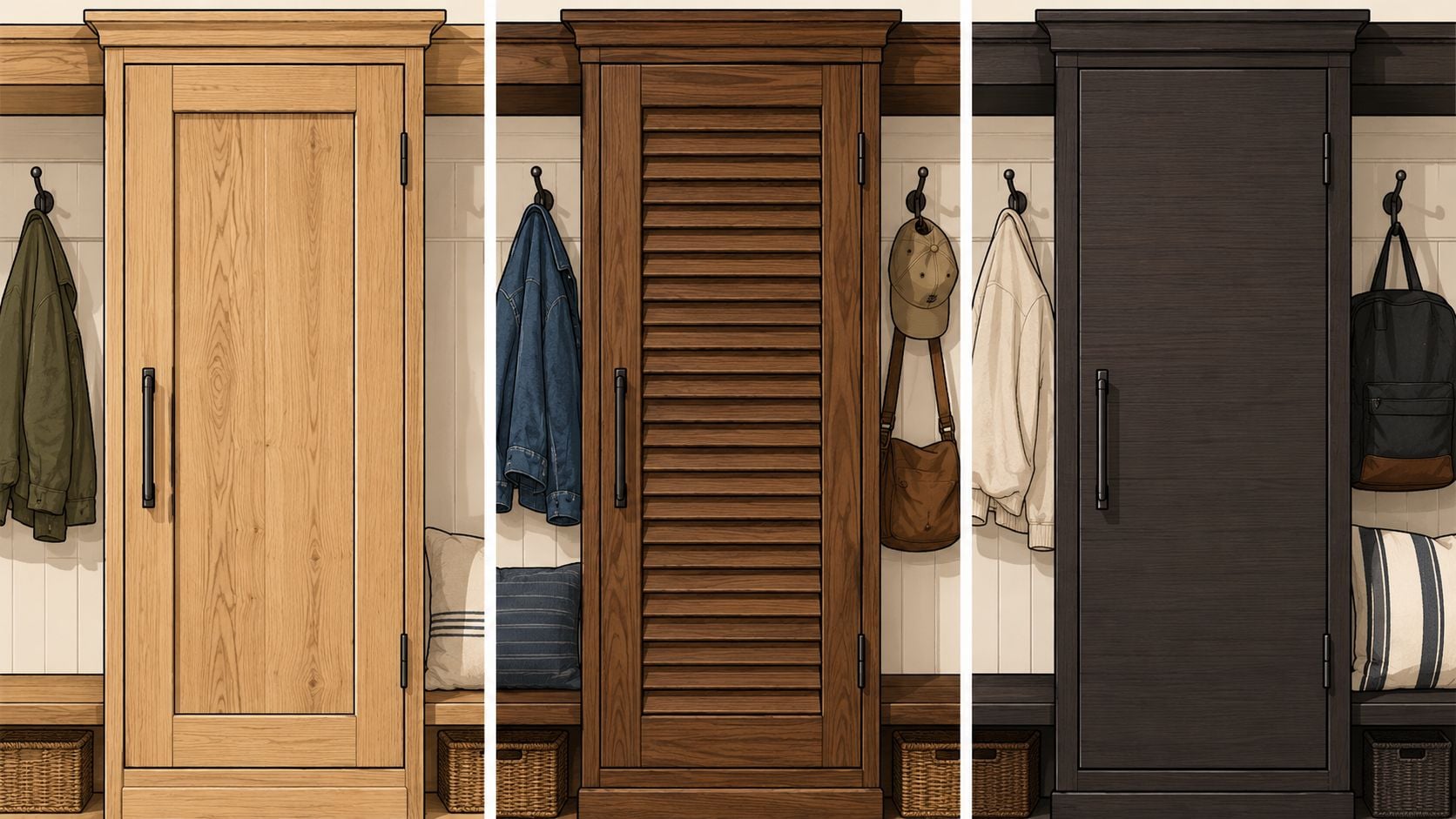
Shaker doors are the safest choice for most homes. They're clean, simple, and flexible enough to fit farmhouse, transitional, traditional, and many updated older homes in Upstate New York.
Flat-panel doors look more clean-lined. They suit cleaner interiors and can help a larger locker wall feel less busy.
Louvered or vented doors add texture and solve a practical problem in spaces that collect damp gear. They tend to feel a little more casual, but in the right finish they still look refined.
A locker wall should match the architecture around it. If the trim, casing, and nearby furniture are classic, a severe modern door can look out of place fast.
Material choices that age well
A door style can be attractive in almost any material. The bigger difference shows up years later.
Here's the trade-off most homeowners face:
| Choice | What works | What to watch |
|---|---|---|
| Solid hardwood | Better durability, repairability, richer finish depth | Higher upfront cost |
| Wood veneers over quality core | Can offer a furniture-grade look with stability | Quality varies widely |
| Lower-grade panel products | Budget-friendly at first | More vulnerable to wear, swelling, and a short service life |
For an entry that gets daily use, oak, maple, and cherry remain dependable choices because they hold up, take finish well, and don't go out of style. Heirloom-minded buyers often gravitate toward Amish-made furniture for that reason. The joinery, wood selection, and finish work usually reflect a long-term mindset rather than a quick trend cycle.
Material quality also affects how the piece responds to seasonal changes. In the Capital Region, homes see dry heated air in winter and more humidity in warmer months. That makes wood preparation and construction methods important. Homeowners comparing solid wood options can learn more about how kiln-dried wood affects stability and performance.
Security, appearance, and daily use
Most residential buyers focus first on style, but door function matters too. Hinge quality, door alignment, and closure feel all shape whether the piece feels substantial or flimsy. Homeowners interested in the mechanics behind durable locker door construction may find this overview of Security for self-storage doors useful because it highlights how door design influences strength and usability.
A beautiful locker that rattles, sags, or closes poorly won't feel like a good purchase for long. The best units get both parts right. They look settled in the home, and they work without fuss every single day.
Perfect Sizing and Layout for Your Capital Region Home
Sizing mistakes are what turn a promising locker project into a daily annoyance. A unit can look beautiful in a photo and still fail in a real Albany or Greene County home if the depth is wrong, the bench crowds the walkway, or the doors open into traffic.
The first step is simple. Measure the wall, then measure how the family moves through that area. A narrow passage to the kitchen or garage needs a different solution than a wide side entry.
Depth matters more than most people think
For bulky outerwear and backpacks, the interior has to be deep enough to work without forcing the doors. According to mudroom locker dimension guidance, an internal depth of 16 to 18 inches is ideal for winter coats and backpacks, while units designed for hangers need a full 24-inch depth so doors don't snag on clothing.
That's a major issue in Upstate New York homes where heavy coats aren't optional for part of the year. A locker that's too shallow may still hold a light jacket, but it won't perform well once parkas, boots, and school bags enter the picture.
A practical layout checklist
Before choosing a final configuration, homeowners should think through the daily bottlenecks.
- Walking path first: The unit should store gear without pinching the route into the house.
- Use-based zoning: Shoes low, coats mid-level, lesser-used seasonal items higher up.
- One section per person when possible: Shared compartments tend to get messy faster.
- Bench placement: A bench helps with boots, but it shouldn't stick out so far that the room feels blocked.
Some homes need a full wall with doors from one end to the other. Others work better with a lighter arrangement, such as a bench center with taller side lockers. The right answer depends on the shape of the room and where traffic crosses.
In a tight entry, a slightly smaller locker that preserves easy movement usually works better than a deep, oversized unit that dominates the space.
How to measure with fewer surprises
A lot of sizing errors come from measuring only the wall width and ignoring the obstacles around it. The better approach is to record:
- Overall wall width
- Ceiling height
- Door swing clearance
- Baseboard, trim, vents, outlets, and nearby windows
- How far doors or drawers can open without conflict
For homeowners who want to map things out before shopping, this room measuring guide is a useful place to start. It's especially helpful for people deciding whether a freestanding piece will fit cleanly or whether a custom-size solution makes more sense.
Planning on paper is good. Visualizing the whole wall is better. A room planner can help homeowners test spacing, see whether a bench crowds the entry, and decide if the layout should prioritize coats, shoes, or hidden storage overhead.
Essential Features Beyond Just the Doors
Many locker units look good at first glance. Fewer hold up well once they're filled with wet boots, heavy bags, and daily-use hardware.
The difference usually comes down to details that aren't obvious in a showroom photo. Bench design, hardware quality, interior function, and airflow all matter. If one of those pieces is wrong, the unit becomes harder to live with.
Bench design and hardware choices
A built-in-looking base bench creates a grounded, furniture-quality appearance. It's often the best choice for families who want the piece to feel permanent and substantial.
A more open or floating bench can lighten the visual weight, which helps in smaller entries. It also makes the floor easier to clean underneath. The trade-off is that it can feel less anchored if the overall design doesn't support it.
Hardware deserves more attention than it usually gets. Knobs, pulls, and hinges take constant abuse in an entry. Good hardware should feel solid in the hand, coordinate with nearby finishes, and suit the door style rather than fight it.
The feature homeowners overlook most
Ventilation is where many attractive designs fall apart. Closed compartments don't just hide shoes and coats. They also trap moisture.
Industry guidance is clear on this point. Ventilated locker construction guidance notes that solid doors on entryway lockers require engineered ventilation, such as louvered panels or grilles, to create airflow and prevent moisture buildup, mold, and odor from wet clothing and shoes.
That matters a great deal in the Capital Region, where snow, slush, and damp outerwear are routine parts of the season.
A closed shoe compartment without airflow may look tidy on day one and smell wrong not long after.
Features that make a locker work harder
The strongest designs usually include a combination of practical touches:
- Dedicated boot space: Keeps wet footwear from migrating across the floor.
- Easy-clean surfaces: Important near the bottom of the unit where salt and grit collect.
- Hooks inside the right compartment: Useful for bags and grab-and-go items.
- Upper closed storage: Better for off-season accessories and less-used gear.
For households that need seating and hidden storage together, a bench with cushion and storage can help clarify whether a softer, multipurpose approach fits the room better than a full locker wall.
A locker should do more than conceal clutter. It should manage the mess in a way that stays sanitary, usable, and easy to maintain.
Why Custom Amish and USA-Made Lockers Are the Best Investment
There's a clear difference between a locker unit that fills a wall and one that feels made for the house. Custom sizing, solid materials, and American craftsmanship are usually what create that difference.
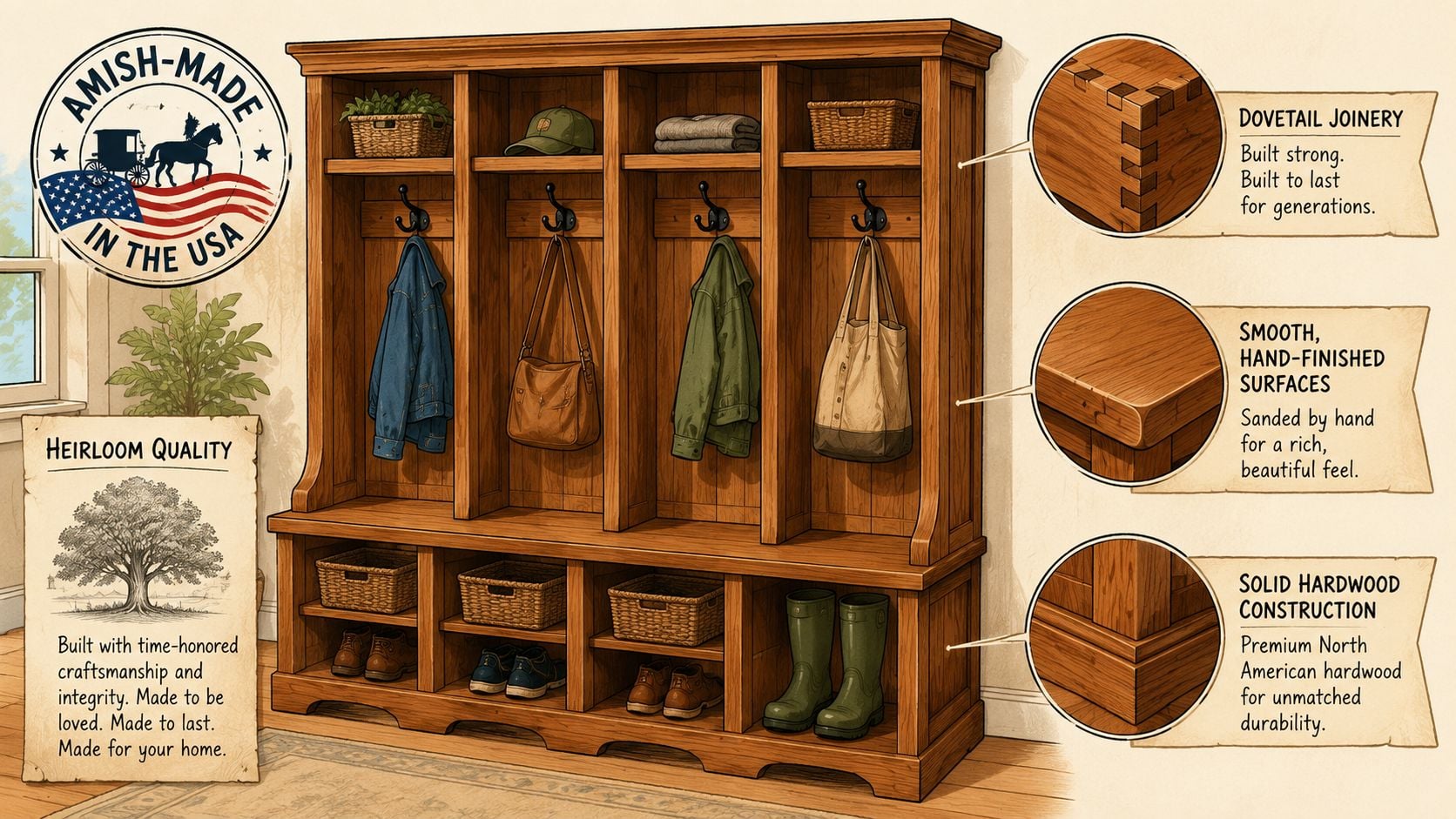
Mass-market pieces can serve a short-term need. For a busy family entry, though, the weak points often show up early. Doors drift out of alignment. The finish takes damage. Interior panels flex under real use. That's why many homeowners looking for a lasting solution prefer custom Amish and USA-made lockers.
Construction quality changes everything
A quality locker starts with the unseen structure. Guidance on durable locker construction specifies that 3/4-inch plywood is required for all vertical dividers and support cleats when long-term structural integrity matters.
That detail tells homeowners a lot. Thin materials may reduce cost, but they don't offer the same confidence when the piece has to support loaded compartments, repeated door use, and the general abuse of family life.
Why customization pays off
Custom work isn't only about appearance. It solves fit and function problems that standard pieces can't always address.
Consider what customization can control:
- Exact size for the wall: Helpful in older Freehold and Capital Region homes where dimensions aren't forgiving.
- Wood species and finish: Allows the locker to match surrounding trim or existing furniture.
- Interior configuration: More shoe storage, deeper coat sections, or a different bench arrangement.
- Hardware selection: A small choice that affects the whole look.
That kind of flexibility is one reason Amish furniture remains so appealing. Buyers who care about heirloom quality often want more than a generic rectangle with doors. They want a piece that looks settled in the home and still feels relevant years from now.
Better value over time
A higher-quality locker usually costs more upfront. That part is obvious. What's less obvious is how often the lower-cost option has to be replaced, repaired, or worked around.
Worth remembering: The entry is one of the hardest-working areas in the house. Furniture in that spot should be built for impact, weight, and repetition.
American-made and Amish-crafted pieces also appeal to homeowners who want transparency in materials and workmanship. That's especially true when the purchase is part of a broader home project involving flooring, benches, or other permanent-feeling furnishings.
For buyers exploring that path, learning more about what sets Amish furniture quality apart can help connect the visible beauty of the piece with the less visible construction decisions that support it.
A locker wall should feel like a long-term improvement to the home, not a temporary patch for clutter.
Your Local Entryway Solution at Tip Top Furniture
For homeowners around Freehold, Greene County, Albany, Schenectady, Troy, and the broader Capital Region, the right entryway storage usually comes down to three things. It has to fit the house, handle the climate, and hold up to daily life.
That's where a local showroom with experience matters. Tip Top Furniture & Mattresses has served the region since 1978, and its professional design services have been available since 1984. That kind of longevity gives homeowners something useful. Steady guidance from people who understand how local homes are laid out and how local families typically use their entry spaces.
The advantage isn't just furniture selection. It's the ability to coordinate a room more completely. A shopper can think through custom order options, compare heirloom-quality Amish furniture, consider flooring at the same time, and get guidance that keeps the entry consistent with the rest of the home. That one-stop approach is especially helpful when the locker project is part of a bigger refresh.
For many households, budget matters just as much as style and construction. That's why flexible payment options and in-stock value pieces are worth considering alongside custom work.
A practical next-step list looks like this:
- For custom fit: Ask about a complimentary design consultation.
- For budget flexibility: Review Flexible Financing options.
- For immediate-value finds: Browse the Clearance Corner.
- For a full-home approach: Visit the Freehold showroom and compare materials, finishes, and coordinating pieces in person.
A good entryway locker doesn't just hide clutter. It changes how the home functions the moment someone walks in the door.
For homeowners ready to create a cleaner, harder-working entry, Tip Top Furniture & Mattresses offers the kind of local guidance that makes the process easier. Visit the Freehold, NY showroom to explore heirloom-quality storage, custom order options, Amish-made furniture, and coordinating home pieces, or book a complimentary design consultation to plan a locker solution that fits the way the household really lives.