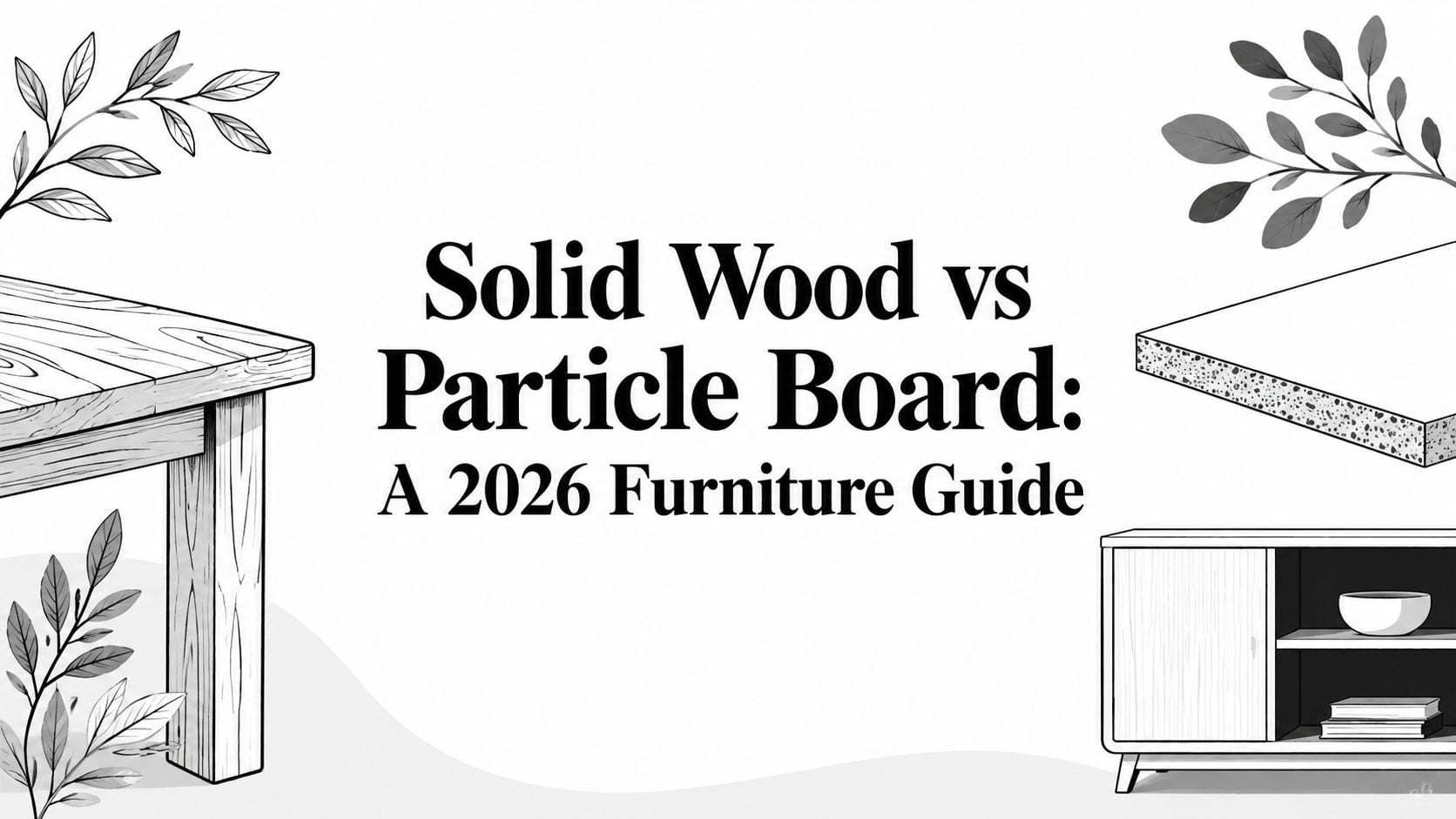
Solid Wood vs Particle Board: A 2026 Furniture Guide

A lot of furniture decisions start the same way around the Greater Albany Capital Region. A family in Albany needs a dining set that won't wobble through busy weeknights. A homeowner in Troy is replacing a dresser that already sags. A couple near Schenectady is furnishing a first place and trying to decide whether to spend less now or buy once and be done.
That's where the solid wood vs particle board question matters. The material under the finish affects how a piece feels, how it handles daily use, and how long it stays in service. After serving Upstate New York from Freehold since 1978, and offering professional design services since 1984, one lesson stays consistent. Good furniture buying starts with construction, not just color, price tag, or whatever looks good under showroom lights.
Solid wood furniture is made from natural lumber such as oak, maple, cherry, or walnut, which allows stronger joinery and a longer service life. Particle board is made from small wood particles and sawdust bound with resin, which lowers durability and shortens lifespan, as explained in this solid wood and particle board construction overview.
Anyone trying to sort through styles, budgets, and rooms can benefit from a practical starting point. This related guide on how to shop for furniture smartly is useful before narrowing down specific materials.
Table of Contents
- Choosing Your Next Piece of Furniture
- A Side by Side Quality Comparison
- The True Cost of Furniture Over a Lifetime
- Choosing the Right Material for Each Room
- Sustainability and Environmental Impact
- Which Furniture is Right for You
- Your Checklist Before Visiting Our Freehold Showroom
Choosing Your Next Piece of Furniture
Most shoppers don't walk into a showroom asking for particle board or solid wood by name. They ask for a bed that won't creak, a dresser that won't rack out of square, or a dining table that still looks right after years of family use. Material choice sits underneath all of those goals.
In practical terms, solid wood suits buyers who care about steadiness, repairability, and long-term ownership. Particle board often appeals to shoppers focused on immediate budget, temporary living arrangements, or pieces that won't see hard daily use. That doesn't make one material universally right and the other universally wrong. It means the right answer depends on where the piece will live and what that piece has to survive.
What solid wood means in real furniture
Solid wood uses natural boards cut from lumber. That gives builders the ability to use stronger joinery and produce pieces that feel grounded when someone opens a drawer, leans on a tabletop, or shifts weight onto a bed rail.
That difference matters in homes across Freehold, Albany, Troy, and Schenectady where furniture isn't decorative only. It gets used every day.
Practical rule: Buy the construction first. Style can be updated later. A weak core stays weak no matter how attractive the finish looks.
Where particle board fits
Particle board is made from compressed wood particles and resin. In the right setting, it can serve a purpose. In the wrong setting, it tends to show its limits quickly.
A simple way to think about it is this:
- High stress pieces need stronger material.
- Short-term pieces can justify lower-cost construction.
- Moisture-prone rooms punish lower-grade engineered wood fast.
- Family-use furniture rewards better construction over time.
For local homeowners planning rooms that need to last, especially in dining rooms, bedrooms, and everyday living spaces, this decision affects more than appearance. It affects replacement cycles, comfort, and whether the piece still feels dependable years from now.
A Side by Side Quality Comparison
The fastest way to compare solid wood vs particle board is to look at how each one performs in real use.
| Attribute | Solid Wood | Particle Board |
|---|---|---|
| Durability | Better for repeated daily use and heavier loads | More prone to sagging and breakdown under stress |
| Aesthetics | Natural grain, variation, and heirloom character | Often finished with veneer or laminate for a uniform look |
| Repairability | More suitable for sanding, refinishing, and repair | Harder to repair once chipped, swollen, or structurally damaged |
| Weight | Usually feels more grounded and substantial | Often lighter, but not necessarily stronger |
Durability and structural feel
The performance gap between these materials is considerable. Particle board is only approximately one-third to one-quarter of the average strength of plywood, and testing shows it performs poorly under pressure and tends to sag. That's one reason solid wood remains the better choice for furniture that carries weight or gets used constantly, according to this strength comparison discussion on wood products.
That mechanical difference shows up in ordinary moments. A loaded dresser drawer, a bed frame under nightly use, or a dining table that gets pushed, leaned on, and cleaned over and over all ask a lot from the material.
Aesthetics and visual character
Solid wood has natural variation. Grain changes from board to board, and that's part of the appeal. For many Capital Region homeowners, especially those furnishing a long-term home, that character is the point.
Particle board often delivers a more uniform surface. In some styles, especially modern or clean-lined looks, that can work visually. Readers interested in current frame styling can browse these 2026 wood frame sofa trends for design inspiration that connects construction choices to room style.
A piece can look similar across a showroom floor, but the structure underneath decides whether it still feels right after years of use.
Repairability and long-term care
Solid wood gives homeowners options. Scratches, finish wear, and surface dullness don't automatically mean the end of the piece. A well-built wood table or chest can often stay in the home through refreshes and changing tastes.
Particle board is far less forgiving once damage reaches the surface or edges. When panels swell, break down around fasteners, or lose shape, repair becomes much less practical.
Joinery matters here too. Buyers who want to understand why some furniture stays square longer should look at this explanation of the mortise and tenon joint, one of the clearest signs that a piece was built to hold together.
Weight and everyday handling
Weight can fool people. A lighter piece isn't automatically easier in the long run if it shifts, racks, or loosens up with use. Solid wood often feels heavier and steadier because the material itself carries consistent strength through the board.
Particle board can be convenient to move into an apartment or upstairs bedroom, but that convenience doesn't always translate to confidence in daily use. For furniture that needs to feel anchored, substance matters.
The True Cost of Furniture Over a Lifetime
Shoppers often focus on purchase price because it's the number sitting right in front of them. The bigger number is usually the replacement pattern.
Why sticker price can mislead
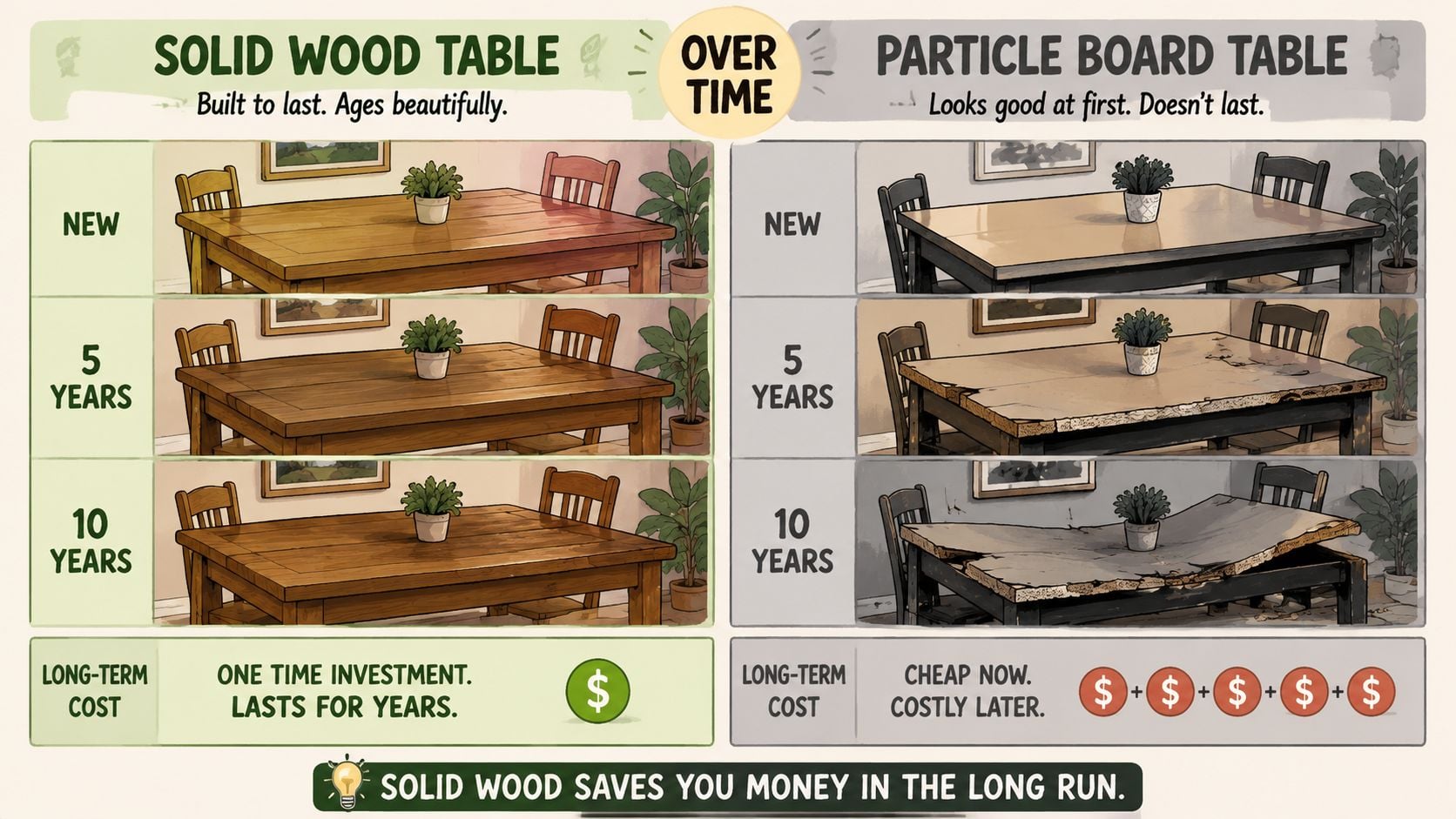
One clear example shows why the lower ticket price doesn't always mean lower ownership cost. A particle board dining table priced at $799 may need to be replaced six times over 30 years, for a total of $4,794. A single solid wood table priced at $3,500 averages $116 annually over the same period, which gives it much stronger long-term value, based on this dining table lifespan and cost comparison.
That math lines up with what many homeowners already suspect. Replacing a cheap piece over and over doesn't just cost money. It also means more delivery delays, more setup, more disposal, and more frustration.
For a household planning to stay in place, especially in the Albany area where buyers often furnish for real daily living rather than short turnover, total cost of ownership is the more useful lens.
Where financing can help
The challenge, of course, is that better furniture often asks for a bigger upfront commitment. That doesn't mean a family has to settle for construction they already know they'll outgrow.
For buyers thinking about long-term use, it helps to compare expected lifespan before making the final call. This guide on how long furniture should last offers a practical benchmark for that conversation.
A sensible buying approach often looks like this:
- Spend more on high-stress pieces such as dining tables, bed frames, and dressers.
- Save on lower-stakes items that won't carry heavy use.
- Use financing carefully when it helps bridge the gap between short-term budget and long-term value.
- Think room by room instead of trying to solve the whole home at once.
That approach usually leads to fewer regrets than chasing the lowest initial number.
Choosing the Right Material for Each Room
Furniture doesn't fail in every room for the same reason. A dining table deals with weight and movement. A bathroom vanity deals with moisture. A bedroom dresser deals with loaded drawers and repeated opening and closing.
Kitchen and bathroom realities
Moisture changes the solid wood vs particle board discussion fast. Particle board readily absorbs water, leading to swelling and irreversible damage, while solid wood and high-quality plywood are far less likely to warp, which makes them the stronger choice for kitchens and bathrooms, according to this wood panel moisture comparison.
That's the reason many experienced buyers won't gamble on particle board anywhere near sinks, steam, splashes, or damp seasonal conditions. One plumbing drip or repeated humidity swing can permanently alter the panel.
Readers comparing storage and cabinet materials may also find this practical look at Joey'z advice on cabinet wood helpful when thinking through kitchen projects.
Moisture damage in particle board usually isn't cosmetic. Once swelling starts, the panel doesn't go back to its original shape.
Living rooms and bedrooms
Living rooms and bedrooms usually reward stronger construction, especially for case goods. Dressers, nightstands, bed frames, entertainment pieces, and family-use tables all benefit from materials that stay square and hold hardware better over time.
For shoppers browsing room-specific options, these collections for living room furniture and bedroom furniture help show where sturdier materials make the biggest difference in everyday use.
A few practical matches:
- Bed frames work better in solid wood when the goal is less movement and better long-term stability.
- Dressers and chests benefit from stronger drawer support and more dependable structure.
- Coffee tables and end tables can go either direction depending on use, but family rooms often justify the upgrade.
- Dining furniture usually earns the investment because it sees repetitive force and frequent cleaning.
Entryways home offices and casual spaces
Not every purchase has to be heirloom quality. A low-use guest room, light-duty home office surface, or temporary setup may not need the same construction as the family dining room.
The key is matching the material to the job. Buyers get into trouble when they ask temporary materials to do permanent work.
Sustainability and Environmental Impact
Environmental value isn't only about what a piece is made from. It's also about how long that piece stays useful.
The waste question
Particle board is more affordable partly because it uses recycled wood materials. That can sound like the greener choice at first glance. The larger sustainability issue is replacement frequency.
According to this particle board and plywood sustainability discussion, solid wood furniture is ultimately more sustainable because its longer lifespan reduces the need for repeated replacement and the added waste that comes with engineered alternatives.
That's an important distinction for homeowners furnishing a long-term house in the Capital Region. If a piece stays in service for years and can keep going through changing needs, it places less demand on manufacturing, delivery, disposal, and replacement.
Why heirloom quality changes the equation
Amish furniture often enters the conversation. Handcrafted, USA-made solid wood pieces are often chosen because they're meant to stay in the home, not rotate out with the next move.
For readers thinking beyond furniture alone, this broader guide to sustainable renovation materials is a useful companion when coordinating interiors with flooring and larger home updates.
Another helpful reference is this page on sustainable wood furniture, which looks at how longevity and responsible buying work together.
Buying less often is one of the simplest forms of sustainability available to a homeowner.
That doesn't mean every room needs the most expensive piece on the floor. It means the more permanent the role, the more sense it makes to choose furniture that won't become waste after a short run.
Which Furniture is Right for You
A couple buys a dining set for their first house in the Capital Region. Five years later, the table still matters, but now it has hosted holidays, homework, and weeknight dinners. That is usually the point when the material choice stops feeling theoretical.
For the forever homeowner
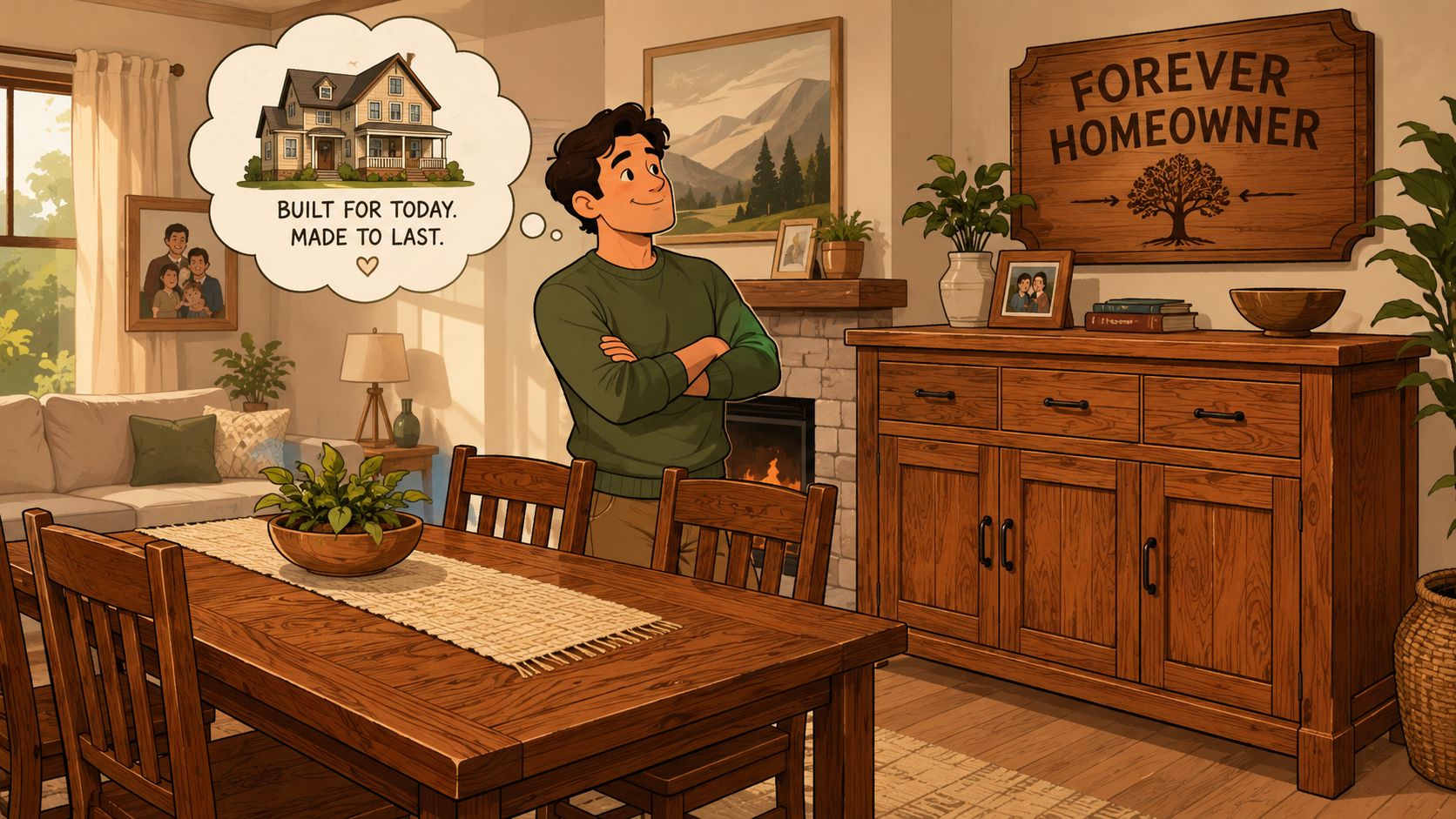
Families putting down roots in Albany, Troy, Schenectady, or Greene County usually get the best return from solid wood in the pieces they use every day. Dining tables, dressers, bed frames, and storage furniture take real wear. They also tend to stay in the home through growing kids, rearranged rooms, and changing styles.
Solid wood fits that kind of ownership because it gives you options later. Scratches can often be corrected. Finishes can be refreshed. A well-built piece can move from one room to another and still make sense. That is part of what gives it heirloom value. It earns its keep over time instead of being replaced the first time life gets busy.
Shoppers in this group usually care about a few things:
- Long service life with materials that can handle regular family use
- Repairability instead of a replace-it mentality
- Custom choices in species, finish, and size for a better fit
- A more permanent look that still feels right years from now
Before choosing custom sizes or larger case goods, it helps to review a practical guide on how to measure a room for furniture. Good measurements prevent expensive mistakes.
For the first apartment or short-term setup
Particle board still has a place. I would consider it for a guest room, a first apartment, or a temporary setup where the goal is to stay on budget and get through the next few years without overspending.
It works best in dry, low-demand spaces where the piece will not be moved often and does not need to stand up to heavy weight, moisture, or rough handling.
A short-term buyer may be well served by particle board for:
- Starter apartments where flexibility matters more than longevity
- Dorms or early-career setups that may not survive several moves
- Light-use surfaces with a smooth, uniform top
- Temporary rooms that will likely be redone later
The key is matching expectations to the material. Particle board can be serviceable. It is rarely the right answer for a piece you expect to keep for decades.
For shoppers balancing budget and longevity
Many households land in the middle, and that is often the smartest approach. Spend more on the pieces that support daily life and put up with constant use. Save on the pieces that play a lighter role.
In practice, that often means buying solid wood for the dining table, bed, dresser, or main living room storage, then using less expensive materials in a home office, spare room, or occasional-use area. That approach makes financial sense for Upstate New York homeowners who want their money going into furniture they will still respect ten or fifteen years from now.
Disposable furniture can look cheaper only at the register. Over the life of a home, replacing weak pieces again and again usually costs more than buying one well-made piece that stays useful. For many Capital Region families, solid wood is not only the nicer option. It is the steadier long-term investment.
Your Checklist Before Visiting Our Freehold Showroom
The smartest furniture shoppers don't just look at style. They test, inspect, and ask direct questions.

What to inspect on the floor
Bring a simple checklist and use it. A few quiet minutes of inspection can prevent years of annoyance at home.
- Check for movement by gently trying to wiggle the piece. A quality item should feel planted, not loose.
- Open every drawer and notice whether it glides smoothly and stays aligned.
- Look at the back panels and undersides because hidden areas often reveal the construction quality.
- Inspect edges and corners for signs of thin coverings, weak seams, or vulnerable surfaces.
- Notice the weight distribution rather than just total weight. A piece should feel balanced and solid.
Questions worth asking before you buy
A shopper doesn't need trade training to ask useful questions. A few direct ones usually bring the truth to the surface.
Ask what the piece is made of, not just what it looks like from the front.
Useful questions include:
- What material is used in the top, sides, drawer boxes, and back?
- What kind of joinery holds it together?
- How will this finish handle family use?
- Is this piece intended for a dry room or a moisture-prone space?
- Can it be repaired, refinished, or reordered in a different wood or finish?
Measurements matter too. Before visiting, it helps to review this guide on how to measure a room for furniture so the piece fits the space and the traffic flow.
A practical showroom visit often goes better with a short prep list:
- Bring room dimensions including wall lengths, window locations, and door swings.
- Photograph the space so finishes and proportions can be judged more accurately.
- List the problem you need solved such as storage, seating, durability, or layout.
- Set priorities in order so construction, size, budget, and style don't compete blindly.
For shoppers coming from Albany, Schenectady, Troy, or nearby communities, that preparation makes the Freehold visit much more productive.
For homeowners comparing solid wood vs particle board, the right next step is seeing construction up close. Tip Top Furniture & Mattresses welcomes shoppers from Freehold and the Greater Albany Capital Region to bring measurements, photos, and questions into the showroom. Those planning a larger project can also explore custom ordering, request a complimentary design consultation, try the free online room planner, browse clearance options, or ask about flexible financing before making a final decision.