How to Style a Living Room: Expert Tips

A lot of homeowners start the same way. They stand in the living room, look at the sofa, the hand-me-down chair, the rug that almost works, and the blank wall above the console, then realize the room still doesn't feel finished.
That's usually not a styling problem alone. It's a planning problem, a scale problem, and sometimes a quality problem. Most advice on how to style a living room leans hard on quick visual tricks, but it rarely deals with the bigger question of how to build a room that still feels right after the current look fades. A more durable approach is to keep the core pieces timeless and let trend-driven details live in accents, as noted in this design discussion on lasting living-room style.
For homeowners in Freehold, Albany, Schenectady, Troy, and across the Capital Region, that matters. A living room has to handle real life. It has to work on winter evenings, busy weekends, and ordinary Tuesdays. It should reflect personal taste, but it also needs to stand up to use. That's why the strongest rooms are usually built slowly and edited carefully, not copied all at once from a trend reel.
A useful starting point is home design where to begin. It helps turn broad ideas into actual decisions about layout, scale, and what belongs in the room.
Table of Contents
- Before You Begin Defining Your Living Room's Purpose
- Assess Your Space and Plan Your Albany Home Layout
- Establish a Focal Point and Choose Anchor Furniture
- Select Your Color Palette and Textures
- Layer Lighting and Finishing Touches
- Smart Shopping and Budgeting for Your Project
Before You Begin Defining Your Living Room's Purpose
Before choosing a style, the room needs a job. Some living rooms are formal and rarely used. Others are the center of the house, where people watch movies, read, host guests, fold laundry, and drop backpacks by the door.
That difference changes everything. A room meant for daily family use needs tougher upholstery, better walkways, and surfaces that can handle constant use. A room used mostly for conversation can carry lighter fabrics, smaller side tables, and a more edited layout.
Decide what the room must do every week
A practical way to style a living room is to answer a few blunt questions first.
- Who uses it most: Adults, kids, guests, or everyone.
- What happens there daily: Watching TV, reading, entertaining, napping, or all of the above.
- What frustrates the room now: Not enough seating, no clear focal point, too much clutter, poor lighting, or traffic cutting through the middle.
- What needs to last: The sofa, a wood coffee table, storage furniture, or custom seating that fits the room properly.
A room with too many jobs often looks confused because it is confused. Styling works better when the purpose is clear.
Practical rule: If a piece doesn't support the way the room is actually used, it usually becomes visual clutter no matter how attractive it is.
Separate timeless choices from temporary ones
Personal style should show up in a living room, but not every decision deserves equal weight. The biggest mistake is treating the whole room like a trend purchase. Curved accents, fresh colors, and updated lamps can be fun. A poorly built sofa in a fashionable shape is usually not.
A stronger approach is to divide the room into two categories:
| Decision type | Better long-term approach |
|---|---|
| Core pieces | Choose timeless shapes, durable materials, and comfortable proportions |
| Accent elements | Let pillows, throws, art, and smaller decor carry the more current look |
Family-owned stores with long design experience usually see the same pattern: The rooms that age well aren't the ones with the most accessories. They're the ones with solid foundations and enough restraint to let meaningful pieces stand out.
Assess Your Space and Plan Your Albany Home Layout
Rooms in the Greater Albany Capital Region come with all kinds of quirks. Some have fireplaces that make layout easy. Some have long, narrow footprints. Others open straight from the front door into the living space, which means styling and circulation have to work together.
The measuring stage isn't glamorous, but it prevents the most common mistakes.
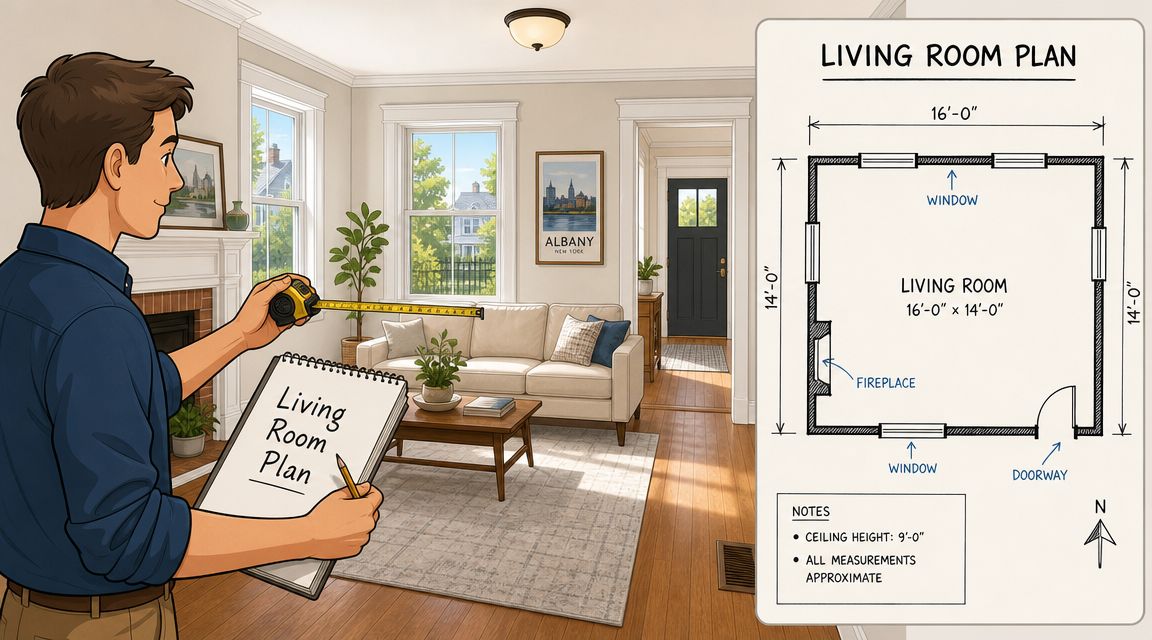
Measure the room before choosing furniture
Start with the room itself, not the furniture wish list. Measure the walls, window placements, door swings, vents, radiators, and any architectural feature that takes up visual space.
Then mark the furniture footprint. For a functional layout, use 30 to 36 inches of circulation clearance between large furniture pieces, reduce to 24 inches in tighter rooms, keep the coffee table 14 to 18 inches from the sofa, and size a rectangular coffee table to about two-thirds of the sofa length, based on the layout guidance in this living room layout reference.
For homeowners who want to test arrangements before moving anything heavy, how to plan room layout is a practical place to start.
Plan around movement, not just seating
A good-looking room that forces people to sidestep around every chair isn't styled well. It's overcrowded.
Look at how people enter the room, where they naturally walk, and where they pause. If the route to a hallway, stair, or kitchen cuts through the living room, protect that path first. Then build the seating area around it.
A few layout choices tend to work better than others:
- Float furniture when the wall placement is weak: A sofa set away from the perimeter can define the social zone more clearly.
- Use a rug to mark the main gathering area: This helps the room feel intentional, especially in open-plan homes.
- Keep visual weight balanced: If one side has a fireplace or media unit, the opposite side needs enough substance to avoid feeling lopsided.
- Avoid blocking daylight: Tall pieces near windows often make the room feel tighter than it is.
Some homeowners also look for ways to maximize your living room space when dealing with open-plan layouts or awkward footprints. The useful takeaway isn't to add more furniture. It's to zone the room so each area reads clearly.
The easiest way to make a room feel larger is often to remove one unnecessary piece, not squeeze in one more.
One practical option for planning at scale is the room-planning service available through Tip Top Furniture & Mattresses, which lets homeowners test fit and flow before committing to major pieces.
Establish a Focal Point and Choose Anchor Furniture
Every successful living room has a center of gravity. Sometimes it's a fireplace. Sometimes it's a large window. Sometimes it's a media console, a substantial piece of art, or a built-in wall.
Without that visual leader, the room tends to feel scattered. Furniture ends up facing in different directions, decor competes for attention, and nothing quite settles.
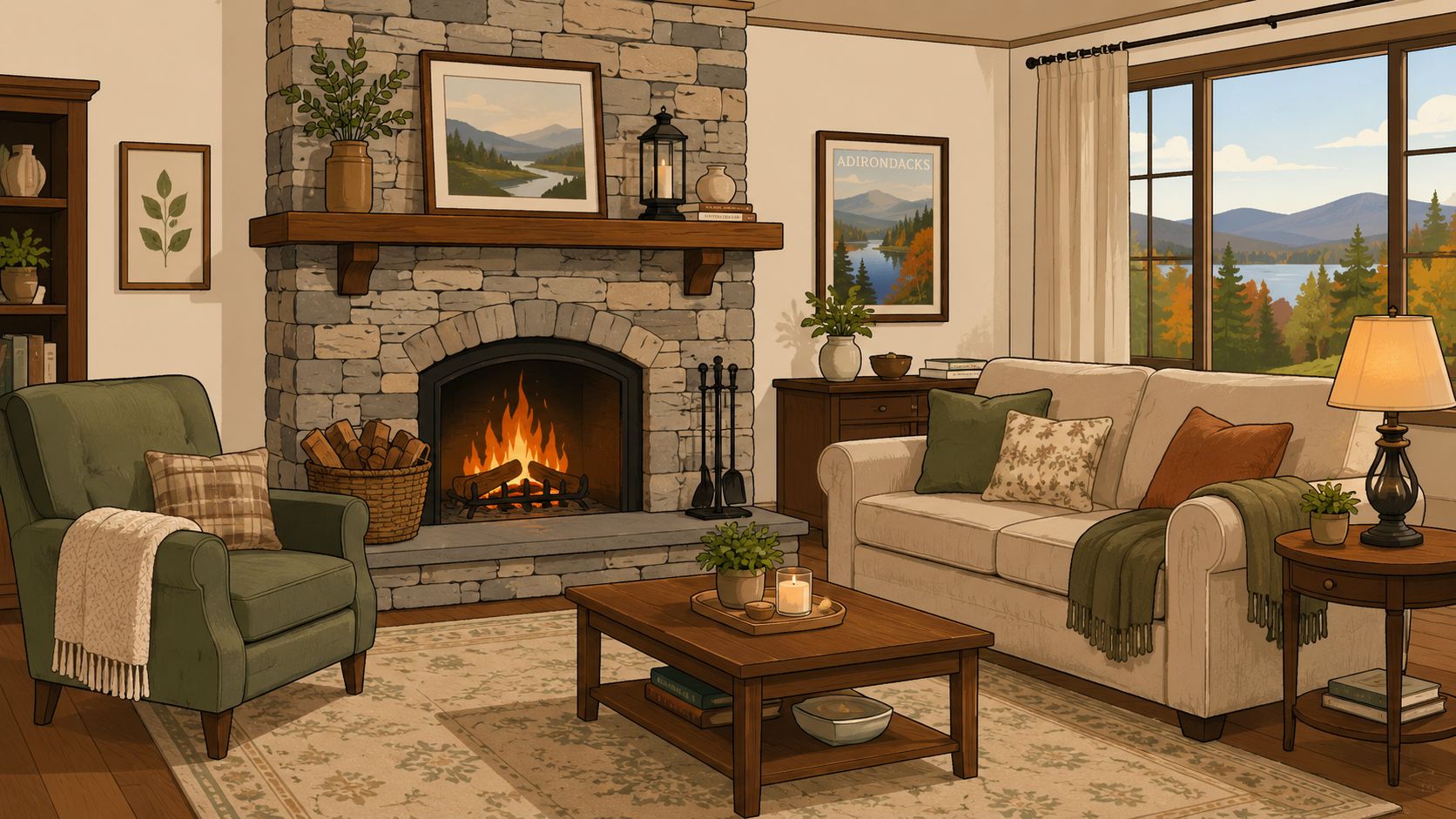
Choose one visual leader
A focal point doesn't have to be dramatic. It has to be clear.
If the room already has one strong architectural feature, support it instead of fighting it. If it doesn't, create one with a substantial element that gives the seating arrangement a reason to exist.
Good focal points usually share a few traits:
- They're visible on entry
- They anchor the largest furniture grouping
- They don't compete with three other “main” features
- They can handle supporting decor without looking cluttered
A wall with a media cabinet, art above it, and balanced lighting can work beautifully. So can a fireplace with restrained styling. What usually fails is trying to make the TV wall, gallery wall, and bar cabinet all act as the star at once.
Buy fewer anchor pieces, but buy them better
Once the focal point is set, choose the furniture that carries the room. That usually means the sofa first, then the main chair or pair of chairs, then the coffee table and storage pieces.
This is the part where quality matters most. The anchor pieces get used the hardest and seen the most. If the frame feels weak, the scale is off, or the upholstery already looks tired in the showroom, the room won't improve with accessories.
A stronger formula looks like this:
| Anchor piece | What to prioritize |
|---|---|
| Sofa | Seat comfort, arm scale, fabric durability, silhouette that won't date quickly |
| Chairs | Proper proportion to the sofa, comfortable seat depth, visual contrast without style conflict |
| Coffee table | Solid material, useful surface area, shape that supports circulation |
| Media or storage piece | Width that matches the wall, enough presence to support the focal point |
For homeowners replacing older items, donation can be one practical path. This Emmanuel Transport donation guide is a useful general resource for thinking through what can be passed along instead of discarded.
The coffee table often gets overlooked, even though it visually ties the entire seating area together. A foolproof guide to the perfectly styled coffee table shows how to make it useful without turning it into clutter storage.
A living room usually looks more expensive when the main pieces are calm, scaled properly, and allowed to breathe.
Select Your Color Palette and Textures
Once the room has a workable layout and solid anchor pieces, color can do its real job. It should unify the room, not rescue it.
That's why the most dependable palettes usually start with a restrained base. A 2024 interior design summary reports that 63% of consumers prefer minimalist designs, which helps explain why living rooms with a clear focal point, limited clutter, and a smaller number of larger statement pieces continue to feel broadly appealing, according to this 2024 interior design summary.
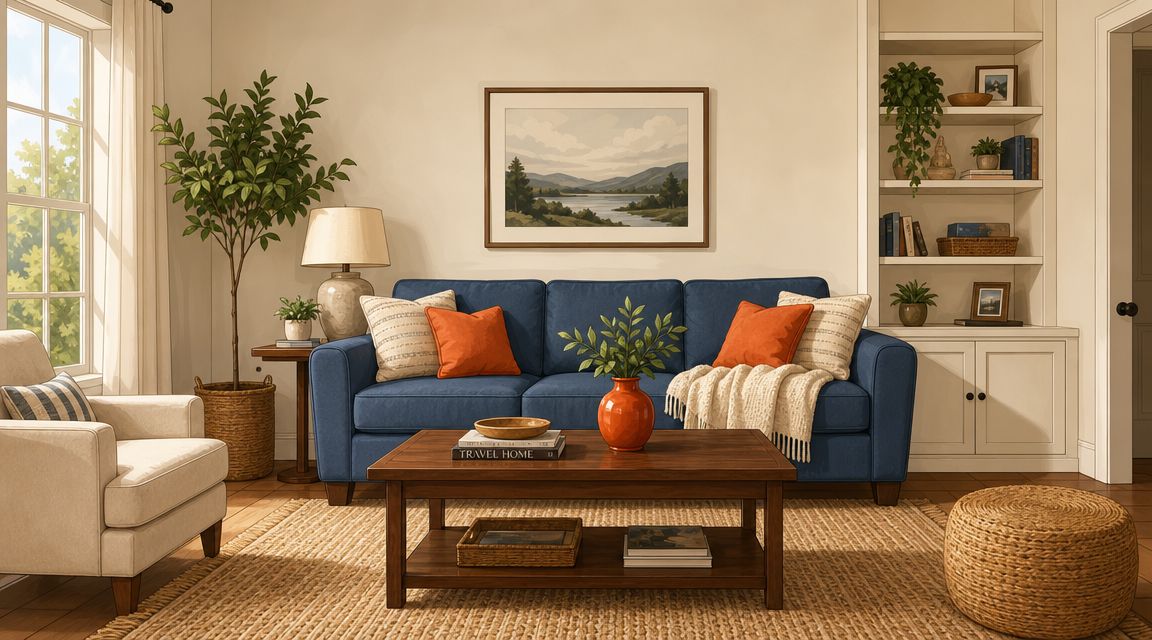
Build a palette that feels settled
A calm room doesn't have to be bland. It just needs discipline.
A useful guideline is the familiar 60-30-10 approach. Keep the largest surfaces in one dominant family, support them with a secondary color, then use a smaller accent color for energy. The exact shades can lean warm, cool, rustic, refined, or traditional depending on the home.
A balanced palette often works like this:
- Dominant color: Walls, large rug, or main upholstery
- Secondary color: Curtains, chairs, or painted case goods
- Accent color: Pillows, art, throws, ceramics, or greenery
For more detailed direction, color palette for living room offers practical combinations that help narrow choices.
Use texture to keep calm rooms from feeling flat
If every surface is smooth and every fabric is similar, even a good palette can fall flat. Texture is what gives a living room depth.
That usually means combining materials with different visual and tactile weight. Think wood with upholstery, wool with metal, linen with leather, matte finishes with a small amount of shine. This is especially important in Upstate New York homes, where layered interiors often feel more comfortable through long indoor seasons.
Consider mixing these elements:
- Natural wood: Adds warmth and permanence
- Soft woven textiles: Rugs, throws, and pillows soften hard edges
- Visible-leg furniture: Keeps a room feeling lighter
- Aged or matte metal: Adds contrast without turning cold
- Subtle pattern: Brings movement without dominating the room
Flooring is part of the palette too. For homeowners thinking about cohesive material transitions, this article on transforming your space with hardwood floors offers useful visual ideas for working with wood tones in decorated rooms.
The room doesn't need more colors to feel finished. It usually needs better contrast in material, texture, and scale.
Layer Lighting and Finishing Touches
This is the stage where a room stops looking newly furnished and starts looking lived in on purpose. Good styling depends less on adding things and more on adding the right layers in the right order.
Lighting comes first. If the lighting is harsh, flat, or poorly placed, even strong furniture choices can feel underwhelming.
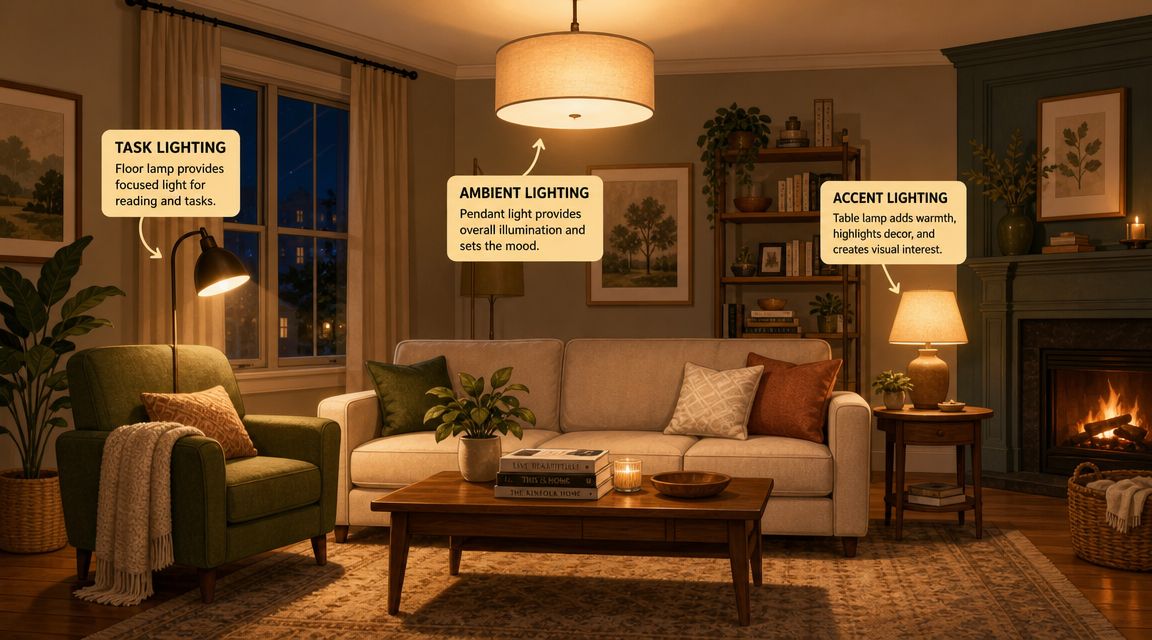
Light the room in layers
A living room works better when the lighting serves more than one purpose. Overhead light handles general visibility, but it rarely creates enough warmth on its own. That's where lamp light and focused accent lighting matter.
A well-layered room usually includes:
- Ambient lighting: Ceiling fixtures or other broad room light
- Task lighting: Table lamps or floor lamps near seating
- Accent lighting: Light directed toward art, shelves, or architectural details
The exact fixture style can vary. What matters is coverage, warmth, and placement where people use the room. Put your living room in the best light is a helpful reference when a room feels finished during the day but dull at night.
Edit the accessories
Once lighting is handled, textiles and decor can do the softer work. Curtains add height and softness. A rug defines the seating zone. Throws and pillows make the room feel occupied rather than staged.
Then come the finishing objects. Books, trays, ceramics, framed art, family photos, and collected pieces should tell a story, but only if they're edited.
A simple comparison helps:
| Finishing choice | What usually works | What usually doesn't |
|---|---|---|
| Pillows | A few with texture or contrast | Too many small pillows that get tossed aside |
| Wall decor | One strong arrangement with breathing room | Lots of scattered small pieces |
| Shelf styling | Mix of books, objects, and open space | Every surface completely filled |
| Rugs and curtains | Layers that soften and define | Pieces chosen only for color, not proportion |
A room often feels more personal when at least a few accessories have history. Travel finds, inherited objects, and favorite books bring more depth than generic filler decor.
The finishing touches should support the room's personality, not compete to become the personality.
Smart Shopping and Budgeting for Your Project
A well-styled living room doesn't require buying everything at once. In fact, that's often how expensive mistakes happen. A better approach is to separate the room into high-use investments and lower-risk additions.
The best money usually goes into what gets touched every day. The sofa, primary chairs, and hard-working tables carry more weight than the trendiest mirror or decorative accent.
Spend where daily life happens
A simple budgeting mindset helps:
- Invest first in seating: Comfort and construction matter more here than almost anywhere else in the room.
- Choose durable tables: Coffee and side tables take daily wear, so flimsy materials usually show age fast.
- Save on changeable accents: Lamps, pillows, art, and decor can evolve over time.
- Use clearance strategically: Accent furniture and decorative finishing pieces are often easier places to hunt for value.
That approach tends to create a room that feels stable even if the styling develops gradually. It also leaves room for custom ordering when a standard size, finish, or fabric won't solve the room properly.
Solve awkward layouts with intentional pieces
Some of the trickiest rooms in the Albany area aren't small. They're busy. A front door may open directly into the living room, or the space may double as a passage to stairs or another part of the house.
That kind of layout needs zoning more than decorating. A major underserved angle in living-room styling is how to handle rooms that also function as circulation paths. Designers often use low bookcases, runners, and console tables to create a visual boundary without blocking flow, as discussed in this entry-through-living-room design reference.
In practical terms, that means:
- A slim console can suggest an entry edge
- A runner can guide movement without cutting through the seating area visually
- A low bookcase or open divider can separate arrival space from gathering space
- A lighter-leg chair or sofa can preserve sightlines in a room that already feels busy
Budgeting gets easier when purchases solve more than one problem. A rug can define a zone. A console can add storage and establish a boundary. A custom piece can fit an awkward wall where standard furniture always feels wrong.
For homeowners ready to move from ideas to actual room decisions, Tip Top Furniture & Mattresses offers a practical next step. The Freehold, NY showroom serves the Greater Albany Capital Region with living room furniture, custom ordering, design help, flooring coordination, clearance options, delivery, and flexible financing, which can make a full-room project easier to plan and complete.