Oak vs Maple Furniture: Which Wood Suits Albany Homes


The radiator is still clicking in a Schenectady dining room, the tabletop is cold under your hand, and two samples are sitting where the placemats should be. One shows a bold stripe of grain. The other is almost quiet, pale and smooth. Both are solid hardwood. Both could be the table your family uses for homework, holidays, and weeknight plates for the next twenty years. Oak vs maple furniture is that choice, and it is less about which wood is "better" than about grain, dents, and how a Capital Region house swings from dry heat to humid summers.
Oak vs Maple at a Glance
Oak fits furniture where the open, visible grain is part of the design. Maple, specifically hard maple, fits smooth, even surfaces and tougher daily use in clean contemporary rooms.
If you are choosing a dining table, bedroom set, desk, or chest for a home in Albany, Troy, Schenectady, or the wider Capital Region, the useful comparison is a set of trade-offs, not a sales pitch. A well-built piece of either species will outlast a poorly built one. Species is only one part of how a table ages.
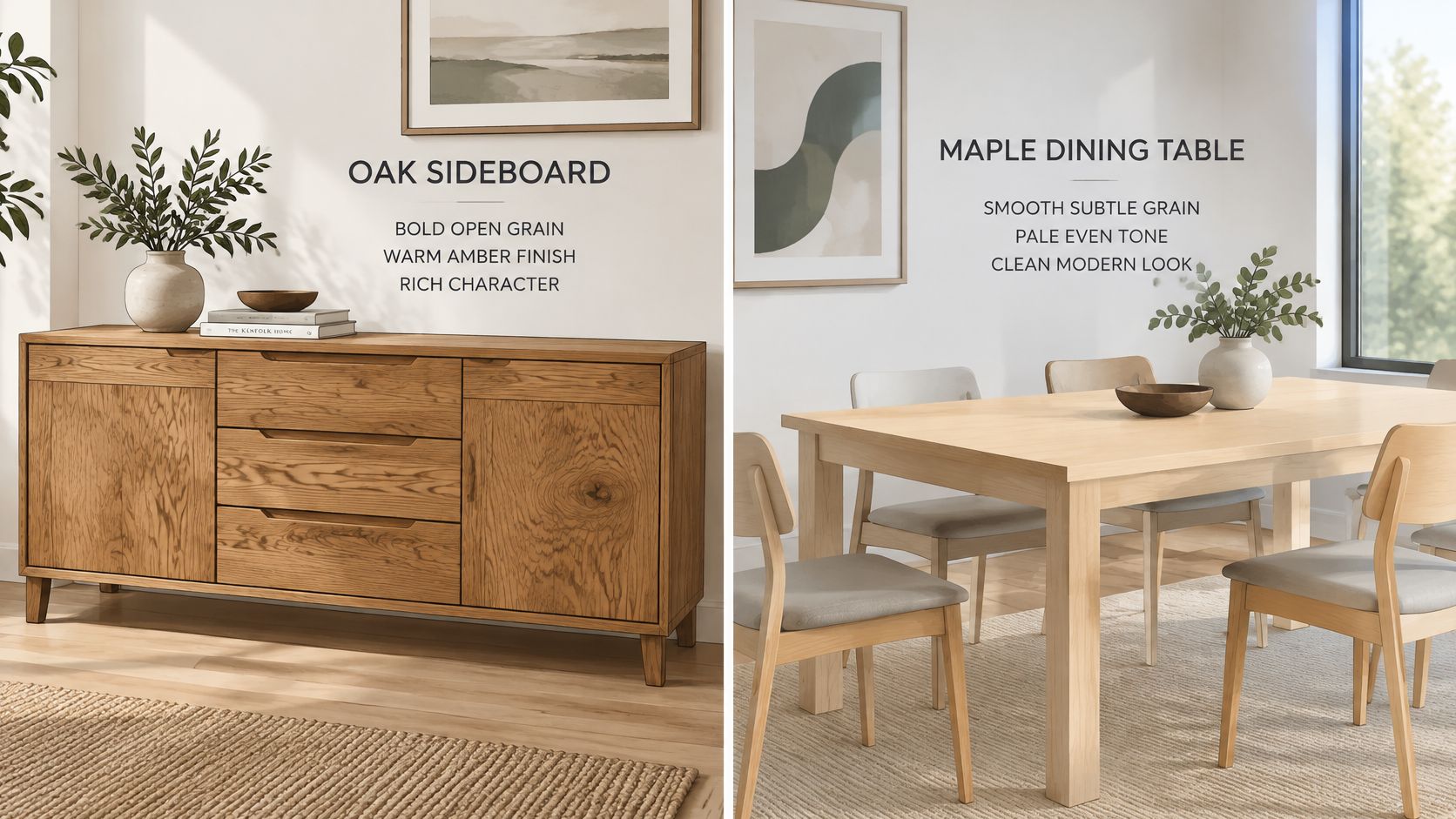
| Factor | Oak | Maple |
|---|---|---|
| Grain | Open, prominent and showy | Close, fine and uniform |
| Color tendency | Warm golden to pinkish brown | Pale, creamy white to light reddish brown |
| Stain behavior | Takes traditional stains evenly, grain stands out | Smooth surface, can blotch with dark stains unless conditioned |
| Everyday wear | Tough and strong, grain hides minor marks | Harder, resists dents better on flat surfaces |
| Movement tendency | Lower total shrinkage | Slightly higher total shrinkage, needs careful construction |
| Best style fit | Traditional, craftsman, rustic, farmhouse | Contemporary, Scandinavian, mid-century, minimalist |
| Care focus | Humidity control and grain-matched refinishing | Humidity control and evenly conditioned refinishing |
Treat the table as tendencies, not a promise for every board. Growth rate, cut, and finish change how a single piece behaves.
Hardness numbers come next, then how humidity moves a top, then cost and availability, then care, then which room and which final pick fits the way you live.
How Hard Oak and Maple Hold Up to Daily Wear
A dining table near a sunny window or a desk used every day faces repeated impacts, not just gradual wear. Published physical-properties figures from the USDA Forest Products Laboratory show sugar maple and common oaks are similar in weight, while maple rates higher in hardness.
| Species | Janka hardness (lbf) | Specific gravity | Density (lb/ft³) |
|---|---|---|---|
| Sugar (hard) maple | 1,450 | 0.63 | 44 |
| White oak | 1,360 | 0.60 | 48 |
| Northern red oak | 1,290 | 0.63 | 44 |
What those pounds of force mean
The Janka test measures the force needed to embed a 0.444-inch steel ball halfway into wood. The red oak reference uses this measure to compare resistance to dents: a higher rating means a surface is less likely to take an indentation from a concentrated impact. A dropped mug or a chair leg puts force into a small area, where the difference in hardness can matter.
In the Forest Products Laboratory figures, sugar maple is roughly 12% harder than northern red oak and about 7% harder than white oak. Those comparisons use the listed values.
Hard maple is heavy, strong, stiff, hard, shock-resistant, and fine-textured. Its relatively high shrinkage makes drying and construction important. Oak is heavy, hard, tough, stiff, strong, and generally straight-grained. Density alone does not settle the comparison: sugar maple and northern red oak share about 0.63 specific gravity and 44 lb/ft³, while white oak is listed near 0.60 and 48 lb/ft³.
Where the extra hardness earns its keep
- Dining tabletops: Maple suits a surface that handles plates, laptops, and children's projects in the same spot each day.
- Kitchen seating and chair seats: Hard maple is less likely to dent under repeated scooting and dropped toys.
- Desks: Pen points and monitor feet are less likely to leave indentations in hard maple.
- Children's furniture: Its higher indentation resistance can help on surfaces that see frequent impact.
Oak's visible texture can make a light scuff less conspicuous than it would be on maple's smoother face. That affects how a mark looks, not whether the wood resists the impact that caused it.
Practical rule: Choose maple for tops and seats that take daily abuse. Choose oak when its visible grain matters more than the added dent resistance of maple.
Hardness cannot compensate for a weak frame. Look for solid stock and sound joinery, such as a mortise and tenon joint, rather than relying on a hardwood label alone.
Grain, Color and How Each Wood Takes Stain
Stand a few feet back and the difference is immediate. Oak announces a pattern. Maple mostly steps out of the way.
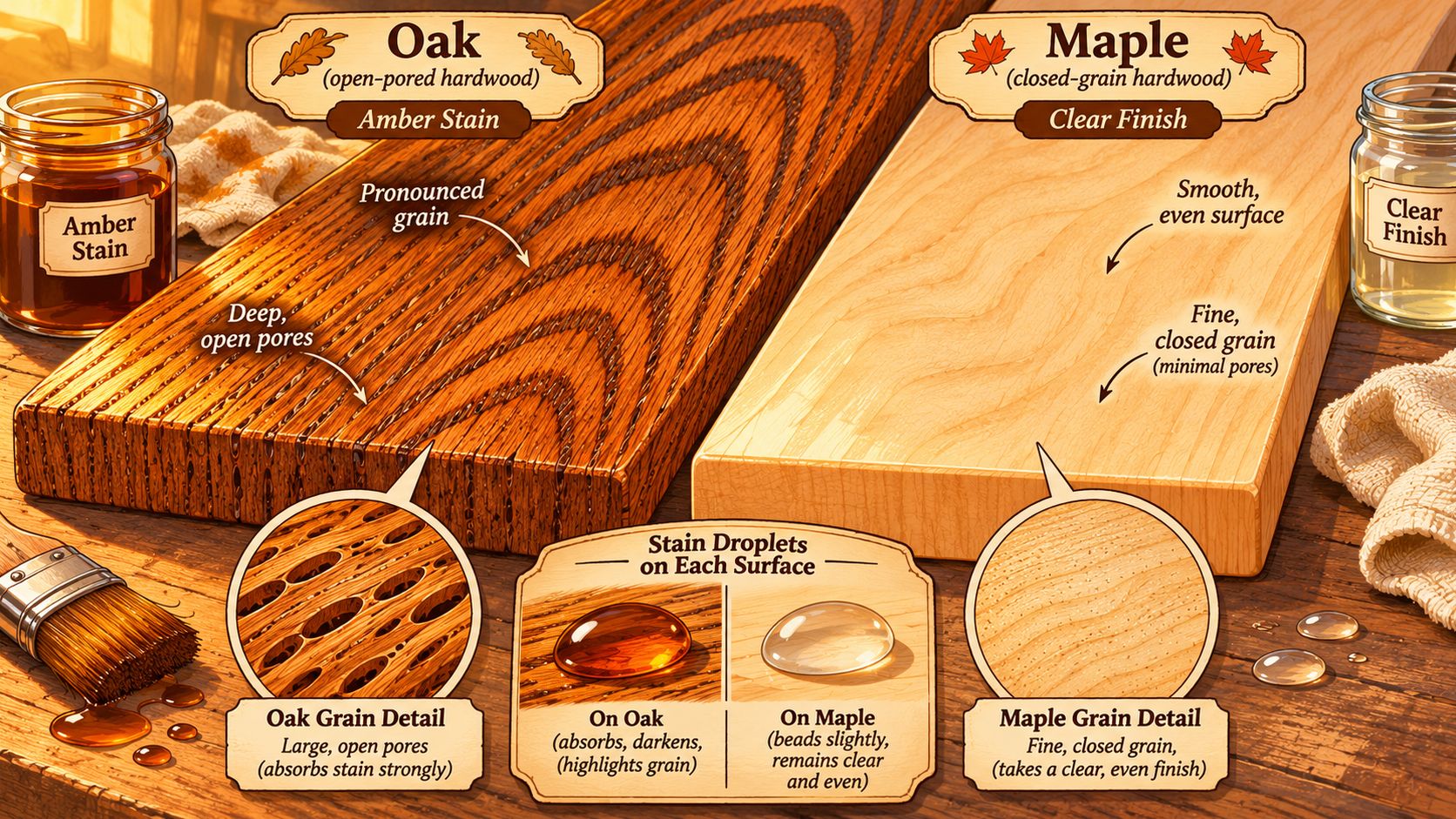
The U.S. Forest Products Laboratory identifies oak as an open-grained hardwood and hard maple as a close-grained hardwood. Hard maple has a fine, uniform texture. Oak has open grain and a prominent, showy pattern. Those pores decide both the unfinished look and how stain behaves. A closer look at wood grain patterns makes that pore difference easier to see before you commit to a finish.
How stain sits in the wood
Oak's open pores drink traditional stain and hold it in the grain lines. Under a clear or amber-toned finish, the pattern reads strongly, and the color can deepen toward warm amber or espresso without looking flat.
Maple's close grain and pale, creamy face stay even and understated. That same tight surface can blotch with a dark stain, because pigment grabs some areas and skips others. A pre-stain conditioner, a lighter stain, or a clear coat avoids that patchy result.
Oak's open pores emphasize the grain lines. Maple presents a smoother, more consistent surface.
Three finish habits prevent most regrets:
- Test every stain on an offcut from the same board, under the light the piece will live in.
- Condition maple before any pigment stain, especially a dark one.
- Wipe excess stain within a few minutes so it does not sit and go muddy.
Matching the wood to the room's look
Oak suits traditional, craftsman, and farmhouse rooms where grain is a feature, not a distraction. Maple suits modern and minimal pieces that need a light, consistent surface so the shape of the furniture does the talking.
In a showroom, look at the grain under the actual store lights. Ask whether you want that pattern visible across the room or quiet enough to disappear beside paint and fabric.
How Humidity Moves Oak and Maple Tabletops
A common assumption is that maple, being harder and tighter, is the more stable tabletop. Shrinkage figures say otherwise.
USDA Forest Service shrinkage data report hard maple at about 4.8% radial, 9.9% tangential, and 14.7% volumetric shrinkage from green to oven-dry. Northern red oak is about 4.0%, 8.6%, and 13.7%. The tangential-to-radial ratio is roughly 2.1 for both. Hard maple is not the more dimensionally stable choice. It can move a bit more as moisture changes.
| Species | Radial (%) | Tangential (%) | Volumetric (%) |
|---|---|---|---|
| Hard maple | 4.8 | 9.9 | 14.7 |
| Northern red oak | 4.0 | 8.6 | 13.7 |
Across the grain, not along it
The Forest Products Laboratory notes that movement parallel to the grain is generally only about 0.1% to 0.2% from green to oven-dry. Across the grain, movement is much larger. A wide top changes width, not length. That is why a leaf that fit in October can feel tight in July, or why a seam opens a hair after the heat comes on.
When a solid top is screwed down as if it will never move, shrinkage after installation can open cracks between boards or split a joint. The fix is built in, not added later with a clamp.
What to check under the top
Ask whether the piece uses breadboard ends, floating fasteners, figure-eight clips, or elongated screw holes, and whether the lumber is furniture-grade and kiln dried. Those details let the top expand and contract without forcing the base apart. Oak's somewhat lower shrinkage is a modest advantage. It does not excuse a top that is pinned rigid.
Albany-area houses make this personal. Forced-air heat dries rooms hard in winter. Humid summers push moisture back in. Keep indoor relative humidity near 30–50%. Keep solid wood off radiators, supply vents, and damp exterior walls. A finish slows moisture exchange. It does not stop movement.
A small seasonal gap at a joint is normal. A crack running through a glued joint is a build problem. An inexpensive hygrometer, set on an interior shelf away from vents, radiators, and outside walls, shows whether the room sits in that 30–50% band.
Cost, Availability and Amish-Made Options Near Albany
A quote for oak or maple needs more than a species name. Price reflects grade, board width, drying quality, finish, and joinery. Two tables made from the same wood can differ substantially if one uses narrow, flat-sawn boards and the other uses wider, carefully dried stock with a harder finish.
Oak is common in traditional and rustic furniture, while maple appears often in contemporary and custom solid-wood pieces. For a Capital Region home, compare the details that affect ownership: how the wood was dried, how the top is built, and whether the joinery can be maintained or repaired over time.
What belongs on any quote
- Species: Get the exact wood, such as red oak, white oak, or hard maple. “Hardwood” alone does not tell you what you are buying.
- Drying: Ask whether the stock is kiln-dried and intended for indoor furniture.
- Top construction: Confirm whether the top is solid wood or veneer over another core.
- Joinery: Compare construction details, such as mortise-and-tenon joints or dovetails, with hardware-only assembly.
- Finish warranty: Have the coverage and duration stated in writing.
For example, one oak-table quote may specify kiln-dried boards and mortise-and-tenon construction, while another says only “hardwood” and lists cam-lock assembly. Those are not equivalent offers, even if the tables look similar. Ask the seller to clarify the species and construction before comparing the totals, including delivery and setup.
Tip Top Furniture & Mattresses offers Amish furniture handcrafted in the USA. Its family-owned Freehold showroom has been in business since 1978, and its professional design services have been available since 1984. The shop carries furniture from over 50 manufacturers and offers custom ordering, including choices of wood type and finish. That can help when a room calls for a particular combination rather than an in-stock piece. Dining furniture is a useful place to apply the quote checklist: compare the table and chairs for wood, finish, construction, and total cost, rather than judging by the table price alone.
Caring for Oak and Maple Furniture for Decades
Dust, wipe, and pad the surface. That short routine is what keeps a solid top in daily use for decades, after the first scuff has long since happened.
- Dust weekly with a soft, dry cloth so grit does not act like sandpaper.
- Wipe spills at once with a barely damp cloth, then dry the spot.
- Use coasters, pads, and felt under decor, lamps, and anything that slides.
- Keep pieces out of direct sun. Both woods shift color. Oak tends to deepen toward amber. Maple tends to yellow.
- Skip silicone polishes. They feel slick and then fight a later refinish.
Joint stress from Capital Region humidity swings is covered earlier. Between those seasons, the habits above decide whether you repair a finish or replace the piece.
Run the same sequence before a move. Furniture upkeep tips for Boston homeowners cover a piece that has to survive differently heated houses as well as a normal year at home.
Repair instead of replace
Mechanical joinery, including mortise and tenon, can be taken apart and tightened decades later. A loose leg or a worn finish is usually cheaper to repair than to replace the whole piece. More detail sits in this guide to caring for wood furniture.
For a small touch-up, sand lightly, match stain on an offcut, and blend color into oak's grain rather than painting a flat patch. Maple's uniform surface shows uneven sanding and stain lines more easily, so stop sooner and test more. On maple I recommend an extra test patch. A dark line reads across that even surface in a way oak grain can hide.
Call a finisher or a furniture repairer when you see:
- A crack through a joint, not a hairline seasonal opening at an edge.
- A loose leg or stretcher that rocks after the fasteners are snug.
- A failing finish across a large area, where spot work would show.
Which Room, Style and Situation Suits Oak or Maple
A Schenectady table used for breakfast and homework is a different piece of ownership than a nightstand that mostly holds a lamp. The room, the wear, and a Capital Region winter decide oak or maple. There is no single winner wood.
Dining in a busy household leans maple when the top takes daily meals and you want clean lines. Oak earns that room when the grain is part of a traditional or farmhouse look and the finish is meant to be seen. Maple chairs can sit with an oak top only if the stain is matched. If it is not, the set looks like two different purchases.
Bedroom dressers and nightstands work in either species. Pick by the rest of the room. These surfaces see folded clothes more than dropped pots, so hardness is the wrong tie-breaker.
Home office desks lean maple for a smooth writing surface that resists scuffs from arms, clamps, and pens. Children's furniture leans the same way, because edges and tops that get climbed on show every nick for years.
One Albany-area house makes the split concrete. Keep oak in the living room, where you want grain readable from the sofa, and maple on the desk and in the kids' room, where cups, sleeves, and toys hit every day. A wide oak coffee table near a heat register will open and close across the grain between a dry January and a muggy July. Leave the top room to move, and use fasteners you can reach later so a seasonal gap can be tightened instead of replacing the table. Maple moves less and stays visually quiet, which is why a deep scuff or an uneven refinish stays obvious for the life of the piece. Coastal and cottage rooms can take either species. Keep one wood in that room so color and grain do not fight. Living room, bedroom, dining, home office, and entertainment pieces follow that same rule.
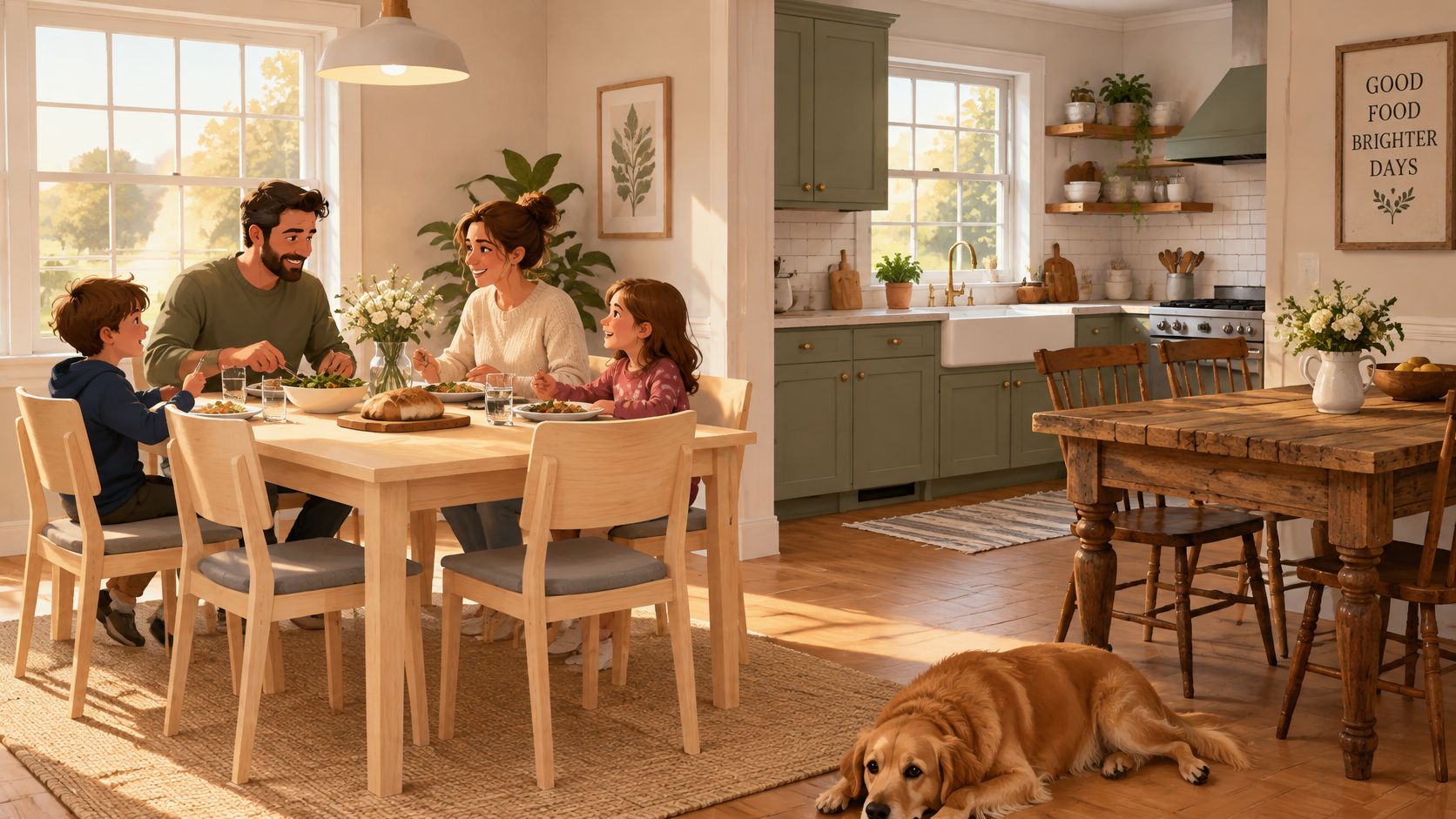
Weigh the top and the edges for daily wear. Decide whether the grain should read from across the room or stay quiet. Then ask what indoor humidity does through a heated winter and a humid summer. For any solid top, joinery and kiln-dried stock matter more than the species name. Check how the top is fastened before you fall for the finish sample. I would rather own a top I can reset in year twenty than a prettier sample that is glued shut.
The Freehold, NY showroom is the practical next step for Albany-area projects. Compare oak and maple in person, use custom ordering when you need a specific wood, size, and finish, and ask the design consultants to line that wood up with flooring and the rest of the house. Look at flexible financing if the project covers more than one room, and check the Clearance Corner for pieces that are ready now.
Tip Top Furniture & Mattresses helps Capital Region homeowners compare solid oak and maple in person, then order the wood, size, and finish that fit the room, with design help and flexible financing from the Freehold showroom. Bring the questions about wear, grain, and winter dryness, and look at real tops rather than photos. Visit Tip Top Furniture & Mattresses to compare pieces, ask about custom ordering, or book a design conversation before you decide.