
Blackout Curtains for Bedroom: How to Choose and Hang Them


At 5:40 on a June morning in Albany, the room is almost dark. Almost is the problem. A bright seam runs along the top of the rod, a thin stripe glows where the two panels meet, and the ceiling carries a faint reflection from the streetlight across the road. The fabric is doing its job. The installation isn't.
That gap between "blackout curtains" as a label and darkness as a result is where most bedroom light problems live. The fix is rarely a more expensive panel. It's a wider rod, a longer drop, a center overlap and a seal at the edges. Choosing blackout curtains for bedroom windows comes down to picking the right level of light control, measuring for coverage rather than for the glass, hanging the hardware so it clears the frame, and testing the finished room at night before deciding the curtains failed.
What Blackout Curtains Are and Which Level You Need
Blackout curtains are opaque panels, tightly woven or lined, that stop most outside light from crossing the glass. Blackout describes a performance level, not a brand, a weave or a specific fabric, which is why two panels carrying the same word on the package can behave nothing alike in the same window.
The idea predates the bedroom market. Blackout regulations in the United Kingdom began on 1 September 1939, two days before Britain declared war, and required households to keep visible light from escaping after dark because lit buildings helped enemy aircraft identify populated areas, as BBC accounts of wartime blackout precautions describe. Families hung heavy dark curtains and blocked windows with cardboard, brown paper or black paint. Through the Blitz, from 7 September 1940 to 11 May 1941, the routine held, and the rules only eased into a dim-out in September 1944. The design principle that survived is simple: dense fabric plus full coverage equals darkness.
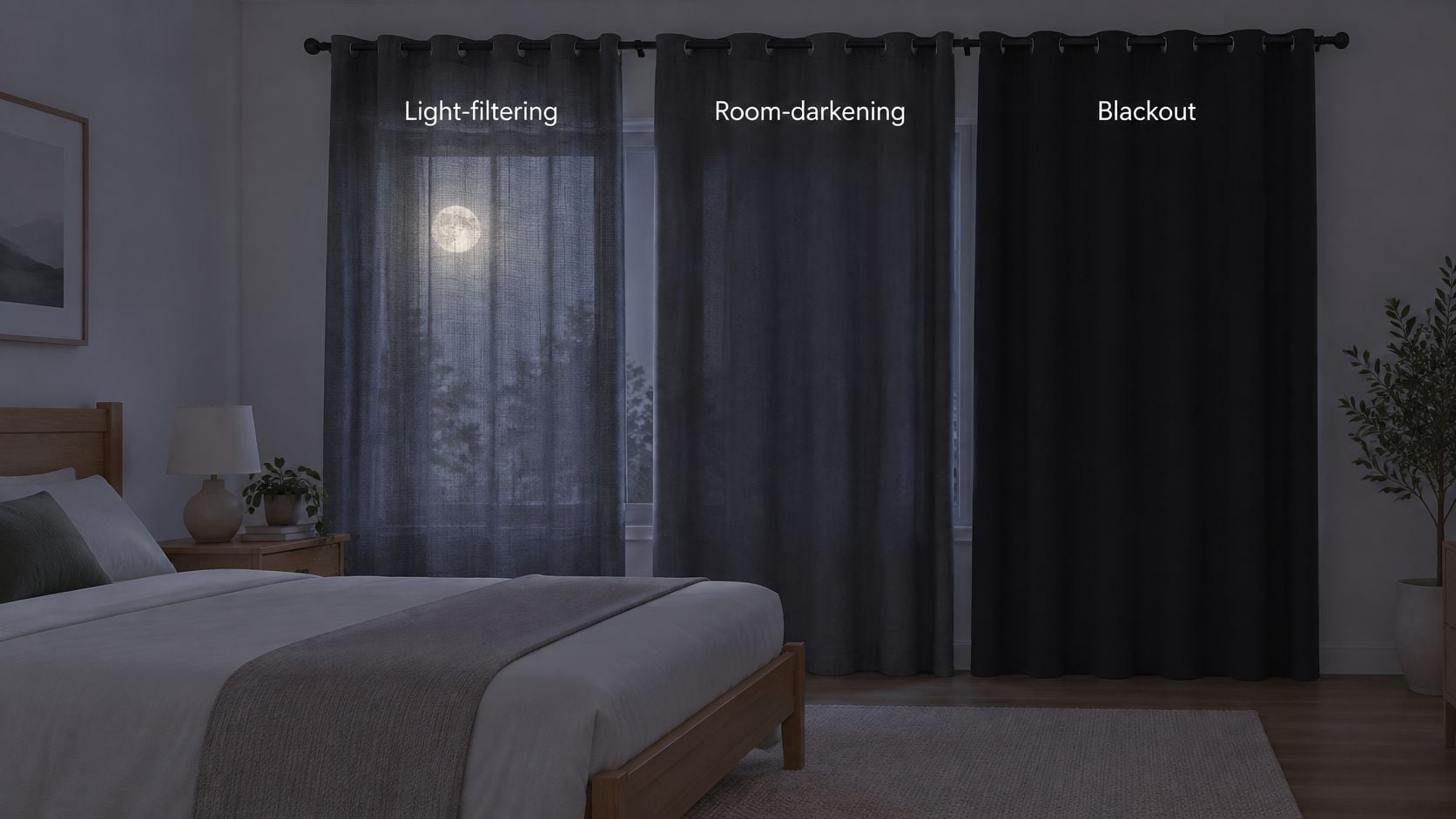
| Level | What it blocks | Typical construction | Best bedroom fit |
|---|---|---|---|
| Blackout | Nearly all visible light when fitted well | Multi-layer or thick lined fabric, often with a thermal backing | Streetlit rooms, shift sleepers, early-sunrise windows |
| Room darkening | Most daylight, with some glow at the edges | Dense single or lined layer | Most bedrooms and guest rooms |
| Light filtering | Softens daylight but leaves the room bright | Lightweight woven or sheer-style fabric | Living rooms and kitchens, not sleep spaces |
| Privacy lining | Blocks views into the room, little light | Opaque lining under a decorative face fabric | Street-facing rooms that need privacy only |
The distinction shows up at the edges. A true blackout panel kills the glare from the streetlight across the road. A room-darkening panel dims the room and still leaves a pale glow along the seams and under the hem.
So match the level to the problem. A window facing a parking lot, a neighbor's security light or an unobstructed eastern horizon, and any room used by a shift sleeper, justifies full blackout. A guest room or a nursery often does well with room darkening, which keeps the room dim without the heavier hand and structure of a coated panel.
A test you can run in the store
Take the panel to a dim corner, hold a bright flashlight flat against the back of the fabric and watch the front. Pinpricks of light mean the fabric transmits. A soft wall of glow means it's a room-darkening panel wearing a blackout label. Sleep Foundation guidance on bedroom light frames it the same way: these treatments block the majority of outside light, and the uncovered portions of the window plus the gaps around the edges decide what's left.
For anyone who already sleeps in a black mask, SleepHabits blackout mask recovery advice covers how to use one while a drifted schedule gets back on track. If the choice between panels, shades and layered setups is still open, the guide to choosing window treatments compares them room by room.
Name the level first. The tape measure comes second, and the rest of the project gets simpler.
What Blackout Curtains Do for Sleep and Energy in the Capital Region
Light at night costs real sleep. In a review of light exposure and sleep, people exposed to light while sleeping got about 10 fewer minutes of sleep per night and reported more fatigue, nighttime confusion, excessive daytime sleepiness and impaired daytime functioning, while residents of cities with 500,000 or more people experienced outdoor illumination three to six times more intensely than people in less-populated areas.
Sleepers have reached the same conclusion on their own. In a 2025 survey of sleep habits, blackout curtains were the most frequently reported way to cut nighttime light in the bedroom, chosen well ahead of limiting evening screen time, and reported use ran highest among young women.
Winter comfort is the other half of the story. A Nashville government report on window thermal performance found that closing curtains or lowering plain blinds reduced heat loss by roughly 40% to 50% under its stated conditions. The report works through an example: a typical single-glazed sash window with a U-value of 4.3 W/m²K could reach approximately 2.6 W/m²K when covered by heavy curtains and ordinary roller blinds. Those are modeled conditions rather than a promise about a fuel bill, and real results move with glazing, drafts, fabric and how completely the panel covers the opening.
That last qualifier matters more than the fabric label. A heavy panel hung inside the frame leaves the sash edges exposed, and heat slips around it the same way light does. Coverage is what turns a curtain into insulation.
The Capital Region makes the case concrete. June dawn arrives early enough to wake a light sleeper at 5:15, and January sun bouncing off snow throws glare through a west window at eye level. In an older house still running original double-hung sashes, air slips past the meeting rail all winter, so a lined panel earns its keep twice.
What curtains can't do
Curtains control light. They don't set a bedtime, muffle a barking dog, cool a warm room or replace window weatherstripping. A 2025 adolescent-bedroom study found that more than half of participants used blackout curtains and still showed no significant association between curtain type, window direction, bedroom lighting color and sleep problems, as the adolescent bedroom environment study reports. The stronger predictor in that study was parental awareness of adequate sleep time, associated with lower odds of insufficient sleep at an odds ratio of 0.36 for junior-high students and 0.49 for high-school students.
The honest framing: a blackout panel removes one obstacle to sleep. It doesn't remove the other four.
That suggests a cheap experiment rather than a purchase. Keep a one-week sleep log with the curtains open, then run a second week with them closed, noting bedtime, wake time, how often the night broke and how the morning felt. Two weeks of plain notes settle more questions than a fabric swatch. Twelve practical tips for better sleep cover the schedule, temperature and screen habits that sit outside the window's control, and clock changes bring their own disruption, so daylight savings guidance from SouthShore Fine Linens is worth a read before the switch.
How to Measure Bedroom Windows for Full Light Control
The rule most sizing charts skip: make the rod wider than the window, then make the fabric wider than the rod. A panel that spans only the glass leaves two bright margins the width of the frame, plus whatever leaks over the top.
| Window width | Rod width |
|---|---|
| 36 in | about 44 to 48 in |
| 60 in | about 70 in |
Measure in this order
- Width at three points. Run a steel tape edge to edge across the top, middle and bottom of the window and keep the widest reading. Old frames are rarely square, and half an inch of lean is enough to open a light gap.
- Add the overhang. Add 8 to 12 inches (20 to 30 cm) to the window width for the rod, roughly 4 to 6 inches on each side, so the panel covers the frame and a strip of wall beyond it.
- Set the rod height. Mark the rod 4 to 6 inches above the top of the frame. That lifts the header, pleats or grommet tops clear of the glass so light can't spill over the top.
- Measure the drop. Run the tape from the rod line to the floor. Floor length, finishing half an inch above the floor, is the default for blackout; sill-length and apron-length panels leave a band of light and a cold draft path under the bottom edge.
- Multiply for fullness. Rod width times 2 to 2.5 gives total fabric width, split across two panels. Heavier fabric needs slightly less fullness than sheers, but a blackout panel still needs enough width to stack past the frame when it's open.
The geometry matters for more than darkness. A curtain mounted several inches beyond the frame, extending below the sill and sealing reasonably well at the sides performs better than a narrow panel that leaves exposed perimeter gaps, according to technical reference material on blinds, curtains and shutters. Width and drop do the same work for heat that they do for light.
One more sizing trap: standard curtain panel sizes rarely match a calculated rod width, so plan to buy for fullness and let the hem be adjusted rather than squeezing two narrow panels over a wide span.
Measurements to bring to the showroom: window width at its widest point, rod height above the frame, drop from rod line to floor, ceiling height, and a phone photo of the window with the trim visible.
The free online room planner can test a layout to scale before anything gets ordered, which is faster than discovering a rod finial collides with a closet door.
How to Mount Blackout Curtains and Fix Light Leaks
A panel can pass a fabric test and still fail the room. Light behaves like water. It finds the seam, the half inch above the sill and the finger-width gap at the hinge side. Light control depends on measured transmittance and installation geometry rather than the marketing label: independent testing has run curtains against a bright 5,000-lumen flashlight, and one reported laboratory comparison found that healthy adults exposed to 100 lux during sleep had higher heart rate and blood pressure than when sleeping in darkness, as Consumer Reports' blackout curtain testing describes.
Even highly opaque fabric can't darken a bedroom when light bypasses the panel through side gaps, the top header or the space below the sill.
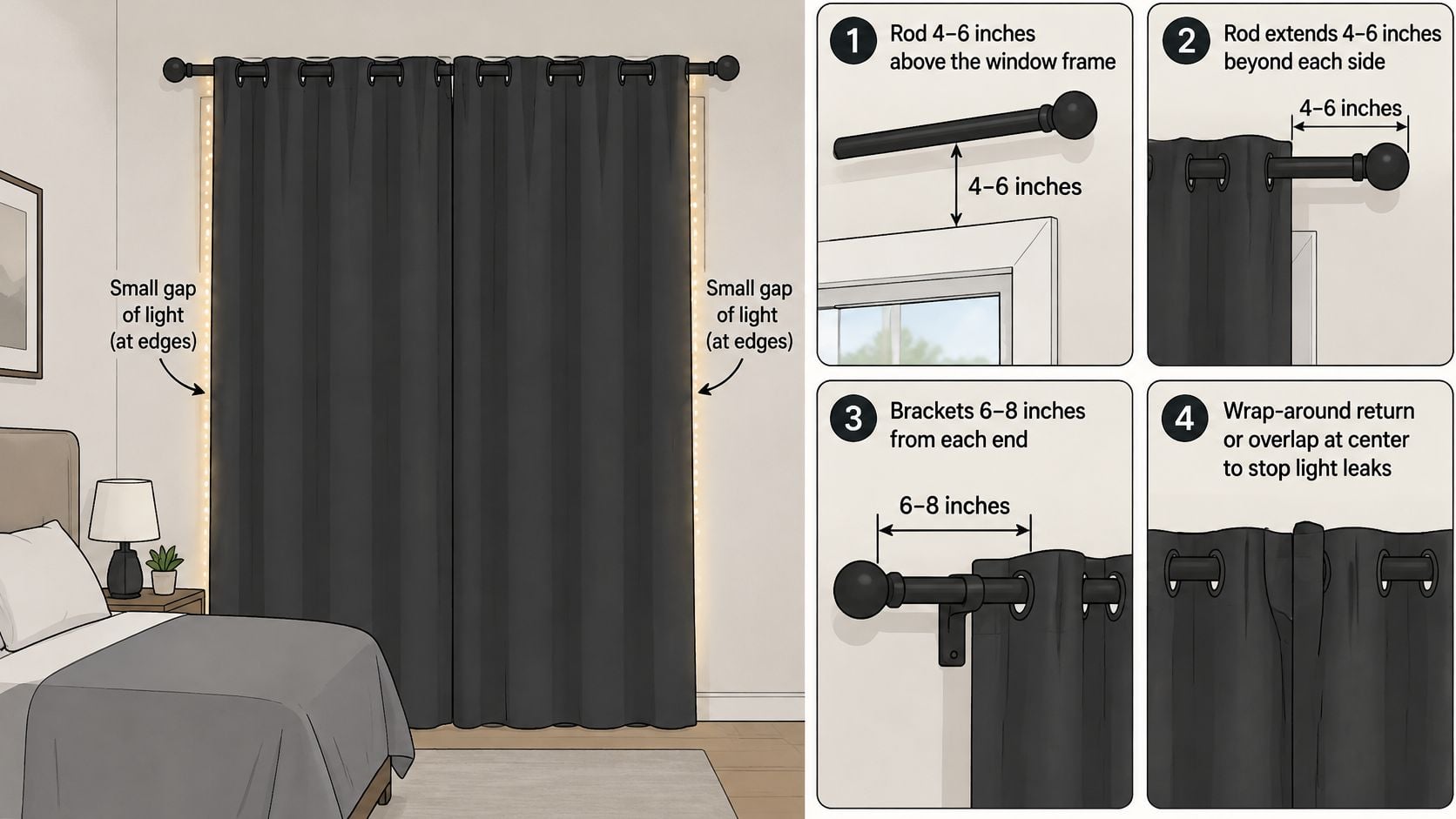
Six mounting steps that stop the leaks
- Set the rod above the frame, not on it. Hang it at the height and width worked out in the measuring step: high enough that the header clears the glass, wide enough that the panel covers the frame and the wall beside it instead of stopping at the trim.
- Space the brackets for the weight. Keep brackets within 6 to 8 inches of each end and no more than 36 inches apart, and add a center bracket for heavy lined panels. A sagging rod tilts the panel away from the wall and opens a gap along the top.
- Overlap the center seam by 1 to 2 inches (2.5 to 5 cm). Two panels that merely meet leave a vertical stripe of light exactly where the bed faces.
- Take the hem to the floor, half an inch above. A panel that stops at the sill lets light run underneath and breaks the still-air layer that does the insulating work.
- Seal the sides where light is close. Add side returns, a wraparound rod, or magnetic and Velcro edge seals when a streetlight or a neighboring window sits at eye level. These are the details that separate a dark room from a dim one.
- Remove internal light sources. Chargers, alarm displays, night-lights and standby LEDs all survive a blackout panel, because the panel only controls exterior illumination.
Run a night test before blaming the fabric
Turn off every light in the room after dark, close the panels, and give your eyes two minutes to adjust. Then inspect the top, the sides and the floor line. A visible line means the panel is fine and the coverage isn't. A flashlight check after hanging catches what a glance in the store can't: a fabric that looks solid under retail lighting can still leak at its edges once it's up against a real window. For the anchors, brackets and fittings that hold a heavy lined panel square, the window treatments DIY guide walks through the hardware side of the job.
Match each leak to its fix
| Symptom | Likely cause | Fix |
|---|---|---|
| Thin line of light at the window sides | Panel narrower than the frame | Widen the rod 4 to 6 in (10 to 15 cm) each side and add side returns |
| Glow above the header | Rod mounted too low | Raise the rod 4 to 6 in above the frame |
| Light under the sill or bottom edge | Panel ends above the sill | Lengthen the panel to the floor, half an inch above |
| Bright line at the center seam | Panels do not overlap | Overlap the leading edges 1 to 2 in (2.5 to 5 cm) and add a return or a magnetic seal at the seam |
| Bright spot in the room but not at the window | Internal light source | Cover chargers, alarm displays and night-lights |
| Panel sags or pulls off the rod | Too few brackets for the weight | Brackets within 6 to 8 in of each end, no more than 36 in apart, plus a center bracket for heavy lined panels |
Mounting also decides whether the panel insulates
A curtain system attached at the window head and side trim and extending beyond the sill improved thermal performance in an evaluation by the Alaska Housing Finance Corporation's window insulation study, which reported that for a hypothetical low-performing window, movable insulation with an R-value of 1 reduced heat loss by 17%, while R-5 insulation reduced it by 36%. The same evaluation noted the curtain system did not create an airtight seal. So a lined panel slows heat transfer and cuts drafts. It doesn't replace weatherstripping or a window upgrade.
Care that keeps the coating intact
- Vacuum the face fabric monthly with a brush attachment, because dust dulls the surface and holds odors near the glass.
- Spot clean by the care label, testing any cleaner on a hidden corner first.
- Skip the hot dryer on lined and thermal panels. Heat breaks down the blackout coating, and once that layer cracks, light comes through in patches.
- Rotate panels every six months if one side of the window takes more sun, so fading and coating wear stay even.
- Replace any panel with thin patches or peeling backing. No amount of edge sealing compensates for fabric that has stopped blocking.
Styling and Layering Blackout Curtains in a Bedroom
Start with a specific room: a south-facing bedroom in the Capital Region with pale walls, an oak floor and a bed against the long wall. At noon it looks calm. In June it's striped with light at 6 am. The goal there isn't a black box. It's a soft room that can turn dark on demand.
The three-layer system gets there. Layer one is the blackout lining or blackout backing, sewn behind the decorative face fabric. Layer two is that face fabric, which carries the color and texture the room shows. Layer three is optional: a sheer or light-filtering panel hung in front, so daytime light stays gentle while the blackout panel sits open.
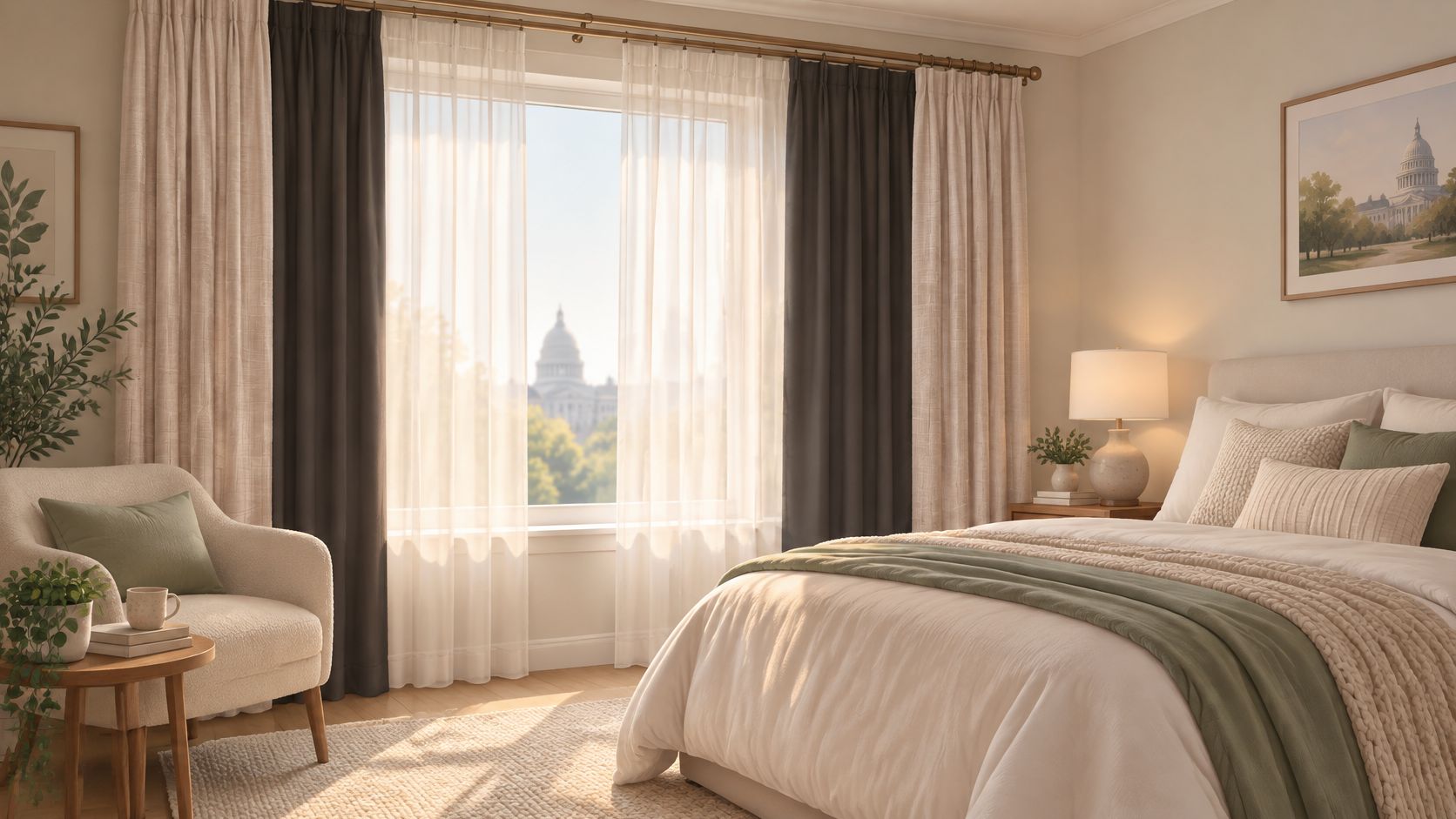
- Color. A darker face fabric hides edge glow better, while a white or light backing reflects summer radiant energy, so a dark face with a pale back is a working combination rather than a compromise.
- Pattern and scale. Pull the palette from the headboard, bedding and wall color, then let one bold print anchor an otherwise plain room.
- Hardware. A wide decorative rod buys the overhang the panel needs, and substantial finials finish the look without narrowing the coverage.
- Length. Floor length reads as luxurious, but pooling fabric collects dust and creases, so a clean break just above the floor is easier to live with.
Coordinating all of that with the rest of the room is where local help earns its place. Tip Top Furniture & Mattresses works with local sewing shops to customize window treatments that coordinate with the fabrics in a customer's space, and the showroom carries window coverings from Norman and Comfort Tex, a division of Hunter Douglas. If the room needs warmth rather than another neutral, the burnt orange curtain ideas show how a saturated face fabric reads against a lined back.
The showroom checklist: the light level the room needs, the face fabric and backing, and the rod width that clears the frame.
Choose Blackout Curtains and Visit Our Freehold Showroom
Two panels with the same shelf price can cover a window very differently. Width, lining, backing, length and hardware all feed the final figure, so compare quotes on specification rather than sticker. A coated blackout panel costs more than a dense room-darkening one. A thermal lining adds cost but handles light and heat together. Fullness drives total fabric width more than most shoppers expect, floor-length panels use more fabric than sill-length, and an odd-sized opening pushes you into custom pricing. Rod, brackets and finials are often excluded from a quoted price, and installation into plaster or brick takes different anchors and more time than drywall.
The cheapest quote usually leaves something out.
Savings claims deserve the same scrutiny. A DOE-supported review reports that optimized high-efficiency window attachments can reduce whole-home summertime cooling use by roughly 15% to 25%, and field demonstrations of affordable shading options have logged savings anywhere from 3% to 30%, per Pacific Northwest National Laboratory's window attachments resource guide. The spread is wide because it depends on the window, the fit and how consistently the treatment gets closed. Buy for light control and comfort first, and treat any energy figure as a possibility rather than an invoice.
Ready-made panels suit standard windows and a quick refresh. Custom ordering suits an unusual opening, a specific fabric or a finish that has to match existing furniture. At Tip Top Furniture & Mattresses, that process runs through style, size, fabric and finish, and skilled craftsmen can work from a picture or a sketch when a piece doesn't exist yet. Payment options include special financing on purchases made with a Synchrony Home Card (see store for details), the Clearance section advertises savings of up to 70% off, and monthly specials take 10% to 60% off retail value on furniture and mattress brands.
The showroom is family-owned, has operated in Freehold, NY since 1978, and serves homeowners across the Greater Albany Capital Region, including Greene County, with one-stop shopping for furniture, mattresses, window treatments and floor coverings. Bring the measurement sheet, a fabric sample if there is one, and the budget. Note the mounting surface too, since the wall behind the rod decides which anchors the job needs, and a specification that accounts for the wall, the rod projection and the exact opening is what separates full blackout from a panel that glows at the edges. Check the Clearance racks first, sit down with a design consultant, and leave with a specification instead of a guess.
Tip Top Furniture & Mattresses helps Capital Region homeowners finish a bedroom properly, from blackout-lined window treatments and the rods that stop edge leaks to the beds, dressers and nightstands around them. Bring your window measurements and a photo of the space to the Freehold, NY showroom, and the team can match a light-control level, a fabric and a hanging plan to your room. Browse the collections online, check current Clearance savings or book a design consultation before the next early sunrise wakes you.