USA Made Wood Furniture: What It Really Means


A homeowner from Albany may walk into a showroom, spot a handsome oak table with a “Made in USA” tag, and assume the label answers every question about its origin. But the lumber, panels, hardware, finish, and final assembly can each have a different story. Knowing what the claim does and doesn't establish helps shoppers choose a table that suits their home, budget, and expectations.
That distinction matters across the Greater Albany Capital Region, where winter heating dries indoor air and summer humidity brings seasonal wood movement. It also matters to shoppers drawn to Amish craftsmanship, where solid wood and custom options can be part of a longer-term furnishing plan. A clear conversation about materials and construction needn't feel awkward. It's a practical way to understand what a label means before making a purchase.
What Every Shopper in Albany Gets Wrong About USA Made
At a Freehold showroom, a Capital Region shopper might ask about a dining set's species, finish, and size, then pause at the “Made in USA” tag. The label is useful, but it doesn't automatically tell the shopper where each component came from. A table can be assembled domestically while still containing imported materials or hardware, and those details can affect how a claim should be understood.
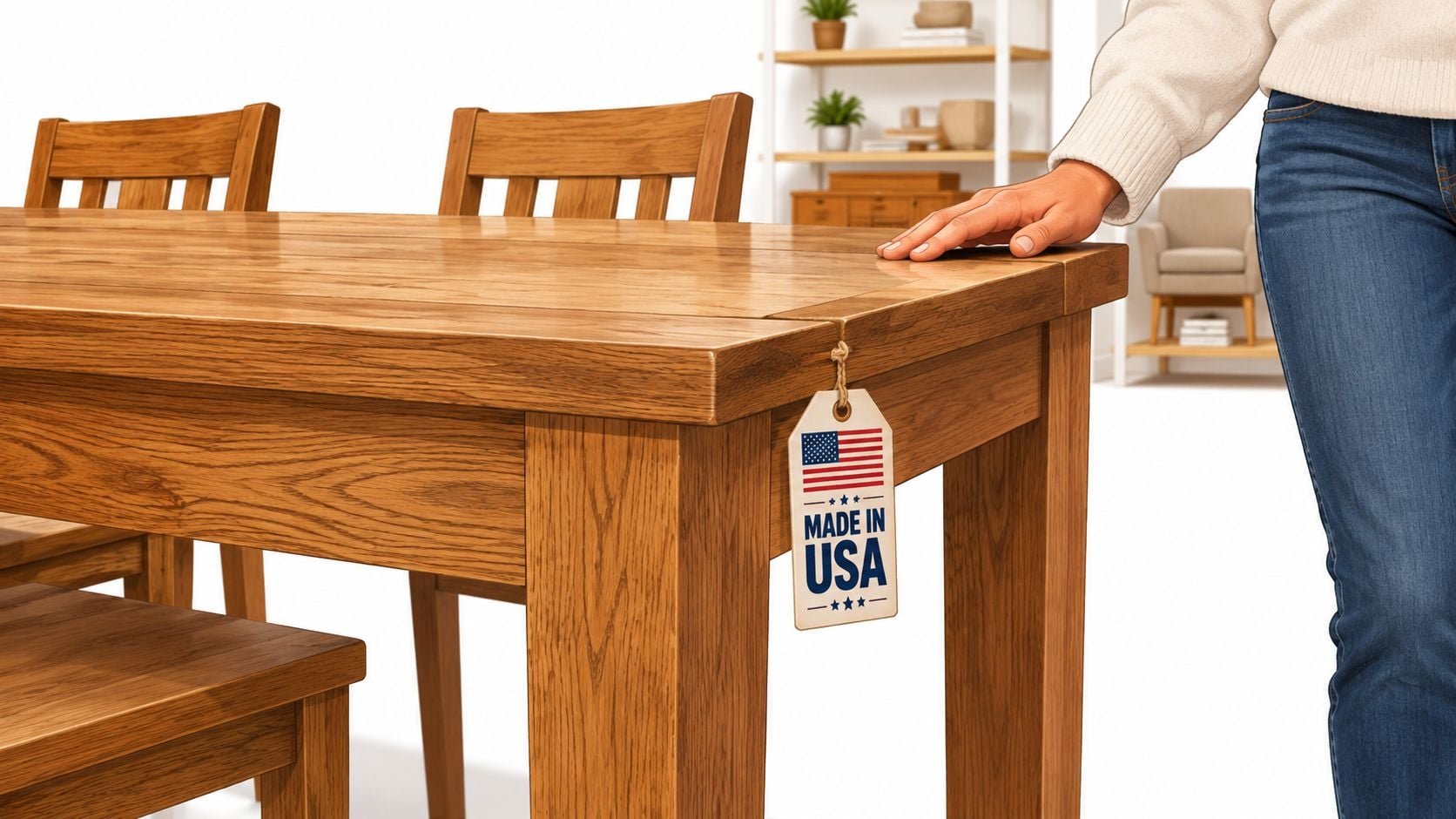
For shoppers comparing USA-made wood furniture, the useful questions go beyond the tag. Where was the lumber harvested and dried? Were any panels pressed domestically? Where did finishing happen, and where was the piece assembled? Those are reasonable questions, not a challenge to the person helping at the showroom.
The Federal Trade Commission's standard for an unqualified “Made in USA” claim is more specific than “assembled here” or “American craftsmanship.” The details of that standard matter because an origin claim is about the product's overall manufacturing story, not just the location where the final screws were tightened.
A practical starting point: Ask what the label means for the specific piece, then ask which materials and steps are domestic.
A shopper comparing solid wood and composite construction can also review how solid wood differs from particle board. The aim isn't to reject a piece because one component has a different origin. It's to understand what's being sold, what the claim supports, and whether the construction suits the household.
How the FTC Defines Made in USA for Wood Furniture
The FTC says an unqualified “Made in USA” claim requires a product to be “all or virtually all” made in the United States, with final assembly or processing occurring domestically and the claim supported by a reasonable evidentiary basis. The agency's Made in USA compliance guidance explains the standard for marketers.
In plain language, domestic assembly by itself doesn't settle the question. The FTC considers the share of total manufacturing costs tied to U.S. parts and processing, how important any foreign content is to the finished product's function, and how far that content is removed from the completed item. A maker or seller needs evidence for the claim, not just a confident label.
Follow the furniture supply chain
For a wooden table, the relevant story may include the lumber's origin, where it was kiln-dried, where composite panels were made, who supplied the hardware, where the finish was applied, and where final assembly took place. A foreign screw or drawer slide doesn't automatically answer whether a claim is allowed. Its role and cost matter alongside the rest of the product.
“American craftsmanship” and “Made in USA” also aren't interchangeable. The first can describe skill or style without making the same specific origin claim. Shoppers in Albany, Schenectady, and Troy can ask a retailer to clarify the wording and explain what documentation supports it.
A useful question is, “Can you tell me which parts and manufacturing steps are domestic for this piece?” That gives the seller room to explain the supply chain without requiring the shopper to know every legal detail. If the claim is qualified, such as identifying a domestic assembly step while disclosing imported content, the qualification should be clear enough not to leave a misleading impression.
Wood Species, Kiln Drying, and Why Construction Matters Most
A wood species can tell a shopper something about appearance and typical use, but it can't guarantee how a finished piece will perform. Black walnut and cherry have historically been used primarily for furniture and cabinets, while wood properties also vary with where and how a tree grew, as USDA Forest Service research describes in its discussion of wood characteristics and performance.
Hardwood furniture may be made from oak, maple, cherry, walnut, or other species. The names matter, but so do lumber quality, joinery, panel design, and finishing. A table made from a familiar hardwood still needs construction that accommodates wood's response to changing indoor conditions.
Why moisture content matters
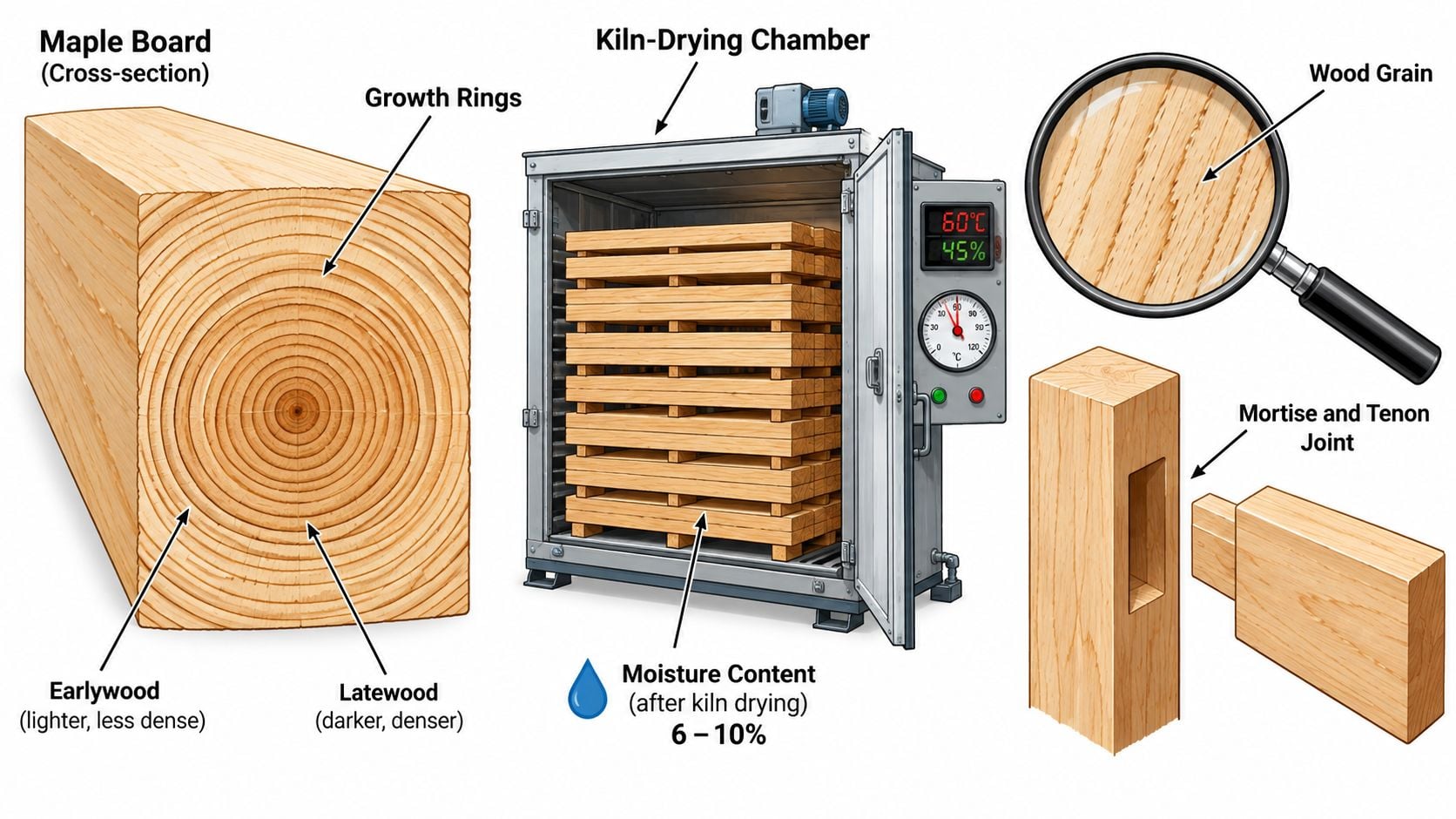
Wood is hygroscopic, which means it gains or loses moisture as the air around it changes. The USDA Forest Products Laboratory says hardwood lumber used for furniture, cabinets, flooring, and millwork is typically kiln-dried to approximately 6 to 8 percent moisture content. That target helps reduce the risk of gaps at joints, open miters, panel shrinkage, splits, and finish failure. See the USDA guidance on wood moisture and dimensional movement.
That matters in Upstate New York homes, where heated winter rooms can be much drier than summer interiors. Wide solid-wood panels need room to move; floating panels and properly designed joinery can allow that movement rather than trapping boards rigidly. Shoppers can ask about kiln-drying and panel construction, then learn more about what kiln-dried wood means.
Solid hardwood, veneer, and engineered panels aren't the same thing. Solid wood is lumber through the thickness; veneer is a thin layer of real wood applied over a core; engineered panels use wood fibers, particles, or layers bonded together. For a plain-language overview of what makes solid wood furniture, it helps to compare the material itself with the way the piece is built.
Amish Craftsmanship and What Sets It Apart in the Capital Region
Amish furniture is part of the wider American-made furniture conversation, not a separate definition of domestic origin. Many Amish-made pieces are built in small workshops, often from solid hardwood, with traditional joinery and choices for wood, dimensions, and finish. Those features can appeal to households looking for a piece that can be customized to a room and kept in service over time.
Custom work and construction choices
A shopper might compare a standard domestic dining table with an Amish-made table that can be ordered in a different wood, size, or finish. The custom piece may take more planning, but the extra choices can help it suit an existing dining room or coordinate with other furniture. Dovetail joints and mortise-and-tenon construction are examples of joinery shoppers may encounter, though construction quality depends on the whole design rather than a single technique.
Amish craftsmanship doesn't automatically answer every origin question. Buyers should still ask about materials, panels, hardware, finishing, and the specific meaning of any country-of-origin claim. A solid-wood table can be well made while including components sourced elsewhere, so transparency remains useful even when workmanship is a key reason for choosing the piece.
Custom ordering can also mean discussing lead times and confirming specifications before placing an order. A local showroom can help turn a photograph, room measurement, or rough sketch into a clearer conversation about dimensions, wood, finish, and fit. For shoppers weighing these details, a guide to Amish furniture quality can help focus attention on construction and materials, not just appearance.
For families across Albany and the Capital Region, the practical comparison is between the level of customization, the construction details, and the timeline that works for the household. The right choice is the one whose origin, materials, and design are clear, and whose form fits the way the home will use it.
A Verification Checklist You Can Bring to Any Showroom
A buyer doesn't need to be a furniture expert to ask useful questions. At a Freehold showroom or elsewhere, these prompts can help reveal what a product's origin label covers and whether its construction suits the room.
- Where did the lumber come from, and where was it kiln-dried? Ask for the species and, if available, information about the lumber's origin and drying process.
- Are there composite panels? Drawer bottoms, cabinet backs, and hidden panels may use hardwood plywood, MDF, or particleboard rather than solid wood.
- Do regulated panels comply with TSCA Title VI? EPA limits are 0.05 ppm for hardwood plywood, 0.11 ppm for MDF, 0.13 ppm for thin MDF, and 0.09 ppm for particleboard. Compliance requires testing and certification through an EPA-recognized third-party certifier. The EPA's consumer guidance on formaldehyde standards explains the requirements.
- Where was the finish applied? Ask which finish is used and where the finishing work takes place.
- What hardware does the piece use? Request the hardware's origin if that information is available.
- Is the country-of-origin claim qualified or unqualified? Ask what the wording means for the entire product, rather than assuming the tag describes every component.
- What written information can the seller provide? Useful records may include a product specification, origin statement, or panel compliance information.
“Eco-friendly” is broad wording; it doesn't substitute for a specific panel category or certification status. For a custom order, buyers can ask that the agreed wood, panel materials, finish, and origin details appear in the written specifications.
| Question to Ask | What It Reveals | Acceptable Documentation |
|---|---|---|
| Where were the lumber and panels sourced? | Material origin and construction | Product specification or manufacturer statement |
| Do composite panels meet TSCA Title VI? | Compliance status for regulated panels | Compliance statement or certification information |
| What supports the origin claim? | Whether the wording reflects the full supply chain | Written origin explanation or supporting records |
| Where were finishing and final assembly done? | Locations of key production steps | Manufacturer or retailer documentation |
Caring for USA Made Wood Furniture Across Upstate New York Seasons
A well-made piece still needs care that suits its material and finish. For homes in Upstate New York, seasonal changes can affect solid wood, so owners should keep furniture in a stable indoor environment and avoid placing it where heat or moisture changes are concentrated.
Keep a dining table away from heating vents and avoid pressing large solid-wood pieces directly against an exterior wall where conditions may fluctuate. A humidifier during a dry heating season can help moderate indoor conditions, but care should follow the manufacturer's guidance for the particular finish and furniture. Spills should be wiped up promptly, especially on unfinished or more delicate surfaces.
Match care to the finish
Paste wax, oil finishes, and modern coatings don't all respond to the same products. Before applying polish or attempting to remove a water ring, check the care instructions and test any treatment in an inconspicuous spot. A surface scratch may need a small, finish-specific repair, while widespread wear or deep damage is a better reason to ask a refinishing professional.
For routine upkeep, use a soft cloth and avoid harsh cleaners or abrasive pads unless the manufacturer specifically recommends them. A wood furniture care guide can help owners build a maintenance routine around the finish and how the piece is used.
Before a move: Protect corners, support the piece from its frame, and avoid lifting a table by its top or a chair by its arms. Secure removable parts separately so the joints don't take the strain.
Care also connects back to the buying decision. A piece with sound joinery and a finish that can be maintained or renewed may have a clearer repair path than one with a damaged surface that can't be restored easily. Asking about refinishing, warranty coverage, and recommended care before buying helps a household plan for normal wear rather than treating every mark as a reason to replace the furniture.
Choosing the Right Piece for Your Home and Budget
No single material is right for every room. A solid-hardwood dining table may make sense for a household that expects heavy daily use and wants the option of refinishing it. A well-made veneer piece can be a sensible choice for a formal room where a consistent surface and careful use matter more than repeated sanding.
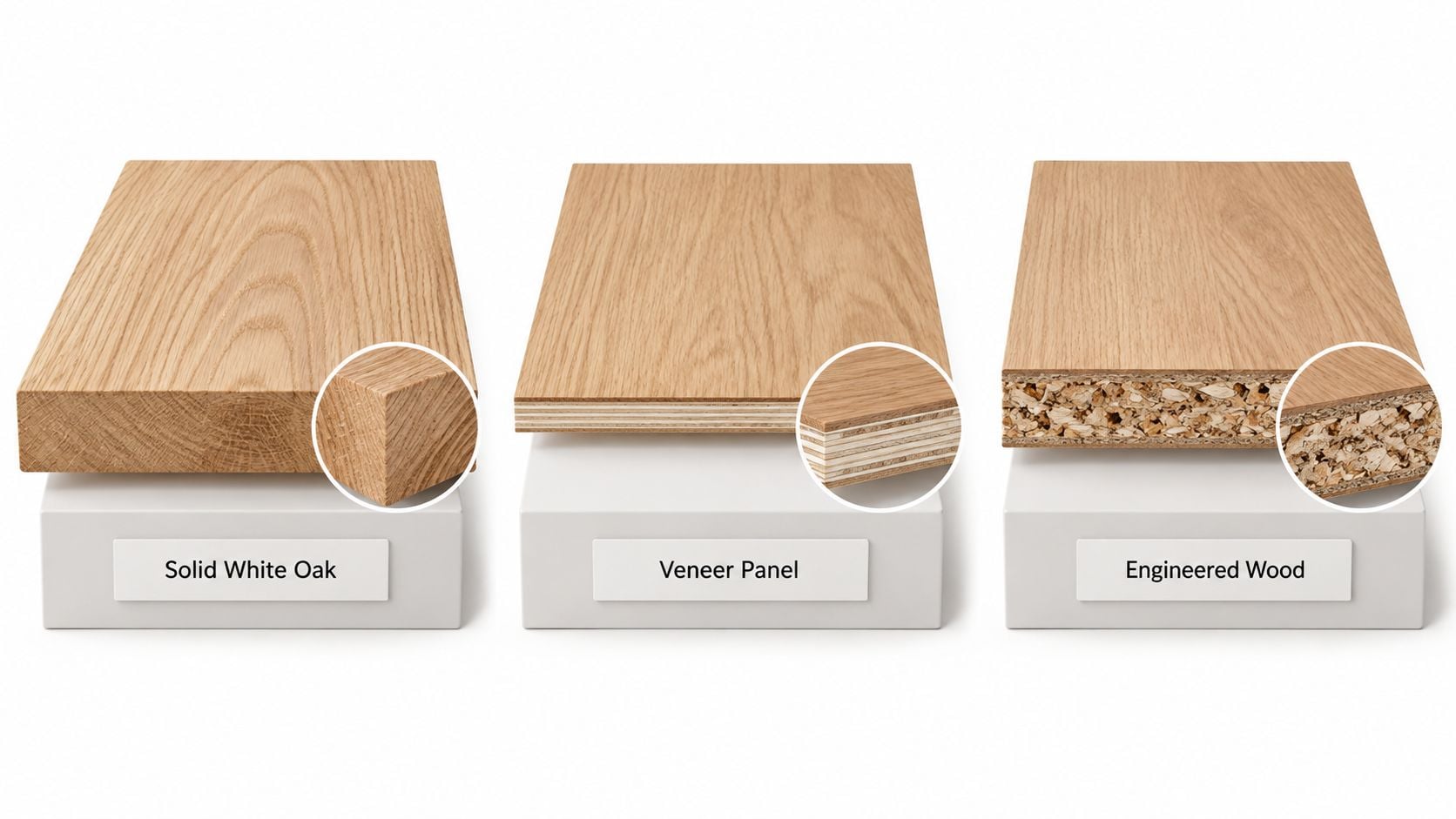
A child's bedroom set or starter apartment may call for a lower-cost option, provided the buyer understands what the panels are and how they'll hold up to spills, moving, and everyday use. Engineered boards can keep a purchase affordable, but some are more vulnerable to moisture than solid wood. The decision should reflect how the item will be used, not just the material printed on a tag.
Consider use, repair, and budget together
Solid wood often offers repair and refinishing possibilities, but it can cost more and still needs construction that permits seasonal movement. Veneer can use less solid timber and provide a stable appearance, though a damaged surface may be harder to restore. Engineered panels may work well in the right setting, but water exposure and edge damage deserve attention.
Domestic furniture is also bought in a market reshaped by imports. Research on U.S. wood household furniture found that domestic shipments fell 51 percent between 2000 and 2009 and remained 48 percent below 2000 levels by 2019, while imports rose from 23 percent of the market in 1997 to 78 percent in 2019. The industry analysis of U.S. wood furniture production, imports, and consumption provides context for why shoppers benefit from asking precise questions about origin.
For a bunk room or shared sleeping space, a buyer can also review this practical guide to bunk beds for adults while considering size, intended use, and construction. For any larger purchase, compare the total project cost with the intended service life, repair options, and room requirements. Furniture financing options may help households plan a purchase, while clearance inventory can offer another way to balance budget and quality.
Bringing It Home to Freehold and the Greater Albany Capital Region
The homeowner who entered a showroom looking only for a “Made in USA” tag can leave with a more useful set of questions: What is the wood? Where were the panels and hardware made? What supports the origin claim? How does the construction accommodate seasonal movement, and what care or repair will the piece need?
At Tip Top Furniture & Mattresses, shoppers in Freehold, Greene County, and the Greater Albany Capital Region can compare furniture for different rooms alongside décor, flooring, and mattresses. The family-owned showroom has served the area since 1978, and professional design services have been available since 1984. Its selection includes products from more than 50 trusted manufacturers, along with custom-order options for choosing a style, size, wood, and finish.
A practical next step is to bring room measurements and a list of intended uses. Shoppers can also bring a photograph or sketch when considering a custom piece, use the free online room-planning software to visualize scale, and ask the design team about coordinating furniture, décor, and flooring. Flexible payment options, including special financing available with a Synchrony Home Card, can help make a project manageable; the Clearance Corner offers another route for budget-conscious shoppers.
The best choice isn't the piece with the boldest label. It's furniture whose materials, origin claim, construction, and care requirements make sense for the household and its Upstate New York home.
Visit Tip Top Furniture & Mattresses in Freehold to compare USA-made and Amish furniture, ask about custom wood and finish options, and get help planning a piece for your home. The team also offers design guidance, room planning, flooring, mattresses, delivery, flexible financing, and clearance finds for shoppers across the Greater Albany Capital Region.