Top Rated Memory Foam Mattress: A Buyer’s Guide for 2026

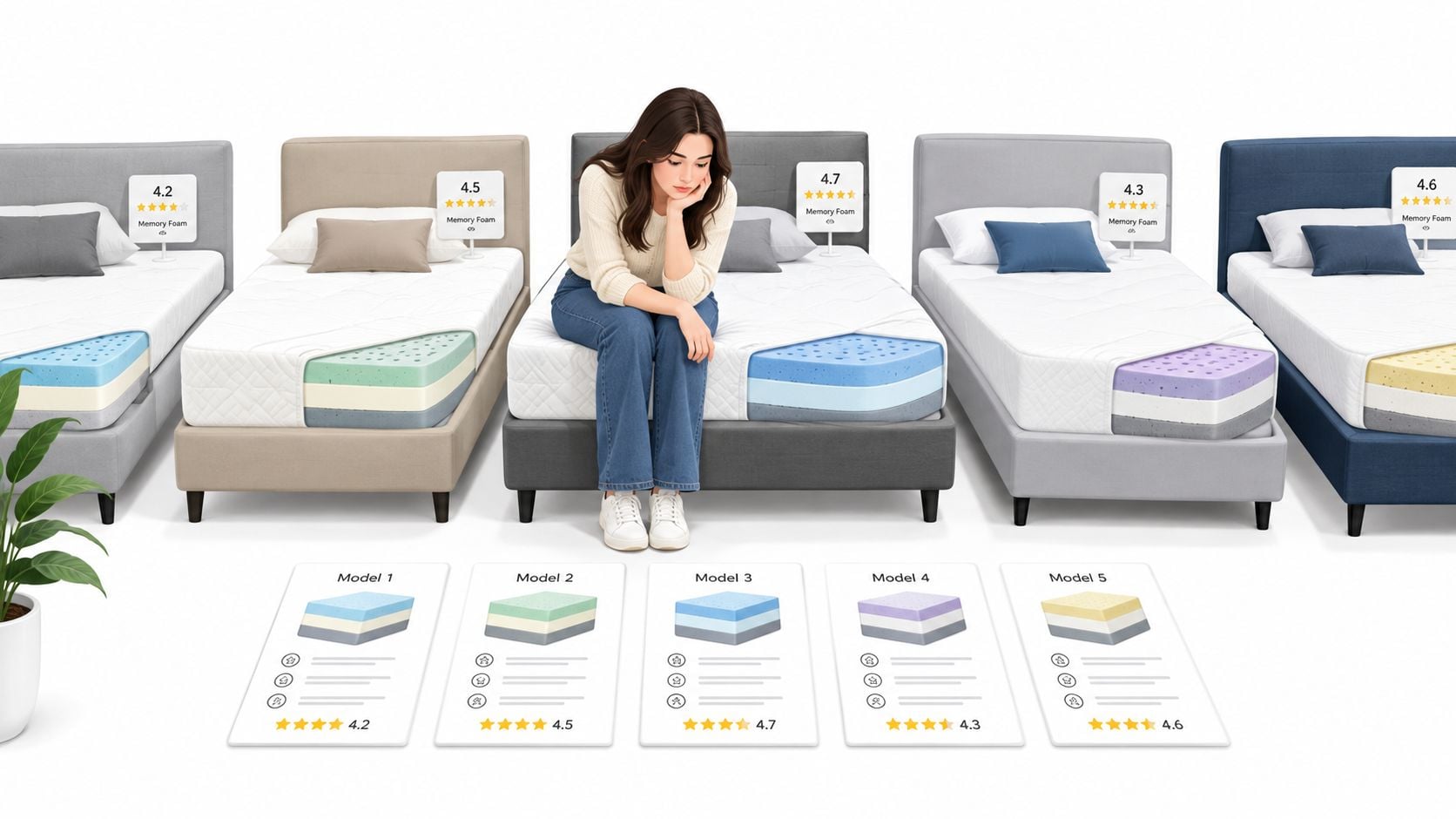
By the third Saturday of mattress shopping, the labels start to blur. One bed promises cooling, another claims pressure relief, and a third wears a “top rated” badge that looks convincing until five similar models appear on the same showroom floor. For shoppers in Albany, Schenectady, Troy, Freehold, and the wider Capital Region, the smartest purchase isn't the mattress with the loudest rating. It's the mattress with construction details that match the sleeper.
Memory foam remains popular for good reason. Its NASA-era development began with viscoelastic foam designed for impact absorption and pressure distribution, and engineer Charles Yost helped develop an open-cell version in 1966, before commercial efforts expanded in the following years. By the 1980s, the formula had entered the public domain, helping bring pressure-relieving foam into consumer bedding. Market estimates place the global memory foam mattress category in the billions, but a large market doesn't make every model a smart buy.
What Top Rated Really Means in a Crowded Mattress Market
A shopper can spend an afternoon lying on five mattresses and still leave without a clear answer. The beds may carry different names, but their showroom tags often repeat the same promises: best support, cooling comfort, advanced foam, and exceptional value. The phrase top rated memory foam mattress usually reflects a ranking system, not a universal fit.
Rankings can combine owner reviews, editorial scoring, commercial relationships, and automated comparisons. That means one model may rank near the top on one list and much lower on another without the mattress changing at all. Ratings are useful for building a shortlist, but they shouldn't replace construction research or a proper test lie-down.
The rating needs a construction check
A credible candidate should make its internal specifications easy to find. The label or product page should identify:
- Foam density: Listed in pounds per cubic foot, this helps reveal whether the comfort layers were built for lasting use.
- Firmness information: A useful description explains feel and support instead of relying only on a soft, medium, or firm label.
- Certification: A third-party foam certification gives shoppers a clearer baseline for emissions and material standards.
- Owner feedback: Reviews become more useful when they cover different body types, sleep positions, climates, and extended ownership.
Density deserves special attention because 4 to 5 PCF is commonly identified as a quality range for memory foam comfort layers, with premium foam often beginning around 5 PCF. Independent foam guidance explains why density affects durability, support, and resistance to impressions.
Practical rule: A mattress that hides its foam density isn't automatically poor, but it hasn't earned a confident recommendation yet.
Cross-checking three independent sources is sensible, provided each source explains how it reached its conclusions. A list without methodology should be treated as advertising with a ranking attached. For shoppers who want to understand why a quality mattress matters beyond the first night, this long-term mattress health guide provides useful context.
How Memory Foam Works and Why It Feels Different
Memory foam is viscoelastic polyurethane foam. The material combines slow flow under pressure with gradual recovery after the pressure disappears. That combination creates the familiar cradling sensation, but it also explains nearly every major strength and complaint associated with foam mattresses.
Heat and pressure change the feel
The simplest comparison is warm butter on cold toast. In a cooler room, memory foam can feel firmer and respond slowly. As body heat and pressure reach the surface, the foam softens and conforms around the shoulders, hips, and lumbar curve.
Mattress-grade formulations are engineered around a glass-transition range near roughly 30 to 37°C, according to technical material guidance. The important point isn't the laboratory term. It's that the mattress responds to the sleeper rather than behaving like a fixed slab.
That response generally creates three practical effects:
- Pressure distribution: The surface gives under heavier body areas, reducing the concentrated load that often bothers shoulders and hips.
- Motion isolation: The foam absorbs movement instead of sending a strong bounce across the surface, which can suit couples with different schedules.
- Slow recovery: The mattress may take longer to return after a sleeper changes position, especially when the foam is dense.
Foam doesn't feel like every other mattress
An innerspring mattress usually provides more lift and bounce. Latex tends to feel buoyant and quickly pushes back, making movement easier. Memory foam does the opposite. It allows a sleeper to settle into the surface and creates a deeper, quieter cradle.
That makes it especially appealing to side sleepers who need room around the shoulder and hip. Stomach sleepers and active combination sleepers may prefer a faster surface because deep contouring can make repositioning feel harder.
Cooling features respond to the material's natural behavior, rather than removing it. Gel infusion, open-cell structure, and phase-change materials can improve temperature management, but memory foam still tends to retain more heat than innerspring or latex designs. A clear explanation of the material appears in this memory foam mattress guide.
Key Specs to Compare Before You Fall in Love With a Mattress
A first lie-down tells only part of the story. The mattress may feel wonderful for a few minutes while concealing a weak comfort layer, a thin support core, or an unspecified foam blend. Density, profile, firmness data, and certification deserve a place beside the comfort impression.
Density is the durability filter
Foam density measures how much a cubic foot of foam weighs. Higher density generally supports better durability, resistance to permanent impressions, and pressure distribution. Independent guidance commonly associates 4.0 to 5.5 lb/cf memory foam with roughly 8 to 12 years of use, while cheaper 2.5 to 3.5 lb/cf foam can develop permanent impressions in about 18 months, depending on construction and sleeper conditions. Longevity guidance explains why shoppers should ask for the actual specification.
The same source emphasizes that an 11 to 13 inch profile can be more informative than marketing language or warranty length, although thickness alone doesn't guarantee quality. A tall mattress with weak foam isn't a bargain.
Firmness numbers need a sleeper attached
ILD, or indentation load deflection, describes how much force a foam sample needs to compress. It can help compare materials, but ILD isn't a complete comfort score because the cover, layer thickness, zoning, and body shape all alter the finished feel.
The practical question is whether the surface allows the shoulders and hips to settle without letting the midsection drop too far. The mattress firmness guide can help shoppers connect firmness to sleeping position before testing beds.
| Spec | What It Measures | Quality Benchmark | Red Flag |
|---|---|---|---|
| Density | Foam mass and general durability | Comfort layers commonly around 4 to 5 PCF | Density not disclosed |
| ILD | Compression resistance and firmness behavior | A stated range paired with a clear feel description | A firmness label with no construction detail |
| Profile | Total mattress height and layer space | A substantial build with useful comfort and support layers | Extra thickness with no meaningful layer explanation |
| Certification | Emissions and material standards | CertiPUR-US or another recognized third-party certification | No certification information |
| Base and transition layers | Structural support and movement through the mattress | Clearly described support core and transition design | A single foam layer marketed as a complete system |
CertiPUR-US-certified foam is described as meeting baseline standards for certain chemicals and low VOC emissions. One independent source states emissions below 0.5 parts per million for certified foam, as outlined in this memory foam safety overview. Certification doesn't settle comfort or durability, but it gives shoppers a concrete screening point.
Memory Foam Types and Which Sleepers They Fit Best
Not every memory foam mattress behaves the same way. The foam recipe, surface design, support core, and use of coils can shift the experience from deep cradle to lightly contoured support.
Traditional foam favors deep contouring
Traditional memory foam offers the most recognizable slow-moving feel. It can work well for side sleepers who want strong pressure relief and couples who value motion separation. The cost is familiar too. Traditional foam tends to retain more warmth, respond more slowly, and provide weaker edge stability than a well-built hybrid.
Gel-infused memory foam adds heat-absorbing or heat-dispersing material near the surface. It can feel cooler during initial contact, but a gel layer doesn't change the underlying behavior of viscoelastic foam across the entire night. Hot sleepers should judge the full construction, including airflow through the support core.
Open-cell and enhanced foams take different paths
Open-cell foam creates more room for air movement within the material. That can make the surface feel less closed-in, although a more breathable structure may not provide the same dense, enveloping sensation as traditional foam.
Copper- or charcoal-enhanced constructions are marketed for temperature management and material performance. The sensible approach is to treat those features as supporting details, not proof that the mattress will sleep cool or last longer. The entire layer stack still matters.
Hybrids suit sleepers who want foam without the full foam experience
A hybrid combines memory foam with a coil support system. Coils typically improve edge stability, airflow, and ease of movement, while the foam comfort layer retains some pressure relief and motion control. The tradeoff is less pure foam isolation and more surface activity.
| Sleeper priority | Construction worth testing | Main compromise |
|---|---|---|
| Deep shoulder and hip relief | Traditional or dense memory foam | More heat and slower movement |
| Temperature management | Open-cell, gel-infused, or hybrid foam | Cooling features don't eliminate heat retention |
| Easy repositioning | Responsive foam or hybrid | Less enveloping contour |
| Strong perimeter support | Hybrid | More bounce and less uniform foam feel |
| Partner motion control | Dense all-foam design | Edge sitting may feel less stable |
The mattress types guide helps organize these categories before a showroom visit. At Tip Top Furniture & Mattresses, the bed matching system translates sleep position, comfort preference, and support needs into specific floor models without asking shoppers to guess from a label.
A Practical Shopping Checklist for Testing Mattresses in Person
A showroom test should resemble your actual night, not a quick sit followed by a sales conversation. Bring the pillow closest to your usual height, remove bulky clothing, and give slow-response foam time to contour. This mattress shopping guide can help you prepare before visiting the floor.
Use one repeatable test on every bed
Start in your normal sleep position for at least eight to ten minutes. Do not default to your back just because it makes conversation easier. After the surface settles, check whether your shoulder, hip, and lower back still feel supported.
Use the same sequence for each selected model:
- Change positions naturally. Roll from side to back and back again. A combination sleeper should notice how much effort repositioning requires.
- Test partner movement. Have one person turn or get up while the other remains still. A clear wave across the surface signals weaker motion isolation.
- Check the perimeter. Sit near the edge, then lie down and roll toward it. Noticeable collapse points to limited edge support.
- Press and release the foam. Slow recovery can create a secure cradle. Excessive delay can leave you feeling stuck.
- Assess the cover. Keep a hand on the surface for roughly 30 seconds. Notice warmth, moisture, and whether the fabric feels able to release heat.
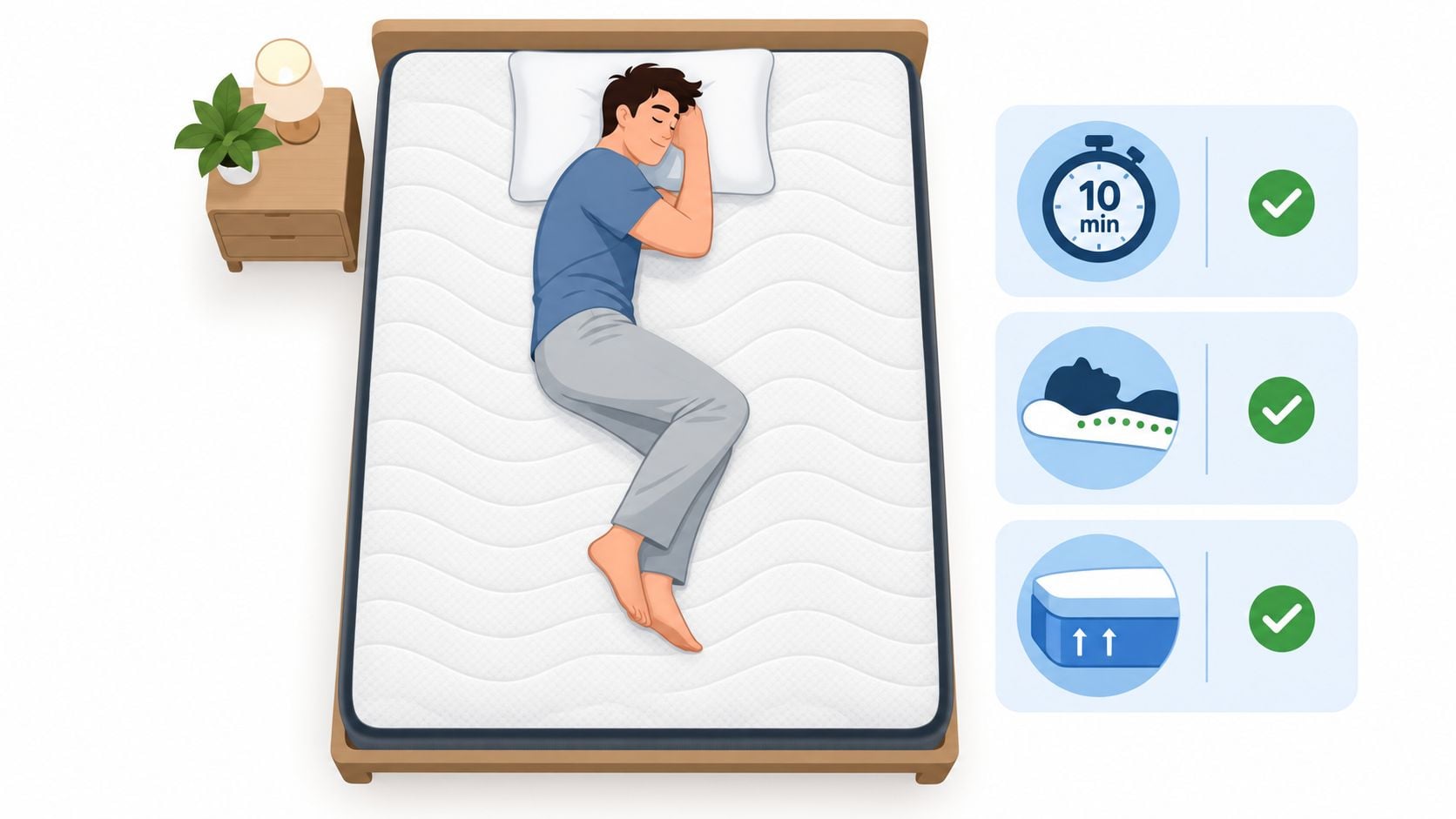
Match firmness to posture and build
Strict side sleepers usually need cushioning beneath the shoulder and hip. Back sleepers generally need balanced support that keeps the pelvis from sinking too far. Stomach sleepers should test firmer surfaces, especially if a softer bed lets the midsection dip.
Body weight changes the result. A bed that supports a lighter sleeper may feel too soft for a heavier adult. A firm model that suits a heavier stomach sleeper may press uncomfortably against a lighter side sleeper.
Do not stop at feel. Ask the showroom staff to identify the foam density, profile height, and relevant certifications for each finalist. Those specifications give the hands-on test context. A soft first impression means little if the construction does not suit your support needs.
Showroom shortcut: Compare two or three carefully selected beds instead of rushing through a long row and trying to remember every sensation.
Common mistakes include judging only the first minute of softness, ignoring the pillow, testing too many beds consecutively, and overlooking warmth because the store feels cool. Tip Top Furniture & Mattresses can use its in-store bed matching process to narrow the choices, then help partners test different support needs on the same visit.
Why the Highest Rating Is Not Always the Right Mattress
A five-star average can't reveal who left the reviews. Review totals often combine side sleepers, stomach sleepers, lighter bodies, heavier bodies, warm rooms, cool bedrooms, and different budgets into one number. That number may describe broad satisfaction, but it can't predict whether a particular sleeper's hips will sink too far.
A top rated memory foam mattress for a heavier stomach sleeper may feel excessively plush to a lighter side sleeper. The reverse can happen too. A dense, firmer build may keep one sleeper aligned while creating pressure at another sleeper's shoulder.
Personal fit beats crowd approval
Star counts can also reflect issues unrelated to long-term comfort. An owner may praise the initial softness, complain about an odor during setup, or review a warranty interaction rather than the mattress's performance after extended use. Those experiences matter, but they shouldn't be treated as equivalent evidence.
Verified specifications offer a steadier foundation:
- Density gives a practical clue about foam resilience.
- Profile height shows how much room the design has for comfort, transition, and support layers.
- Firmness details help connect the mattress to posture and body shape.
- Certification adds a material and emissions screening point.
- Longer-term feedback reveals whether the first impression held up.
A ranking can start the search, but a shopper should reject any model that conceals essential construction information. The right choice is the bed that fits the sleeper's body, position, climate, partner needs, and foundation, even if another mattress receives more attention online.
Trials, Warranties, Care, and Local Support for Long-Term Sleep
A mattress purchase doesn't end when the delivery team leaves. Trial rules, warranty language, foundation compatibility, and basic maintenance can decide whether a comfortable bed remains useful over time.
Read the trial terms before relying on them
A sleep trial may include a required adjustment period before a return becomes available. The fine print can also address pickup arrangements, return shipping, exchanges, stains, and other conditions. Shoppers should ask for the policy in writing and identify the exact process before placing the order.
Warranty coverage deserves the same scrutiny. A warranty may cover manufacturing defects or sagging beyond a stated threshold, but it won't necessarily cover every softening change or comfort preference. The practical questions are straightforward:
- What depth of body impression qualifies?
- Does the warranty cover the cover, foam, foundation, and handles?
- Who pays transportation or inspection costs?
- Does using an incompatible base affect coverage?
- What evidence must the owner provide?
Protect the materials with simple habits
Memory foam doesn't need complicated care, but it does need protection from moisture and uneven wear. A breathable mattress protector helps preserve the cover while allowing the surface to ventilate. Owners should vacuum the surface periodically, spot-clean spills with mild detergent, and avoid soaking the foam.
A useful proper mattress cleaning guide offers step-by-step cleaning guidance for owners who want more detail. Any cleaning method should allow the mattress to dry completely before bedding returns.
Rotation can help distribute wear. A head-to-foot rotation every three to six months is commonly recommended in independent mattress guidance, although a model's own care instructions should take priority. Flipping isn't appropriate unless the manufacturer designed the mattress for two-sided use.
Local help has practical value
For households in Freehold and the Greater Albany Capital Region, a local showroom can keep the conversation grounded in the actual home. Tip Top Furniture & Mattresses has served the area since 1978, and its professional design services have been available since 1984. That experience matters when a mattress purchase is part of a larger bedroom project involving a bed frame, flooring, window treatments, or coordinating furniture.
The store offers USA-made mattresses and sleep accessories, personalized bed matching, custom ordering, delivery, and flexible financing options. Its one-stop model also includes furniture, décor, flooring, and a Clearance section for shoppers seeking immediate availability or lower pricing. More than 50 trusted manufacturers are represented across the showroom, giving local customers room to compare materials and construction instead of choosing from a single narrow line.
A mattress partnership should include the practical details: measuring the bedroom, confirming the foundation, arranging delivery, and understanding what happens if the fit isn't right. Those conversations are easier when the customer can return to a nearby showroom rather than handle every question through a distant online form.
Visit Tip Top Furniture & Mattresses in Freehold, NY, for hands-on mattress matching, USA-made sleep options, delivery, flexible financing, and guidance suited to homes across Albany and the Capital Region. The showroom can also coordinate bedroom furniture, flooring, décor, custom orders, and Clearance finds so the entire sleep space works together.