French Style Sofas: A Complete Buyer’s Guide


A living room in Albany can be asked to do a lot. It may host morning coffee, children's homework, weekend guests, and a laptop during the workday. The challenge is finding a sofa that brings elegance without turning the room into a formal space nobody wants to use.
French style sofas solve that tension when the style is matched to the household. Their carved details, curved profiles, and upholstery add character, while the right frame, fabric, and depth can support ordinary daily life. For homeowners in Freehold, Greene County, Albany, Schenectady, and Troy, the important question isn't whether the sofa looks French. It's whether its proportions and construction fit the room.
Why French Style Sofas Still Captivate Homeowners
A Capital Region homeowner may begin with a familiar problem. The existing sofa is comfortable but visually plain, while the room needs more personality. A heavily ornate piece may look impressive in a showroom but feel excessive beside family furniture, modern lighting, or a practical home office corner. French style sofas sit between those extremes, offering decorative structure without demanding a palace around them.
That balance comes from the history of French furniture. The Louis XIV period, from 1661 to 1700, established an ornate Baroque vocabulary. Louis XV, from 1723 to 1774, moved toward lighter Rococo curves, while Louis XVI, from 1774 to 1792, introduced neoclassical restraint. The French Revolution of 1789 changed the course of furniture history, and the Empire period, from 1804 to 1815, is widely treated by furniture historians as the last great era of classical French furniture-making. These periods still influence contemporary sofa frames, legs, backs, and decorative trim through the evolution documented in this timeline of French furniture periods.
Beauty that earns its space
The strongest French-inspired sofa doesn't sit apart from the household. It gives a traditional room a focal point, softens a contemporary open plan, and adds a sense of finish to a space with simple floors and neutral walls. A curved back can make a compact sitting area feel more welcoming, while exposed wood can connect the sofa to a nearby table or cabinet.
The style also works because it offers range. A Louis XVI-inspired settee can suit a quiet reading area, while a French Provincial sofa can support a busier family room. French Country versions generally feel less formal and easier to combine with relaxed textiles, baskets, painted wood, and everyday accessories.
Practical rule: A French sofa should make a room feel more considered, not less usable.
The category also belongs to a substantial furniture market. One industry estimate values the French sofa market at €2.7 billion, while another projects France sofa market revenue at USD 9,755.8 million in 2025 and USD 13,160.5 million by 2033, as reported in this France sofa market outlook. Those figures point to an established category shaped by heritage, upholstery, comfort, and decorative appeal.
For broader room direction, homeowners can review Tip Top's guidance on French-style decor before choosing a sofa. The practical takeaway is simple. French style sofas belong in living rooms that need both visual character and a place to sit, work, talk, and unwind.
The Three Main French Sofa Variations Explained
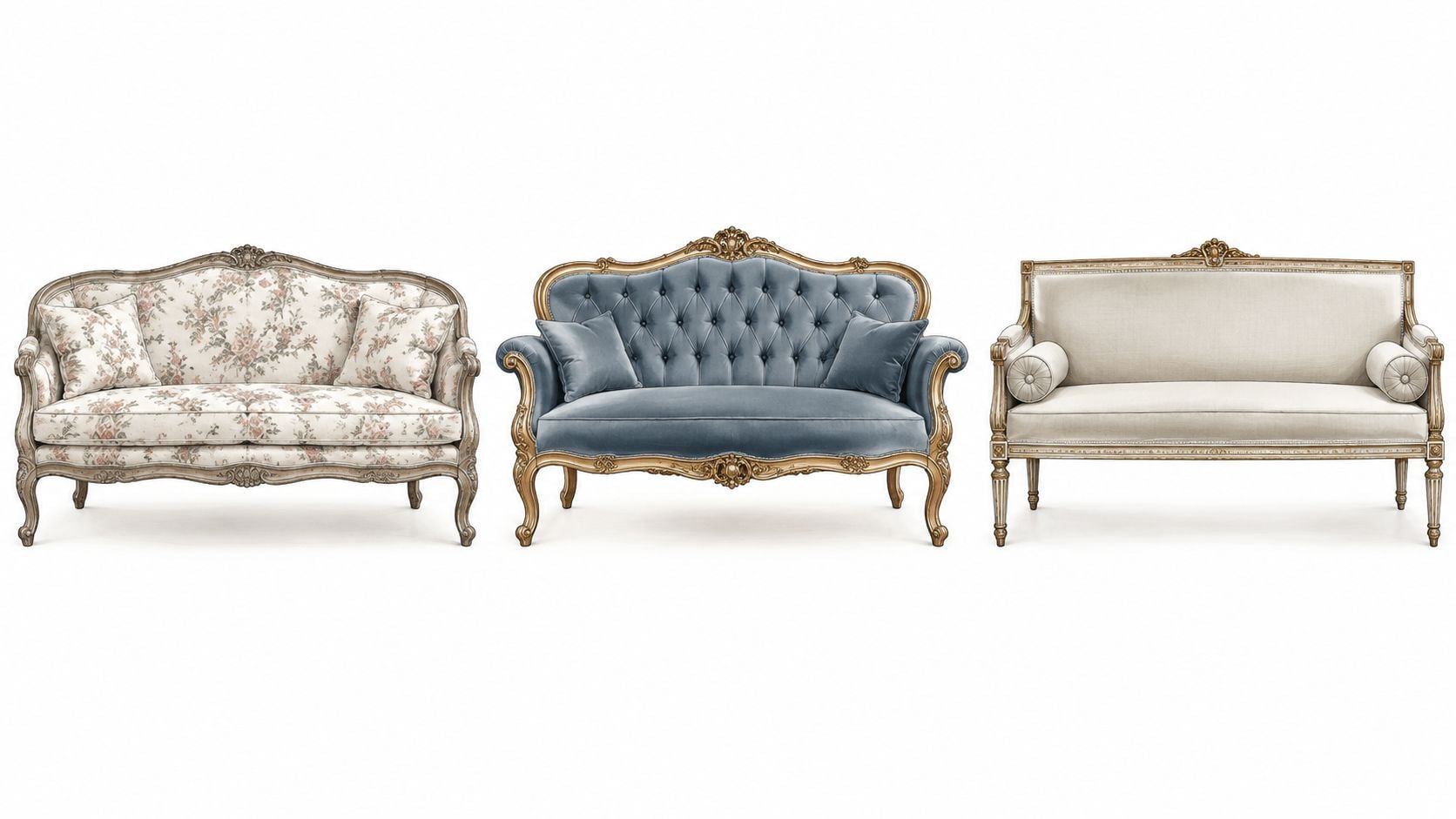
French style sofas aren't one uniform design. Buyers should identify the family of the sofa first, then judge its size, fabric, and construction. Three useful categories are French Provincial, Louis-style, and French Country.
French Provincial
French Provincial furniture developed in rural regions such as Provence, Normandy, and Bordeaux during the 17th and 18th centuries. Local artisans adapted the grandeur associated with Paris and Versailles into simpler pieces for country homes, which explains the style's combination of elegance and restraint, as described in this French Provincial furniture guide.
Look for:
- Painted or lightly finished wood, often in soft, muted tones.
- Cabriole legs or gently shaped supports.
- Curved arms and backs without overwhelming ornament.
- Textiles with checks, stripes, plaids, or toile.
- A sturdy, approachable attitude suited to everyday rooms.
French Provincial is the safest starting point for a household that wants French character without excessive formality. It pairs well with practical upholstery, family-friendly layouts, and mixed furniture collections.
Louis-style sofas
Louis-style furniture should be separated by period rather than treated as one look.
- Louis XIV is the most monumental, with Baroque ornament, strong framing, and a grand presence.
- Louis XV is lighter and more fluid, with Rococo curves, floral influence, and cabriole legs.
- Louis XVI is more disciplined, with neoclassical symmetry, straighter lines, and restrained decoration.
The period names refer to distinct design languages. A Louis XIV sofa can dominate a room, while Louis XV brings softness and movement. Louis XVI is often the easiest to place in a formal sitting room because its symmetry works with traditional architecture and cleaner contemporary surroundings.
French Country
French Country is the relaxed option. It borrows the warmth of provincial interiors but usually feels less precise than a Louis-style piece. The proportions may be more generous, the finish more weathered, and the upholstery more casual.
Choose French Country when the room includes:
- Natural textures
- Painted or distressed wood
- Relaxed cushions
- Soft neutrals
- A mix of old and new furnishings
The distinction matters at the showroom. A sofa with formal carved trim and straight neoclassical lines asks for different supporting furniture than a relaxed, slipcovered provincial design. Identifying the style before shopping prevents a beautiful sofa from becoming the wrong sofa.
Signature Features and Construction Details
Authentic French style sofas depend on more than decorative trim. The frame, proportions, legs, arms, and upholstery all contribute to the recognizable result. A buyer who knows those components can separate a convincing French-inspired design from a sofa that uses a pale fabric and curved arm.
Frame materials and visible structure
Museum-held French seating is typically built on carved hardwood or beech and walnut frames with upholstered surfaces. That combination gives the sofa a defined silhouette and allows exposed wood to function as part of the design rather than as hidden support.
Common details include:
- Carved hardwood rails along the back or arms.
- Beech or walnut framing with a painted, stained, or gilded finish.
- Cabriole legs with pad or scroll feet.
- Curved arms that turn inward or soften toward the seat.
- Shaped backs that create a formal architectural outline.
- Nailhead trim or welt cord used to clarify edges.
Frame joinery deserves attention, especially when a sofa will receive daily use. Buyers evaluating hardwood furniture can review this explanation of the mortise-and-tenon joint to understand why connected frame components matter.
Proportion changes the experience
A documented Louis XVI canapé measures 40 × 61 1/4 × 27 1/4 inches, or 101.6 × 155.6 × 69.2 centimeters, according to upholstered seating construction information. That compact example shows why authentic French seating often emphasizes formal sitting posture and room-scale elegance rather than deep, sprawling lounging.
The measurement isn't a rule for every modern sofa. It is a warning against assuming that a French silhouette will automatically provide the depth of a contemporary lounge sofa. A compact frame may be ideal in a parlor, entry sitting area, or bedroom seating zone, but less suitable as the only sofa in a busy family room.
Upholstery completes the language
The classic palette includes white, cream, beige, ivory, and duck egg blue. Checks, plaids, stripes, and toile can add country character, while a solid neutral lets carved wood and curved arms lead visually.
A practical inspection should cover:
- Frame movement, including rocking, creaking, or loose arms.
- Seat support, especially if the sofa will be used for long periods.
- Cushion recovery, meaning how well the cushions regain their shape.
- Trim alignment, including welt cord and nailhead spacing.
- Finish consistency, particularly on exposed legs and rails.
A French sofa earns its place through the cooperation of those details. Decorative carving can't compensate for poor support, and attractive upholstery can't fix unsuitable proportions.
How to Choose the Right French Sofa for Your Space
The correct French sofa depends on the room's job. A homeowner furnishing a formal sitting room can prioritize carved detail and upright posture. A household using the living room for remote work, television, reading, and guests needs a more forgiving seat and a layout that can change without becoming cramped.
Before visiting a showroom, homeowners should measure a room for furniture perfectly. Record wall lengths, door swings, window locations, walkways, and the position of outlets. A sofa that fits the wall may still block the route between the kitchen and the front door.
Match the style to the room's workload
A Louis XVI settee works well when the room needs a polished accent rather than the household's primary lounging station. Its symmetry and compact presence suit a formal sitting area, a bedroom, or a conversation zone arranged around occasional chairs.
French Provincial makes more sense when the sofa needs to carry daily activity. Its country influence, sturdy character, and textile flexibility allow it to sit comfortably beside practical tables, storage pieces, and family accessories. French Country is the relaxed choice when cushions, texture, and informal use matter more than precise symmetry.
| Style | Best Room Type | Daily Use Rating | Formality Level |
|---|---|---|---|
| Louis XIV | Formal sitting room or statement room | Moderate | High |
| Louis XV | Conversation area or refined living room | Moderate to high | Medium-high |
| Louis XVI | Formal sitting room, bedroom, or compact lounge | Moderate | High |
| French Provincial | Main living room or mixed-use family room | High | Medium |
| French Country | Casual living room or open-plan space | High | Low to medium |
Test the sofa for real life
A showroom impression isn't enough. Each household should test the sofa against its actual routine:
- Remote work: Can the sitter maintain a comfortable posture without leaning awkwardly?
- Conversation: Do the arm height and seat angle support face-to-face seating?
- Family use: Can the upholstery tolerate regular contact and easy cleaning?
- Changing layouts: Does the sofa remain useful if a desk, chair, or play area moves?
- Traffic flow: Can people pass without brushing against corners or blocking doors?
A sofa can be beautiful at the wall and inconvenient in the room. Layout decides whether the purchase succeeds.
The most common mistake is choosing the most decorative piece in the showroom. A better decision pairs the desired French vocabulary with the room's actual demands. That usually means selecting the most detailed sofa that still supports the household's daily rhythm.
Upholstery Choices and Long-Term Care
Upholstery determines whether a French sofa feels rustic, luxurious, or overly precious. The right fabric should support the style while matching the household's tolerance for maintenance.
Choose the textile by use
Linen creates an airy, natural appearance and suits French Provincial or French Country rooms. It can look especially convincing in cream, ivory, or soft blue, but households should expect a relaxed surface rather than a perfectly uniform one.
Cotton offers a familiar, versatile hand and works well with checks, stripes, plaids, and toile. It suits rooms where traditional pattern matters, although the exact cleaning requirements depend on the fabric construction and manufacturer's instructions.
Velvet adds depth and formality. It can make a Louis XV or Louis XVI silhouette feel richer, especially in a muted jewel tone or neutral, but its directional pile deserves regular attention.
Performance blends are practical for children, pets, and high-use rooms. They can preserve the desired color and pattern while reducing anxiety about ordinary spills, provided the care instructions are followed.
For homeowners comparing pattern directions, browse fabric prints for sale to study how checks, stripes, florals, and toile-like visual rhythms may work with carved frames and curved backs. The fabric should support the sofa's shape, not compete with it.
Build a manageable care routine
Start with the manufacturer's cleaning instructions. Avoid applying a household product before checking whether it suits the fabric, finish, and stain treatment requirements.
A useful routine includes:
- Vacuuming upholstery gently, using an appropriate attachment to remove dust from seams and welt cord.
- Treating spills promptly, blotting rather than rubbing so the mark doesn't spread.
- Rotating loose cushions, when the manufacturer permits it, to encourage even wear.
- Protecting high-contact areas, especially arms and seat fronts in homes with children or pets.
- Arranging professional cleaning, based on use, fabric instructions, and visible soiling rather than an arbitrary schedule.
Custom upholstery is particularly valuable when the sofa's frame is right but the showroom fabric isn't. Tip Top's guide to upholstery materials can help buyers compare feel, appearance, and practical demands before selecting a finish.
The best fabric isn't the most delicate or the most technical. It's the one that lets the household use the sofa without constant worry while preserving the French character that attracted the buyer in the first place.
Styling and Placement Strategies for Albany Homes
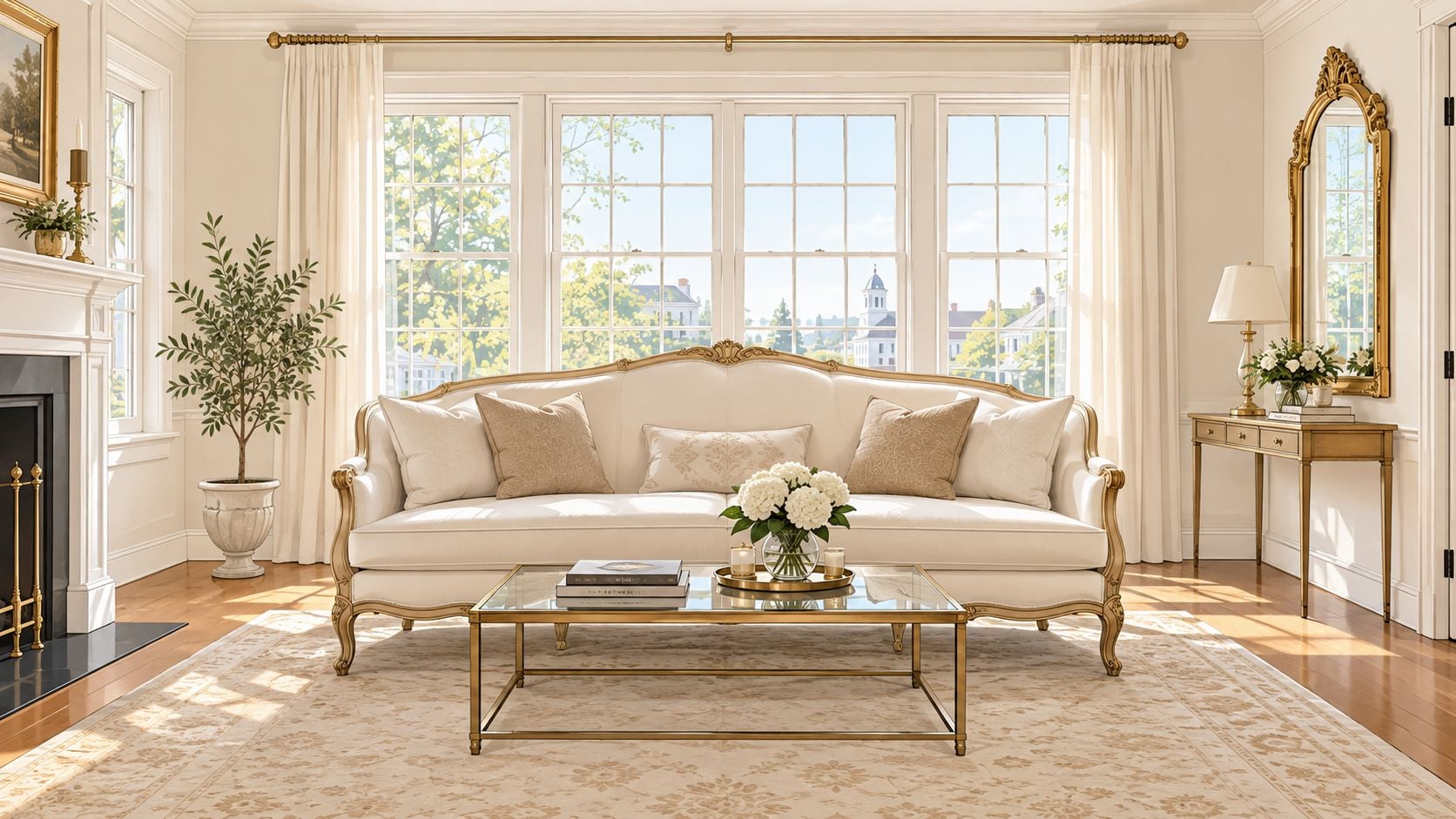
French style sofas need breathing room and supporting pieces with discipline. In a traditional Albany or Greene County room, the sofa can align with a fireplace, a central window, or a strong architectural wall. In an open plan, it should define the living area without creating a barrier between the seating zone and the kitchen.
Create a conversation area
Place the sofa where its back, arms, and carved details can be seen. Pushing an ornate sofa tightly against a wall can reduce its impact, while floating it too far into a narrow room can interrupt circulation.
For a traditional room:
- Center the sofa on the fireplace or principal wall.
- Use accent chairs to form an open angle rather than a rigid row.
- Choose a coffee table with enough visual weight to relate to the sofa.
- Add lighting at the sides without hiding the arms or woodwork.
For an open layout:
- Use the sofa's back to establish the living zone.
- Keep the kitchen and dining routes clear.
- Repeat one material or color in nearby furniture.
- Use a rug to define the seating area without overloading the pattern.
Balance ornate and quiet elements
A carved sofa already provides emphasis. The surrounding pieces should support it, not compete with it. A simple lamp, restrained coffee table, or lightly patterned chair often works better than another heavily decorated statement piece.
Wall art can reinforce the room without making it feel staged. Homeowners looking for ways to organize collected pieces can review these gallery wall ideas from Colorado Art Services, then choose a composition that relates to the sofa's width and visual height.
Design principle: Repeat the sofa's color or finish nearby, but don't repeat every decorative detail.
Use local design support
A French-style room may involve more than a sofa. Window treatments, flooring, accent seating, wall color, and lighting all affect whether the final result feels cohesive. Tip Top's professional design services, available since 1984, can help homeowners coordinate furniture, décor, and flooring around a particular room and lifestyle.
Custom ordering also gives the room a stronger chance of fitting correctly. A homeowner may need a specific seat width, wood finish, or fabric to connect a French-inspired sofa with existing Amish furniture, USA-made pieces, or inherited furnishings. A coordinated plan works especially well for Capital Region homes where traditional architecture and updated family spaces often share the same floor plan.
Where to Shop and How to Order Custom French Sofas
Seeing a French sofa in person reveals details photographs miss. Sit height, cushion firmness, arm position, frame scale, and fabric texture all affect the decision. Customers in Albany, Schenectady, Troy, Greene County, and surrounding communities can visit the Freehold showroom to compare living room options from 50+ trusted manufacturers.
A custom order can specify:
- Style and overall silhouette
- Size and seat dimensions
- Wood type
- Finish or paint color
- Fabric, pattern, and trim
The process becomes more useful when buyers bring room measurements, fabric samples, photographs, and a clear description of daily use. Tip Top's guide to getting started with a custom order outlines the information needed to move from an idea to a personalized piece.
The showroom also supports broader projects. Its one-stop selection includes living room furniture, bedroom pieces, décor, window treatments, flooring, USA-made mattresses, and heirloom-quality Amish furniture handcrafted in the USA. Flexible financing, delivery, clearance inventory, and professional design guidance can help homeowners plan the purchase without separating the sofa from the rest of the room.
Tip Top Furniture & Mattresses helps Freehold and Greater Albany Capital Region homeowners select French-inspired living room furniture, custom upholstery, Amish furniture, flooring, mattresses, and décor in one place. Visit Tip Top Furniture & Mattresses to explore current options, arrange delivery, discuss flexible financing, or schedule a design consultation for a French-style sofa that works in everyday life.