Modern Furniture Designs: The Ultimate Buying Guide

You know the room. The sofa looks tired, the dining table feels too bulky, and the online cart keeps filling up with pieces that look right in photos but seem wrong for the actual layout at home. In the Capital Region, that mismatch shows up fast, especially in older houses, apartments, and bonus rooms that don't give furniture the courtesy of square corners or generous clearances.
That's why modern furniture designs work best when they're treated as a fit problem first and a style choice second. Clean lines matter, but so do scale, construction, and how a piece behaves in a real room with traffic, pets, kids, and odd angles. The goal isn't to make a house look like a showroom. The goal is to make it look intentional and live well.
What Modern Furniture Designs Really Mean Today
A lot of shoppers use “modern” to mean whatever looks current. That's too loose. In design terms, modern furniture traces back to the Mid-Century Modern movement, which took shape in the 1940s–1960s and spread because it favored cleaner silhouettes, open forms, and materials that could be mass-produced. That history still matters because it explains why modern pieces usually look lighter, simpler, and less ornamented than traditional furniture.
A homeowner in Albany might say they want “modern,” then show examples that mix contemporary, mid-century, and even minimalist details. That's normal. Contemporary means what's current now, while modern refers to a specific design lineage. Mid-century modern is the historical branch that still influences a huge share of today's market.
The market side is just as real as the style side. One industry report values the global furniture market at USD 516.66 billion in 2022, while another places it at USD 523.3 billion in 2022 and projects growth to USD 751.4 billion by 2030 at a 4.3% CAGR. The same data set says 80% of furniture shoppers start their search online wifitalents furniture design industry statistics. That's exactly why so many people arrive in a showroom already half-decided, then realize the room has different needs than the browser tab suggested.
Practical rule: if a piece relies on ornament to look substantial, it's not doing the job of modern furniture. The structure, proportion, and restraint should carry the design.
The clearest way to identify modern furniture today is to ask three questions. Does it look visually light? Does it solve a function without extra fuss? Does the shape feel disciplined rather than decorative? The elements of a modern home line up around exactly those ideas, which is why the style stays useful in real homes instead of fading into trend noise.
Key Materials and Construction Behind Modern Pieces
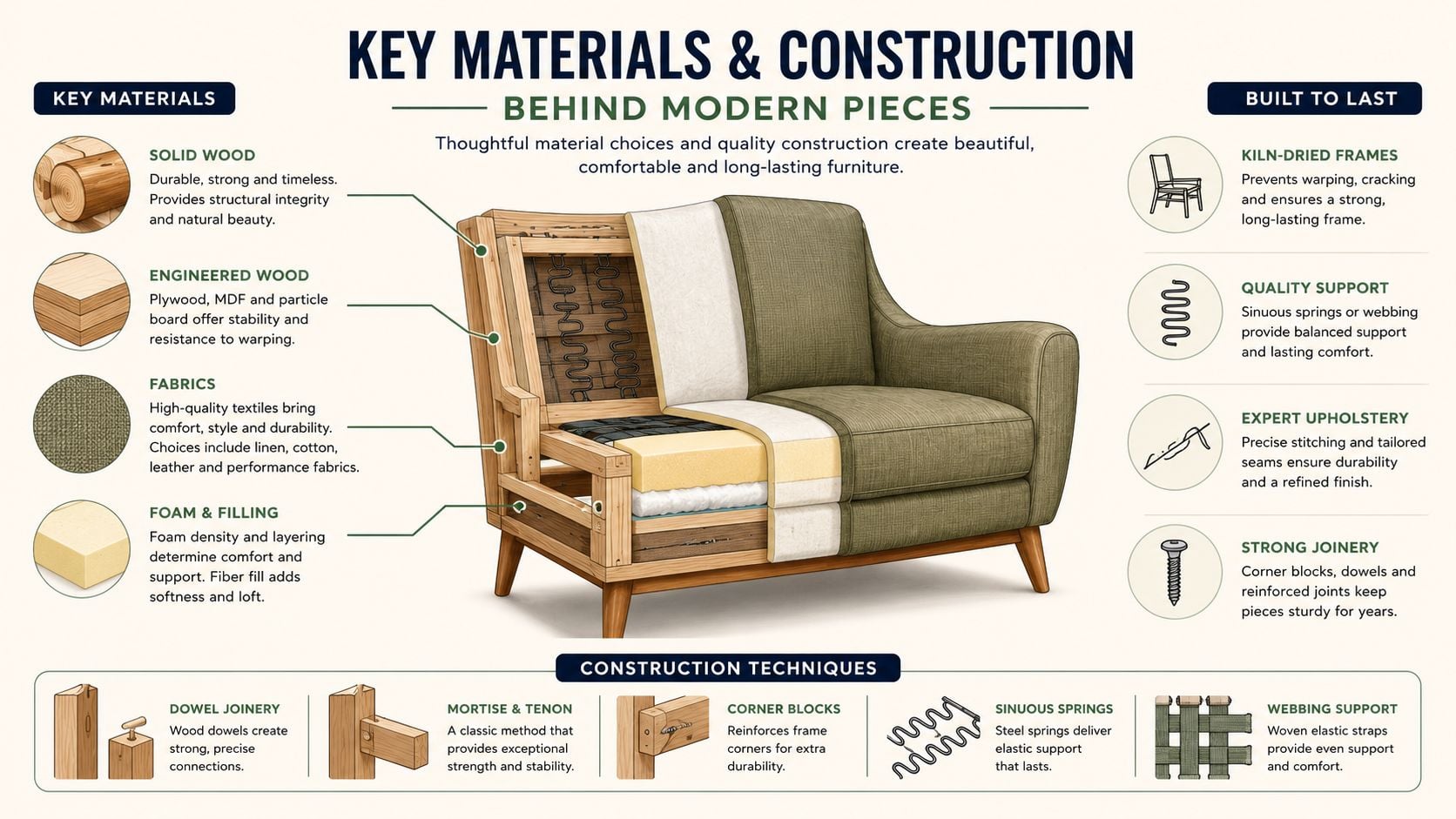
Modern furniture looks simple on the surface, but the value sits inside the frame, joinery, and finish. Industry guidance for furniture specifications says designers should define dimensions and tolerances, material properties, construction details, functional requirements, and quality and safety standards so pieces can be produced consistently and tested against expected use conditions drafting technical specifications for furniture components. That's the difference between a piece that merely looks modern and one that survives daily life.
What to inspect before buying
For load-bearing seating and tables, the frame system matters more than the silhouette. Technical specifications commonly call for steel or hardwood frames, welded joints for strength, and powder-coated steel finishes with dry film thickness above 40 to 50 µm or more than 50 microns, plus salt-spray resistance above 1000 hours in higher-spec office furniture steel furniture design specifications presentation. Those details improve corrosion resistance, scratch resistance, and long-term stability.
That's why modern pieces often mix tubular steel, reinforced polymers, and modular assemblies. The lighter look comes from disciplined structure, not from flimsy materials. A chair can look airy and still be well-built if the joints are sound and the frame is honest.
Simple test: if the frame feels vague, hollow, or overdecorated, the piece is probably compensating for weak construction.
Solid wood still has a place in modern interiors, especially when the profile is kept clean. Amish handcrafted pieces bring that solid feel without pushing the room into traditional territory. For buyers who want a cleaner edge, engineered concrete also belongs in the modern conversation. Glass fiber reinforced concrete is high strength, significantly lighter than solid concrete, weatherproof, and suited to precise or organic forms Elementi Shop concrete furniture guide.
For buyers who want a closer look at how a built piece holds together, the mortise and tenon joint guide is worth reading. In practice, the smartest shoppers ask about frame material, finish durability, and how the piece was joined before they ever worry about color.
The Curved Furniture Trend and When It Actually Works
Curved seating is everywhere, and plenty of it looks great in photos. That doesn't mean it belongs in every home. Recent independent reporting says curved modular seating rose from 14% in 2022 to 31% of premium furniture sales across 23 North American metropolitan markets the curve revolution article. That's a real shift, but the style conversation usually skips the part buyers care about most, whether curves help the room or chew up usable space.
Where curves earn their keep
Curved pieces work when the room needs softness, movement, or a focal point that breaks up hard architectural lines. They're strong in larger living rooms, open-plan spaces, and areas where a straight sofa would feel too rigid. They can also keep a room from looking boxy if the rest of the layout is very square.
But curved furniture can appear larger than angular pieces because continuous surfaces draw the eye more strongly. That means a curved sofa may feel elegant in a photo and stubborn in a narrow room. In a small apartment or a multi-use space, that visual weight can make circulation harder, especially if the piece sits near a doorway or a tight traffic lane.
Curves should be used deliberately, not as a one-off “statement” that ignores the rest of the room.
The smarter move is to balance soft shapes with lighter elements around them. A curved sofa needs breathing room, slimmer side tables, and enough negative space to keep the room from feeling crowded. Repeating the curve once or twice, rather than scattering it across every major piece, keeps the layout calm.
For Capital Region homes, especially older floor plans, the question isn't whether curves are fashionable. It's whether the shape improves flow. If a room already has irregular edges, a curved piece can either smooth the layout or make it harder to zone. The difference usually comes down to scale, not style.
Room-by-Room Modern Styling for Real Homes
Modern furniture has to work differently in each room. A living room can carry a lower, longer profile. A bedroom needs visual quiet. A dining area needs circulation. A home office needs storage that doesn't look heavy. That's where layout discipline matters more than trend chasing, especially in homes with sloped ceilings, alcoves, angled walls, or awkward corners.
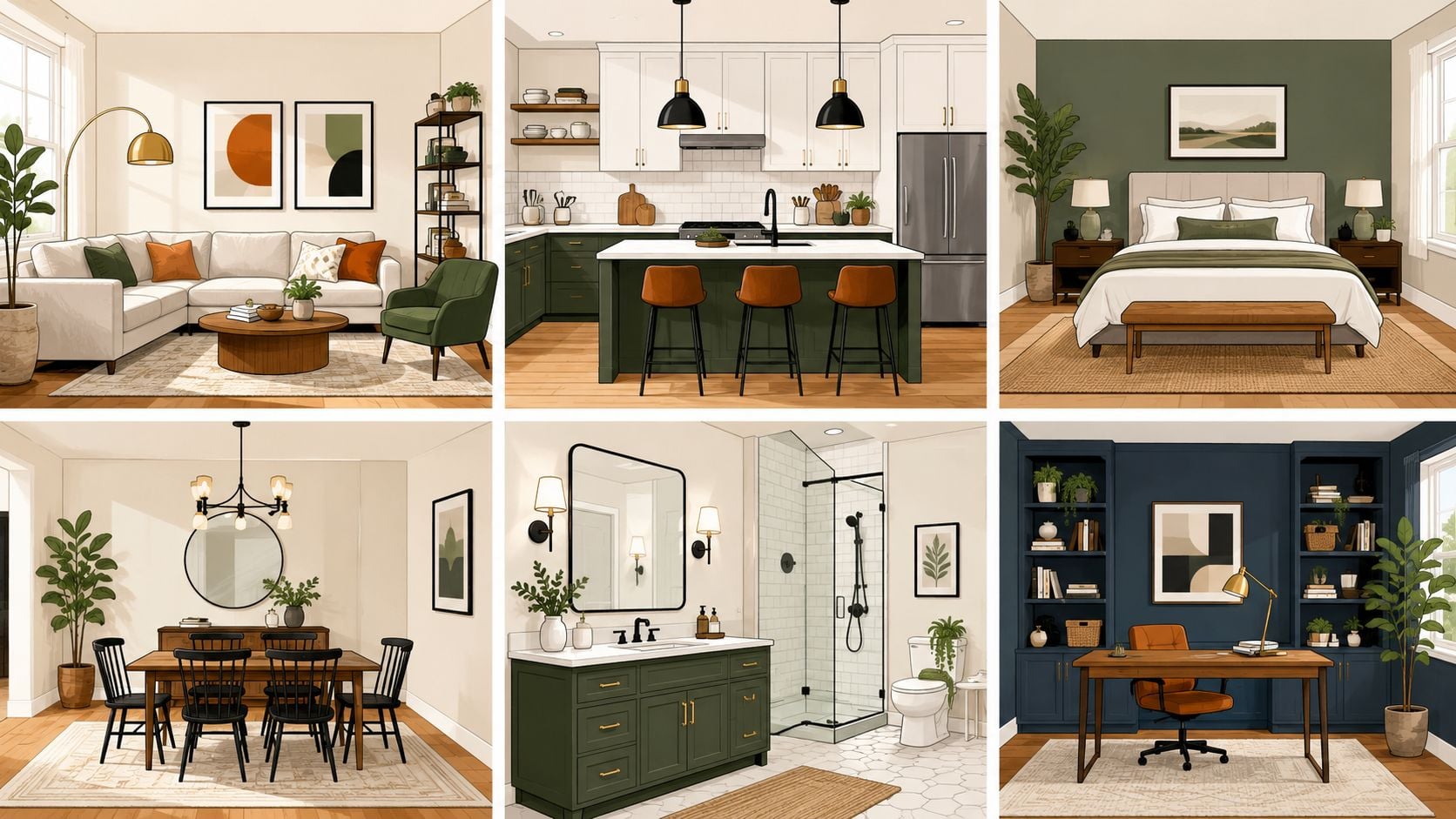
Measure the room like a planner, not a browser
Irregular geometry changes everything. Multiple depth measurements, wall-angle verification, height checks, and floor-level confirmation tell a buyer whether a piece will fit, not just whether it looks like it should fit awkward spaces design guidance. That matters in older Capital Region homes where one wall can be straight and the other one can be just off enough to ruin a tight fit.
A useful process looks like this:
- Measure at several points. A single width number is rarely enough in a room with a slope or angle.
- Check clearance at openings. Doors, radiators, stairs, and hall turns decide what gets in and what doesn't.
- Map zones before buying. Seating, storage, and walk paths need separate space.
- Use scale before style. A piece that fits the layout is always better than a beautiful piece that jams the room.
Match the room to the function
Living rooms need a clear anchor, usually the largest seating piece, then smaller companions that don't block circulation. Bedrooms benefit from low, clean-lined silhouettes that keep the room from feeling crowded. Dining areas do better with rectangular or round tables chosen for movement, not just aesthetics.
For anyone trying to test layouts before spending money, the new home furniture checklist is a practical place to start. One smart habit is to sketch the room first, then place furniture around traffic paths instead of against every wall. If the room feels tight on paper, it'll feel worse once the boxes are opened.
Choosing the Right Materials for Your Lifestyle
A busy family room, a pet-friendly den, and a spare bedroom all place different demands on modern furniture. The finish may be what catches your eye first, but daily use decides whether a piece keeps working or starts looking tired. Durability, weight, and upkeep matter just as much as the profile and color.
| Modern Furniture Materials Compared | Durability | Maintenance | Best For | Weight Consideration |
|---|---|---|---|---|
| Solid hardwood | Strong and long-lasting | Needs routine care | Dining tables, case goods, heirloom pieces | Heavier, harder to move |
| Engineered concrete | Durable when sealed and made well | Needs sealing and sensible cleaning | Accent tables, statement pieces, outdoor use | Can be very heavy unless engineered |
| Metal frames | Strong when properly finished | Easy to wipe, finish matters | Seating, desks, mixed-material pieces | Usually lighter than wood or concrete |
| Upholstered pieces | Depends on frame and fabric | Fabric choice drives upkeep | Sofas, chairs, bedrooms, family rooms | Moderate, varies by build |
Concrete pieces need careful inspection before anyone brings one home. Check whether the piece uses engineered concrete, whether it is handmade or machine-cast, whether it is sealed for protection, how much it weighs, and what care routine it needs how to choose concrete furniture for modern homes. Those details decide how well it handles water and stains, whether it makes sense in an apartment, and whether it can be carried upstairs without turning delivery day into a headache.
Sustainability also belongs in the decision. Industry reporting shows that many consumers are willing to pay more for sustainable furniture options, and that furniture production uses a meaningful share of global timber furniture design industry statistics. That does not mean every shopper needs the greenest label on the floor tag. It means a well-made solid wood piece can be the smarter long-term choice than a cheaper item that needs replacing sooner.
For upholstery, the upholstery materials guide on Tip Top's website is the right place to sort fabric options by real use, not just color. In homes that want a modern look without disposable furniture habits, Amish solid wood stays one of the clearest value choices because it keeps the clean profile while giving the piece real staying power.
Why Local Expertise Matters for Modern Furniture Shopping
Online browsing is useful, but it can't tell a homeowner how a sofa feels in the room, how a finish reads in daylight, or whether a chair sits too deep for actual use. Since 80% of furniture shoppers start their search online, the buying journey often begins digitally and ends with uncertainty furniture design industry statistics. That's where local expertise earns its place, especially for buyers in Freehold, Albany, Schenectady, Troy, and the surrounding Capital Region.
Tip Top Furniture & Mattresses has served the area since 1978, with professional design services available since 1984, and access to over 50 trusted manufacturers. It also offers custom ordering, a free online room planner, flexible financing through the Synchrony Home Card, and a Clearance Corner for shoppers who want quality without paying full price. For a single project, that mix matters because modern furniture usually works best when the room plan, finish, and scale are handled together.
What a good local showroom changes
A showroom lets the buyer compare scale in person. A designer can also help connect furniture, décor, flooring, and mattress choices so the whole home feels intentional instead of pieced together. That kind of guidance is especially useful when a room needs a modern piece but the budget or dimensions don't fit a standard catalog size.
Best use of local help: bring room measurements, photos, and a clear budget. That gives the consultant something workable instead of a vague style wish.
Tip Top also fits the practical side of shopping, not just the aesthetic side. The Freehold, NY showroom supports one-stop shopping for living room, bedroom, dining, home office, décor, flooring, and mattresses. For buyers who want modern pieces without sacrificing fit or service, that matters more than endless scrolling ever will.
Caring for Modern Furniture to Preserve Its Look
Modern furniture rewards clean surfaces, but those surfaces still need regular care. The finish is often the first thing to show neglect, and once that happens, the whole piece starts looking older than it is. Care should match the material, not a one-size-fits-all routine.
Material-specific habits that actually help
Wood needs dusting, gentle cleaning, and protection from standing moisture. The wood furniture care guide is useful for keeping solid pieces in good shape, especially in homes with handcrafted Amish furniture or other solid wood favorites. Metal frames should be wiped clean with a soft cloth, and powder-coated finishes should be treated gently so the coating stays intact.
Sealed concrete is durable, but it still benefits from cautious cleaning and respect for the seal. Upholstery needs the most discipline, because spills, body oils, and daily abrasion can wear on fabric faster than many buyers expect. For a deeper clean, a fabric-safe cleaning resource such as upholstery cleaning guidance can be helpful when a sofa or chair needs more than a quick vacuum.
Tip Top's custom ordering service also helps reduce maintenance later. Choosing the right finish and fabric upfront makes everyday care easier than trying to fix a mismatch after delivery. That's the practical way to protect resale value and keep a room looking crisp.
A simple care rhythm beats occasional deep panic. Wipe surfaces before grime builds, rotate usage where possible, and keep hot mugs, sharp objects, and wet cups off sensitive finishes. Modern furniture looks best when it's treated like an investment, not temporary décor.
Your Next Steps to a Modern Home
The smartest modern furniture purchase starts with three checks, construction, fit, and livability. If the frame is sound, the scale works in the room, and the material fits the household, the style usually takes care of itself. That's why so many bad buys come from choosing by photo instead of by use.
For homeowners in the Capital Region, the next move is simple. Use a room planner to map the space, bring measurements to a consultation, and compare a few material options before deciding. If the budget is tight, the Clearance Corner can solve a room faster than waiting for the perfect sale. If customization matters, custom ordering is the right path, especially for unusual sizes or finishes.
Modern furniture designs should feel calm in the room, not fragile, trendy, or overthought. The best pieces are the ones that fit the space, hold up under real use, and still look sharp a few years later. That's the standard worth keeping.
Tip Top Furniture & Mattresses helps Freehold and Greater Albany Capital Region homeowners choose modern furniture that fits real rooms, real budgets, and real daily use. Visit Tip Top Furniture & Mattresses to explore furniture, mattresses, décor, flooring, custom options, financing, and showroom guidance in one place.