Your New Home Furniture Checklist: A Room-by-Room Guide for the Capital Region

So, you've got the keys to your new home in the Albany Capital Region. Congratulations! Staring at empty rooms can feel overwhelming, and the temptation is to buy everything at once. Don't. After 45+ years in our Freehold showroom, we often see first-time buyers splurge on a dining set before they own a decent mattress or skip measuring doorways entirely. The fix is simple: measure your rooms first, then phase your purchases in this order: bedroom, living room, dining area. That's your immediate next step.
Tackle Your New Space Room by Room
Moving is a huge project, no doubt about it. For new homeowners everywhere from Schenectady to Troy, the first instinct is often to fill every single room right away. After more than 45 years of helping families settle into their homes from our Freehold, NY showroom, we've learned that a patient, planned approach always works out better in the end. Rushing can lead to expensive mistakes and furniture that just doesn't feel right for your space or your style.
The very first thing you need to do? Get out the tape measure. Seriously. Before you even start daydreaming about sofas or dining tables, measure your rooms and sketch out a basic floor plan. Knowing your dimensions saves you from the future headache of a beautiful piece not fitting through the doorway or completely swallowing a room. To make it even easier, you can play around with our free online room planner to visualize different layouts without breaking a sweat.
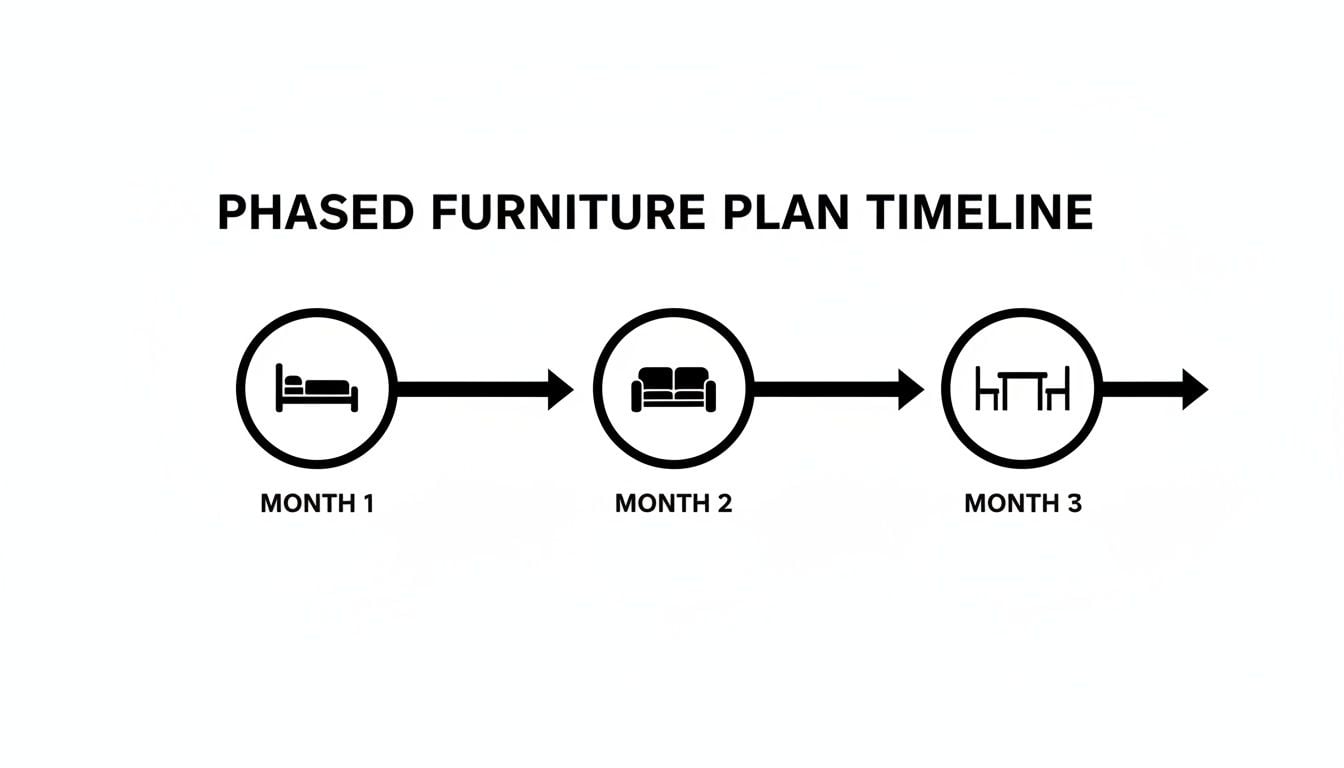
Your First 90 Days: A Phased Furniture Plan
The goal for the first few months isn't about achieving Pinterest-perfect rooms. It's about creating a comfortable, functional place to live. A smart plan lets you invest in high-quality, foundational pieces now, knowing you can build on them over time. This is how you create a home that reflects who you are, mixing what you need today with your vision for tomorrow.
Here's a quick-glance guide to prioritizing your furniture purchases in the first three months. The idea is to get the essential functions covered before moving on to other rooms.
| Phase | Timeline | Room Focus | Key Furniture Pieces |
|---|---|---|---|
| Phase 1 | First 7 Days | Bedroom | A quality mattress, bed frame, and basic window coverings. |
| Phase 2 | 7–30 Days | Living Room | A comfortable sofa or sectional and one coffee or end table. |
| Phase 3 | 30–60 Days | Dining/Kitchen | A dining table and chairs for meals and connection. |
| Phase 4 | 60–90 Days | Home Office | An ergonomic chair and a functional desk. |
This simple timeline approach ensures your core living needs are met first, giving you the freedom to furnish secondary spaces thoughtfully as you settle in.
| Phase | Timeline | Room Focus | Key Furniture Pieces |
|---|---|---|---|
| Phase 1 | First 30 Days | Bedroom | A quality mattress, bed frame, and basic window coverings. |
| Phase 2 | 30-60 Days | Living Room | A comfortable sofa or sectional where you can relax. |
| Phase 3 | 60-90 Days | Dining/Kitchen | A dining table and chairs for meals and connection. |
Let Your Home's Style Evolve Naturally
When you slow down and furnish in phases, you give yourself time to live in your new home. You'll discover where the foot traffic naturally flows, which room gets the best morning light, and how you really use each space. This kind of real-world insight is priceless when you're ready to choose those bigger, more permanent pieces down the road.
Rushing to furnish a home often leads to buying items that are "good enough for now" instead of pieces you'll love for years. Patience is your best design tool.
Once your essential furniture is in place, you can start fine-tuning the layout with proven furniture arrangement tips from design experts. As a family-owned business serving the Greater Albany community from our Freehold, NY showroom since 1978, we're here to help make this process feel exciting, not exhausting. You're not just filling a house; you're building a home.
What Furniture Should I Buy First for a New Home
Okay, you've got your keys, the moving truck is gone, and you're standing in a sea of boxes. This section gives you a sequence, not just a list — what to buy first for a new home, in what order, and why.
Buy in this order. Each tier exists for a functional reason — sleep, recovery, daily routine — not looks.
Tier 1: Mattress + bed frame (days 1–7). Sleep is the one thing you cannot outsource. Poor sleep makes every moving task harder, and recovery from hauling boxes depends on real rest. Get a quality mattress and a basic frame with support plus blackout window coverings in week one. Trying to "make do" on a floor mattress for a month is a regret many new homeowners experience early on.
Tier 2: Sofa + one coffee or end table (days 7–30). You need one real place to sit that isn't a box, plus a single surface for a drink or the remote. Together, they turn the living room into a usable room instead of a staging area.
Tier 3: Dining table + 2–4 chairs (days 30–60). Eating hunched over a counter gets old fast, and a table restores the ritual of meals while everything else is still in disarray.
Tier 4: Home office basics (days 60–90). With hybrid and remote work remaining a standard arrangement for many households in 2026, an ergonomic chair and a functional desk move from nice-to-have to essential within the first two to three months.
Buying in this sequence means every dollar spent early solves a daily problem. Everything beyond this — bookcases, accent chairs, entertainment consoles — waits its turn.
The data backs this ordering up: across the furniture market, beds account for a significant share of furniture revenue — the sleep category is the single biggest reason people buy furniture at all.
Pro Tip: Don't have the budget for a brand-new sofa right away? Our Clearance Corner is the perfect place to find high-quality, discounted pieces from trusted manufacturers that are available for immediate delivery to your Albany-area home.
For more ideas on foundational pieces, check out our guide on the top 10 must-have furniture pieces for a stylish home. Getting these basics right is how you turn an empty house in Albany, Schenectady, or Troy into a home you love, right from the start.
Best Furniture for First-Time Homeowners
First homes get furnished differently from forever homes. You're balancing a mortgage, moving costs, and rooms you haven't lived in yet. Understanding how to choose furniture for a new home means recognizing the essentials-versus-wishlist distinction, which matters more here than at any other point.
Useful furnishings to add early to a house: a second lamp in the living room (reduces the overhead-light-only effect), a bench or hooks at the entry, and dresser storage so unpacked boxes stop accumulating.
Nice-to-haves to postpone: accent chairs, a full dining set upgrade, entertainment centers, decorative mirrors and art. These are exactly the items that get returned or resold when bought in week one.
What counts as furniture in practical terms: anything large that isn't attached to the house and serves a room's primary function — beds, sofas, tables, chairs, desks, dressers. Mattresses count. Lamps, rugs, and decor technically fall under furnishings and accents, not core furniture.
A furniture shopping list works best when it is organized around a defined budget rather than a collection of attractive items. U.S. consumer units spent an average of $2,414 on household furnishings and equipment in 2024, down from $2,508 in 2023 and $2,701 in 2021, according to BLS consumer expenditure data. That three-year decline shows why a written plan can help shoppers control costs while still prioritizing quality. Before visiting a showroom, divide the budget into categories such as essential furniture, mattresses, décor, delivery, flooring, and possible custom work. Then rank each purchase as “needed now,” “useful later,” or “someday.”
How to Make a Furniture Shopping List
A shopping list that works is built around a budget and a floor plan, not assembled from things you liked on Instagram. Here's the method we walk customers through at the Freehold showroom.
- Measure every room. Record wall lengths, doorway widths, and the path from your entrance to each room. A common measurement mistake involves sofas ordered the right length but too deep for the stairwell turn, so verify depth clearances carefully.
- Define each room's purpose and users. Living room: household of three, TV and lounging. Home office: two remote workers. Write it down per room.
- List needed items per room, tagged "needed now," "useful later," or "someday."
- Set a total budget (see the 10–20% rule below) and divide it into categories: essential furniture, mattresses, décor, delivery, flooring, possible custom work.
- Phase purchases into the 90-day sequence and track what's ordered, delivered, and still open.
| # | Item | Room | Priority | Budgeted? |
|---|---|---|---|---|
| 1 | Mattress + bed frame | Bedroom | Now | ☐ |
| 2 | Window coverings | Bedrooms | Now | ☐ |
| 3 | Sofa | Living room | Weeks 2–4 | ☐ |
| 4 | Coffee/end table | Living room | Weeks 2–4 | ☐ |
| 5 | Dining table + chairs | Dining | Month 2 | ☐ |
| 6 | Desk + ergonomic chair | Office | Month 2–3 | ☐ |
| 7 | Dresser | Bedroom | Month 2 | ☐ |
| 8 | Area rug | Throughout | Month 3 | ☐ |
| 9 | Entry bench | Entryway | Month 3 | ☐ |
| 10 | Floor lamp | Living room | Month 3 | ☐ |
One thing the list format forces that ad-hoc shopping never does: you can see tradeoffs. If the sofa eats 40% of the budget, something in month two slips a month. Better to decide that on paper than at the checkout.
If you want a broader room-by-room reference beyond furniture alone, this ultimate home inventory checklist pairs well with the table above.
Budgeting For Your New Home Furniture in the Albany Area
Let's talk numbers. Furnishing an entire home is a huge undertaking, and figuring out the financial side is just as important as picking out the perfect sofa. For anyone buying a new home here in the Albany Capital Region, getting a handle on your budget from day one is the single best way to avoid stress down the road.
Think of your budget less as a restriction and more as a roadmap. It's what helps you build the home you've been dreaming of, piece by piece, without the guesswork.
A good rule of thumb we've shared with customers for years is to plan for 10% to 20% of your home's value for furniture. Of course, this is just a starting point. Your personal style, whether you have kids and pets, and how you see your life unfolding in this new space will all play a role in that final number. The most important thing is landing on a plan that feels right for you.
How To Allocate Your Furniture Budget
The smartest way to tackle a whole-home budget is to break it down by room, focusing first on the spaces where you'll spend the most time. Not every room needs the same level of investment right away. By being strategic, you can make the biggest impact where it counts.
Room-by-room planning is supported by the scale of actual household furniture spending: in 2024, the average U.S. consumer unit spent about $648.24 on furniture alone, while average spending on mattresses and springs was approximately $114, according to Statista expenditure figures. These figures are useful when building a shopping list because they show that a complete furnishing project often includes several distinct purchasing decisions rather than one single transaction.
Sample Furniture Budget Allocation
| Room or Category | Suggested Budget Percentage | Investment Priority (High/Medium/Low) | Tip Top Specialty To Consider |
|---|---|---|---|
| Living Room | 25-30% | High | Custom Order Sofas, USA-Made Sectionals |
| Master Bedroom | 20-25% | High | USA-Made Mattresses, Solid Wood Dressers |
| Dining Room | 10-15% | Medium to High | Amish Dining Tables, Heirloom-Quality Pieces |
| Home Office | 5-10% | Medium | Functional Desks, Ergonomic Chairs |
| Guest/Kids Rooms | 10-15% | Medium to Low | Durable Youth Furniture, Versatile Pieces |
| Decor & Accents | 5-10% | Low | Lamps, Rugs, Window Treatments |
Using percentages like this helps ensure that the foundational rooms—where you'll be relaxing, sleeping, and gathering with loved ones—get the quality they deserve from the very beginning.
The Invest vs. Save Mindset
Once you've got a budget, the strategy comes into play: deciding where to spend and where you can save. The goal is to invest in the "forever" pieces that get used every single day and be a bit more frugal with trendy items or things that aren't critical to your daily comfort.
- Where to Invest: Put your money into the items that will see the most wear and tear. We're talking about your mattress, your living room sofa, and your dining room table. These are the absolute workhorses of your home. Choosing something high-quality, like a solid wood Amish dining table, isn't just buying a place to eat—it's buying a future family heirloom. These are true investments in your home's comfort and longevity.
- Where to Save: You can be much more budget-conscious with the fun stuff, like accent pieces and decor. Items like side tables, lamps, throw pillows, and wall art are perfect places to save. They're much easier and less expensive to swap out in a few years when your style changes.
This balanced approach lets you build a home on a strong foundation of quality while still giving you the freedom to add personality without breaking the bank.
Making Quality Furniture More Accessible
We get it. Furnishing a new home is a major expense. That's why, since way back in 1978, we've made it our mission to help families in Freehold, Schenectady, and across the Capital Region get furniture they love without having to drain their savings. High quality should never feel out of reach.
Your budget shouldn't force you to choose between quality and necessity. The right financial tools can help you get the durable, beautiful furniture you want now, turning a large expense into manageable monthly payments.
Smart financing makes all the difference. Spreading a mattress-and-frame package over several months so you don't compromise on the one item you use every night is a practical choice, rather than financing decorative pieces that could have waited. Instead of settling for a sofa you don't really love or a mattress that won't hold up, flexible payment plans can bridge that gap for the pieces worth stretching for. To see just how simple it can be, you can explore our flexible furniture financing options and find a plan that works for your new home budget.
Adding Comfort, Character, and Personality
Okay, you've got the essentials covered. There's a comfortable bed to fall into, a welcoming sofa for guests, and a proper table for meals. Now, the fun begins.
This is the point where you move past pure function and start layering in the pieces that make a house feel like your home. It's all about adding the comfort, character, and personality that show who you are. For homeowners around Albany, Schenectady, and Troy, this is the perfect time to explore styles and create spaces that are one-of-a-kind.
This next phase of your new home furniture checklist often starts with spaces that have become more important than ever, like a home office.
Furnishing Your Modern Home Office
With so many people working in hybrid or fully remote roles, that spare room or quiet corner has turned into mission control. Creating a dedicated, comfortable office isn't an expense; it's an investment in your productivity and well-being.
Here's what you absolutely need for a functional and inspiring workspace:
- An Ergonomic Chair: You'll spend a lot of time here. A supportive chair that helps you maintain good posture isn't just a luxury, it's a necessity.
- A Functional Desk: Think about how you work. Do you need a large surface for multiple monitors, or is a simple, compact writing desk enough? Make sure it has the right storage to keep you organized.
- Adequate Lighting: A good desk lamp can help reduce eye strain and keep you focused, especially during long upstate New York winters.
Don't overlook the floor under that new desk. In home offices converted from spare bedrooms, flooring replacement often comes up, and it's worth understanding your options before committing — this luxury vinyl plank vs. laminate comparison via Nexora Flooring breaks down the durability and cost tradeoffs clearly.
Completing Your Living Spaces
Once the home office is sorted, you can shift your focus back to the main living areas. It's time to bring in the supporting characters—the pieces that add depth, style, and extra functionality to your home.
Think about adding things like:
- Accent Chairs: A stylish armchair can offer extra seating, but it's also a great way to introduce a pop of color or a new texture. It can instantly create a cozy reading nook.
- Bookcases and Shelving: These are perfect for displaying your favorite books, family photos, and treasured decor. They add a personal touch that tells your family's story.
- An Entertainment Center or TV Console: A well-chosen console does more than just hold your TV. It organizes all your media devices and hides those messy cords, creating a clean, polished look.
Your home should be a collection of what you love. Once the foundational pieces are in place, every new item is an opportunity to add another layer of your personality.
Making It Truly Yours with Custom Orders
What happens when you can't find the exact piece you're picturing in your head? Stop settling and start personalizing. Our Custom Order service is for homeowners who have a specific vision and refuse to compromise.
Instead of endlessly searching for something that's "close enough," you get to take control of the design.
- Select Your Fabric: You can choose from hundreds of fabrics to find the perfect color, pattern, and texture for that new sofa or accent chair.
- Choose Your Finish: Match the wood stain of a new bookcase to your existing pieces for a look that feels intentionally designed and cohesive.
- Specify Your Size: Need a slightly narrower console table for that tight hallway? Or a larger dining table for big family gatherings? We can make it happen.
This service transforms furniture shopping from a search into a creative process. It ensures every single piece fits your space and your style just right. For a little inspiration on pulling it all together, check out our guide on how to mix and match different furniture styles.
Investing in Timeless Quality with Amish Furniture
As you begin adding more permanent, "forever" pieces to your collection, think about the lasting value of true craftsmanship. Our heirloom-quality Amish Furniture is more than just a purchase—it's an investment in timeless style and incredible durability.
Handcrafted right here in the USA from solid wood, these are the kinds of pieces that get passed down through generations. An Amish-made dining table or bedroom set quickly becomes a central part of your family's story, bringing a special warmth and enduring beauty to your home.
A durable furniture list should include sustainability and longevity criteria, not only price. A 2025 industry analysis estimated the global eco-friendly furniture market at $50 billion in 2024 and projected a 7.5% compound annual growth rate from 2026 through 2033, reaching $90 billion by 2033, according to Lectra's environmental challenges report. The same analysis reported that Europe generates 10.78 million tons of furniture waste annually, while only about 10% is recycled; it also stated that 80% of global consumers are willing to pay more for eco-friendly products. These numbers give shoppers a practical reason to identify construction quality and material origins before buying.
Tying It All Together with Flooring
Finally, don't forget to look down. The right flooring ties your entire design together, creating a beautiful transition from one room to the next.
Whether it's the classic warmth of hardwood, the cozy comfort of carpet, or the practical durability of laminate, your floor sets the foundational tone for your home's style. As a true one-stop shop, we make it easy for Capital Region families to coordinate their new furniture with the perfect flooring. It simplifies the entire design process and guarantees a beautiful, cohesive result. At Tip Top Furniture & Mattresses, we've been helping families do just that from our Freehold, NY showroom since 1978.
Bringing Your Vision to Life With Local Experts
A detailed furnishing a new home checklist is a fantastic starting point. But let's be honest—turning a list of items into a cohesive, beautifully furnished home is a whole different ballgame. This is usually the point where the excitement of a new home meets the reality of empty rooms, and it's easy for new homeowners in the Capital Region to feel a bit stuck.
The good news? You don't have to figure it all out by yourself. Since 1978, our family has helped countless neighbors manage this exact process, and we know that creating a home is about more than just filling rooms. It's about making smart, lasting choices that fit your life. That's where a little hands-on expertise really makes a difference.
Professional Design Services Since 1984
For over four decades, our Professional Design Services have been the secret weapon for local homeowners. Think of it as having an experienced guide right by your side. A complimentary design consultation can help you bridge the gap between the rooms you've imagined and the actual space, budget, and timeline you're working with.
Our designers have seen it all. They can help with those common but tricky situations that pop up, like:
- Coordinating New and Old: You have a beloved armchair from your last place, but you have no idea what style of sofa will complement it without clashing.
- Perfecting the Flow: Your living room has an awkward layout, and you need to find a sectional that seats the whole family without blocking the path to the kitchen.
- Creating a Cohesive Look: You're picking out new flooring and want to be sure the wood tones will harmonize with the dining set you've been eyeing.
This kind of personalized guidance is built on years of real-world experience and a deep knowledge of the products we carry from over 50 trusted manufacturers. To get the conversation started, you can easily book your complimentary design consultation and let our team help you tackle your new home furniture checklist.
The Irreplaceable Value of Our Freehold Showroom
Browsing online is great for getting ideas, but seeing, touching, and sitting on furniture in person offers a better sense of what suits you. A visit to our Freehold, NY showroom can help you make decisions you'll be happy with for years to come. It's where you can appreciate the quality of solid wood Amish craftsmanship or find out which sofa cushions have that "just right" feel.
A checklist gets you organized, but a conversation with an expert gets you results. Our goal is to listen to your needs and help you find pieces that you will love for decades.
This hands-on experience is more important than ever, as many furniture retailers continue to see rising demand for living room and dining room furniture, highlighting a big focus on creating comfortable, inviting spaces for gathering. How does your own checklist align with what's happening in home design?
Ultimately, furnishing your new home should be an exciting journey, not a stressful one. By partnering with our local, family-run team, you get access to decades of expertise, personalized design guidance, and a commitment to quality that has defined us for generations. From custom ordering that perfect piece to arranging professional delivery to your Albany, Schenectady, or Troy home, we're here to help you every step of the way.
Your New Home Furniture Questions Answered
Here are the questions we hear most often from first-time homeowners at our Freehold showroom — answered directly.
What Furniture Do I Need Most as a First-Time Homeowner?
Beyond the phased sequence outlined above, consider the supporting items that make a house livable from day one. Window coverings round out the bedroom for privacy and sleep. After the core tiers are in place, focus on dresser storage so unpacked boxes stop accumulating, and add a second lamp in the living room to reduce the overhead-light-only effect. Everything else — accent furniture, entertainment centers — waits for month two or three.
How Do I Make a Furniture Shopping List That Actually Works?
Five steps: (1) measure every room and every doorway, (2) write down each room's purpose and who uses it, (3) list items per room tagged "now," "later," or "someday," (4) set a total budget and split it across the categories on your list, (5) phase purchases into the 90-day plan and track orders as they're placed. The full method and a ready-to-copy table sit in our shopping list section above.
How Much Should I Budget for Furniture in a New Home?
The 10–20% rule of thumb still holds. For example, if you purchase a standard three-bedroom home in the Albany area for around $300,000, setting aside $10,000 to $30,000 for furniture provides a realistic framework for a full, quality furnishing. Two levers help: financing spreads the foundational pieces (mattress, sofa) over monthly payments, and shopping clearance sections allows you to find discounted items from trusted manufacturers. If you want to stretch your budget further, prioritize constructible longevity — solid wood and durable upholstery.
At Tip Top Furniture & Mattresses, we're here to help you turn that new house into a home you'll love for a lifetime.
Browse our full collection of home furniture and start building your dream space today!