Flooring Nebraska Furniture Mart: Expert Comparison


A lot of homeowners around Albany start the same way. They look at flooring samples online, compare a few prices, and assume the big decision is material. Hardwood or luxury vinyl. Light oak or warm brown. Wide plank or traditional strip.
The real decision usually comes earlier. Who is going to guide the project, price it clearly, coordinate the moving parts, and still answer the phone if something feels off later? That's where a search for flooring nebraska furniture mart often turns into a bigger comparison between a high-volume retailer and a relationship-driven local business.
For homeowners in Albany, Schenectady, Troy, and the surrounding Capital Region, that choice affects more than style. It affects scheduling, installed cost, design cohesion, and how much stress lands on the homeowner instead of the store.
Table of Contents
- Choosing Your Flooring Partner in the Albany Capital Region
- Comparing Flooring Selection and Brand Variety
- The Installation and Local Service Experience
- Access to Professional Design Consultation
- Comparing True Project Cost and Financing
- Evaluating Warranties and Long-Term Support
- Your Best Choice for Flooring in Upstate New York
Choosing Your Flooring Partner in the Albany Capital Region
A homeowner in the Capital Region often starts with a simple goal. Replace worn flooring before hosting family, before moving into a newly purchased home, or before finishing a larger room refresh. Then the questions pile up fast. Who has enough selection. Who can explain the differences clearly. Who will stay involved once the paperwork is signed.
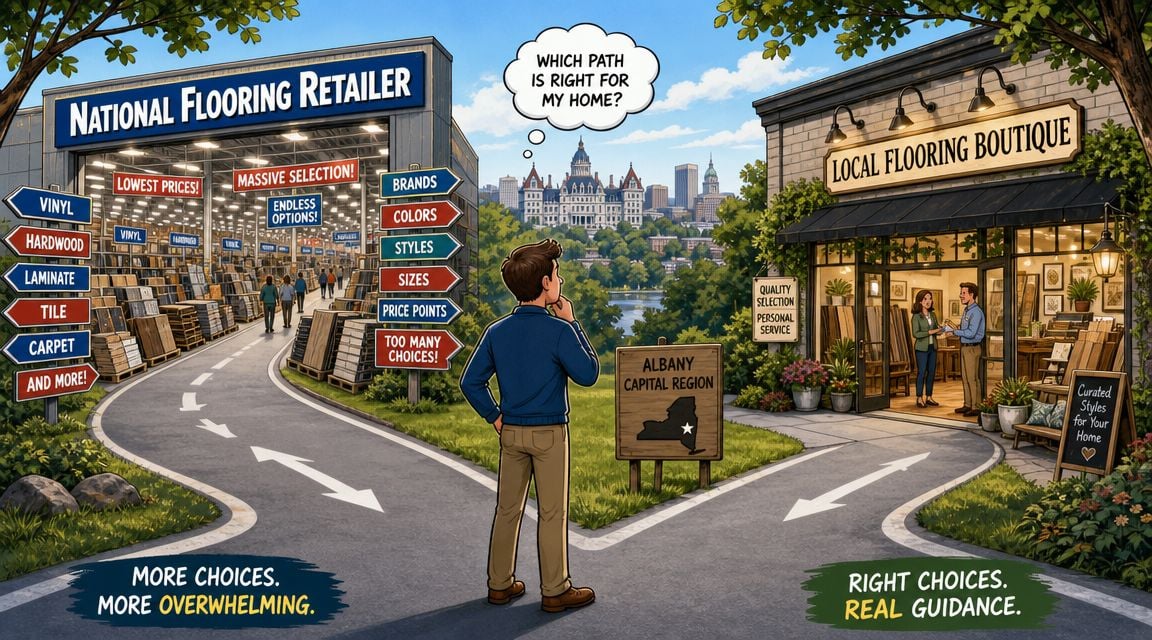
Two very different ways to buy flooring
On one side is Nebraska Furniture Mart. It has a long operating history and a very large retail footprint. Its own company history says it was founded in 1937 and independent company data cited in the same factual summary describes it as operating at major-market scale with approximately $1.1 billion in revenue and about 5,000 employees according to the referenced company information.
That scale tells a homeowner something important. NFM is built for volume. It's a high-capacity retail model, not a neighborhood flooring shop built around a tight local service radius.
On the other side is the local family-business model that many Upstate New York homeowners still prefer. In Freehold and across the Greater Albany area, people often want a store that knows the region, understands older homes, and can talk through the job in plain language. That matters in a market where room transitions, uneven subfloors, and mixed-use spaces are common.
Practical rule: The flooring itself matters, but the buying model matters almost as much.
What Albany area homeowners usually care about most
Most homeowners aren't shopping for flooring as a hobby. They want a result that looks right, lasts, and doesn't become a project-management headache. That's why the better comparison isn't just catalog versus catalog.
It's more useful to compare the total project experience:
| What matters | Large high-volume retailer | Local relationship-based business |
|---|---|---|
| Selection | Usually very broad | More curated |
| Buying experience | Process-driven | Conversation-driven |
| Installation oversight | Often layered through a larger system | Usually more direct |
| Design coordination | Product-focused | Whole-room focused |
| Post-sale support | Can feel more centralized | Usually more personal |
For homeowners building or renovating in custom homes around the region, broader planning also matters. This guide for Saratoga custom home buyers is a useful outside resource because it reflects the kind of whole-project thinking that flooring decisions should fit into, not interrupt.
Shoppers who want a local perspective on wood flooring options can also review this article on best places to buy hardwood flooring, which helps frame the difference between broad inventory and hands-on guidance.
Comparing Flooring Selection and Brand Variety
The selection is a prominent feature of flooring nebraska furniture mart. The assortment is huge, and that's not guesswork. A Logility press release states that NFM's supply chain manages more than 650,000 available SKUs, and the retailer supports that catalog with tools such as a Floor Finder. The same factual summary also notes that its flooring categories include hardwood, laminate, luxury vinyl, tile, and carpet, with options including solid hardwood construction as described in this source.
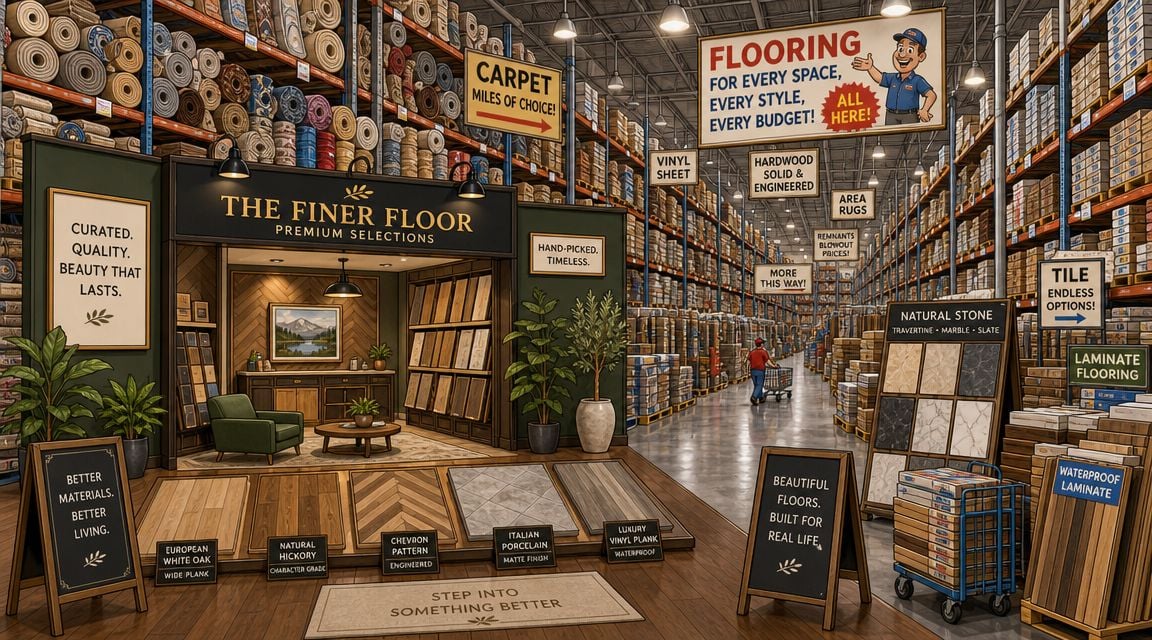
Breadth can help and it can overwhelm
A massive assortment helps when a homeowner already knows what they want. If the shopper is precise about species, color tone, wear layer category, board width, or carpet style, broad inventory increases the chance that something close is available.
But large catalogs also create a common problem. Too many choices flatten the important differences.
A homeowner can spend hours comparing products that look similar on a screen but behave very differently in a real house. One floor may suit a busy entryway. Another may make more sense in a dry bedroom. Another may be selected mostly because it's easy to maintain in a household with pets and kids. Without strong guidance, selection can become guesswork disguised as research.
For homeowners sorting through tile choices as part of a broader remodel, this outside resource on how to find your ideal floor tile is helpful because it focuses on material fit, not just appearance.
Curated selection makes decisions easier
A local showroom usually competes differently. It doesn't try to be endless. It tries to be useful.
That means narrowing the field to lines that fit real homes, real budgets, and long-term expectations. In the Freehold showroom model, the value is often in editing, not sheer volume. Instead of asking a homeowner to sort through a giant digital shelf, the staff helps eliminate poor fits early.
That's especially useful when the project involves more than one room. A curated approach helps with:
- Consistency across spaces so adjacent rooms don't look accidentally mismatched
- Finish and texture balance when natural light changes from room to room
- Material fit based on traffic, moisture exposure, and cleaning habits
- Custom ordering options when standard inventory doesn't solve the design problem
Some homeowners also want products with a stronger craftsmanship story, especially when the flooring needs to coordinate with solid wood furniture or a more traditional interior. In those cases, a curated local showroom can make it easier to explore American-made and Amish-crafted looks without forcing the customer to do all the filtering alone.
For readers comparing room-specific performance, this article on the best flooring for living room spaces is a practical next step because it focuses on use, comfort, and visual flow rather than just sample-board appeal.
Big selection is helpful. Relevant selection is what saves time.
The Installation and Local Service Experience
A flooring sample can look perfect in the showroom and still disappoint after installation. That's why the installation side deserves more attention than it usually gets.
Installation is where good flooring goes bad
Large retailers often publish useful technical guidance. NFM's vinyl buying guide, for example, explains that felt-backed sheet vinyl uses adhesive, while loose-lay sheet vinyl with fiberglass backing installs without adhesive, and it outlines differences among backing and installation methods in its vinyl flooring guide. That's useful product information.
It doesn't solve the hardest part of the job. The finished result still depends on the crew doing the work.
A floor can fail visually long before it fails structurally. Planks can drift off line. Transitions can feel abrupt. Trim details can look rushed. Subfloor issues can telegraph through resilient flooring. Homeowners often assume installation is standardized, but it isn't. The material may be consistent. The field execution rarely is.
Why local accountability changes the experience
A local service model often sets itself apart. The advantage isn't only familiarity. It's accountability.
When the same business helps select the product, explains the prep requirements, and stays tied to the outcome, the homeowner has a clearer path if questions come up. That lowers the chance of finger-pointing between sales, scheduling, and installation.
A practical way to judge any flooring seller is to ask who owns each step:
- Before the job who confirms site conditions and realistic expectations
- During scheduling who communicates if the timeline shifts
- At installation who has authority to address a problem on site
- After completion who handles a callback without passing the customer around
A smooth flooring job usually comes from clear responsibility, not from the biggest showroom.
For shoppers trying to budget installation realistically before they commit, this breakdown of hardwood flooring installation cost is useful because it highlights the kinds of job-site variables that affect the final number.
In the Albany area, this matters even more in older homes where floors may not be perfectly flat and where room-to-room transitions can be less predictable than in new construction. Local knowledge doesn't make those problems disappear, but it often helps surface them earlier.
Access to Professional Design Consultation
Many flooring mistakes aren't technical. They're visual. The floor might be durable, installed correctly, and still feel wrong in the room because it fights the wall color, the cabinet finish, or the furniture scale.
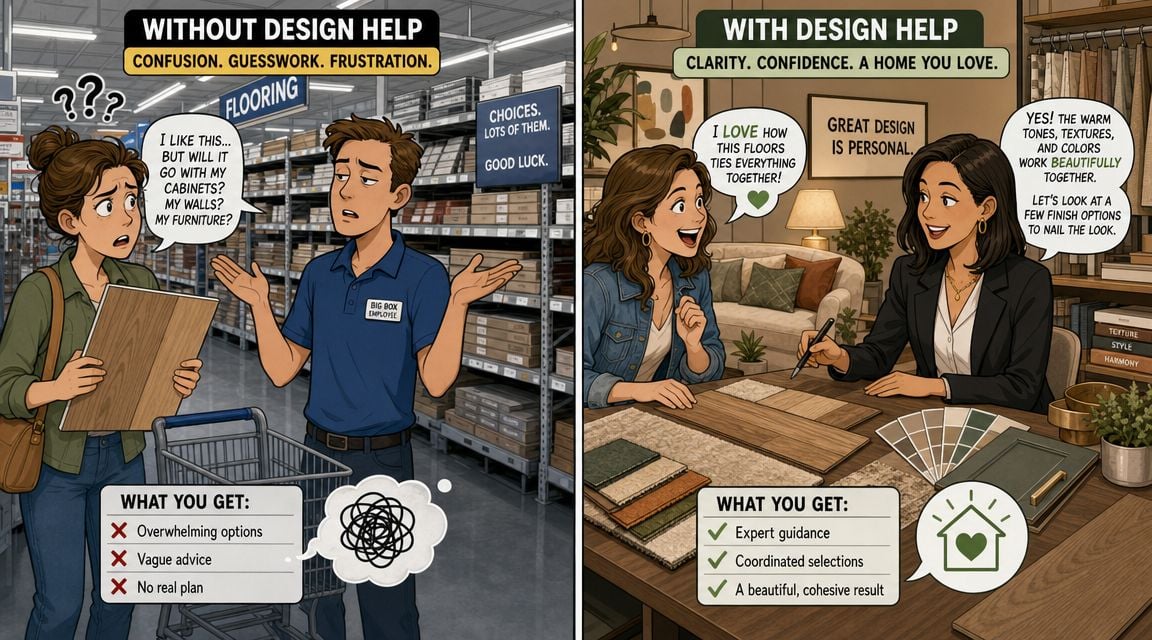
Flooring should work with the whole room
A big retail environment often treats flooring as a category purchase. The homeowner shops that department, chooses a product, and moves on. That can work for straightforward replacements.
It's less effective when the home is being updated as a whole. In that situation, flooring should be evaluated alongside upholstery, wood tones, lighting, rugs, and how the room is used. A pale, cool-toned floor can make existing cherry furniture look disconnected. A busy grain pattern can compete with patterned fabrics. A dark floor may anchor a large room beautifully but feel heavy in a smaller one with limited daylight.
That's why design consultation changes the result. It shifts the conversation from “Which sample looks nice?” to “Which floor helps the whole space make sense?”
One-stop planning changes the outcome
Tip Top Furniture & Mattresses offers interior design consultation services and has provided professional design services since 1984, according to the publisher background. That kind of service matters because it joins flooring to the rest of the home instead of treating it like an isolated transaction.
A homeowner in the Capital Region often benefits from asking broader questions such as:
- Will this floor make existing furniture look better or worse
- Does this color hold up in winter light and summer light
- Will the texture fight with area rugs or support them
- Is this material still going to feel right if the room gets repainted later
Design insight: The right floor doesn't just match the room. It makes the room easier to furnish for years.
That's where local showroom planning often outperforms aisle-based shopping. The homeowner gets help connecting surfaces, finishes, and function before the order is finalized.
Comparing True Project Cost and Financing
The biggest pricing mistake in flooring is comparing only the product line on the tag. That number matters, but it rarely reflects the full commitment.

Sticker price is only part of the budget
NFM's own flooring services page says installation depends on a formal measure, requires verbal price approval before ordering, and warns that if approval is delayed, the order won't be placed and installation may not proceed as scheduled as outlined here. That process is clear enough operationally, but it also points to something homeowners should pay close attention to. The advertised product price is only one layer of the job.
The harder costs often appear after the home is measured and the actual conditions are known. A project can change because of subfloor prep, transitions, furniture moving, old-floor removal, stair details, or job-site discoveries that weren't obvious from a sample board.
That doesn't mean a large retailer is automatically more expensive. It means the comparison has to be honest. The homeowner needs to compare full installed scope to full installed scope, not shelf price to final invoice.
How to compare quotes the right way
A better comparison uses a line-by-line approach. Homeowners should ask for clarity on what's included, what's assumed, and what could change.
Useful questions include:
- What prep work is included and what would trigger added charges
- Who moves furniture and whether that's part of the quote
- How transitions, trim, and edge details are handled
- What happens if the measure reveals a problem under existing flooring
- How scheduling works if approval or materials are delayed
This is also where financing can help if it's used the right way. Financing shouldn't be a way to ignore cost. It should be a way to manage a project without compromising on the material or installation quality that the room needs. Homeowners weighing payment flexibility can review furniture financing options as part of planning the bigger home project.
A low sticker price can still become the higher-cost choice if the quote leaves too many variables unresolved.
Evaluating Warranties and Long-Term Support
Most homeowners ask about warranties near the end of the conversation. They should ask earlier.
A warranty on paper is not the same as real support
Product warranties are only part of the story. The more practical question is what happens when a homeowner has a concern after the install is complete. Boards separate. A transition loosens. A seam becomes noticeable. A room settles and exposes an issue no one saw on day one.
In a large corporate structure, the answer can involve multiple parties. Sales may not be installation. Installation may not be the same team that handles follow-up. The homeowner can end up explaining the same issue several times before anyone decides who owns it.
A local business usually offers a simpler chain of responsibility. The store that sold the project still has a reputation attached to the outcome, especially in a community where repeat business and referrals matter.
What long-term satisfaction usually depends on
Long-term satisfaction usually comes down to three things:
- Clear records of what was selected, promised, and installed
- Accessible follow-up when a customer needs help after the job
- Local accountability from people who expect to keep serving the same region
If a flooring problem shows up later, homeowners want a person, not a maze.
That's especially relevant around Albany and the surrounding towns, where homes vary widely in age, layout, and seasonal movement. A responsive local point of contact can matter just as much as the written warranty language.
Your Best Choice for Flooring in Upstate New York
A homeowner doesn't need the same buying model for every flooring project. The right choice depends on how much support the project needs.
When a big-box model may fit
A high-volume retailer can make sense for a shopper who already knows the product category, is comfortable managing details, and mainly wants access to broad inventory. That path may also appeal to someone who treats flooring as a straightforward material purchase and is prepared to handle more of the process personally.
For a simple room refresh with few unknowns, that can be enough.
When a local full-service model makes more sense
Many Albany-area homeowners want something different. They want better guidance on material fit, stronger design coordination, a clearer installed quote, and a single point of accountability from selection through follow-up. That's where the local family-business model often delivers more long-term value, even if the comparison starts with product shopping.
The strongest flooring projects usually have a few things in common:
- The homeowner understands the full job cost before committing
- The flooring choice fits the room, not just the sample
- Someone stays accountable after the sale
- The project supports the whole home, not just one surface
For households in Freehold, Albany, Schenectady, Troy, and the wider Capital Region, that's often the deciding factor. The better question isn't “Who has more flooring?” It's “Who is set up to help this project go right from start to finish?”
Homeowners who want a guided, local approach can explore Tip Top Furniture & Mattresses for flooring, furniture, design coordination, flexible financing, and whole-home planning from its Freehold, NY showroom serving the Greater Albany Capital Region. Visiting the showroom, booking a design consultation, or reviewing financing options is a practical next step for anyone who wants clearer answers before committing to a flooring project.