The Ultimate Comforter Size Chart for a Perfect Fit

Trying to find the right comforter for your bed in the Greater Albany Capital Region can feel like a guessing game, but it doesn't have to be. A comforter size chart is the best tool for the job. It provides the standard dimensions needed to match a comforter to your mattress, whether you have a cozy Twin or a spacious California King. As a family-owned business helping local families since 1978, we know this simple reference is the key to getting that perfectly draped look every time.
Your Quick Reference Comforter Size Chart
A comforter is always wider and longer than the mattress it's made for — that extra fabric creates the "overhang" that drapes over the sides and foot of the bed, hides the box spring, and gives the whole setup a polished finish. Four decades and a half of conversations in our Freehold, NY showroom have taught us exactly which numbers matter most for local homes.
How did we settle on the dimensions below? We started with standard mattress footprints, then added the drape most shoppers want: enough to fully cover a 12-to-16-inch mattress and still stop several inches above the floor. We intentionally publish ranges rather than single numbers, because manufacturers disagree by a few inches even on the same "standard" size. Labels vary between brands, so checking the measurements is essential (NCOA mattress size guide).
What follows is a quick-reference chart, an inches-only breakdown, a method for measuring your own bed, and then size-by-size guidance with our honest take on where off-the-shelf standards fall short.
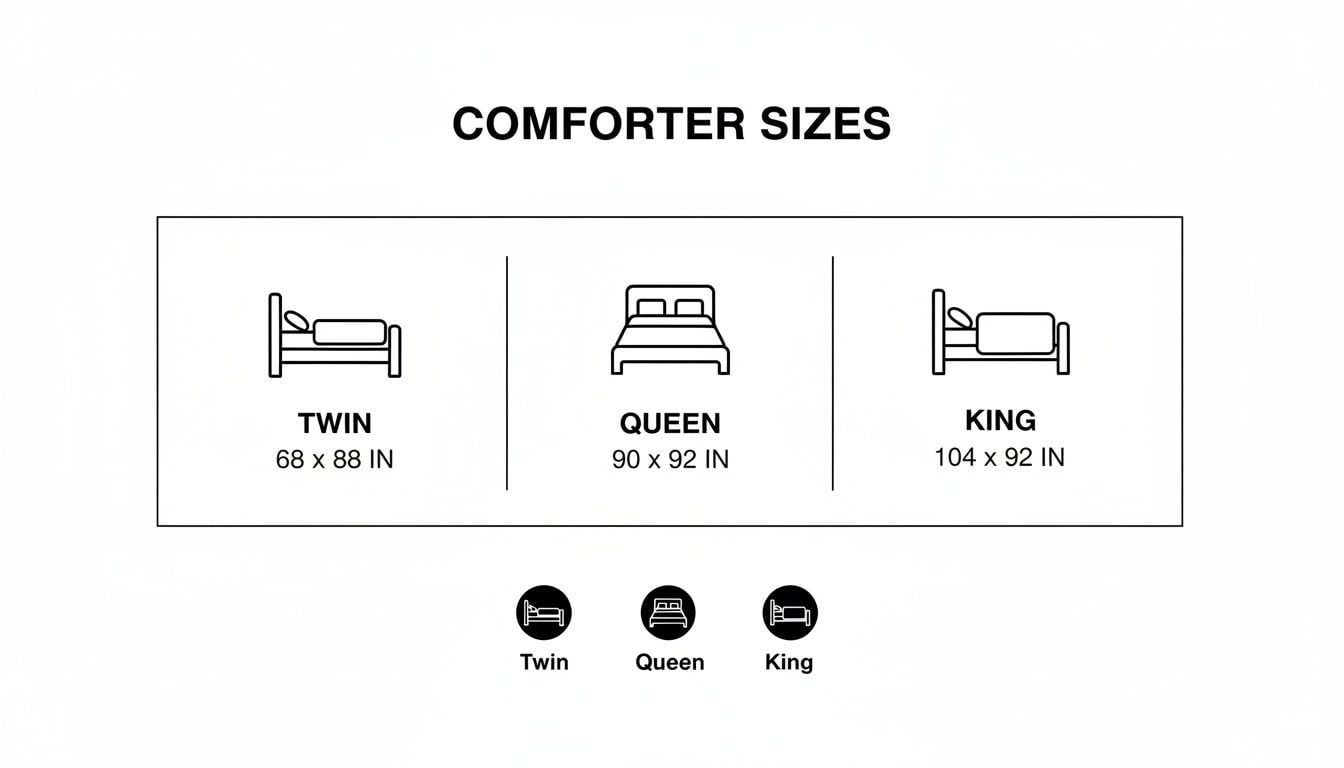
The image below shows the standard comforter dimensions for the most common bed sizes we see in our Freehold, NY showroom.
| Mattress Size | Mattress Dimensions (Inches) | Standard Comforter Dimensions (Inches) |
|---|---|---|
| Twin | 38" x 75" | 66"–68" x 86"–88" |
| Twin XL | 38" x 80" | 68" x 90" |
| Full / Double | 54" x 75" | 81"–84" x 86"–88" |
| Queen | 60" x 80" | 88"–90" x 90"–94" |
| King | 76" x 80" | 104"–108" x 90"–94" |
| California King | 72" x 84" | 104"–108" x 96"–98" |
Keep this table handy when you're shopping, as it gives you a solid baseline for what to look for.
Why Sizing Matters So Much
A well-sized comforter doesn't just look better; it feels better. It's what prevents that nightly tug-of-war over the covers and keeps chilly drafts from sneaking in, especially during our cold New York winters.
While these standard sizes are a fantastic starting point, they're just one piece of the puzzle. For a deeper look at how to pick the perfect bedding layers, from sheets to protectors, take a look at our complete guide to bedding, protectors, and comforters. Getting the size right is the foundation for turning your bedroom into your favorite room in the house.
Comforter Size Chart in Inches
If you're standing at a mattress or comparing tags with a tape measure, here are the same dimensions stripped down to the numbers themselves:
- Twin comforter: about 68 inches wide by 88 inches long
- Twin XL comforter: about 68 inches wide by 90 inches long
- Full comforter: about 81–84 inches wide by 86–88 inches long
- Queen comforter: about 88–90 inches wide by 90–94 inches long
- King comforter: about 104–108 inches wide by 90–94 inches long
- California King comforter: about 104–108 inches wide by 96–98 inches long
Two things to notice as you scan those ranges. First, only the king and California king sizes share a width band. The Cal King's extra 4 inches of length distinguishes them. Second, every comforter is roughly 28 to 32 inches wider than its matching mattress. That gap isn't accidental; it exists to drape. The deeper your mattress, the more of that allowance gets "used up" covering the sides.
Why Standard Charts Are Just a Starting Point for Albany Homes
Think of a standard comforter size chart as a good map. It'll get you to the right city, but you still have to follow the local streets to find your destination. While those charts give you an excellent foundation, they're not the final word on getting that perfectly dressed bed.
The biggest factor those charts almost always miss? Mattress depth.
Mattresses today are a whole lot thicker than they were a generation ago. Our family has been in the furniture business since 1978, and we've watched mattresses grow from simple 8-inch profiles to 12-to-16-inch hybrids and pillow-tops. A comforter made for an older, thinner mattress is going to look skimpy on a modern bed, leaving that annoying gap between the comforter and the box spring.
It is common for shoppers to try reusing an older comforter on a newly delivered mattress. On a 14-inch mattress, an older 90-inch-wide comforter leaves barely an inch of drop per side, and the first drafty night often sends them back for a proper upgrade.
The Impact of a Few Inches
You might not think a few inches matter, but it makes a huge difference. A comforter that gives you a generous 15-inch drape on a 10-inch mattress will only hang down a measly 11 inches on a 14-inch mattress. That four-inch difference is what separates a cozy, fully covered bed from one that leaves you fighting drafts all night.
This isn't just a trend for folks in Albany, Schenectady, and Troy; it's a manufacturing shift we've tracked across the industry. Back in the '90s, a standard queen mattress was about 8–10 inches deep. Now, 12–15 inches is common, which has forced comforter makers to add width just to keep up.
Expert Tip: If you have an extra-deep mattress or a plush topper on top of that hybrid build, always size up your comforter. Many customers with Queen beds choose a larger size to get that luxurious, floor-sweeping look — a designer trick for a reason.
Regional differences also come into play. In the United States, a king-size comforter is typically designed to cover a mattress measuring 76 by 80 inches. Bedding terminology changes substantially between North America and Europe, making actual measurements more reliable than labels. For a full side-by-side of these naming conventions, see this linen and duvet size guide from Linen Owl, and this Australian bedding size chart. Both drive home why measuring your own bed is the most important step.
How to Measure Your Bed for a Perfect Comforter
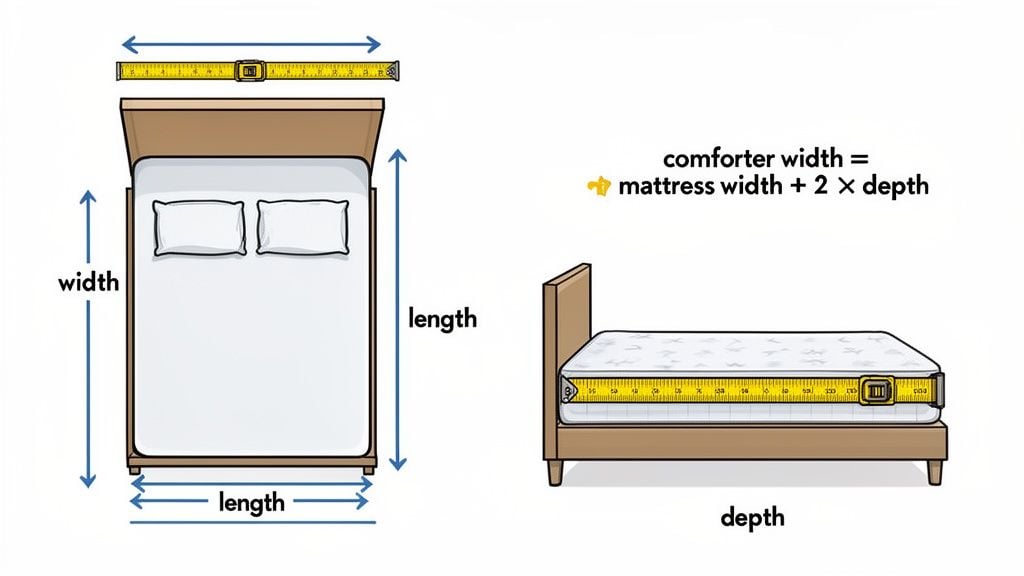
You can stare at a comforter size chart all day, but to get that perfect, catalog-worthy fit, you'll need to grab a tape measure. It's the single most important step you can take, especially if you have one of today's modern, deep mattresses. Trust us, it's a five-minute job that saves a ton of guesswork and guarantees you'll love how your new comforter drapes.
When customers visit our Freehold showroom, we always tell them to measure three key dimensions before they even start looking. It's a simple trick based on our 45+ years of experience that takes the mystery out of the process.
The Three Essential Measurements
Ready? Just follow these simple steps to get the exact numbers you need.
- Measure the Width: Run your tape measure from the left edge of your mattress clear across to the right edge. Jot that number down.
- Measure the Length: Now, measure from the head of the mattress all the way to the foot. This one is less critical for the side drop, but it's still good to know.
- Measure the Depth (Height): This measurement is especially important. Measure from the bottom edge of your mattress straight up to its highest point on top. If you use a plush mattress topper, make sure you include it in this measurement!
One quirk to keep in mind while you measure: quilting projects often cut differently than comforters. If you or someone in your family sews your own bedding, see On Pins & Needles Quilting Co. for details on quilt measurements.
With those numbers in hand, you can figure out your perfect comforter width in seconds.
The Perfect Overhang Formula
To make sure your comforter hangs beautifully over both sides and covers the mattress completely, just use this simple formula:
Mattress Width + (Mattress Depth x 2) = Your Ideal Comforter Width
Let's say you have a Queen mattress that's 60 inches wide with a 14-inch depth. You'll need a comforter that's at least 88 inches wide (that's 60 + 14 + 14) just to cover the sides. For that really luxurious, generous drape, we'd suggest aiming for something in the 90–92 inch range.
These same basic rules apply to more than just comforters. For a complete look at getting the right fit for your entire bedding set, check out our guide on correct bed sheet measurements.
How I Picked These Comforter Sizes
These numbers aren't pulled from a single manufacturer's spec sheet, because no two agree. Here's the method behind every figure in this chart:
- Standard mattress footprints first. Every mattress dimension (38" x 75" for a Twin, 60" x 80" for a Queen, 76" x 80" for a King) comes from the settled industry standard, not a marketing label.
- The overhang formula. Each range was calculated using the width-plus-twice-depth formula described above, ensuring the comforter clears the sides of a typical mattress.
- A bias toward ranges. Since manufacturers disagree on the same size label, I'd rather give you the honest band than a false precision number.
If your measurements land outside these bands, that's not you doing it wrong — it's a sign a standard size won't serve you.
A Detailed Breakdown of Comforter Sizes
A quick reference chart is a helpful starting point, but making a bed well also means understanding the details behind each comforter size. Here in our Freehold, NY showroom, we're always helping customers from Albany to Schenectady understand the subtle differences. Here's what each size is designed for, along with some common variations you'll encounter.
Twin And Twin XL Comforters
A Twin comforter is typically sized around 68 inches by 88 inches. It's designed to perfectly fit a standard Twin mattress (38" x 75"). This makes it the go-to choice for kids' rooms, guest beds, and especially bunk beds, where you need enough coverage without a ton of extra fabric hanging down.
The Twin XL comforter is just a bit longer, usually about 68 inches by 90 inches. That extra length is specifically for a Twin XL mattress (38" x 80"), which is the standard size you'll find in college dorms. It's also a great pick for taller kids or adults who need that little bit of extra legroom.
Full Or Double Comforters
Designed for a Full (sometimes called a Double) mattress (54" x 75"), a Full comforter generally measures somewhere between 81 and 84 inches wide and 86 to 88 inches long. The inch ranges above are the dimensions to check on a Full comforter label. Knowing these full size comforter dimensions gives you a nice, comfortable drape on all three sides of a standard Full bed.
You might notice some brands selling a combined "Full/Queen" size. Be a little careful with these. While they work just fine for a Full bed, they can sometimes feel a bit skimpy on a true Queen, especially if your mattress is on the deeper side.
Expert Insight: If you have a Full bed with an extra-deep mattress or you've added a plush pillow topper, consider sizing up to a Queen comforter. It'll give you a much more luxurious and generous overhang, so you never have to worry about the mattress peeking out. Our custom ordering options can also help you get the perfect fit.
Queen Comforters
The dedicated Queen comforter is easily the most requested size in our showroom. The standard queen comforter size dimensions are 88 to 90 inches wide by 90 to 94 inches long (for a 60" x 80" mattress), which provides fantastic coverage for most Queen beds, even those with a moderately deep mattress. When checking the size of queen comforter in inches, these queen size comforter dimensions ensure you have enough fabric to tuck or drape properly.
If you really want to get into the nitty-gritty of this particular size, you might find this ultimate guide to the fitted comforter queen to be a helpful read.
King And California King Comforters
For a King bed, the dedicated size is 104 to 108 inches wide by 90 to 94 inches long. These king size comforter dimensions will always drape a standard King mattress (76" x 80") better than an oversized Queen. The size of king comforter options provides roughly 14 to 16 inches of extra width per side beyond the mattress footprint, which allows the fabric to hang vertically and cover the sides of a deep mattress while hiding the frame. Understanding what size comforter for king bed setups works best means recognizing that this extra width spans the bed to keep two sleepers comfortably covered at once.
A California King comforter, on the other hand, is designed for the longer and slightly narrower Cal King mattress (72" x 84"). Its dimensions are typically 104 to 108 inches wide by 96 to 98 inches long, giving you that extra length. Getting the mattress dimensions right is the first step, and you can learn more in our guide on how to choose the best bed and mattress size.
The comforter sizes we see today are often shaped by regional trends. Here in North America, Queen and King sizes really dominate the market. On a global scale, one report points out that Double or Full/Double comforters are the most popular size segment. You can learn more about these global comforter market trends.
Choosing a Size for Your Desired Style
A comforter size chart gives you the numbers, but your personal style is what really makes the final call. The way a comforter drapes over the sides of your bed—what designers call the "overhang" or "drape"—is one of the biggest factors in your bedroom's overall look and feel. Getting that drape right can completely transform your entire space.
For homeowners all over the Greater Albany Capital Region, knowing how to achieve a certain look is everything. You can go for several different styles, and each one needs a slightly different approach to sizing.
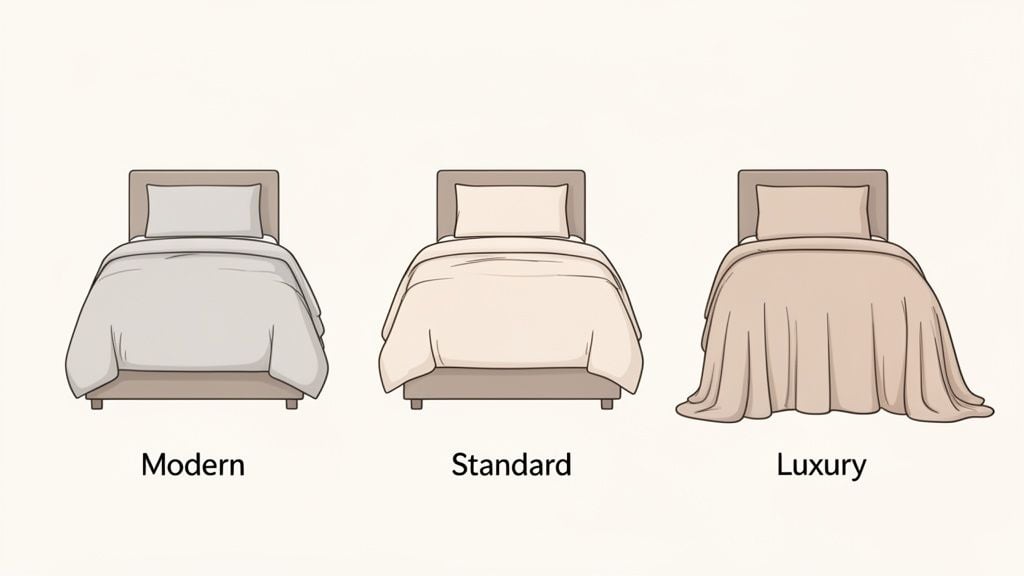
Different Styles of Drape
- The Minimalist Look: This is a clean, modern style where the comforter just covers the sides of the mattress, leaving the bed frame and box spring exposed. To pull this off, you'll want a comforter that's only a little wider than your mattress plus twice its depth.
- The Standard Drop: This is the look you see most often. The comforter hangs down far enough to hide the mattress and box spring, usually stopping a few inches from the floor. The dimensions you see on a standard comforter size chart are typically designed to create this balanced, classic appearance.
- The Luxurious Pool: For a dramatic and cozy vibe, you can go with an oversized comforter that pools generously on the floor. This high-end look is a favorite design trick we see among our customers looking for that extra touch of elegance.
Expert Tip: To get that luxurious, oversized look, try sizing up. Placing a larger comforter on a smaller bed creates an incredible amount of drape that looks elegant and feels extra cozy, while providing plenty of coverage for both sleepers.
Pulling off these looks often means thinking beyond the standard sizes you find on the shelf, which is where our 45+ years of experience in our Freehold, NY showroom really comes in handy. If you want to get it just right, our custom ordering options let you specify the exact dimensions you need to bring your vision to life.
For more inspiration on pulling your whole look together, check out our guide on accessorizing the bed of your dreams. It's packed with ideas for creating a beautiful and cohesive bedroom retreat.
Finding Your Perfect Bedroom at Tip Top Furniture
Choosing the right comforter is often that final, satisfying touch that pulls your whole bedroom retreat together. For our neighbors here in the Greater Albany Capital Region, a great comforter isn't just about warmth; it's about elevating the entire room's design. Our family's 45+ years of experience help guide that finishing touch.
Here at Tip Top Furniture & Mattresses, we offer a true one-stop shop from our 35,000-square-foot showroom in Freehold, NY — furniture, mattresses, window treatments and floor coverings all under one roof.
Going Beyond the Standard Size Chart
Sometimes, a standard comforter size chart just doesn't cut it. Maybe you have an extra-deep mattress or a unique, custom bed frame that throws off the usual measurements. This is exactly why we take a more personalized approach: Tip Top's staff are trained to help customers determine which bedding is right for them, using a series of questions to narrow down the choice — we start with the mattress, then work outward.
- Custom Ordering: If you just can't find the perfect dimensions off the shelf, our custom ordering service is your answer. We can help you create bedding that perfectly matches your vision and complements your furniture.
- Expert Coordination: Tip Top's design consultants can even visit your home, and our in-house decorator takes measurements on-site and generates a computer-aided design of the project before anything is ordered.
- Flexible Financing: We want to make it easy to finish your entire project at once. You can apply for flexible financing to bring your perfect bedroom to life without any delay.
For our showroom in Upstate New York, many homeowners use thicker mattresses for our cold winters, which often requires looking beyond standard dimensions to find adequate coverage.
Let our family help yours. Stop by our Freehold showroom today and let us help you find every piece you need for your perfect bedroom oasis.
Common Questions About Comforter Sizes
Even with a handy comforter size chart in front of you, it's completely normal to have a few lingering questions. As a family-owned business serving the Greater Albany Capital Region since 1978, we've heard them all. Here are answers to the questions we hear most often right here in our Freehold showroom.
Can I Use a King Comforter on a Queen Bed?
Absolutely! This is a popular trick designers use to get that luxurious, oversized look you see in magazines. Putting a King comforter on a Queen bed gives you a much more generous drape on the sides — a 106-inch-wide king over a 60-inch queen leaves roughly 23 inches of total side width to drape with, which swallows the deepest pillow-top and keeps the box spring completely hidden.
On a practical note, it's also a great way to prevent the nightly tug-of-war over the covers. Sizing up is a straightforward adjustment that helps keep both sleepers comfortably covered throughout the night.
What Is the Difference Between a Comforter and a Duvet?
The biggest difference comes down to their construction. A comforter is a single, quilted piece of bedding. The filling is stitched right into place, so it's ready to use the moment you take it out of the bag. You'll often find them sold in convenient, matching "bed-in-a-bag" sets.
A duvet, on the other hand, is just the insert. It's designed to go inside a separate, washable duvet cover. The big advantage of duvets is style versatility—you can change the cover for a quick and easy room refresh without buying all new bedding. Tip Top's staff can walk you through which setup suits your household, whether you prefer the all-in-one simplicity of a comforter or the flexibility of a duvet.
Does a Full/Queen Comforter Fit a Queen Bed Well?
This is a common point of confusion. A "Full/Queen" size is a hybrid that's made to work for both mattress sizes — but a true queen comforter runs 88–90 inches wide by 90–94 inches long, and a Full/Queen often sits at the bottom of that band. For reference, standard full size comforter dimensions are 81–84 inches wide by 86–88 inches long. That means a Full/Queen will cover a Full mattress just fine, yet on a standard Queen bed it can come up short alongside the mattress, especially with a deep profile.
For a true Queen bed, the queen comforter dimensions above almost always provide better coverage and a more polished, intentional look. If you're on the fence, measure your mattress depth first: anything over 12 inches and I'd steer you straight to a dedicated Queen or even a King.
Our Expert Takeaway
"Ever wonder why vintage comforters feel so much smaller? It's because mattresses used to be much thinner—typically just 7 to 9 inches deep. Today's modern mattresses, especially with pillow-tops, can easily be 12 to 16 inches tall. Bedding manufacturers have had to adjust their 'standard' sizes over the years just to keep up with these thicker profiles."
With over 45 years of experience, we've seen these standards evolve firsthand. We can help guide our customers from across the Capital Region to find bedding that fits today's beds perfectly.
At Tip Top Furniture & Mattresses, we do more than just sell furniture; we help you create a home you love. From finding the perfect Amish bedroom set to selecting a USA-made mattress, our team is here to help.
Visit our Freehold, NY showroom to complete your bedroom oasis.