How to Choose Curtains for a Living Room


A living room can look finished on paper and still feel wrong in daily use. Afternoon sun may wash out the television, a north-facing window may send a cold draft across the sofa, and a beautiful pair of panels may stop awkwardly above the floor. For homes around Freehold, Albany, Schenectady, and Troy, how to choose curtains for a living room starts with comfort and operation, then moves into color and style.
The right treatment balances winter warmth, summer glare, privacy, family safety, and the furniture already in the room. It should also suit the way the household lives, whether that means opening the curtains every morning, keeping children away from cords, or making a large open-concept space feel more settled.
Assessing Light and Energy Needs First
Most homeowners begin with a fabric color. That's backwards. The first question is whether the living room needs more daylight, less glare, better nighttime privacy, or a stronger barrier against cold glass.
The U.S. Department of Energy reports that approximately 30% of a home's heating energy can be lost through windows, which makes window coverings relevant to winter comfort in Upstate New York. DOE-supported research also finds that tested energy-efficient window attachments can produce heating-energy savings of 10–20% and cooling-energy savings of 8–10%, although results vary with climate, window type, season, and operation habits. These figures don't mean an ordinary decorative curtain guarantees the same result. They do show why construction matters. The Department of Energy's winter window guidance supports treating window coverings as part of a comfort plan, not just a finishing touch.
A cold, draft-prone, north-facing window usually benefits from lined or insulated curtains that close fully at night. A bright south- or west-facing window often needs tighter-weave fabric, a lining, or layered treatment to control glare and unwanted solar warmth.
Match the curtain to the window orientation
Use the room's exposure as a practical filter:
- North-facing windows: Choose lined fabric when the glass feels cold, while keeping the daytime layer light enough to preserve available daylight.
- South-facing windows: Consider light-filtering or solar-control layers that soften strong sun without making the room gloomy.
- West-facing windows: Prioritize glare control for late-day sun, particularly if the sofa or television faces the glass.
- Drafty windows: Select a close-fitting lined or interlined panel, and make sure the curtain can overlap and extend beyond the opening.
DOE guidance recommends opening curtains or shades during sunny winter days to admit warmth, then closing them at night to help retain indoor heat. That daily routine matters as much as the fabric itself. A heavy panel left permanently open won't protect the room after sunset, while a blackout treatment kept closed all day may make a naturally comfortable room feel unnecessarily dark.
Practical rule: Choose the construction from the window's problem, then choose the color from the room's design.
Homeowners comparing options for Albany-area living rooms can also review these living room window treatment recommendations before selecting a rod, lining, or layered system.
Measuring for Fullness and Proper Drop
A curtain panel that matches the glass width usually looks flat and undersized. The fabric needs room to fold, and the hardware needs enough width for the panels to stack beside the glass instead of covering it when open.
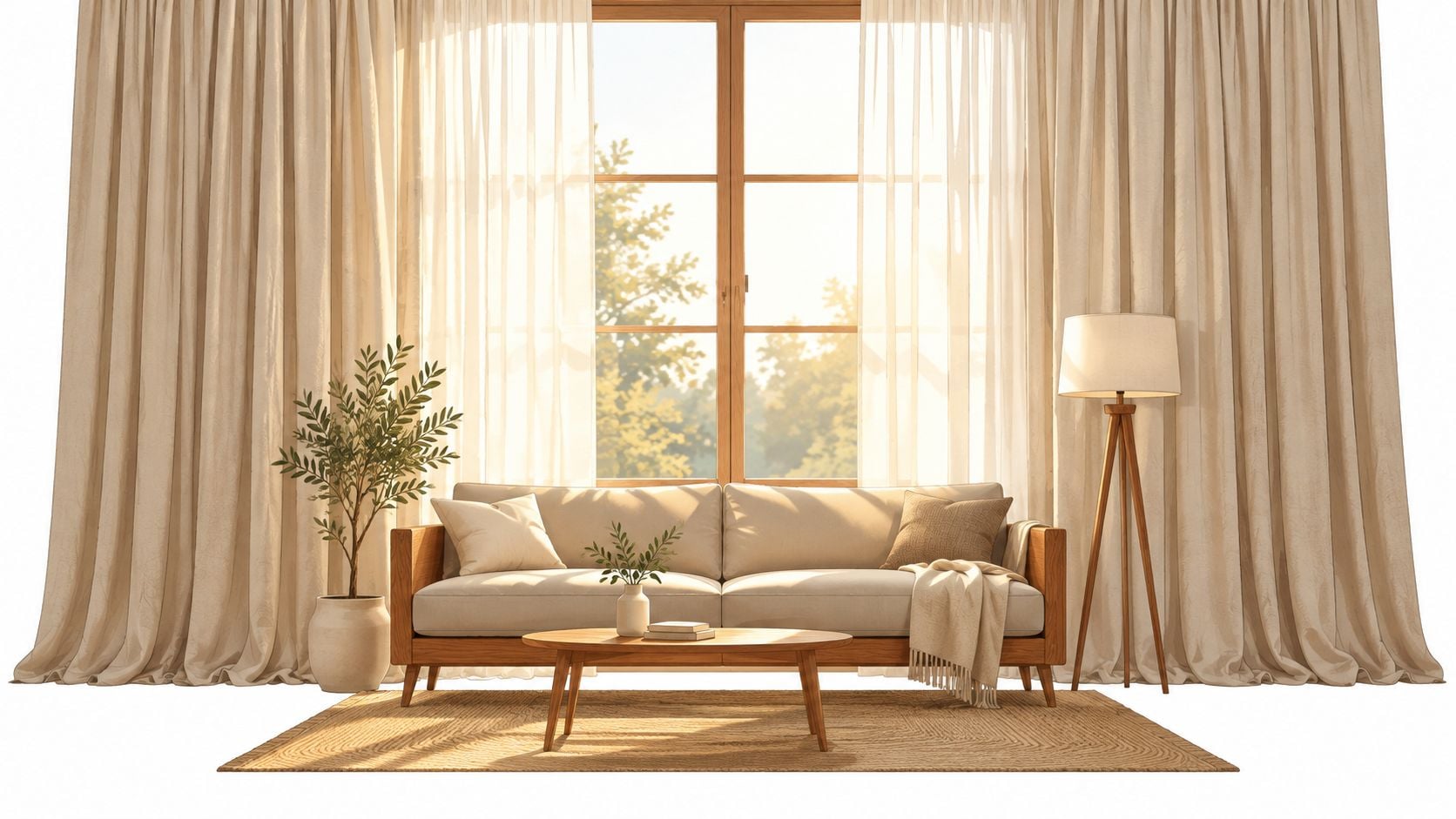
For most living rooms, the rod or track determines fabric width, not the window. Gathered curtains generally need fabric measuring about 2 to 2.5 times the rod width, as explained in this guide to calculating curtain fullness. The fabric multiplier depends on the heading and weight. Pinch pleats and fuller gathers need more material than a simple flat panel.
Follow a four-stage measurement process
Record the opening at three points. Measure width and height at the top, middle, and bottom. Older frames may be out of square, and one measurement can hide a meaningful variation.
Choose the mounting position. Decide whether the rod or track will sit inside the frame or outside it. An outside mount generally gives more visual height and lets the fabric cover the wall around the opening.
Set the finished drop before ordering. Decide whether the curtain will finish at the sill, below the sill, or near the floor. For a polished floor-length installation, the fabric should generally finish about 1 cm, or roughly 0.4 inches, above the floor. Sill-length curtains should end about 1 cm above the sill, while below-sill curtains commonly extend about 15 cm below it. This curtain measuring guide explains why the finished position must be measured from the heading or track, not just from the glass.
Calculate total finished fabric width. Measure the full rod or track, select the fullness ratio, then divide the total between the panels. A two-panel arrangement often gives the most balanced opening, but a single panel can make sense beside a door or in a tight corner.
Mounting the rod several inches above and beyond the frame can make the window appear larger and allow the panels to stack clear of the glazing. That extra width must be checked against radiators, doors, furniture, and available wall space. A curtain that collides with a bookcase or traps heat above a radiator isn't properly specified.
A written schedule prevents expensive guesswork. It should list:
- Rod or track width
- Panel count
- Finished length
- Fullness ratio
- Lining and heading
- Return and stack-back
- Shrinkage or dimensional-stability requirements
For washable natural fibers, the fabric should be processed according to the manufacturer's guidance before final hemming. Homeowners handling unusual windows can also consult this practical curtain advice from Quote My Wall for additional measuring considerations.
For panel proportions and finished widths, the curtain panel size guide provides a useful reference before ordering.
Selecting Fabrics and Linings for Every Season
Fabric choice should follow the room's exposure and privacy needs. An unlined linen-look panel may be ideal for a bright room that needs softness, but it won't perform like a lined drape beside cold glass or under intense afternoon sun.
The simplest way to compare treatments is to separate the jobs. Sheers manage daytime softness and privacy, lined panels add structure and nighttime coverage, and blackout or thermal linings provide stronger control where glare, privacy, or drafts demand it.
Curtain Lining and Fabric Performance Guide
| Lining Type | Best For | Key Benefit |
|---|---|---|
| Unlined | Bright rooms with modest privacy needs | Preserves daylight and keeps the treatment visually light |
| Standard lined | Draft-prone windows and everyday privacy | Improves drape, coverage, and protection for the face fabric |
| Blackout lined | Television glare, strong sun, and nighttime privacy | Limits incoming light and creates a more complete visual barrier |
| Insulated or interlined | Cold glass and winter comfort | Adds weight and resistance when the curtain is fully closed |
| Sheer layered with a heavier panel | Rooms needing flexible day and night control | Allows daylight by day and stronger privacy after dark |
Consumer Reports, citing Department of Energy information, reports that medium-colored draperies with white plastic backings can reduce heat gain by 33 percent. The result depends on the installation and the fabric, so the treatment should sit close to the window, with the top, sides, and center sealed as practically as the room allows. This explanation of drapery and solar heat control offers useful context.
Color still matters, but it's not only decorative. Medium and darker fabrics can create a grounded look and reduce visual glare, while lighter fabrics preserve a brighter atmosphere. A west-facing living room with a television may need a lined panel even if the preferred style is relaxed linen. A shaded north-facing room may need a lighter face fabric paired with a discreet lining, rather than a dense blackout treatment.
The most adaptable arrangement is usually a sheer or light-filtering layer nearest the glass and a heavier curtain outside it. The inner layer handles daytime privacy without sacrificing natural light. The outer layer closes for winter evenings, nighttime privacy, or strong afternoon sun.
For a patterned option, a floral panel can act as the room's accent while quieter upholstery and flooring keep the overall design composed. A carefully selected black floral curtain option can work particularly well when the living room already includes related tones in a rug, pillow, artwork, or wood finish.
Prioritizing Safe and Accessible Hardware
A curtain system has to be safe and easy to operate, not merely attractive from across the room. This becomes especially important in homes with young children, older adults, pets, or anyone with limited reach or grip strength.
The U.S. Consumer Product Safety Commission reports that about eight children age eight or younger die each year on average from strangulation involving cords on blinds, shades, draperies, and other window coverings. That makes cordless, inaccessible-cord, wand-operated, or professionally motorized systems a serious selection criterion. The CPSC window-covering safety notice provides the relevant safety warning.
Cord safety shouldn't be treated as an accessory decision made after the fabric is chosen. The operating system affects where the treatment can be installed, how children interact with it, and whether the adults in the household can use it without strain.
Select hardware around the people using it
- Young children: Choose cordless or inaccessible-cord systems, and keep furniture from creating an easy climbing route to the window covering.
- Older adults: Favor lightweight fabrics, smooth traverse hardware, wands, or pull-assist systems over heavy panels that require force.
- Limited reach or mobility: Avoid rods mounted too high for daily operation. Motorization can help when it includes a practical manual backup.
- High-traffic openings: Use hardware that moves panels smoothly and parks them clear of doors and walking paths.
- Heavy lined curtains: Specify sturdy rods or tracks with suitable support rather than relying on a decorative pole designed for light fabric.
A beautiful finial can't compensate for a rod that binds. Pinch pleats may suit a formal room, but they're a poor choice if the household opens the curtains frequently and lacks a traverse system. Grommets can slide easily, while ripple-style or track-based systems can provide a cleaner operating path for broad openings.
The same thinking applies to related window treatments. Homeowners planning a Roman shade can review Roman shade installation guidance before selecting a mounting height, control style, and location relative to nearby furniture.
A safe curtain is one that every intended user can operate without climbing, pulling hard, or reaching into a cord loop.
Motorized curtains can support timed daylight and temperature routines, but the system should be checked for power-failure operation, manual control, privacy settings, and household compatibility. Automation is useful only when it remains understandable and accessible.
Coordinating Textiles with Your Living Room Decor
Curtains shouldn't look like they were purchased after everything else was finished. They occupy a large vertical area, so their color, texture, and visual weight affect the sofa, flooring, wood pieces, lighting, and architectural details at the same time.
A documented American museum reproduction project researched 17th- and 18th-century fabrics and treatments for a historic house, showing that curtains have long been selected to coordinate architecture, textiles, privacy, and status. The historical lesson is practical: window treatments work best when they belong to the room's larger material story. This museum account of curtain history and fabric coordination offers a helpful example.
Build the palette from what already works
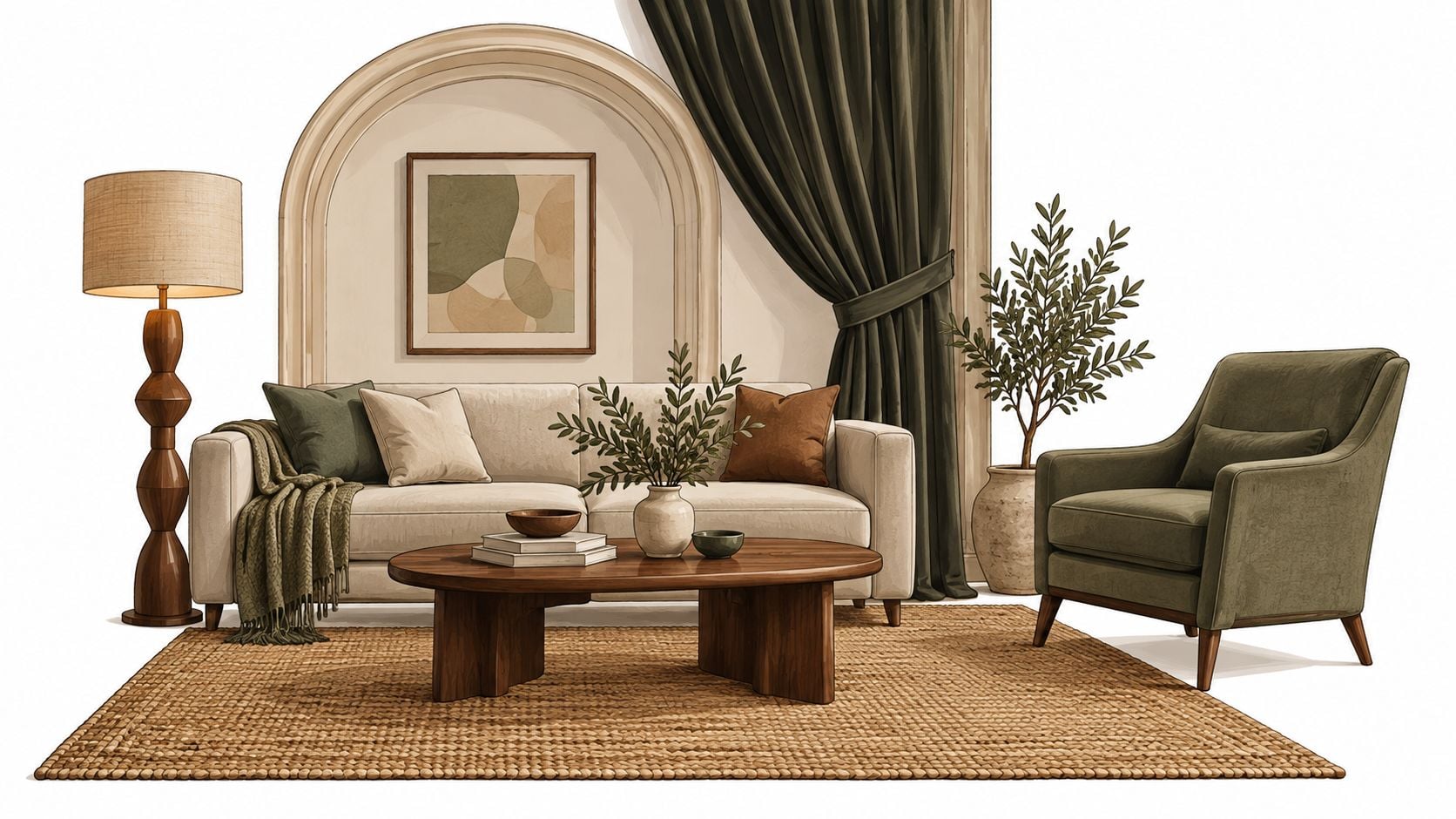
A strong starting point is the room's largest established piece. A solid wood table, an Amish-made cabinet, a patterned rug, or a substantial sofa can provide the color and texture cues for the curtain.
- Wood furniture: Echo the warmth of the wood with a natural linen, muted clay, olive, or warm neutral fabric. The curtain doesn't need to match the stain exactly.
- Patterned rugs: Pull one quieter color from the rug for a solid curtain. Repeating a secondary tone usually looks more settled than copying the boldest shade.
- Neutral upholstery: Use texture, a subtle stripe, or a restrained pattern to add depth without overwhelming the sofa.
- Open-concept rooms: Repeat the curtain's undertone in nearby dining, flooring, or entry furnishings so the treatment connects zones rather than creating a visual stop.
- Small living rooms: Hang the treatment high and use a close wall color when a calmer, more spacious effect is needed.
Hardware should participate in the design without competing with it. Black hardware can reinforce dark lighting or metal details, warm metal can relate to lamps and cabinet pulls, and wood rods can soften traditional rooms with solid wood furnishings.
Pattern mixing needs discipline. If the room already has a patterned rug and expressive upholstery, a solid curtain with visible weave is usually the better choice. If the furniture is quiet, a floral, stripe, or geometric panel can become the vertical feature that gives the room personality.
Tip Top Furniture & Mattresses can also coordinate living room furnishings, décor, window treatments, and flooring through one local showroom process, which is useful when the room needs more than a curtain change.
Bringing Your Vision to Life with Custom Ordering
Off-the-shelf curtains work well when the window is straightforward, the size is standard, and the room's needs are modest. Custom ordering becomes worthwhile when the windows are unusually tall, out of square, close to radiators, part of an open-concept layout, or exposed to competing glare and draft conditions.
A consultation should begin with the room rather than a fabric book. The designer can identify the window orientation, observe how daylight changes, note where people sit, check stack-back space, and determine whether the treatment must work with blinds, shades, doors, or heating registers.
When a tailored treatment earns its place
Custom ordering is especially useful when a household needs:
- Exact fullness and drop, rather than a compromise based on standard panel sizes.
- A coordinated heading, such as pinch pleats, ripple-style folds, or a functional traverse system.
- Specific lining, including layered, blackout, or insulated construction.
- Fabric and finish coordination across sofas, rugs, Amish furniture, flooring, and nearby rooms.
- Safer operation, with cordless, wand-operated, or motorized hardware suited to the household.
- A complete written specification, including rod width, panel count, finished length, return, lining, and stack-back.
Tip Top's professional design services have been available since 1984, and its Freehold showroom serves homeowners throughout Greene County and the Greater Albany Capital Region. The family-owned business has operated since 1978, offering furniture, mattresses, décor, flooring, window treatments, custom ordering, delivery, and flexible financing in one location. Its selection includes pieces from 50+ trusted manufacturers, along with USA-made products and heirloom-quality Amish furniture handcrafted in the USA.
The design process can also extend beyond curtains. A homeowner furnishing a living room may coordinate a solid-wood coffee table, an American-made sofa, flooring, lighting, and window treatments without forcing each item to match. For households working within a defined budget, financing options and the Clearance Corner can make it easier to complete the room in a sensible order rather than settling for mismatched pieces.
For guidance shaped to your space, review the custom window treatment design service and bring window measurements, room photos, fabric samples, and a list of daily concerns to the appointment. A clear conversation about drafts, glare, privacy, safety, and operation will produce a better curtain than choosing a color in isolation.
Visit Tip Top Furniture & Mattresses in Freehold, NY, for local design help with living room curtains, furniture, flooring, and décor serving Albany and the wider Capital Region. The showroom can help homeowners compare lined, layered, custom, and accessible treatments, with custom ordering, delivery, flexible financing, and clearance options available for the complete room project.