Mattress Edge Support Explained for Better Sleep


Notice of mattress edge support often comes before knowledge of the term.
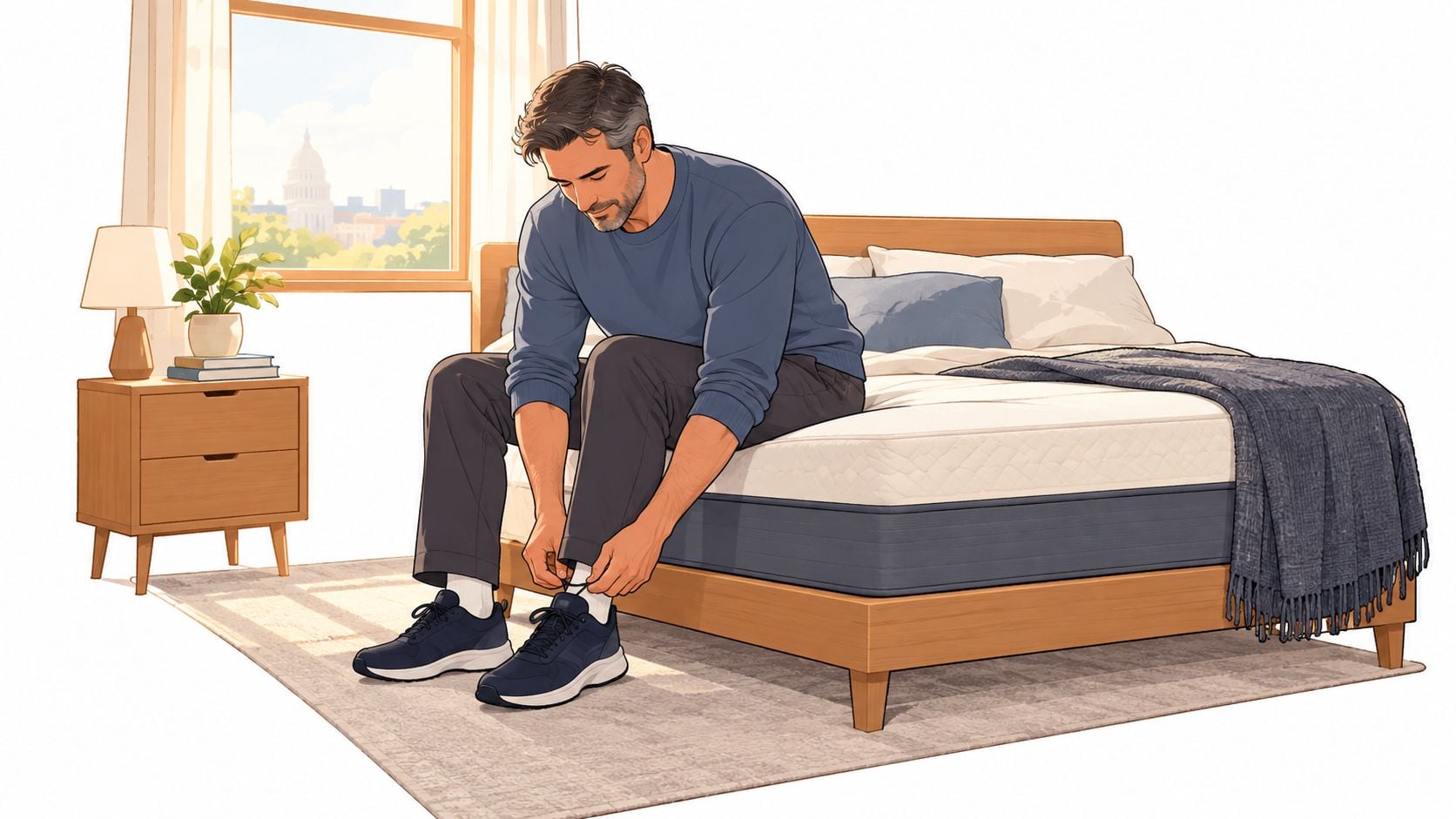
A weekday morning makes the point. Someone sits down to pull on socks and the side of the bed holds steady, or it squashes down and makes the body tilt outward. At night, two sleepers share a queen and one person drifts toward the perimeter, only to feel that uneasy “less mattress” sensation near the side. In another home, an older parent uses the bed edge as a handhold to stand up, and that little bit of stability matters every single day.
That's why edge support deserves more attention than it usually gets. It isn't just about whether a mattress feels nice for ten minutes in a showroom. It affects usable sleep space, ease of movement, and how supported the perimeter feels during daily routines. For shoppers around Albany, Schenectady, Troy, and Greene County, it can be one of the clearest differences between two mattresses that otherwise seem similar.
For anyone also planning the full bedroom, flooring plays into the feel and function of the space, so it can help to see Flacks Flooring bedroom collection for ideas on how a bedroom comes together as a whole.
A strong mattress is also part of a bigger health decision, especially for people replacing an old bed that no longer supports them well. That broader connection is covered in this look at why a high-quality mattress matters for long-term health.
Introduction Why Your Mattress Edge Matters More Than You Think
You sit on the side of the bed to pull on your socks, and the mattress dips more than you expected. Later that night, your partner sleeps near the perimeter and leaves the center untouched because the edge feels less secure. Those are small moments, but they tell you something important about the mattress.
Edge support is not just a comfort detail. It is a performance trait you can notice, compare, and test. A mattress may feel pleasant in the middle yet still lose usable space around the border. That trade-off shows up in two simple ways. How the edge behaves when you sit on it, and how it behaves when you lie near it.
That matters in everyday life across the Capital Region. Couples often want the full width of the bed. Older adults often use the side as a steady place to sit before standing. Families replacing an aging mattress are usually trying to solve more than softness alone. They are also trying to improve support, safety, and long-term comfort, which ties closely to why a better mattress supports long-term health.
A mattress edge works like the frame around a porch step. If that outer area feels firm and reliable, the whole surface feels easier to use. If it compresses too quickly, the bed can seem smaller than its stated size.
That is why edge support deserves a closer look before anyone buys. In a showroom, many shoppers test only the center for a minute or two. A better approach is to check the perimeter on purpose, first by sitting, then by lying near the side. At Tip Top's Freehold showroom, Capital Region shoppers can compare those two tests across different mattress builds and feel how construction choices change the result.
For anyone planning the full room at the same time, it can also help to see Flacks Flooring bedroom collection and think about how the bedroom functions as a complete space.
What to judge right away
A useful mattress test starts with a few plain questions:
- Does the edge stay reasonably steady when you sit down?
- Can you rest near the side without feeling like you need to slide back toward the center?
- Does the mattress construction fit how your household uses the bed each day?
Those answers tell you far more than a label alone. They also make it easier to compare one mattress to another without getting lost in sales language.
What Mattress Edge Support Really Means
A mattress can feel comfortable in the middle and still disappoint at the border. Edge support is the mattress's ability to stay stable when your weight shifts toward the perimeter, whether you are sitting to put on socks or lying close to the side.
That makes edge support a performance measure, not just a sales phrase. You can observe it, compare it, and test it the same way you would test how a chair seat holds weight at the front edge.
Two edge tests matter
Edge support has two parts, and shoppers often blend them together.
Sitting edge support is what you feel when you lower yourself onto the side of the bed. A supportive edge compresses some, but it does not drop so far that getting up feels awkward or unstable.
Lying edge support is different. It describes how usable the sleep surface feels when your shoulder, hip, or whole body rests near the side. A mattress can feel acceptable for sitting and still make the outer few inches feel less secure for sleeping.
That distinction clears up a common point of confusion. The edge is doing one job during a quick sit test and another job during an overnight sleep test.
Why the edge can feel stronger or weaker
The perimeter of a mattress works like the rim of a sofa cushion. If that rim keeps its shape, the full surface feels easier to use. If it folds down too easily, the cushion seems smaller even when the measurements have not changed.
The same idea applies here. Good edge support helps the mattress hold its shape under concentrated pressure at the side. Weak edge support allows deeper compression at the border, which can create a rolling or sliding sensation near the perimeter.
This does not mean the whole mattress is firm.
A mattress can have a plush top and still hold up well at the edge. What you are feeling is the combination of comfort layers on top and the support structure underneath. That is why two beds with a similar softness rating can feel very different once you move from the center to the side.
What shoppers should pay attention to
A simple way to judge edge support is to separate comfort from stability.
Ask these questions:
- Does the side sink a little, or a lot, when you sit down?
- Do you feel balanced near the edge while lying down?
- Does the outer area stay usable, or does it feel like space you should avoid?
Those are practical clues, especially for couples, older adults, and anyone who uses the edge every day getting in and out of bed.
At Tip Top's Freehold showroom, Capital Region shoppers can try both tests on the same visit. Sit on the side first. Then lie near the perimeter for a minute. That side-by-side comparison makes edge support much easier to understand because you can feel the trade-off for yourself instead of guessing from a label.
How Different Mattress Types Build Edge Support
Construction is what sets the edge behavior. Two mattresses can look nearly identical from the outside, yet feel very different when you sit on the side or lie near the perimeter. The reason is simple. The border is built with different materials, and those materials decide how the edge handles concentrated weight.
The easiest way to understand it is to separate sitting support from lying support. Sitting puts a lot of force in one small spot, like pressing down on the corner of a couch cushion. Lying spreads body weight across a wider area, so the edge does not have to resist the same kind of sharp downward pressure. A mattress can do well in one test and only fair in the other.
The main construction approaches
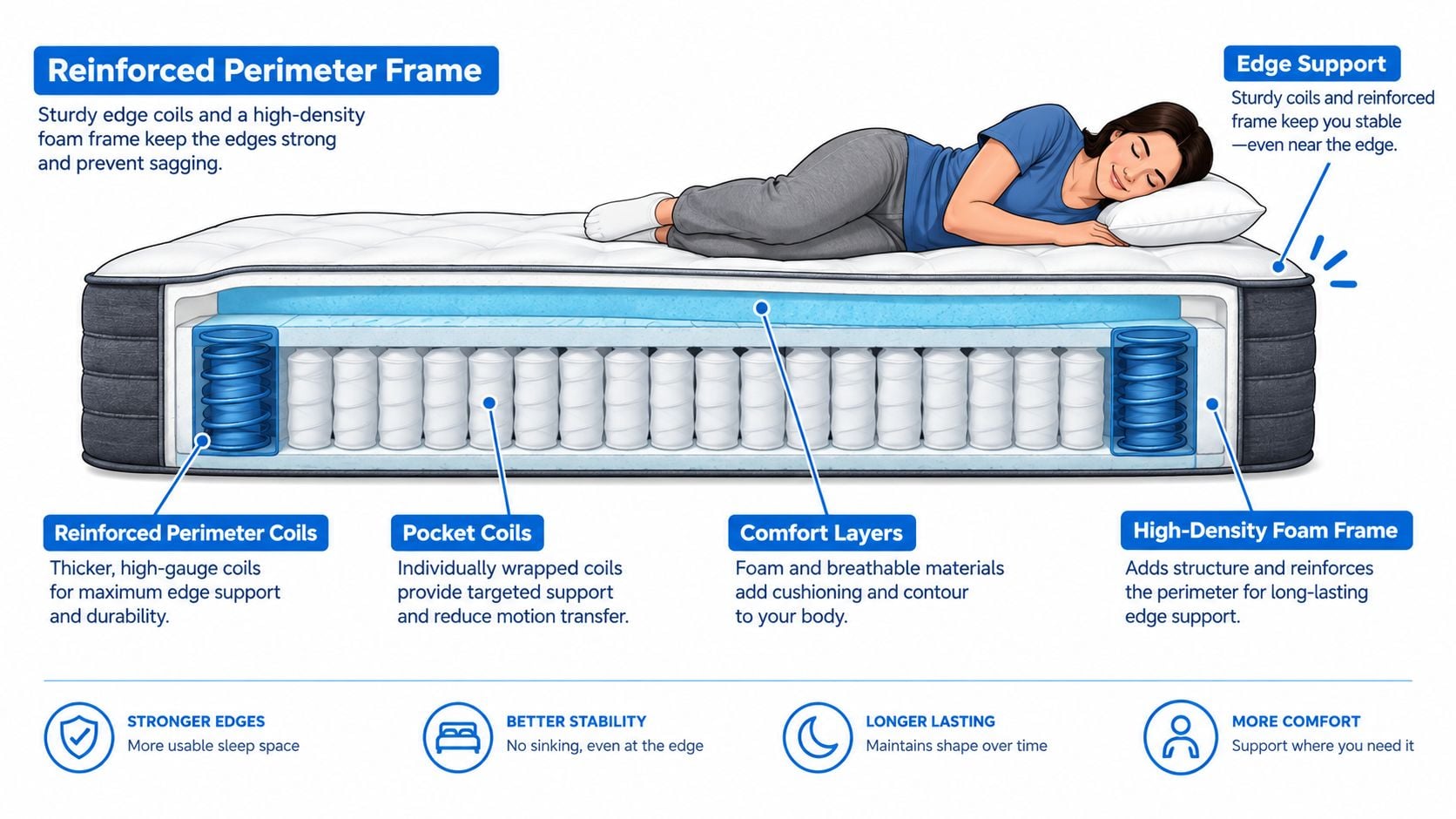
Traditional innerspring mattresses often use a firmer outer coil section or a steel border rod around the perimeter. That creates a more defined edge, especially during a sitting test. If you perch on the side to put on socks or stand up in the morning, this type of build usually feels steadier and more upright.
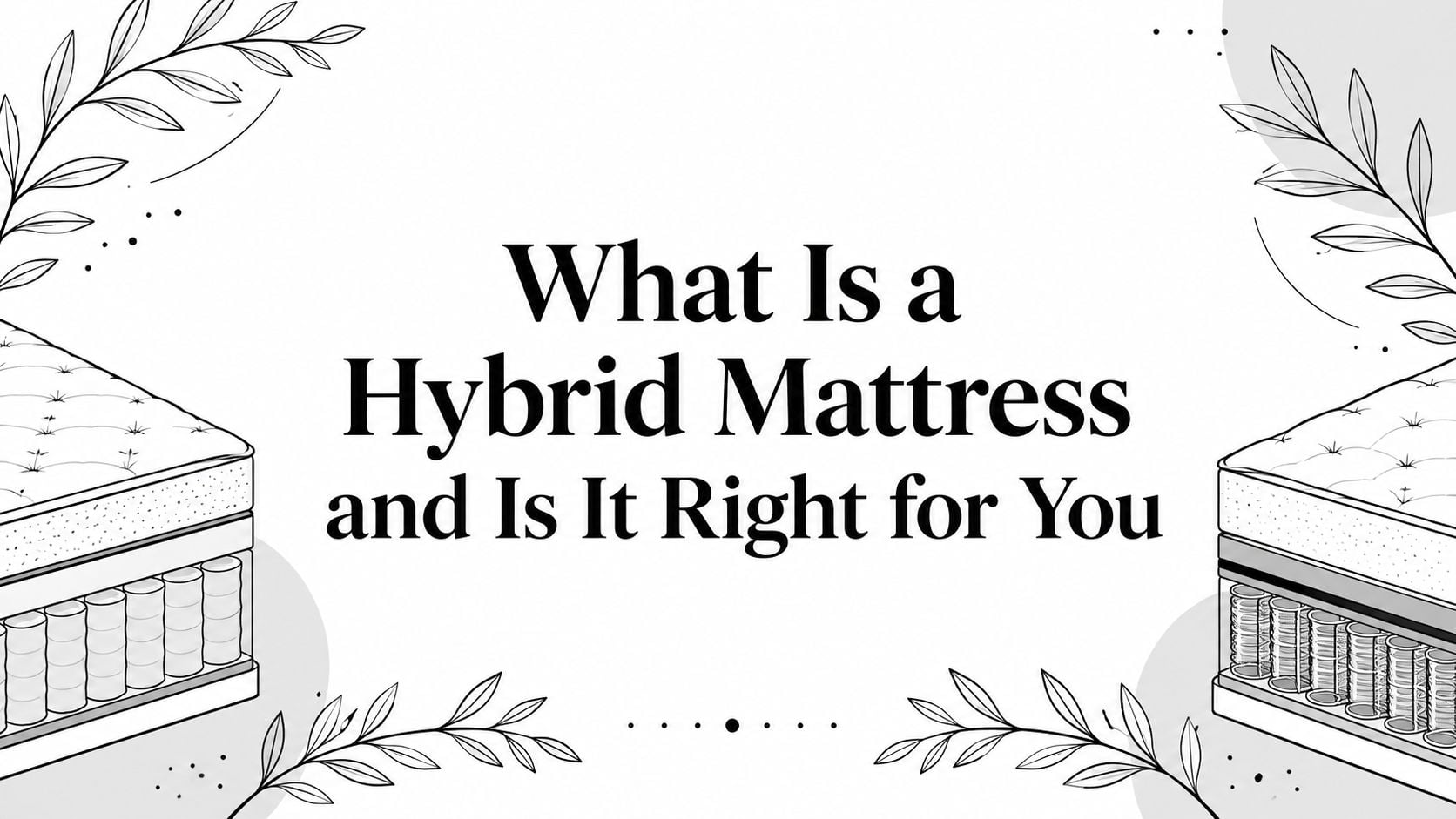
Pocketed coil and hybrid mattresses can be built a few different ways. Some use reinforced coils around the outside rows. Others surround the coil unit with dense foam rails. Reinforced coils often keep more of the springy, supportive feel at the side. Foam rails can make the border feel smoother and more cushioned, though the exact result depends on how dense and wide that foam is.
All-foam mattresses have a different challenge. Without metal coils at the perimeter, the border has to rely on firmer foam, thicker sidewalls, or other stiffening features to keep the edge from folding down too far. That can work well for lying near the side, but sitting support often feels less defined than it does on a coil-based design.
Mattress Construction and Edge Support Comparison
| Construction Type | Edge Reinforcement Method | Typical Edge Feel |
|---|---|---|
| Traditional innerspring | Border rod or reinforced outer coil structure | More defined and sturdy when sitting |
| Pocketed coil hybrid | Firmer perimeter coils | Stable with some contouring |
| Hybrid with foam encasement | Dense foam rail around support core | Cushioned top feel with steadier sidewalls |
| All-foam | Denser perimeter foam or stiffening system | Smoother, more compressible edge feel |
What shoppers feel at the edge
A stronger edge is not always the same thing as a firmer mattress. The top can still feel plush while the perimeter stays controlled underneath. That is why one hybrid may feel inviting at first touch but still hold you up well at the border, while another soft-feeling model can dip more than expected when you sit.
There are trade-offs.
A very rigid perimeter can help with seated stability, but some shoppers prefer a border that feels less abrupt and more blended with the comfort layers. Foam encasement can soften that transition. Reinforced coils can preserve more pushback and bounce. All-foam beds can feel more uniform from center to side, but often with less edge strength during a sitting test.
For families comparing categories, that is why a label alone does not tell the full story. A better starting point is to learn how the basic builds differ in this guide to mattress types explained.
At Tip Top's Freehold showroom, Capital Region shoppers can feel these construction choices in a practical way. Sit on the side first to judge how much the perimeter compresses under a concentrated load. Then lie near the edge to see whether the support stays level and usable. That side-by-side test turns edge support from a vague feature into a measurable performance difference you can feel in minutes.
Why Strong Edge Support Improves Sleep Durability and Daily Comfort
At 6:30 in the morning, the edge of the bed often does the first job of the day. It holds someone while they sit up, plant their feet, and stand. At night, that same edge may need to support a sleeper who drifts close to the side without feeling like the mattress is giving way.
That is why edge support matters in daily life, not just during a quick tryout. It affects how much of the mattress feels usable, how steady the side feels during routine movement, and how well the border handles repeated stress over time.
More of the mattress stays usable
A mattress can measure the same width on paper and still feel smaller in real use if the perimeter compresses too easily. The simplest way to picture it is a dining table with a weak corner. The surface is still there, but people avoid putting weight on that spot.
The same thing happens on a mattress. If the side feels unstable, sleepers tend to shift inward. Couples notice this first. So do guest room shoppers, smaller-space households, and anyone trying to make full use of a queen without feeling crowded.
Strong edge support helps the sleep surface stay consistent closer to the border. That gives people more confidence to use the width they already paid for.
Everyday movement feels steadier
The bed edge is also a working edge. People sit there to put on socks, help a child with pajamas, fold laundry, or stand up after a long night. A side that drops too far can make those simple motions feel less controlled.
This matters even more for:
- Older adults who want a steadier perch before standing
- Anyone recovering from back, hip, or knee soreness
- Households that use the bed edge often during busy mornings and bedtime routines
A good perimeter does not have to feel hard. It should feel supportive in the same way a solid step feels reliable underfoot. For shoppers balancing side support with body comfort, this guide to mattress pressure points can help explain why both need to work together.
Better support at a high-use area
The border of a mattress takes concentrated wear. People sit in the same few spots again and again. That repeated loading is different from lying flat across the center, where weight spreads out more evenly.
A weak edge can start to feel tired sooner because the materials at the perimeter are asked to do a lot of work in a small area. Stronger edge construction helps that high-traffic zone keep its shape and support longer.
Care still matters, of course. Rotating when appropriate, using a proper foundation, and keeping the mattress clean all help prolong mattress lifespan over the years.
At Tip Top's Freehold showroom, this is easy to feel for yourself. Sit on the edge for a real seated test, then lie near the side for a sleep-position test. Those two checks show the trade-off clearly. Some mattresses do better with sitting stability, others feel more forgiving while lying down, and the best choice depends on how your household uses the bed every day.
For a family-owned retailer that has served the region since 1978 and offered professional design services since 1984, long-term value means more than a pleasant first impression. It means the mattress still feels supportive where real life puts the most pressure.
How to Test Mattress Edge Support at Home and In Store
You feel edge support fastest in ordinary moments. You sit down to pull on socks, or you scoot toward the side to get out of bed, and the mattress either feels steady or it does not.
That is why edge support is best treated as a performance check, not a marketing phrase. A useful test looks at two different jobs the edge has to do. It has to hold you up while sitting, and it has to feel secure while lying near the perimeter. Some mattresses do one job better than the other, so both tests matter.
Four quick checks that reveal real edge performance
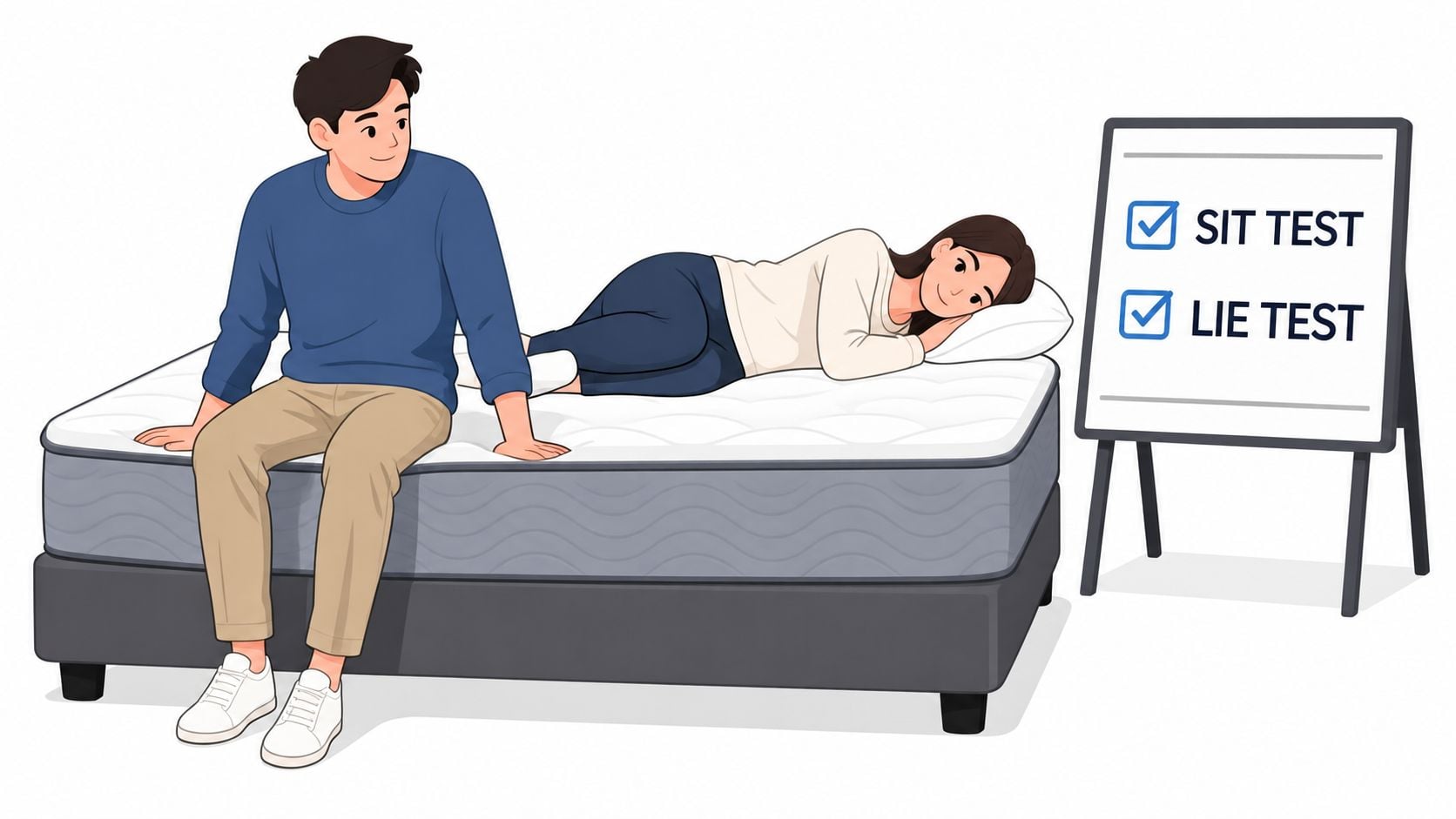
The sit test
Sit on the side where a person would normally dress or stand up. Let your full weight settle for a moment. A well-supported edge should compress some, then hold you in a stable position. If you sink sharply, tilt outward, or feel the border folding under you, the sitting score is weaker.The lie-near-the-edge test
Lie close enough to the side that your shoulder or hip is clearly using the perimeter. This checks a different kind of support. The edge should still feel usable and secure, like the mattress surface continues working almost to the border.The center comparison
Move from the edge to the center and then back again. Some change is normal. What you are looking for is the size of the change. A small difference usually means the mattress uses its full width well. A big drop-off can mean the edge behaves like a softer rim around a firmer middle.The partner check
If two people will share the mattress, test it that way. One person can lie near the side while the other stays closer to the middle. This shows whether the perimeter still feels dependable with shared weight on the bed.
These checks work like testing a staircase handrail and a porch floor. One test asks, "Can it hold a focused load?" The other asks, "Does it still feel safe and useful during normal use?" A mattress edge has to answer yes to both.
What to notice during the test
A strong edge does not have to feel hard. It has to feel controlled.
Watch for these signs:
- Outward slide: Your body feels nudged off the side instead of held in place.
- Deep seat sink: Sitting creates a much larger dip at the border than in the center.
- Roll-off feeling: Lying near the edge makes you tense up or shift inward.
- Sharp transition: The mattress feels supportive in the middle but unfinished at the perimeter.
How to test more accurately in a showroom
At home, you can test the mattress you already own. In a store, you can compare several builds in a few minutes using the same routine each time. That side-by-side testing is where edge support becomes easier to measure.
Try the sit test on a foam model, then on a hybrid, then on a coil mattress. Next, repeat the lying test on each one. You will often notice a trade-off. One mattress may feel steadier for sitting, while another feels more comfortable when lying close to the side. That is normal. Construction choices often shift performance from one type of edge use to the other.
A broader mattress shopping guide for comparing support and comfort can help you keep the testing process consistent from model to model.
At Tip Top Furniture & Mattresses in Freehold, Capital Region shoppers can do these checks in person instead of guessing from labels. The store's bed-matching system can narrow the comfort and support range first. Then your own sit test, lie-near-the-edge test, center comparison, and partner check can show how each mattress performs.
What Specs and Terms to Look For When Comparing Edge Support
A mattress tag can make edge support sound clear when it really is not. Two beds can both say “reinforced edge” and feel very different the moment you sit down or lie near the side. The useful question is simple: what is doing the reinforcing, and what kind of edge performance is it meant to improve?
That matters because edge support is not one single trait. It has two jobs. One is helping the side hold up when you sit on it to put on shoes or stand back up. The other is helping the sleep surface stay steady when your body rests close to the perimeter. A mattress can do well in one job and only fairly well in the other.
Terms that point to real construction
The most helpful spec words describe parts you can picture inside the mattress, much like looking at the frame under a sofa instead of judging the fabric alone.
- Foam encasement: A denser foam rail wraps around the support core to stiffen the perimeter.
- Reinforced coils: The outer row uses firmer or stronger coils than the interior.
- Border rod or border wire: A metal edge support piece, usually found in more traditional innerspring designs.
- Perimeter support system: A broad label that needs a follow-up question. Ask what material forms the edge.
Vague phrases such as “edge-to-edge comfort” or “enhanced perimeter feel” do not tell you much by themselves. They describe a promise, not the method.
Read the spec sheet with two tests in mind
A good way to avoid confusion is to connect each term to a measurable use. Foam encasement often helps the mattress feel more stable during a sit test. Reinforced coils may do a better job balancing seated support with a more natural feel when lying near the side. A border rod can make the edge feel firmer and more defined, which some shoppers like and others find a bit rigid.
That trade-off is normal. Mattress construction works like the sidewall of a tire. A stiffer build can feel steadier under concentrated weight, while a more flexible build can feel smoother when weight is spread out.
What to ask when labels are vague
If the product card uses broad language, ask a store associate a few plain questions:
- What material supports the outer few inches of the mattress?
- Is the edge designed mainly for sitting support, sleeping support, or both?
- Does the perimeter use firmer foam, firmer coils, or another reinforcement method?
- Will the edge feel noticeably firmer than the center?
Clear answers usually mean the construction is clear.
A simple comparison checklist
Use this short checklist when comparing models side by side:
- Look for named components: foam rail, firmer coils, border wire, or another specific perimeter feature
- Separate sitting from lying performance: score each one in your own mind instead of blending them together
- Notice firmness change at the border: some edges feel supportive, others feel abrupt
- Compare similar categories carefully: all-foam, hybrid, and innerspring builds often solve edge support in different ways
- Match the words to the showroom test: if the label promises support, the side of the bed should show it
For Capital Region shoppers visiting Tip Top Furniture & Mattresses in Freehold, in-person testing becomes especially useful. You can read the spec card, hear how the edge is built, then sit and lie near the perimeter yourself. That combination turns edge support from a marketing phrase into something you can measure and feel before you buy.
Smart Buying Tips for Mattress Edge Support in the Capital Region
The smartest mattress decision usually starts with one question. How important is the edge to daily life in this household?
For some people, edge support is a nice extra. For others, it belongs near the top of the list. Couples who use the full width of the bed, adults who sit on the side every morning, and anyone helping an aging parent should weigh it more heavily than shoppers who always sleep centered and rarely use the edge for support.
Match the priority to the construction
Shoppers around Albany, Schenectady, Troy, and Freehold can simplify the process by matching need to build.
- For shared sleeping space: A supportive hybrid or coil-based perimeter often makes more sense.
- For easier sit-and-stand use: Look closely at seated stability, not just overall softness.
- For contouring comfort first: Foam can still work, but the edge should be tested carefully in person.
- For long-term bedroom planning: Mattress choice should fit the room, the frame, and the way the space is used every day.
That broader planning matters in a full-home showroom environment, especially when shoppers are also coordinating bedroom furniture, flooring, décor, or custom pieces.
Don't shop the mattress in isolation
A new mattress often arrives during a bigger life change. A move. A room refresh. A guest room update. A growing family. That's where one-stop shopping becomes useful, especially in the Capital Region.
A household may want to test USA-made mattresses, compare custom-order bedroom furniture, look at Amish-made pieces for long-term durability, and check immediate-availability options in clearance at the same time. Financing and delivery can matter just as much as the mattress spec sheet when a project involves more than one room.
Practical next steps before buying
Strong edge support is worth paying attention to when it changes how the bed is used, not just how it sounds in a brochure.
A shopper comparing options should bring three things into the decision: sleep style, partner needs, and movement needs. Then it becomes easier to narrow the field, test the right constructions, and ask better questions about what sits under the fabric.
People shopping with back support in mind may also want to review guidance on the best mattress for back pain since edge performance is only one piece of the comfort picture.
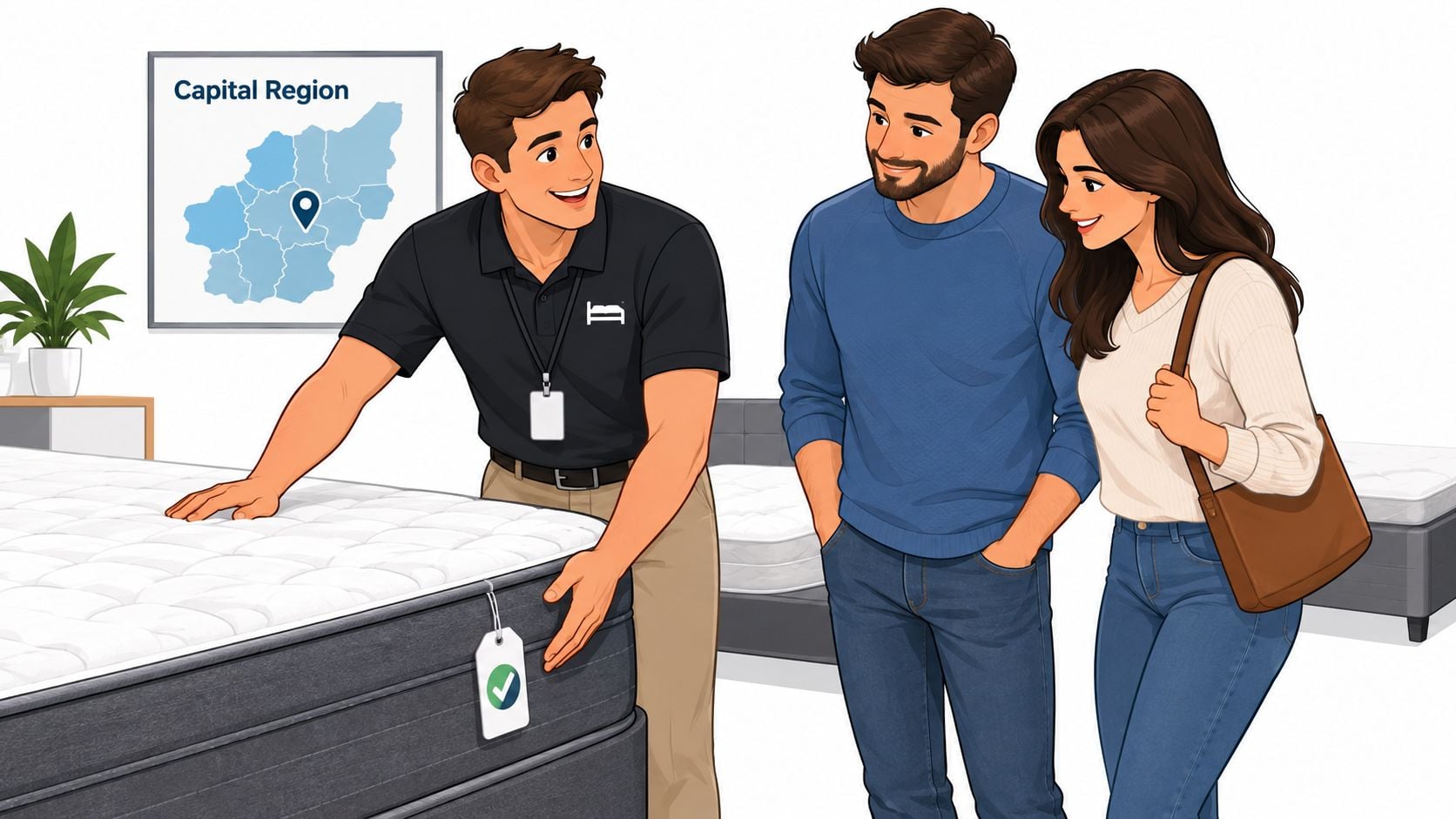
For Capital Region households, the strongest buying move is simple. Test the edge the way the bed will really be used, compare the construction, and choose the mattress that fits the routine, not just the showroom feel.
Shoppers across Albany, Schenectady, Troy, Greene County, and the surrounding area can explore USA-made mattresses, custom options, financing, delivery, and coordinated bedroom solutions at Tip Top Furniture & Mattresses. A visit to the historic Freehold showroom makes it easier to test mattress edge support in person, compare constructions side by side, and get practical help with the rest of the room through design services, furniture, flooring, and clearance finds.